Some spacecraft roar into history on pillars of fire. LightSail 2 did something far more polite: it unfolded a shiny sail, caught sunlight, and nudged itself through orbit like a tiny spaceboat with excellent manners. Built by The Planetary Society and powered not by fuel but by photons, LightSail 2 proved that a small CubeSat could use solar sailing to change its orbit around Earth. For a spacecraft roughly the size of a loaf of bread before deployment, that is not just impressive. That is the spaceflight equivalent of a bicycle winning a hill climb against motorcycles.
The mission was declared a success on July 31, 2019, after the team confirmed that the spacecraft’s orbital changes were caused by controlled solar sailing. LightSail 2 did not merely unfold a sail for a dramatic photo opportunity. It demonstrated a practical technology: using sunlight alone as propulsion for a small satellite. In a field where every gram of fuel matters, that idea is powerful enough to make mission planners lean forward in their chairs.
LightSail 2’s story blends clever engineering, public support, CubeSat innovation, and the dream of traveling through space without constantly paying the fuel bill. It also reminds us that exploration does not always require the biggest rocket, the largest budget, or the loudest engine. Sometimes, all it takes is a reflective sail, a stubborn team, and the Sun doing what it has been doing for about 4.6 billion years.
What Was LightSail 2?
LightSail 2 was a small spacecraft developed by The Planetary Society, a nonprofit space advocacy organization long associated with public education and citizen-supported exploration. The spacecraft was a CubeSat, a standardized type of small satellite that allows researchers, universities, nonprofits, and agencies to test ideas without building massive custom spacecraft from scratch.
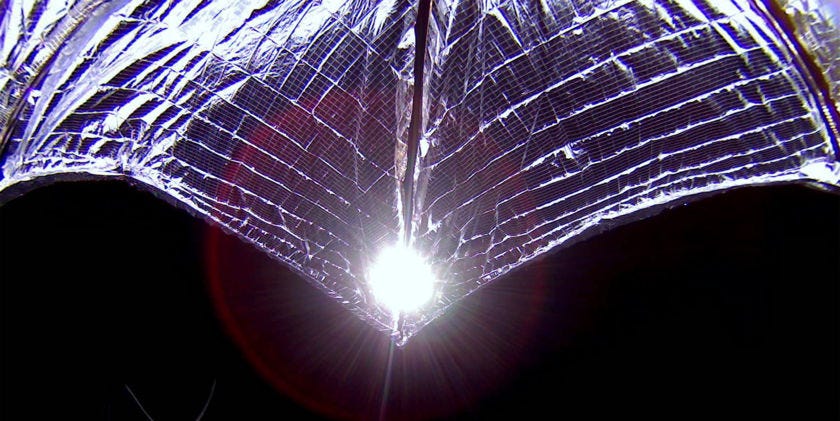
Before deployment, LightSail 2 was compact. After deployment, it became something much more photogenic: a small satellite attached to a square solar sail measuring about 32 square meters, or roughly 344 square feet. That sail was made of thin, reflective Mylar-like material and supported by four lightweight booms. In simple terms, LightSail 2 carried a “mirror kite” into orbit and used it to catch the momentum of sunlight.
The mission’s main goal was not to race across the solar system. It was to answer a practical question: Can a CubeSat use sunlight alone to measurably change its orbit? The answer turned out to be yes. LightSail 2 controlled its orientation relative to the Sun, turned its sail at key points in each orbit, and achieved measurable orbital changes consistent with solar sailing.
How Solar Sailing Works
Solar sailing sounds like science fiction until you remember that light has momentum. Photons, the particles of light, do not have mass in the ordinary sense, but they still carry momentum. When sunlight hits a reflective sail, it exerts a tiny push. Tiny is the important word here. Nobody is getting pinned to a seat by solar-sail acceleration. You would not spill your coffee. You might not even notice if your coffee had a degree in orbital mechanics.
But in space, tiny forces can matter. A solar sail does not need propellant. It does not run out of “wind” as long as sunlight is available. Over time, the repeated push of photons can build up speed or alter a spacecraft’s trajectory. That makes solar sailing especially attractive for long-duration missions, small spacecraft, and future concepts that require efficient travel without carrying heavy fuel tanks.
The Sailboat Comparison
The classic comparison is a sailboat on water. A sailboat uses wind pushing against a sail. A solar sail uses sunlight pushing against a reflective surface. The comparison is useful, though space adds its own twist. There is no ocean, no waves, and no captain yelling “hard to port” while wearing a dramatic hat. Instead, flight software, sensors, reaction wheels, and magnetic torque rods help the spacecraft orient itself.
LightSail 2 performed controlled maneuvers by changing the angle of its sail during different parts of its orbit. When the orientation was right, sunlight added energy to the orbit. When the orientation was not helpful, the spacecraft adjusted to reduce unwanted effects. This process is sometimes described as “tacking,” borrowing language from sailing. The spacecraft was not drifting passively. It was actively trying to sail.
Why LightSail 2 Was Declared a Success
The Planetary Society declared LightSail 2 successful after mission data showed the spacecraft had raised its orbital apogee using sunlight alone. Apogee is the high point of an orbit around Earth. Raising it by controlled solar sailing was the mission’s primary objective. The increase was not huge in everyday terms, but in engineering terms it was a big deal because the spacecraft had no conventional engine doing the work.
This success mattered because LightSail 2 demonstrated controlled solar sailing with a CubeSat platform. Earlier solar-sail missions had shown pieces of the puzzle, including sail deployment and solar-sail propulsion in other contexts. LightSail 2’s achievement was especially important because it showed that a small, relatively low-cost spacecraft could use sunlight to change its orbit in Earth orbit.
The phrase “the CubeSat that could” fits because LightSail 2 was not a giant flagship mission with a billionaire-sized luggage allowance. It was modest, experimental, and packed with constraints. Those constraints made the success more meaningful. Engineers had to fit cameras, control systems, communication equipment, solar panels, sail storage, deployment mechanisms, and attitude-control hardware into a tiny package. Spacecraft design is already hard. Doing it in CubeSat form is like moving into a studio apartment and still insisting on a grand piano.
A Quick Timeline of the LightSail 2 Mission
Launch in June 2019
LightSail 2 launched on June 25, 2019, from Kennedy Space Center in Florida aboard a SpaceX Falcon Heavy rocket. It rode as part of the U.S. Air Force’s STP-2 mission, a complex rideshare flight that carried multiple payloads. LightSail 2 was tucked inside Prox-1, a small satellite built by Georgia Tech, which later released LightSail 2 into orbit.
First Signals and Early Checks
After deployment, the mission team waited for confirmation that the spacecraft was alive and communicating. LightSail 2 phoned home in early July 2019, beginning a careful checkout period. For a small mission, these early signals are emotional gold. A spacecraft can be brilliant on paper, but until it speaks from orbit, everyone is politely holding their breath.
Sail Deployment in July 2019
On July 23, 2019, LightSail 2 deployed its solar sail. The spacecraft extended four booms that pulled out four triangular sail sections, forming a square reflective sail. Images from onboard cameras showed the sail gleaming above Earth, a scene that looked both futuristic and charmingly handmade. It was part spacecraft, part origami, part cosmic picnic blanket.
Mission Success Declared on July 31, 2019
On July 31, 2019, The Planetary Society announced that LightSail 2 had successfully demonstrated flight by light. The team confirmed that the spacecraft’s orbital changes were consistent with solar sailing. This was the mission’s headline moment: a small satellite had used sunlight alone to alter its path around Earth.
Extended Operations and Reentry
LightSail 2 continued operating far beyond its initial technology demonstration. The spacecraft remained in orbit until November 17, 2022, when it reentered Earth’s atmosphere and completed its mission. Its extended life gave researchers more data on solar sailing, attitude control, orbital decay, and the behavior of large sails on small spacecraft.
Why This CubeSat Mission Was Bigger Than It Looked
LightSail 2’s physical size was small, but its implications were not. Solar sailing could help future spacecraft travel without carrying large amounts of propellant. That matters because fuel is expensive to launch, limits mission lifetime, and adds design complexity. A spacecraft that can keep adjusting its orbit using sunlight has a built-in advantage for certain mission types.
Small satellites are changing space exploration because they allow teams to test technology faster and at lower cost. A CubeSat will not replace every large spacecraft, just as a scooter will not replace a cargo ship. But for focused technology demonstrations, Earth-observation experiments, communications tests, and educational missions, CubeSats can do serious work.
LightSail 2 showed that advanced propulsion concepts do not have to wait for giant missions. They can be tested, refined, and proven on small platforms. That opens the door for more creative mission design, especially for universities, nonprofits, and smaller space organizations that cannot casually write checks with “Mars program” in the memo line.
The Engineering Challenge Behind the Shine
At first glance, a solar sail looks simple. It is a shiny sheet in space. How hard can that be? Very hard, as it turns out. The sail has to be folded tightly, survive launch vibration, deploy reliably, maintain shape, and interact with sunlight in predictable ways. The spacecraft also has to know where it is, where the Sun is, how it is rotating, and when to adjust its attitude.
LightSail 2 used an attitude-control system that included a momentum wheel and magnetic torque rods. These helped the spacecraft rotate and manage its orientation. The team had to balance solar pressure, atmospheric drag, power limits, communication windows, and the quirks of operating a tiny spacecraft hundreds of kilometers above Earth.
One of the mission’s most valuable contributions was not just the success announcement. It was the data. Real flight data is the difference between “this should work” and “we watched it work while space tried to make things complicated.” Engineers can use that data to improve future solar-sail missions, design better control systems, and understand how large reflective surfaces behave on small spacecraft.
LightSail 2 and the Future of Solar Sailing
Solar sailing is not useful for every mission. It produces very low thrust, so it is not the right tool when a spacecraft needs a sudden burst of acceleration. Nobody is launching from Earth’s surface with a solar sail unless physics gets a software update. But in space, where continuous small pushes can add up, solar sailing has exciting possibilities.
Future solar-sail missions could monitor the Sun, explore asteroids, maintain unusual orbits, or support deep-space science. NASA has continued developing solar-sail technology through projects such as the Advanced Composite Solar Sail System, which focuses on new materials and deployable boom structures. These efforts build on a long history of solar-sail research and demonstrations, including LightSail 2’s public, highly visible success.
For interplanetary missions, solar sails could reduce dependence on propellant. For small spacecraft, they could extend mission flexibility. For science educators, they offer one of the cleanest explanations of momentum in action: sunlight touches a mirror, the mirror moves, and somewhere a physics teacher quietly celebrates.
Public Support Made the Mission Special
LightSail 2 was not only an engineering mission. It was also a public mission. The Planetary Society’s LightSail program was supported by members and donors who believed that space exploration should not belong only to governments and giant corporations. That citizen-funded model gave the mission a different personality. People were not just watching a spacecraft; they had helped make it happen.
This is one reason LightSail 2 captured public imagination. It was understandable. A small spacecraft unfolded a sail and moved using sunlight. You did not need a doctorate to appreciate the elegance. The mission connected modern CubeSat engineering with an old dream of sailing through space, a dream popularized decades earlier by thinkers and communicators who saw solar sailing as both practical and poetic.
That combination matters for science communication. Some missions are technically important but hard to explain at dinner without losing half the table before dessert. LightSail 2 had the rare advantage of being both meaningful and easy to visualize. “It sails on sunlight” is a pretty good elevator pitch, especially if the elevator goes to orbit.
Lessons From LightSail 2
Small Missions Can Prove Big Ideas
LightSail 2 proved that a small mission can validate a major propulsion concept. The spacecraft did not need to visit another planet to be important. Its success came from answering a targeted engineering question with real orbital data.
Elegant Ideas Still Need Hard Work
Solar sailing sounds simple, but LightSail 2 required years of design, testing, operations planning, troubleshooting, and analysis. Elegant technology is rarely effortless. It only looks effortless after talented people have spent years wrestling with details.
Space Exploration Benefits From Public Imagination
The mission showed that public enthusiasm can support real technology development. LightSail 2 was a reminder that exploration is not only about hardware. It is also about storytelling, education, and giving people a reason to look up.
Experiences and Reflections: What LightSail 2 Feels Like From Earth
Reading about LightSail 2 can feel different from reading about many space missions because it is so easy to imagine. You do not need to picture a complicated engine cycle or a maze of pipes and valves. You picture a small box opening in orbit, booms extending, and a bright sail spreading above Earth. It feels like watching a clever idea take a deep breath.
For students, hobbyists, and space fans, LightSail 2 offers an unusually friendly entry point into orbital mechanics. The mission turns abstract physics into a story. Photons carry momentum. Momentum can push a sail. A sail can change an orbit. Suddenly, textbook concepts stop looking like symbols on a page and start looking like hardware in sunlight. That is the kind of learning experience that sticks because it has both logic and wonder.
There is also something refreshing about the mission’s patience. Modern technology often celebrates speed: faster processors, faster launches, faster downloads, faster everything. Solar sailing is the opposite kind of magic. It is slow, steady, and cumulative. The push from sunlight is tiny, but it never needs refueling. LightSail 2 teaches the value of small forces applied consistently. That lesson works in space, and frankly, it works suspiciously well in regular life too.
Imagine building a school project around LightSail 2. Students could create a simple model sail, test reflective materials, compare surface areas, and calculate how pressure changes over time. They could discuss why a sail works better in space than in a classroom, why atmospheric drag matters in low Earth orbit, and why orientation is everything. The project would naturally blend physics, engineering, math, materials science, and communication. Best of all, it would give students permission to think big without needing a billion-dollar lab.
LightSail 2 also gives amateur skywatchers and science communicators a beautiful story to share. It connects the Sun, Earth orbit, CubeSats, public funding, and future exploration in one neat package. It is the kind of mission that makes people ask follow-up questions. Could solar sails go to asteroids? Could they help monitor space weather? Could they one day support interstellar probes? Those questions are exactly the point. A successful demonstration is not the end of curiosity; it is the beginning of better questions.
From a broader human perspective, LightSail 2 feels hopeful because it shows that exploration can be inventive rather than brute-force. Rockets are magnificent, but they are not the only symbol of spaceflight. A sail catching sunlight suggests a gentler kind of movement, one that works with the environment of space instead of carrying everything from home. That does not make solar sailing a universal solution, but it does make it one of the most elegant tools in the spaceflight toolbox.
In the end, the experience of following LightSail 2 is a reminder that success in space does not always look like a dramatic landing or a flag planted on another world. Sometimes success looks like a small spacecraft proving a principle, sending back data, and quietly expanding what future missions can attempt. LightSail 2 did exactly that. It sailed on sunlight, changed its orbit, and left behind a bright trail of engineering confidence.
Conclusion
LightSail 2 earned its success because it did something wonderfully difficult: it made a tiny spacecraft move by controlled sunlight alone. The mission proved that solar sailing can work on a CubeSat platform, gathered valuable flight data, and helped push propellant-free propulsion from dream territory toward practical mission design. It was small, shiny, stubborn, and scientifically meaningful.
For the future of space exploration, LightSail 2’s legacy is bigger than its sail. It showed that public support can help fly real missions, that CubeSats can test serious technology, and that sunlight itself can become a tool for navigation. The spacecraft may have reentered Earth’s atmosphere in 2022, but the idea it proved is still sailing forward.