A kitchen island is part prep station, part breakfast table, part homework desk, and occasionally part mail-storage facility despite everyone promising that will never happen again. Because it performs so many jobs, the lighting above it must do more than look attractive in real estate photos. It needs to illuminate chopping, serving, cleaning, dining, and late-night snack investigations without creating glare or making the room feel crowded.
The best kitchen island lighting ideas combine practical task lighting with a fixture that supports the kitchen’s overall style. Instead of choosing a pendant simply because it looks adorable online, consider the island’s length, ceiling height, countertop color, surrounding finishes, and daily activities. Good kitchen lighting is normally layered, using island fixtures alongside ambient, task, and accent lighting rather than expecting one heroic pendant to illuminate the entire room.
How to Plan Lighting Over a Kitchen Island
Before exploring specific island light fixtures, measure the island itself. A narrow four-foot island may need one substantial pendant or two compact fixtures. A long island can support two oversized pendants, three medium fixtures, or one linear suspension light. The number is less important than balanced coverage.
As a practical starting point, the bottom of a pendant commonly hangs about 30 to 36 inches above the countertop. This usually provides useful illumination while preserving sightlines across the kitchen. Multiple pendants are often placed approximately 24 inches apart, although the correct spacing depends on shade width, island length, and beam spread. Always test the height against the tallest household member before final installation. Nobody wants breakfast served with a side of forehead-versus-pendant combat.
Choose Light Quality, Not Just Fixture Style
Bulbs matter as much as shades. For most residential kitchens, LEDs in the 2700K to 3500K range create a comfortable balance between warm atmosphere and clear task visibility. A high color rendering index, preferably around 90, helps food, wood, stone, paint, and skin tones appear more natural. That matters when deciding whether a steak is properly browned or merely expressing itself creatively.
Install dimmable fixtures whenever possible. Bright light is useful for preparing dinner, while a softer setting makes the same island more pleasant for dessert, conversation, or winding down after the dishes are finished.
1. Make a Statement With Oversized Pendants
Large pendant lights can give a kitchen island visual authority. Instead of scattering several small fixtures across a wide surface, use one or two generously scaled pendants to create a clean, intentional focal point.
This approach works especially well over long islands in open-concept kitchens, where tiny lights can disappear against tall ceilings and broad sightlines. Dome, drum, globe, and bell-shaped shades are particularly effective because their silhouettes remain readable from across the room.
Oversized does not mean obstructive. Choose fixtures that feel substantial without extending beyond the island’s edges. Light-colored, open-frame, or translucent designs can provide dramatic scale while maintaining an airy appearance. Designers commonly use large fixtures to balance the proportions of long islands and spacious kitchens.
Best for: Large islands, vaulted ceilings, open floor plans, and kitchens that need a strong centerpiece.
2. Keep the View Open With Clear Glass Pendants
Clear glass pendants are ideal when you want decorative lighting without introducing too much visual weight. The transparent shades allow the eye to travel through the fixtures, helping a compact kitchen feel open and preserving views toward windows, cabinetry, or an adjacent living area.
Glass pendants fit transitional, coastal, farmhouse, traditional, and contemporary interiors. Their personality comes from the details: seeded glass feels vintage, smooth globes look modern, ribbed glass adds texture, and faceted shades introduce a subtle sparkle.
There is one small domestic reality to consider: clear glass displays dust and fingerprints with remarkable enthusiasm. Choose shades with openings wide enough for easy cleaning, especially if the island contains a cooktop. A beautiful fixture should not require the flexibility of a circus performer to maintain.
Best for: Small kitchens, rooms with attractive sightlines, colorful cabinetry, or detailed backsplashes that should remain visible.
3. Use a Linear Suspension for Even Coverage
A linear suspension light stretches horizontally over the island, distributing illumination across a broad work surface from one coordinated fixture. It is one of the most practical modern kitchen lighting solutions for long rectangular islands.
Linear fixtures can contain exposed bulbs, glass globes, shaded lamps, or integrated LEDs. Because the entire design is visually unified, it avoids the spacing calculations required by separate pendants. It can also be helpful when the ceiling has only one electrical box but the island needs light over several seating or preparation zones.
Select a fixture that is shorter than the island so the composition has breathing room at both ends. A seven-foot island, for example, may pair well with a fixture approximately four to five feet long, depending on its visual weight. Open-frame designs can be larger, while solid shades may need to be more restrained.
Linear pendants are particularly useful when you want to emphasize the island’s length without creating a parade of separate cords descending from the ceiling. They can provide broad task illumination while maintaining a streamlined appearance.
Best for: Long islands, contemporary kitchens, single-junction-box installations, and homeowners who prefer clean symmetry.
4. Create Rhythm With a Row of Mini Pendants
A row of three or more mini pendants brings rhythm and repetition to the kitchen. This classic arrangement works because the fixtures create a visual path along the island while producing several overlapping pools of light.
Mini pendants are most successful when their spacing is based on the island rather than the entire room. Center the complete group over the countertop, leaving comfortable margins near both ends. Measure from the center of each fixture rather than from the outer edges of unusually shaped shades.
For a six- to eight-foot island, three medium or compact pendants are often easier to balance than four tiny ones. However, a longer commercial-style island may look fantastic with five slim fixtures. The goal is consistent coverage, not winning an award for Most Pendants Installed Before Lunch.
Repeating fixtures can establish the kitchen’s design tone, whether they are simple black cones, milk-glass globes, colorful cylinders, or vintage-inspired schoolhouse shades.
Best for: Medium and long islands, symmetrical kitchens, and layouts that need evenly distributed task lighting.
5. Warm the Room With Woven or Natural Shades
Woven pendants made from rattan, cane, bamboo, rope, or natural fiber can soften a kitchen filled with hard materials. Cabinets, appliances, quartz, tile, and metal hardware create many smooth surfaces, so a textured shade introduces warmth and welcome contrast.
Natural pendants are not limited to beach houses. A tightly woven black shade can look sophisticated in a modern kitchen, while a pale basket-style fixture suits Scandinavian, organic modern, bohemian, and relaxed farmhouse interiors.
Because woven shades filter light, check how much illumination reaches the countertop. Some fixtures create beautiful patterns but provide less direct task lighting. Pair them with recessed lights or choose a design with an open bottom so adequate light falls onto the work surface.
This idea is especially effective when the island includes wood stools, a butcher-block section, or warm veining in the countertop. Repeating one natural texture is usually enough; the kitchen does not need to transform into a tropical resort gift shop.
Best for: Organic modern, coastal, Japandi, bohemian, and neutral kitchens that need texture.
6. Add Character With Industrial Metal Fixtures
Metal pendants provide strong downward task lighting and a confident architectural look. Cone shades, factory-style domes, cage lights, and enamel fixtures work particularly well over hardworking islands used for cooking and food preparation.
Black metal creates crisp contrast against white cabinetry. Aged brass adds warmth and polish. Copper brings character to blue, green, charcoal, and natural wood kitchens. Brushed nickel or stainless steel can quietly coordinate with appliances without demanding attention.
A solid metal shade controls glare by directing light downward, but it can make the ceiling area feel darker. Balance these fixtures with ambient ceiling lights or under-cabinet lighting. A pale or metallic shade interior can also reflect more light onto the countertop.
Matching every metal finish is unnecessary. A kitchen can comfortably combine black pendants, brass cabinet pulls, and stainless appliances when the finishes repeat intentionally and share a compatible visual weight. Colorful metal or blown-glass pendants can also enliven an otherwise neutral kitchen.
Best for: Industrial, modern farmhouse, transitional, loft-style, and high-contrast kitchens.
7. Install a Sculptural Cluster
A cluster of pendants turns functional lighting into an art installation. Instead of hanging identical fixtures in a straight line, group several small globes, cylinders, or organic forms at slightly different heights.
This design can be especially effective over a square island, rounded island, or compact preparation table where a linear arrangement would feel too rigid. It also suits kitchens with tall ceilings because the varied drops fill vertical space.
Keep the cluster controlled rather than chaotic. The shades should share at least one visual trait, such as material, finish, color, or shape. Three smoky-glass globes of different sizes will feel coordinated; three unrelated clearance-bin fixtures may look as though the ceiling is hosting a yard sale.
When using staggered pendants, confirm that the lowest fixture does not block views or interfere with people seated at the island. The brighter elements should still direct enough light toward the center of the work surface.
Best for: Square islands, high ceilings, artistic interiors, and homeowners who prefer asymmetry.
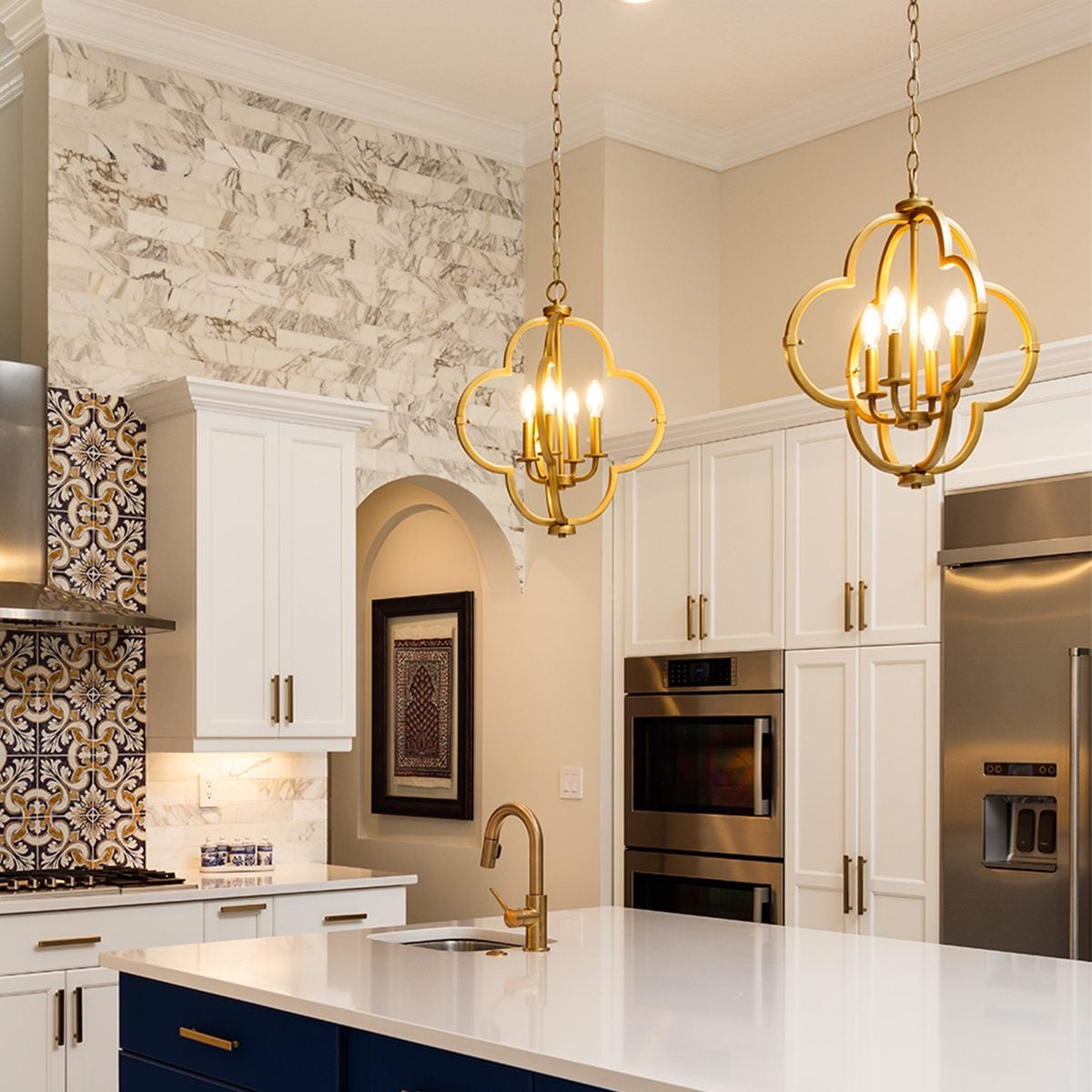
8. Treat the Island to a Chandelier or Lantern
A chandelier is not reserved for formal dining rooms. Over a kitchen island, it can create an elegant focal point while helping define the kitchen within an open floor plan. Modern chandeliers may use branching arms, glass globes, slim LED bars, wooden beads, or simple geometric frames rather than traditional crystal.
Lantern-style fixtures offer a similar sense of presence with a more architectural character. Their open frames make them visually lighter than solid pendants of the same size, which is useful when you want drama without blocking the room.
This idea works best when the island is primarily used for seating, serving, or entertaining. For an island containing a sink or cooktop, make sure the chandelier is easy to clean and delivers sufficient downward illumination. Decorative sparkle is delightful, but it cannot tell whether the onions are burning.
Statement fixtures are widely used to anchor island designs and connect the lighting to the architectural style or period of a home.
Best for: Traditional, glam, transitional, Mediterranean, and open-concept kitchens.
9. Skip Hanging Fixtures in Low-Ceiling Kitchens
Not every kitchen island needs pendants. In a room with a low ceiling, limited sightlines, or a visually busy design, recessed lights, slim flush mounts, or adjustable track heads may be the better solution.
A pair of compact flush mounts can still frame the island without hanging into the room. Recessed fixtures offer an even cleaner ceiling, while adjustable lights can aim illumination toward a sink, cutting board, or seating area. Minimal integrated LED bars are another option for contemporary kitchens where a hanging fixture would feel intrusive.
To prevent the result from looking flat, combine discreet overhead lighting with under-cabinet strips, toe-kick illumination, interior cabinet lights, or a decorative wall sconce. Layering creates depth and allows different sources to be controlled independently.
This approach is also useful when the island sits beneath a skylight or an especially attractive ceiling. Sometimes the smartest statement fixture is no statement fixture at all.
Best for: Low ceilings, small kitchens, minimalist rooms, skylit spaces, and islands positioned near strong architectural features.
Common Kitchen Island Lighting Mistakes
Choosing Fixtures That Are Too Small
A fixture can look surprisingly large in a showroom and strangely tiny above an eight-foot island. Use cardboard, balloons, paper lanterns, or boxes to mock up the proposed dimensions before ordering. Seeing the volume in the actual room is more reliable than trying to imagine it from a product photo.
Ignoring the Beam of Light
Two pendants with identical dimensions may illuminate very different areas. A clear globe spreads light in several directions, while an opaque cone concentrates it downward. Evaluate the fixture’s light distribution, not just its exterior size.
Hanging Pendants Too High
Fixtures mounted near the ceiling can feel disconnected from the island and may produce weak task lighting. Lower them enough to create a visual relationship with the countertop while preserving comfortable views.
Hanging Pendants Too Low
Lights that block faces or require guests to lean sideways during conversation are not cozy; they are obstacles. Test the proposed height while standing and sitting on both sides of the island.
Using One Switch for Everything
Island pendants, recessed lights, under-cabinet lighting, and decorative accents should ideally have separate controls. Independent dimmers let the kitchen shift from bright workspace to relaxed gathering area without turning the room into either an operating theater or a cave.
Experience Notes: What Works in Real Kitchens
One of the most useful lessons from planning kitchen island lighting is that fixture selection should happen after the kitchen layout is settled, not before. The island’s final length, seating position, sink location, ceiling boxes, and nearby cabinet doors can all affect where lights belong. Buying fixtures too early often produces awkward compromises during installation.
For example, imagine an eight-foot island with seating for four. Three medium pendants may appear like the obvious choice. However, if the sink occupies the center of the island, the middle pendant could line up directly with the faucet. That arrangement might look perfect from one angle and unnecessarily crowded from another. Two larger pendants placed over the open work zones could provide a cleaner composition.
Mockups are extremely valuable. Lightweight paper shades, cardboard circles, or balloons can be suspended from painter’s tape to represent the fixture dimensions. Walk around the kitchen, sit at the island, and view the mockups from connecting rooms. A pendant that seems enormous while standing beneath it may look completely appropriate from the living room.
Another recurring lesson is that countertop color affects perceived brightness. White quartz reflects a great deal of light, while soapstone, black granite, dark wood, and deeply patterned surfaces absorb more. A fixture that adequately lights a pale island may feel weak above a dark one. Dark kitchens often benefit from higher lumen output, open-bottom shades, or supplemental recessed lighting.
Glare also deserves more attention than it usually receives. Exposed bulbs may look stylish when switched off, but a bright filament positioned at eye level can become uncomfortable for people seated nearby. Frosted bulbs, diffusers, shaded designs, or lower-output decorative lamps can reduce glare. The goal is to illuminate the countertop, not interrogate everyone eating pancakes.
Cleaning access is another practical issue. Intricate glass fixtures positioned above a cooktop collect airborne grease. Woven pendants can trap dust. Multi-arm chandeliers may require regular attention with a microfiber cloth. None of these materials is automatically wrong, but the cleaning routine should match the household’s patience. A simple metal dome may be a better choice for a serious cooking zone than an elaborate crystal fixture with 200 tiny opportunities for regret.
Ceiling conditions can influence the decision as well. Sloped ceilings may require compatible canopies or flexible cords. Very tall ceilings need enough downrod or chain to connect the fixture visually to the island. Low ceilings may be better served by flush mounts. Before buying, verify the fixture’s maximum and minimum hanging lengths rather than assuming every pendant can be adjusted indefinitely.
Dimmers consistently provide one of the biggest improvements for relatively little visual change. During food preparation, the island can be brightly illuminated. During dinner or drinks, the same fixtures can be lowered to create a warmer atmosphere. Make sure the bulbs, drivers, and dimmer controls are compatible; mismatched components can cause flickering, buzzing, or an annoyingly narrow dimming range.
Finally, the strongest kitchen island lighting designs usually repeat something already present in the room. A brass fixture may echo cabinet hardware. A black frame can connect to window trim. Ribbed glass may relate to cabinet inserts, while a woven shade can repeat the texture of counter stools. This repetition makes the lighting feel integrated rather than added as a last-minute accessory.
The practical sequence is simple: measure the island, identify its primary tasks, determine how much light is needed, mock up the fixture scale, and then choose a style. Following that order prevents many costly mistakes and produces lighting that remains attractive after the latest trend has wandered off to bother another room.
Conclusion
The right kitchen island lighting should make everyday work easier while giving the room a clear visual center. Oversized pendants can balance a large island, glass shades maintain openness, linear fixtures provide broad coverage, and clusters introduce artistic movement. Woven shades add texture, metal pendants sharpen the design, chandeliers increase drama, and low-profile fixtures solve challenging ceiling conditions.
Do not choose according to style alone. Check hanging height, spacing, glare, bulb quality, dimmer compatibility, and the way the fixture looks from nearby rooms. When scale and function are correct, the lighting feels as though it has always belonged therewhich is the interior-design equivalent of making something difficult look suspiciously easy.
Note: General measurements are starting points rather than universal installation rules. Fixture dimensions, electrical requirements, ceiling conditions, local codes, and manufacturer instructions should be reviewed by a qualified electrician before installation.