Movie history is full of close calls. Scripts get rewritten, songs get shortened, scenes disappear, and somewhere in a studio office, a person with a very expensive chair says, “I’m not sure audiences will get it.” Sometimes that note is smart. Sometimes it is the cinematic equivalent of unplugging the fridge because the light inside looks suspicious.
The strangest part is that some of the most iconic movie scenes ever made nearly vanished for reasons that now sound ridiculous. A kid dropped popcorn, a studio executive thought a farm girl singing was too gloomy, a tiny budget made a brilliant visual moment look “unnecessary,” and Walt Disney himself thought two dogs sharing spaghetti might be too silly. Imagine being the person who almost deleted a scene that later became a cultural landmark. That is not a footnote; that is a permanent seat at the “Oops, My Bad” table.
This article looks at five famous scenes that were nearly cut for shockingly dumb, shortsighted, or overly cautious reasons. They survived because artists, animators, producers, and directors pushed back. The result? Film fans got unforgettable moments, and Hollywood got a useful reminder: sometimes the “weird little scene” is the entire soul of the movie.
Why Great Movie Scenes Get Almost Cut
Before we roast the bad decisions, let’s be fair. Editing is not easy. Movies are expensive, test screenings can be brutal, and pacing matters. A scene that feels magical in the script may drag on screen. A musical number can stop the story cold. A joke can flop. A quiet emotional beat can lose a restless audience faster than a buffering wheel on family movie night.
But great scenes are often risky because they do something different. They pause the plot so a character can reveal what they want. They embrace a visual idea that looks absurd on paper. They ask the audience to feel something instead of simply following the next action. That kind of material is vulnerable in the editing room because it is hard to defend with spreadsheets. You cannot easily measure “the audience will remember this forever” in a studio meeting.
That is why the following stories matter. Each almost-cut scene proves that cinema is not only built from plot mechanics. It is built from tone, longing, texture, personality, and those strange little moments viewers carry with them long after the credits roll.
1. “Part of Your World” in The Little Mermaid Was Nearly Cut Because Kids Got Restless
The scene that explains Ariel’s entire heart
In The Little Mermaid, Ariel’s “Part of Your World” is not just a pretty song in a cave full of human objects. It is the movie’s emotional engine. Before she meets Prince Eric, before Ursula’s deal, before the big transformation, Ariel tells us what she wants: not simply romance, but freedom, discovery, and a life beyond the limits imposed on her.
That matters because without this scene, Ariel can look impulsive. With the song, she becomes understandable. Her curiosity is not a random teenage mood swing with fins. It is a deep, long-running desire to cross boundaries and find a world where she feels fully alive. The number gives the story motivation, structure, and emotional clarity. It is the blueprint for the modern Disney “I Want” song, the kind of moment that lets audiences understand a hero’s dream before the adventure begins.
The idiotic reason it almost disappeared
During an early test screening, some children reportedly became restless during the sequence. One famous version of the story says a child dropped popcorn, and that small distraction helped convince Disney executive Jeffrey Katzenberg that the song might be boring. Yes, one child’s snack malfunction almost changed the future of Disney animation. Somewhere, a kernel of popcorn nearly became the most powerful film critic of 1989.
Katzenberg was concerned that the scene slowed the film down. From a business perspective, the fear was understandable: animation depends heavily on rhythm, and younger audiences are not famous for their patient appreciation of character psychology. But cutting the song would have removed Ariel’s inner life. It would have made the plot faster and the movie emptier, which is a bit like improving a birthday cake by removing the cake.
Howard Ashman strongly defended the song because he understood musical storytelling. The audience needed to know what Ariel wanted before watching her chase it. Fortunately, the song stayed, and The Little Mermaid helped launch the Disney Renaissance. Today, “Part of Your World” is one of the studio’s signature songs, and the idea that it was almost removed because of test-audience restlessness feels like a warning label for overreacting to one noisy screening.
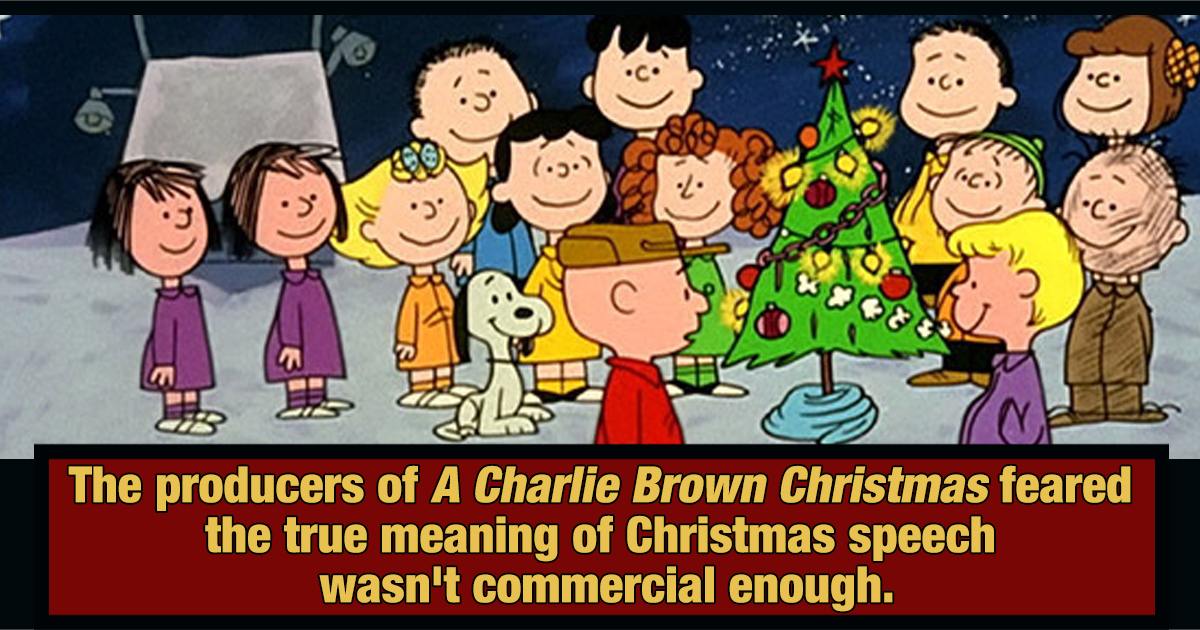
2. Linus’s Speech in A Charlie Brown Christmas Nearly Vanished Because It Wasn’t Commercial Enough
The quiet speech that made the special timeless
A Charlie Brown Christmas is technically a television special, but its place in screen history is so enormous that leaving it out would feel like refusing Snoopy a dance floor. The special follows Charlie Brown as he struggles with the noise, buying, decorating, and general holiday chaos around him. Near the end, Linus steps into the spotlight and explains the meaning of Christmas through a simple, sincere reading from the Gospel of Luke.
Whether viewers connect with the religious message, the anti-commercial theme, or simply the emotional honesty of a kid standing alone on a stage, the scene gives the special its backbone. It turns the story from a cute animated holiday program into something genuinely reflective. It says, in effect, that meaning does not have to be loud, shiny, or wrapped in aluminum.
The idiotic reason it was nearly cut
The special was sponsored by Coca-Cola, which is already hilarious because the story criticizes the commercialization of Christmas. That is like funding a movie called Please Stop Buying Soda and then asking for your logo on the poster. Network and sponsor concerns reportedly centered on whether a direct religious reading would alienate viewers or sponsors. Some decision-makers worried that the moment was too serious, too specific, or not commercial enough for a family holiday broadcast.
Charles Schulz pushed back. He believed the scene belonged at the center of the story, not hidden in a drawer where risky sincerity goes to die. The speech stayed, and the special became a classic. Its jazz score, melancholy tone, child voice actors, lack of a laugh track, and spiritual climax all seemed risky at the time. Together, they made it unforgettable.
The lesson is simple: sometimes the least “marketable” moment is the one that gives a work its soul. Linus’s speech survived because Schulz knew the difference between seasonal decoration and actual meaning. The executives feared controversy; audiences found comfort. Not every powerful scene needs to be focus-grouped until it resembles beige pudding.
3. “Over the Rainbow” in The Wizard of Oz Was Almost Cut for Slowing the Movie Down
The song that defines Dorothy
It is hard to imagine The Wizard of Oz without “Over the Rainbow.” The song is not just famous; it is practically stitched into American film memory. Before Dorothy reaches Oz, before the ruby slippers, before witches and flying monkeys and the yellow brick road, she stands in Kansas and sings of a place beyond her ordinary life.
That moment tells the audience who Dorothy is. She is not merely a girl swept away by a tornado; she is someone who longs for wonder, safety, and possibility. The song sets up the emotional contrast between Kansas and Oz. Without it, the film would still have spectacle, but Dorothy’s dream would feel thinner. The fantasy would arrive before the longing, and longing is what makes fantasy matter.
The idiotic reason MGM nearly removed it
MGM executives reportedly worried that the song slowed down the picture. Some accounts say they felt it was too sad. Others note the odd objection that Judy Garland was singing in a farmyard, as if great cinema can happen in a castle, a ballroom, or a witch’s lair, but absolutely not near hay. Apparently, straw was where musical ambition went to be judged.
For an advance screening, the number was removed. Associate producer Arthur Freed strongly defended it, reportedly making it clear that the song had to stay. The decision to restore it changed film history. “Over the Rainbow” later became Judy Garland’s signature song and was ranked by the American Film Institute as the number one movie song on its list of great American film music.
The near-cut is a perfect example of how dangerous “pacing” can become when treated as the only measure of value. Yes, movies must move. But they also need emotional architecture. “Over the Rainbow” is not a detour; it is the doorway. Remove it, and the whole movie loses part of its heartbeat.
4. The Bus-Top Opera Scene in The Adventures of Priscilla, Queen of the Desert Almost Got Tossed as Unnecessary
The scene that turned a bus into a legend
The Adventures of Priscilla, Queen of the Desert is a low-budget road movie with a giant cultural footprint. It follows three performers traveling across the Australian Outback in a bus named Priscilla. The film is funny, stylish, tender, defiant, and visually outrageous in the best possible way.
One of its most memorable moments features Guy Pearce’s character on top of the bus, lip-syncing opera while a massive silver fabric billows behind him in the desert air. On paper, it sounds like a dare someone invented after too much coffee: “What if we put a drag performer on a moving bus with opera and a giant shiny sheet?” On screen, it is magnificent. It captures freedom, absurdity, vulnerability, and spectacle all at once.
The idiotic reason it nearly disappeared
The production had very little money. The wardrobe budget was famously tiny, the crew had to solve problems creatively, and even the bus itself became a budget puzzle. In that context, a scene that seemed expensive, decorative, or not strictly necessary was easy to target. Reports about the near-cut often point to the small extra cost as the problem. When every dollar matters, even a few hundred dollars can look like a dragon guarding the accounting department.
But director Stephan Elliott understood that the moment was not empty decoration. It expressed the movie’s personality in one wild image. It told the audience that this was not just a road trip; it was a moving performance, a survival strategy, and a glitter cannon fired into the face of dullness.
The scene stayed, and the bus became one of the most recognizable objects in Australian cinema. The film later won an Academy Award for costume design and became a landmark in LGBTQ+ screen history. If the bus-top opera had been cut, the story would still make sense. But it would lose one of the images that made people remember it. Sometimes “unnecessary” is exactly where the magic is hiding.
5. The Spaghetti Kiss in Lady and the Tramp Almost Got Cut Because Walt Disney Thought It Looked Silly
The romantic dinner everyone remembers
The spaghetti scene in Lady and the Tramp is one of the most famous romantic moments in animation. Lady and Tramp sit behind Tony’s restaurant, sharing pasta under soft light while “Bella Notte” gives the whole thing a dreamy glow. Then they accidentally eat opposite ends of the same strand of spaghetti and meet in the middle with a kiss.
It is simple, charming, and instantly readable. The scene works because it translates romance into physical comedy without mocking the feeling. Two dogs eating spaghetti should be ridiculous. Somehow, it becomes sweet. That balance is animation wizardry: the audience laughs, then melts, then considers ordering pasta.
The idiotic reason Walt nearly rejected it
Walt Disney reportedly worried that dogs eating spaghetti would look awkward, messy, or too silly to be romantic. To be fair, if someone described the scene badly, it would sound like a cartoon pitch from a person who had just discovered carbohydrates. But animator Frank Thomas saw the potential. After the idea was cut at the storyboard stage, Thomas revived it and showed how the action could be staged with warmth and elegance.
Disney changed his mind. The sequence remained, and it became one of the defining images of the film. What is funny is that Walt’s concern was not irrational; it was just incomplete. He imagined the worst version of the idea. Thomas showed him the best version.
That distinction matters for creative work. Many brilliant scenes sound dumb before someone executes them beautifully. “Two dogs kiss over noodles” is a joke. The finished scene is cinema. The gap between those two things is craft.
What These Almost-Cut Scenes Teach Us About Filmmaking
These five stories reveal a pattern. The scenes that nearly got cut were not random extras. They were moments of identity. “Part of Your World” explains Ariel’s longing. Linus’s speech gives A Charlie Brown Christmas its moral center. “Over the Rainbow” turns Dorothy’s adventure into an emotional quest. Priscilla’s bus-top opera captures the film’s flamboyant courage. The spaghetti kiss makes Lady and the Tramp timelessly romantic.
The reasons for cutting them were usually practical on the surface: pacing, cost, marketability, test-audience reaction, or fear of looking silly. Those concerns are real. But they can become dangerous when they flatten everything unusual. If every scene must prove its value in the most obvious way, movies become efficient and forgettable. Great films need structure, but they also need grace notes.
Another lesson is that advocacy matters. Howard Ashman defended Ariel’s song. Charles Schulz insisted on Linus’s speech. Arthur Freed fought for “Over the Rainbow.” Stephan Elliott protected Priscilla’s visual poetry. Frank Thomas showed Walt Disney how spaghetti could become romance. In each case, the scene survived because someone could see beyond the immediate objection.
Experience Notes: Watching Iconic Scenes With Fresh Eyes
One of the best ways to appreciate iconic movie scenes is to rewatch them while imagining the film without them. This little exercise is surprisingly brutal. Take “Part of Your World” out of The Little Mermaid, and Ariel’s choices feel less rooted. She still wants the surface world, but the audience has not been invited into that desire. The plot moves, yet the emotional map has a hole in it. It is like getting directions that say, “Turn left where you should already care.”
Do the same with “Over the Rainbow.” Without it, The Wizard of Oz still has color, spectacle, characters, and adventure. But Dorothy’s inner life becomes quieter in the wrong way. The song gives viewers a private moment with her before the tornado turns the movie into fantasy. It says, “This is the ache behind the adventure.” When I rewatch that scene, I notice how still it is compared with the rest of the movie. Nothing huge happens visually, yet everything important happens emotionally. That is the kind of scene executives often underestimate because it does not announce its value with fireworks.
The Lady and the Tramp spaghetti scene is another great rewatch test. Modern viewers may come to it already knowing the parody versions: sitcom jokes, commercials, memes, and people trying to recreate it on dates with questionable hygiene logistics. But the original still works because it is staged with sincerity. The animators are not winking at the audience every three seconds. They let the romance play, even though the situation is funny. That confidence is why the scene survived decades of imitation.
A Charlie Brown Christmas offers a different kind of experience. Linus’s speech slows everything down. In today’s attention economy, that can feel almost radical. The special does not chase a joke, a toy tie-in, or a loud finale. It trusts a child’s voice, a spotlight, and a simple message. Whether someone watches it for faith, nostalgia, music, animation history, or holiday atmosphere, the scene feels like the moment the special stops performing and starts speaking plainly.
Priscilla’s bus-top opera scene is the one that best demonstrates why “plot relevance” is not the only standard. You could summarize the story without it. A character lip-syncs on a bus roof; technically, the plot survives if that moment is gone. But the movie’s spirit would be dimmer. Some scenes are not important because they change what happens next. They are important because they show us what kind of world the film wants to create.
For writers, editors, filmmakers, and even bloggers, these stories are useful reminders. Do not protect every scene just because you love it; that way lies bloated storytelling and possibly a 14-minute dream sequence involving fog machines. But do pay attention to the scenes that reveal desire, tone, theme, or identity. Those are often the first scenes someone calls “too slow,” “too weird,” “too soft,” or “too much.” They may also be the scenes people remember 50 years later.
The next time an iconic movie moment feels inevitable, remember that it probably was not. It survived notes, nerves, budgets, screenings, and somebody’s terrible gut instinct. Movie history is not just made by genius. Sometimes it is made by the person in the room brave enough to say, “No, we are keeping the mermaid song.”
Conclusion
The story behind these iconic movie scenes is funny, but it is also a little terrifying. Some of cinema’s most beloved moments came dangerously close to being removed for reasons that now seem laughably small. A dropped snack, a fear of slow pacing, sponsor anxiety, a tight budget, and doubts about animated dogs eating pasta almost changed film history.
Thankfully, the right people fought for the right scenes. Because of them, audiences got Ariel’s defining song, Dorothy’s dream, Linus’s heartfelt speech, Priscilla’s glittering desert spectacle, and the spaghetti kiss that launched a thousand date-night jokes. The next masterpiece may already be sitting in an editing timeline, looking “unnecessary” to someone in a meeting. Let’s hope there is a Frank Thomas, Howard Ashman, Charles Schulz, Arthur Freed, or Stephan Elliott nearby to save it.
Note: This article is written as original, web-ready content based on real production-history research. It does not include external source links inside the article body, making it easier to copy into a publishing platform.