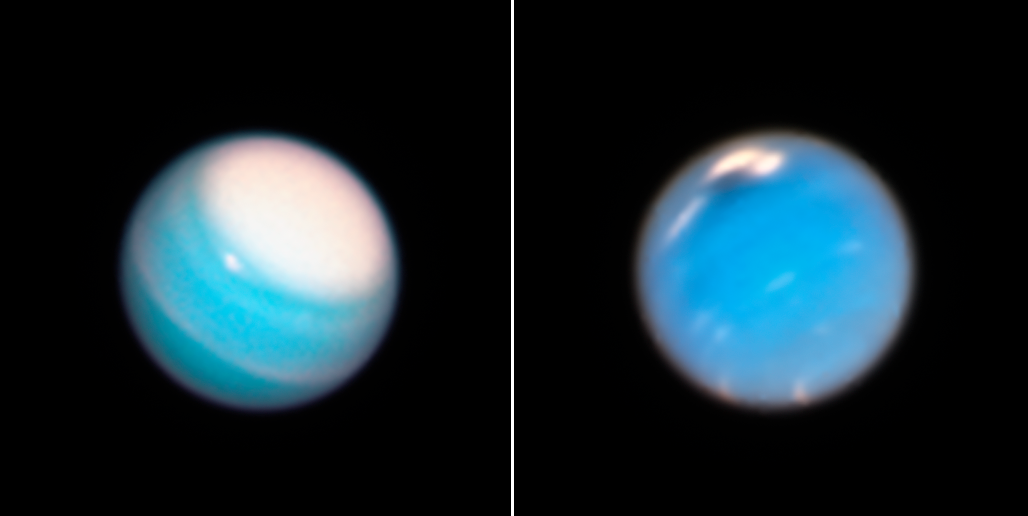
Far beyond Saturn, where sunlight is weak and even the planets seem to speak in whispers, astronomers uncovered three tiny worlds that had been hiding in plain sight. One circles Uranus, while two orbit Neptune. None is large enough to impress Earth’s Moon, but each carries valuable clues about violent collisions, captured objects, and the chaotic construction of the outer solar system.
The three moons were officially announced by the International Astronomical Union’s Minor Planet Center on February 23, 2024. They were provisionally designated S/2023 U1, S/2002 N5, and S/2021 N1. The names sound less like enchanted worlds and more like passwords assigned by an unusually strict IT department, but provisional designations are normal until permanent names are approved.
When the discovery was announced, the new Uranian moon increased Uranus’s known satellite count to 28, while the two Neptunian discoveries brought Neptune’s total to 16. More importantly, the moons became the faintest satellites ever detected around the two ice giants using ground-based telescopes.
Discovery announcement and 2024 moon totals:
Three New Moons, One Very Old Story
These hidden worlds are not miniature versions of Earth, complete with mountains, weather reports, and inconvenient airport security. They are most likely small, dark, irregular chunks of rock and ice. Their value lies not in their scenery but in their orbits.
| Provisional Name | Planet | Estimated Diameter | Orbital Period |
|---|---|---|---|
| S/2023 U1 | Uranus | About 5 miles (8 kilometers) | About 680 days |
| S/2002 N5 | Neptune | About 14 miles (23 kilometers) | Nearly 9 years |
| S/2021 N1 | Neptune | About 9 miles (14 kilometers) | Nearly 27 years |
All three follow distant, eccentric, and strongly inclined paths. Unlike the large regular moons that generally orbit close to their planets in orderly, nearly circular lanes, these objects travel through the outer suburbs of their planetary systems. Their movements suggest that they belong to families of fragments created when larger captured moons were broken apart.
Sizes, periods, and orbital groupings:
S/2023 U1: Uranus’s Almost Invisible Companion
A Moon Smaller Than a Major City
S/2023 U1 is approximately 5 miles across, making it likely the smallest known moon in the Uranian system at the time of its announcement. For perspective, a determined cyclist could cover that distance before breakfast. In space, however, even a modest chunk of material can preserve billions of years of history.
Astronomer Scott Sheppard first detected the moon on November 4, 2023, using one of the Magellan telescopes at Las Campanas Observatory in Chile. Follow-up observations helped researchers calculate its orbit. Once they knew where to look, the team found the moon in older images recorded by the Magellan and Subaru telescopes in 2021.
This is one of astronomy’s recurring jokes: sometimes a discovery has already been sitting on a hard drive for years, quietly waiting for someone to recognize it.
A 680-Day Trip Around Uranus
S/2023 U1 takes approximately 680 Earth days to complete one orbit. Its path is retrograde, meaning it travels in the direction opposite Uranus’s rotation. It also has an eccentric and inclined orbit rather than following a neat circle around the planet’s equator.
Those characteristics identify it as an irregular satellite. Researchers found that its orbital behavior resembles that of two other distant Uranian moons, Caliban and Stephano. The similarities are so strong that the three objects probably belong to the same dynamical family.
The leading explanation is that Caliban, Stephano, and S/2023 U1 are fragments of a larger moon that was shattered in an ancient collision. The original object may have been captured by Uranus during the solar system’s youth and later struck by an asteroid, comet, or another wandering body.
Uranian discovery history, orbit, and family:
Neptune’s Two Long-Lost Ghosts
S/2002 N5: The Moon That Disappeared for Two Decades
S/2002 N5 has the most appropriate backstory for an object described as emerging from the shadows. Astronomers recorded it near Neptune in 2002, but there were not enough observations to prove that it was actually orbiting the planet. Without a reliable orbit, the object effectively became lost.
Scott Sheppard and his colleagues independently spotted the moon again in 2021. Observations made in 2022 and 2023 allowed scientists at NASA’s Jet Propulsion Laboratory to calculate its trajectory. The team then traced the orbit backward and realized that the rediscovered object matched the unidentified point of light seen near Neptune in 2002.
Thus, S/2002 N5 did not suddenly appear. Astronomy simply found the cosmic paperwork it had misplaced.
The moon is estimated to be about 14 miles wide and takes nearly nine years to orbit Neptune. It moves in a prograde direction, the same general direction as Neptune’s rotation. Its orbit resembles those of Sao and Laomedeia, suggesting that all three are fragments of a common parent satellite.
S/2002 N5 recovery and orbital family:
S/2021 N1: The Moon With a 27-Year Commute
S/2021 N1 is smaller and fainter than its Neptunian sibling. Measuring approximately 9 miles across, it was first detected in September 2021 with the Subaru Telescope in Hawaii. Additional observations from the Very Large Telescope in Chile and the Gemini North Telescope in Hawaii were required to confirm its orbit.
That orbit is remarkable. S/2021 N1 takes almost 27 years to travel once around Neptune. A child born when the moon begins one lap could finish college, begin a career, and receive several unwanted emails about retirement planning before the moon returns to its starting point.
Its lengthy journey was the longest known orbital period of any planetary moon when the discovery was announced. The orbit is also retrograde, distant, eccentric, and inclined. S/2021 N1 appears to form another satellite family with Neptune’s moons Psamathe and Neso.
The peer-reviewed orbital analysis also indicates that S/2021 N1 participates in a Kozai-Lidov resonance. In simplified terms, gravitational interactions cause the moon’s orbital inclination and eccentricity to vary in a coordinated way. It is not random wandering; it is a slow gravitational dance governed by celestial mechanics.
S/2021 N1 observations, 27-year orbit, and resonance:
How Astronomers Found Objects That Barely Reflect Light
Discovering a small moon near Uranus or Neptune is nothing like pointing a backyard telescope toward Earth’s Moon. These satellites are tiny, extremely distant, and probably covered with dark material. They reflect so little sunlight that even powerful professional observatories struggle to distinguish them from background noise.
Following the Planet, Not the Stars
Researchers used large telescopes to take dozens of exposures over several hours. Each exposure lasted only a few minutes, but the images were later digitally combined. During the observations, the telescope tracked the motion of Uranus or Neptune rather than remaining fixed on the background stars.
When the frames were stacked, distant stars appeared as streaks because they shifted relative to the moving planet. A moon traveling with the planet remained concentrated in roughly the same location, allowing its faint signal to become stronger.
This shift-and-stack method is the astronomical equivalent of trying to hear one person whispering in a crowded stadium, recording the crowd repeatedly, and then aligning every recording around the whisper.
One Night Is Not Enough
A faint dot in a single image is not automatically a moon. It could be a background star, a galaxy, an asteroid, a detector artifact, or an especially ambitious speck of dust. Astronomers must observe the candidate on multiple nights and demonstrate that its movement matches an orbit around the planet.
Researchers reported that fully establishing each orbit required observations on about five different nights, representing roughly 15 hours of telescope time per moon. For the faintest object, data from several major observatories had to be combined.
Image stacking and confirmation process:
Why Did These Moons Remain Hidden?
They Are Tiny
The three moons range from roughly 5 to 14 miles in diameter. At the enormous distances of Uranus and Neptune, objects that small occupy only a fraction of a pixel in many telescope images. Astronomers are not photographing visible landscapes. They are measuring minute points of light.
They Are Dark
Irregular moons generally have low reflectivity. A dark surface absorbs most of the limited sunlight reaching the outer solar system instead of sending it toward Earth. Neptune’s distant satellites can be tens of millions of times fainter than objects visible to the unaided eye.
Their Planets Create Glare
Although Uranus and Neptune appear faint from Earth, they are enormously brighter than their smallest moons. Light scattered from the planets can overwhelm nearby objects, much as a firefly becomes difficult to see beside a stadium floodlight.
Their Orbits Are Enormous
Irregular moons travel far from their planets, so observers must search a wide area of sky. Their orbital periods can span years or decades, requiring long observation campaigns before scientists can confidently determine their paths.
Challenges involving faintness, distance, and irregular moons:
What the Three Hidden Worlds Reveal About the Early Solar System
The newly detected moons strengthen the idea that every giant planet possesses families of irregular satellites. Jupiter and Saturn have many such groups, and researchers had suspected that Uranus and Neptune should display similar patterns.
The three discoveries supplied the missing evidence. S/2023 U1 groups naturally with Caliban and Stephano. S/2002 N5 resembles Sao and Laomedeia. S/2021 N1 shares important orbital properties with Psamathe and Neso.
These families probably began as larger objects captured by the gravity of the growing planets. Capture would have been easier during the early solar system, when gas, dust, planetesimals, and migrating planets produced a much more complicated gravitational environment.
Later collisions smashed the captured bodies into smaller fragments. The surviving pieces continued moving through similar regions of orbital space, preserving a record of their shared origin.
This means a moon only a few miles across can function like a piece of forensic evidence. Its orbit tells scientists where it came from, how it relates to neighboring satellites, and what kinds of collisions occurred billions of years ago.
The research team has also proposed that debris produced by these ancient breakups could contribute to reddish material observed on the leading hemispheres of some larger Uranian moons, including Titania, Oberon, and Umbriel. That possibility remains an interpretation to be tested, but it connects distant irregular satellites with the surfaces of moons much closer to Uranus.
Dynamical families and early-system implications:
Could More Moons Still Be Hiding?
Almost certainly.
The deep surveys probably completed the inventory of Uranian irregular moons larger than roughly 5 miles and Neptunian irregular moons larger than roughly 9 miles. That does not mean the search is finished. It means astronomers have approached the detection limits of the observations used in this campaign.
Smaller fragments should exist, especially if the known satellite families were created through catastrophic collisions. Studies of irregular-moon populations suggest that the number of fragments rises sharply at smaller sizes.
Finding those objects from Earth will be difficult. Future telescopes may push the limits farther, but a spacecraft visiting the ice giants could search more effectively. From nearby, a probe would not have to peer across billions of miles while competing with Earth’s atmosphere and planetary glare.
Uranus and Neptune have each received only one brief spacecraft visit: Voyager 2 flew past Uranus in 1986 and Neptune in 1989. The tiny outer moons were too dark, distant, or poorly positioned to be identified during those encounters. A dedicated orbiter could transform our understanding of their satellite systems.
Survey limits and need for future exploration:
An Observer’s-Eye Experience: Finding a Moon in a Sea of Noise
Imagine beginning an observing session with no guarantee that your target exists. There is no bright disk waiting in the eyepiece, no dramatic ring system, and no obvious little moon waving from the edge of the frame. There is only a carefully calculated patch of dark sky containing a planet, countless background stars, electronic noise, and perhaps one extraordinarily faint moving dot.
The first challenge is patience. A modern observatory may use an enormous mirror and an advanced digital camera, but the basic problem remains brutally simple: not enough light is arriving. The telescope must collect photons over repeated exposures while tracking the slow motion of the ice giant across the sky.
During the night, an observer monitors atmospheric conditions, telescope performance, focus, guiding, and image quality. A thin cloud can weaken an already delicate signal. Poor seeing can blur faint sources together. A small tracking error can reduce hours of work to a collection of expensive gray rectangles.
There is also little instant gratification. A newly captured frame probably does not produce a cinematic revelation. The candidate moon may be invisible until many exposures are calibrated, aligned, shifted, and stacked. The discovery begins not with cheering but with processing scripts, orbital calculations, and repeated checks for mistakes.
Then a faint point appears.
At first, it is not exciting in the way the public imagines astronomical discoveries. It is a handful of bright pixels. Its importance comes from movement. When images are compared, the point changes position in a way that suggests it is traveling with Uranus or Neptune rather than belonging to the distant stellar background.
The emotional experience is probably a mixture of excitement and suspicion. Astronomers are trained to distrust convenient answers. A detector defect can imitate a source. A cosmic ray can create a bright spot. An unrelated asteroid can pass through the field. Even a real object near the planet may not be gravitationally bound to it.
Instead of immediately announcing a moon, the team asks harder questions. Does the point appear in independent exposures? Does it move at the correct rate? Can another telescope recover it? Does a calculated orbit predict where it will appear weeks or months later?
Confirmation may require requesting scarce observing time from multiple facilities. Telescope schedules are competitive, weather is indifferent to deadlines, and the target may be visible only during limited windows. A moon with a 27-year orbit is in no hurry, but the scientists trying to confirm it certainly are.
The experience becomes even stranger when researchers search archival images. Once an approximate orbit has been calculated, software can predict where the object should have appeared in older observations. Investigators return to data recorded years earlier and inspect positions that previously seemed unremarkable.
Finding the moon in an old image changes the story. The discovery is no longer a brief sighting. It becomes a continuous track through time. In the case of S/2002 N5, the orbital solution connected modern observations to a mysterious object recorded almost two decades earlier.
The final reward is not a detailed portrait. These moons remain unresolved points of light. Astronomers cannot yet describe their craters, shapes, or surface geology with confidence. What they gain is an orbit, and an orbit can be surprisingly talkative.
It reveals whether the moon travels forward or backward, whether its path is circular or stretched, and whether it belongs to a family of related fragments. From those measurements, researchers reconstruct an event that may have happened billions of years ago: the capture of a wandering object, followed by a collision violent enough to shatter it.
That is the distinctive experience of discovering a tiny irregular moon. The observer sees almost nothing, measures movement with extraordinary precision, and eventually uncovers an ancient planetary crime scene.
Why These Three Small Worlds Matter
S/2023 U1, S/2002 N5, and S/2021 N1 will never compete with Europa, Titan, or Triton for celebrity status. They are too small, too dark, and too distant. Yet their obscurity is exactly what makes them scientifically useful.
Large moons have often experienced geological evolution, tidal heating, resurfacing, or internal differentiation. Small irregular satellites are comparatively primitive. Their locations and orbital relationships retain evidence of capture and collision events that occurred while the giant planets were still settling into their present arrangement.
The discovery also demonstrates how far ground-based astronomy has advanced. By combining large telescopes, sensitive cameras, sophisticated image processing, archival searches, and precise orbital modeling, scientists detected objects that earlier surveys could not reliably see.
Three faint dots have therefore added a substantial chapter to the history of the outer solar system. They show that the moon families of Uranus and Neptune resemble those of Jupiter and Saturn, despite the planets’ different masses, tilts, environments, and formation histories.
The solar system may look orderly today, but these hidden worlds tell a rougher story. Planets migrated. Objects were captured. Moons collided. Fragments scattered into strange orbits. Billions of years later, astronomers are still finding the pieces.
Conclusion
The emergence of three hidden moons from the darkness surrounding Uranus and Neptune is more than an update to a planetary inventory. S/2023 U1, S/2002 N5, and S/2021 N1 provide evidence that the outer moons of the ice giants were shaped by the same processes seen around Jupiter and Saturn: gravitational capture, unstable early orbits, and catastrophic collisions.
Their discovery required years of observations and some of the world’s most powerful telescopes. One moon had been lost since 2002. Another takes nearly 27 years to complete a single orbit. The smallest is only about 5 miles across. Together, however, they reveal that the distant solar system is not empty, quiet, or fully explored.
It is simply very good at hiding things.
Note: The moon totals discussed in the main discovery story refer to the February 23, 2024 announcement. NASA reported another Uranian moon, S/2025 U1, in 2025, expanding Uranus’s identified satellite family to 29. That later detection was separate from the three moons covered here.
Current Uranian moon-count context: