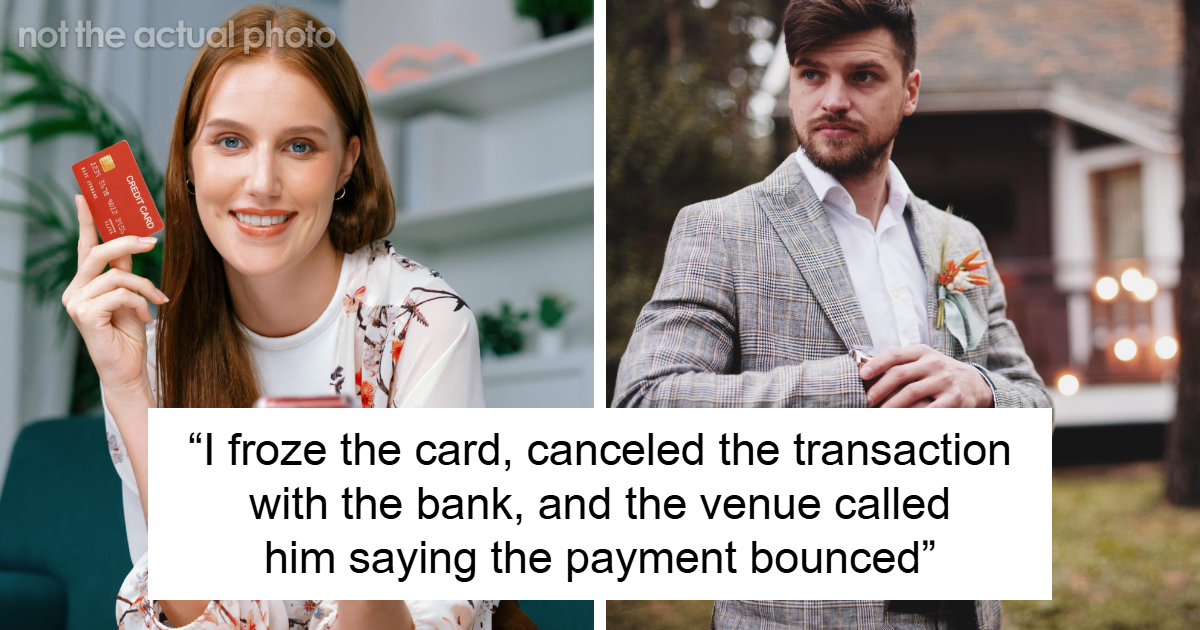
Weddings are famous for bringing out everyone’s soft side: happy tears, sentimental speeches, suspiciously emotional uncles, and at least one person who suddenly believes a $1,200 deposit is “basically not a big deal.” In one viral family dispute, a 25-year-old groom-to-be secretly used his sister’s credit card to place a wedding venue deposit. When she discovered the charge, froze the card, and canceled the payment, the family drama detonated like a bouquet toss thrown directly into a ceiling fan.
The sister was quickly labeled “vindictive,” “dramatic,” and accused of sabotaging the wedding. But the internet was not exactly reaching for tiny violins. Many people argued that using someone else’s credit card without permission is not a romantic budgeting strategy. It is unauthorized use of a financial account, and depending on the details, it can cross into fraud.
This story has all the ingredients of a modern viral debate: wedding pressure, family favoritism, money boundaries, emotional manipulation, and one very exhausted credit card. But beneath the online spectacle is a serious question: when a relative steals from you “for a good reason,” are you cruel for protecting yourselfor are you finally enforcing a boundary that should have existed all along?
The Viral Story: A One-Time Favor Turned Into a Financial Mess
According to the widely discussed account, the sister had previously allowed her younger brother to use her credit card once. That earlier favor came with permission, a clear reason, and repayment. In normal human language, that is called “helping.” Unfortunately, the brother apparently interpreted it as “Congratulations, you now have a reusable family credit line.”
Later, the sister noticed a $1,200 charge from a wedding venue on her card. She did not authorize it. Her brother had used the saved card details to pay a deposit because he and his fiancée did not yet have the money but did not want to lose their preferred date. When confronted, he reportedly promised to repay her after his next paycheck cleared.
That promise might sound comforting if you ignore the tiny detail that he had already used her card without asking. After waiting and receiving no repayment, the sister froze the card and disputed or canceled the transaction. The venue then contacted the groom, and the wedding plans became unstable faster than a folding chair at an outdoor ceremony.
Her brother accused her of ruining his wedding. Her parents urged her to let it go because he was stressed. She responded with the basic financial truth of the century: using someone’s credit card without permission is theft, even if the thief is wearing cufflinks and talking about centerpieces.
Was Canceling the Wedding Deposit Vindictive?
Calling the sister “vindictive” makes for a dramatic family group chat, but it does not fit the facts very well. Vindictiveness suggests revenge for the sake of causing pain. What she did was stop an unauthorized charge on her own credit card after the person responsible failed to repay her.
That is not revenge. That is damage control.
A credit card is not a community snack drawer. It is tied to a person’s credit history, available balance, fraud protections, and legal responsibility. A $1,200 charge can affect utilization, minimum payments, interest, and financial planning. Even if the brother intended to repay the money eventually, intention does not erase the fact that he made a financial decision using someone else’s name and account.
The sister did not cancel the wedding. She canceled her unwilling participation in funding it. Those are two very different things.
Why Unauthorized Credit Card Use Is Serious
In the United States, consumer protection guidance from agencies such as the Federal Trade Commission, the Consumer Financial Protection Bureau, and the Office of the Comptroller of the Currency consistently treats unauthorized card use as a serious issue. Cardholders are typically encouraged to contact the card issuer quickly, report suspicious charges, block or replace compromised cards, and monitor accounts for additional misuse.
That advice exists because unauthorized charges can spiral. Once someone has stored card details, they may be able to make more purchases, set up recurring payments, or create confusion about which charges were approved. The emotional complication of “but he is family” does not make the transaction safer. In fact, family-based misuse can be more stressful because the victim is often pressured to stay quiet.
Credit card companies usually investigate disputed charges. Some cases may require documentation, a fraud affidavit, or even a police report. That does not mean every family dispute becomes a courtroom drama with dramatic music and a judge banging a gavel. But it does mean the victim has a right to treat the matter as financial misconduct, not just an awkward sibling misunderstanding.
The Wedding Pressure Problem
Weddings are expensive. That is not breaking news; that is practically printed on every floral invoice. Recent wedding industry data often places average U.S. wedding costs in the tens of thousands of dollars, with venues, catering, photography, entertainment, attire, and flowers making up major expenses. Venue deposits are commonly required to reserve a date, and many contracts state that deposits or retainers are nonrefundable.
That context helps explain why the brother may have panicked about losing the venue. It does not excuse what he did. A wedding budget is not a permission slip to commit financial betrayal. If a couple cannot afford the deposit, the solution is to adjust the plan, choose a cheaper venue, change the date, reduce the guest list, delay the wedding, or ask for help honestly.
What they cannot do is secretly recruit someone else’s credit card into the bridal party.
Family Pressure: “Let It Slide” Is Not a Financial Plan
One of the most frustrating parts of this story is the parents’ reaction. Instead of focusing on the brother’s unauthorized use of the card, they reportedly pressured the sister to forgive him because he was stressed. This is a familiar pattern in family conflicts: the person who sets the boundary gets treated as the troublemaker, while the person who caused the problem gets wrapped in bubble wrap labeled “but they’re going through a lot.”
Stress explains behavior; it does not automatically excuse it. Plenty of people are stressed and still manage not to use their sibling’s credit card like a wedding coupon. When parents demand that the responsible child absorb the irresponsible child’s choices, they are not keeping peace. They are transferring consequences from the person who created the mess to the person least willing to tolerate it.
That is not family unity. That is emotional accounting fraud.
The Difference Between Help and Entitlement
Helping a family member is generous. Being drafted into financial support without consent is exploitation. The difference is permission.
If the brother had called and said, “We are short on the venue deposit. Could you lend us $1,200, and we will sign a repayment agreement?” the sister could have said yes, no, or “I love you, but absolutely not, and please stop planning champagne dreams on sparkling-water money.” That would have respected her autonomy.
Instead, he skipped the uncomfortable conversation and helped himself. That choice turned a wedding budget problem into a trust problem. The money matters, but the betrayal may matter more. Once someone secretly uses your financial information, you have to wonder what else they think they are entitled to.
Why the Internet Mostly Sided With the Sister
Online commenters tend to be chaotic, but on this issue, many reactions were surprisingly consistent. People argued that the sister was right to protect herself, that the brother’s behavior was deliberate, and that the family’s anger was misplaced. Some pointed out that she could have taken harsher steps and that freezing the card was actually a measured response.
The public reaction makes sense because the situation touches a nerve. Many adults have experienced relatives who blur financial boundaries: borrowing money and “forgetting” to repay it, using guilt as currency, treating a responsible sibling as a backup bank, or framing accountability as cruelty. The sister’s decision felt satisfying to readers because she did what many people wish they had done sooner: she stopped the leak before the whole boat sank.
What the Brother Should Have Done Instead
The brother had several better options, none of which involved secret card usage. He could have delayed booking until he had the deposit. He could have chosen a less expensive venue. He could have negotiated a payment plan with the venue. He could have asked both families for voluntary help. He could have reduced the guest count. He could have opened a separate wedding savings account and waited until the money existed in reality, not just in “next paycheck” fantasyland.
Wedding planning requires emotional maturity because marriage itself requires emotional maturity. If a person cannot handle a venue deposit without stealing from a sibling, that is not a charming pre-wedding hiccup. It is a red flag wearing a boutonniere.
What the Sister Did Right
The sister did several important things correctly. First, she checked her statement and noticed the charge. Many people miss unauthorized transactions because they assume everything is fine until the bill arrives and starts doing jump scares. Second, she confronted the person responsible instead of ignoring it. Third, she gave him a chance to repay. Finally, when repayment did not happen, she protected her account.
Could she have warned him one last time? Maybe. But she was not morally required to continue financing a charge she never approved. The burden was on him to fix the problem immediately, not on her to keep extending grace until her credit card needed therapy.
Practical Advice If a Family Member Uses Your Card Without Permission
1. Contact Your Card Issuer Immediately
Report the unauthorized charge as soon as you notice it. Ask whether the card should be frozen, replaced, or monitored. The faster you act, the easier it is to limit damage.
2. Document Everything
Save screenshots, receipts, text messages, repayment promises, and any communication about the charge. Documentation matters if the issuer investigates or if the family member later rewrites history with Oscar-level confidence.
3. Do Not Share Card Details Again
Even if the person apologizes, assume the old card information is compromised. Replace the card and remove saved payment information from shared devices, apps, or accounts.
4. Separate Emotion From Obligation
You can love someone and still refuse to pay their bill. You can care about their wedding and still refuse to fund it by force. Boundaries do not mean you lack compassion; they mean your compassion has a lock on the door.
5. Consider a Written Repayment Agreement
If you choose to let someone repay you directly, put the amount, due date, and payment method in writing. This may feel awkward, but so does discovering that “I’ll pay you Friday” is apparently a flexible spiritual concept.
What This Story Says About Money and Family
Money conflicts in families are rarely only about money. They are about trust, expectations, roles, and old patterns. In some families, one person becomes the “responsible one,” which sounds flattering until everyone starts treating that person like an emergency fund with legs.
The sister’s choice challenged that role. She refused to absorb the cost of someone else’s poor planning. That is why the reaction was so intense. Families built on uneven accountability often panic when the dependable person stops being convenient.
Healthy family support should be voluntary, transparent, and respectful. It should not require secrecy, pressure, or guilt. A person who truly values your help asks for it. A person who feels entitled to your help takes it and then blames you when you object.
Experience-Based Lessons From Similar Family Money Conflicts
Stories like this feel dramatic, but the pattern is surprisingly common. A relative borrows a card “just once.” A parent asks one sibling to cover another sibling’s bill. Someone promises repayment after payday, after tax season, after the wedding, after the moon enters a more financially responsible zodiac sign. Then the responsible person is left chasing money while everyone else complains that they are making things uncomfortable.
One lesson from these situations is that small boundary violations often predict bigger ones. The first unauthorized use may be framed as harmless because “it was only a deposit” or “he was going to pay it back.” But the real issue is not just the amount. It is the assumption that permission can be skipped when the reason feels important enough. That mindset can show up later in shared apartments, family businesses, caregiving arrangements, inheritance disputes, and emergency loans.
Another lesson is that verbal promises are weakest when emotions are strongest. Weddings create urgency. People become attached to dates, venues, dresses, photographers, menus, and the magical belief that everything will somehow work out if they can just swipe now and explain later. But urgency is exactly when financial boundaries matter most. A rushed decision can create months or years of resentment.
People who have dealt with family financial pressure often say the hardest part is not saying no. The hardest part is surviving the reaction after saying no. The guilt trips can be intense: “But we’re family.” “You know he’s stressed.” “Why can’t you be supportive?” “You’re ruining everything.” These phrases are designed to move attention away from the original wrongdoing and onto the victim’s refusal to cooperate. Once that happens, the conversation becomes upside down.
The best response is calm repetition. “I did not authorize the charge.” “I am not responsible for this payment.” “I am willing to discuss repayment, but I will not allow further use of my card.” This kind of language is boring, which is exactly why it works. Drama feeds on long explanations. Boundaries thrive on short sentences.
Another practical experience-based tip is to never lend money you cannot afford to lose, especially to relatives who already have a history of financial chaos. If helping would put your rent, credit score, emergency fund, or mental health at risk, the answer should be no. A loving no today is often better than a bitter yes that poisons the relationship later.
Finally, this story reminds us that accountability is not cruelty. A canceled unauthorized payment is not sabotage. A frozen card is not a personal attack. It is a financial seatbelt. The brother may have lost a venue date, but the sister could have lost money, credit stability, and trust. One person’s dream wedding does not outrank another person’s right to financial safety.
Conclusion: The Real Villain Was Not the Sister
The 25-year-old groom-to-be wanted a wedding venue badly enough to use his sister’s credit card without permission. When she stopped the charge, he and the family focused on the inconvenience to him rather than the violation against her. That is the heart of the problem.
A wedding is supposed to celebrate commitment, honesty, and partnership. Starting that journey with secret debt on someone else’s card is not exactly a romantic origin story. The sister did not destroy the wedding. She refused to let her finances be quietly hijacked for it.
Being family does not mean having unlimited access to someone’s wallet. Love may be patient and kind, but it should still require authorization before processing a $1,200 venue deposit.
Note: This article is for informational and editorial purposes only. It discusses general consumer finance and relationship-boundary issues and should not be treated as legal advice.