Every famous performer eventually hears the same tiny voice whispering from the corner of the dressing room: “You know what the world needs? My album. My app. My restaurant. My lifestyle magazine. My pasta empire.” Sometimes that voice leads to brilliance. Other times, it leads to a pop single that sounds like it was assembled in a glitter cannon during a Wi-Fi outage.
Welcome to the wonderfully weird world of performers’ garbage side projects: the vanity albums, baffling brands, failed businesses, misfired alter egos, and “please do not put this on my résumé” experiments that prove fame is not always transferable. To be fair, not every project below is truly garbage. Some became cult classics. Some made money. A few were ahead of their time. But all of them earned a place in pop-culture history because they were strange, overconfident, poorly received, or simply impossible to explain without taking a deep breath first.
This list looks at 21 famous performers who stepped outside their main lane and created side projects that were mocked, misunderstood, overhyped, or remembered for all the wrong reasons.
What Makes a Side Project “Garbage”?
A bad celebrity side project usually has three ingredients: a famous name, a questionable concept, and the unmistakable smell of “no one in the room said no.” These projects often fail because audiences can sense when a performer is dabbling rather than developing a real craft. Acting fame does not automatically create musical credibility. A hit TV show does not guarantee fans want a mobile app. A wrestling catchphrase does not mean people want themed pasta.
The funniest thing is that many of these projects were not lazy. Some had major producers, serious budgets, and real promotional campaigns. That only makes the results more fascinating. A small flop is forgettable. A heavily funded celebrity misfire becomes legend.
21 Performers’ Garbage Side Projects
1. William Shatner The Transformed Man
William Shatner’s 1968 spoken-word album is one of the grand monuments of celebrity recording history. Rather than simply singing, Shatner dramatically performed pop lyrics and literary passages with the intensity of a man trying to negotiate peace with a thunderstorm. The result has been mocked for decades, yet it also became oddly beloved. It is not just bad; it is theatrical, confusing, fearless, and completely Shatner. In the museum of weird performer side projects, it deserves its own velvet rope.
2. Steven Seagal Songs from the Crystal Cave
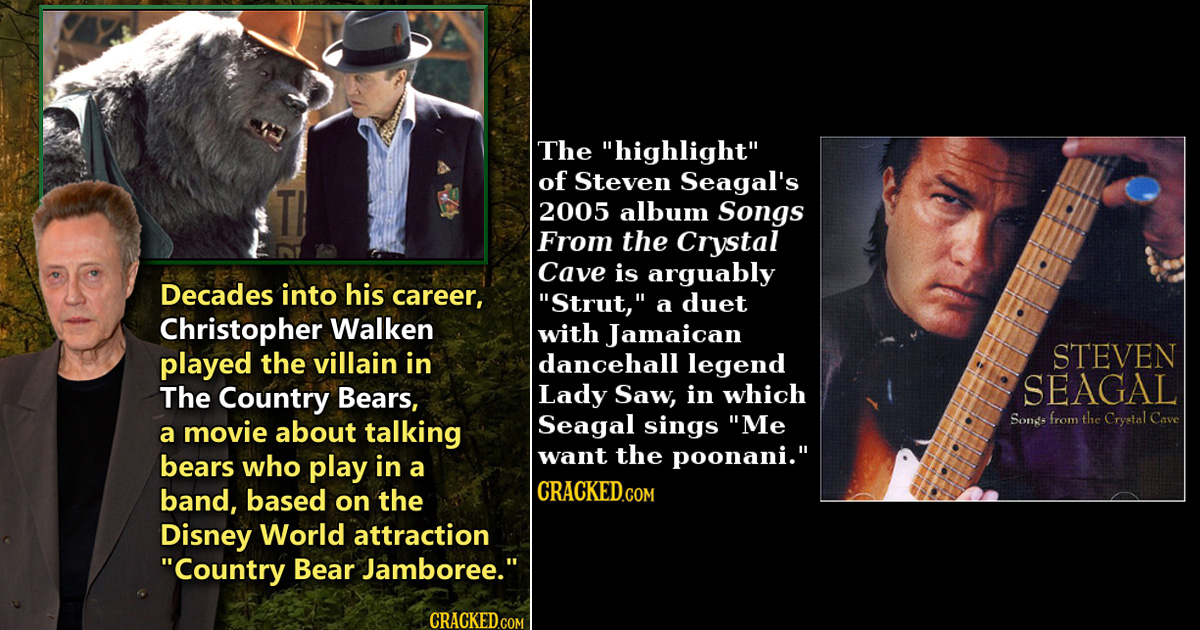
Steven Seagal’s music career sounds like a joke until you discover it is very real. His 2004 album mixed blues, reggae, rock, and spiritual atmosphere into a project that felt less like a record and more like a smoky room where everyone is wearing sunglasses indoors. The album even featured respected collaborators, which somehow made the final product more surreal. Seagal clearly took the music seriously, but listeners were less united. For many, it became the perfect example of an action star believing a ponytail, a guitar, and confidence could do the work of a whole genre.
3. Bruce Willis The Return of Bruno
Bruce Willis did not just release an album; he released a full fictional persona named Bruno Radolini. The project included an HBO mockumentary, a Motown-backed album, and a cover of “Respect Yourself” that actually became a major hit. That is what makes The Return of Bruno so interesting. It was not a total failure. It was also not exactly timeless soul greatness. It sits in that awkward celebrity zone where commercial success and secondhand embarrassment hold hands in matching leather jackets.
4. Eddie Murphy How Could It Be
Eddie Murphy’s “Party All the Time” became a real hit, thanks in part to Rick James, who gave the song its glossy funk engine. But the larger music career around it never escaped novelty status. Murphy had talent, charisma, and enough confidence to power a small city, yet many listeners still heard the project as “the funny movie guy is singing now.” The song survived because it is catchy. The album, however, remains a classic reminder that one monster chorus does not automatically build a durable pop career.
5. Garth Brooks Chris Gaines
Garth Brooks was one of the biggest country stars alive when he decided to become Chris Gaines, a fictional Australian rock artist with a dark wig, soul patch, and a backstory complicated enough to require a user manual. The plan involved an album, a character biography, and a movie that never materialized. The music was not as terrible as the public reaction suggested, but the branding was catastrophic. Fans wanted Garth. Instead, they got a rock alter ego who looked like he had escaped from a dramatic cologne commercial.
6. Scarlett Johansson Anywhere I Lay My Head
Scarlett Johansson’s Tom Waits covers album was too serious to dismiss and too uneven to celebrate without a few raised eyebrows. Produced with indie-rock atmosphere and heavy mood, the album buried her voice under layers of dreamy sound. Some critics admired the ambition; others wondered why one of the most recognizable actors in the world wanted to sound like a ghost whispering from inside a fog machine. It is not garbage in the lazy sense. It is more like prestige garbage: carefully arranged, tasteful, and still slightly baffling.
7. Kim Kardashian “Jam (Turn It Up)”
Kim Kardashian’s 2011 single “Jam (Turn It Up)” is one of the purest examples of a celebrity testing the outer limits of fame. Produced by serious hitmakers, released for charity, and promoted through reality TV, the song had every possible advantage except a compelling reason to exist. Kardashian later admitted she regretted recording it, which is refreshingly honest. The track now lives as a shiny time capsule from the era when every reality star briefly considered becoming a pop star, because apparently the early 2010s had no adult supervision.
8. Tyra Banks “Shake Ya Body”
Tyra Banks turned her music-video shoot into a challenge on America’s Next Top Model, creating a strange loop where a modeling show became promotional machinery for a pop single. “Shake Ya Body” is catchy in the way a mall perfume kiosk is memorable: bright, loud, and impossible to ignore. Banks had charisma, but the project felt more like brand extension than musical destiny. It remains a perfect piece of reality-TV archaeology: part song, part challenge, part “wait, did that really happen?”
9. Jeremy Renner The Jeremy Renner App
Jeremy Renner’s personal fan app began as a place for fans to connect, view content, and interact with his public persona. Then the internet discovered it, and the whole thing turned into a comedy bonfire. Trolls exploited the platform, impersonations became a problem, and the app shut down in 2019. Of all the side projects on this list, it may be the most modern. It did not fail because Renner recorded a bad chorus. It failed because building a private social network around one actor is like placing a cupcake in front of raccoons and hoping for etiquette.
10. Heidi Montag Superficial
Heidi Montag’s Superficial was expensive, glossy, and brutally mocked when it arrived in 2010. At the time, it sold poorly and became shorthand for reality-star vanity pop. Years later, listeners began reassessing it as a misunderstood electro-pop artifact. That twist makes the album more interesting than many traditional flops. Was it bad, or did audiences simply hate the celebrity machine around it? The answer is probably both. Either way, Superficial proves that today’s punchline can become tomorrow’s cult favorite if the hooks are sticky enough.
11. Naomi Campbell Babywoman
Naomi Campbell’s 1994 album Babywoman had style, serious collaborators, and a supermodel aura that should have made it a curiosity at minimum. Instead, it struggled in major Western markets and became one of those “wait, she released an album?” pop-culture footnotes. The project has since gained defenders, especially among listeners who appreciate its fashion-world weirdness and ‘90s production. Still, as a side project, it shows the danger of assuming visual charisma will translate perfectly into audio charisma.
12. Joe Pesci Vincent LaGuardia Gambini Sings Just for You
Joe Pesci actually had musical experience before acting fame, which makes his 1998 album more complicated than a simple vanity project. Unfortunately, the record leaned into his My Cousin Vinny persona and mixed lounge, comedy, jazz, and hip-hop in ways that tested patience. Some tracks had charm, but the overall effect was like being trapped at a theme restaurant where the entertainment refuses to take a break. Pesci is a brilliant actor. This album is a brilliant conversation starter for people with unusually strong stomachs.
13. Russell Crowe 30 Odd Foot of Grunts
Russell Crowe’s band, 30 Odd Foot of Grunts, was real, persistent, and far more committed than casual observers expected. That did not stop the name from sounding like a rejected fantasy-football team. Crowe toured, recorded, and treated the music seriously, but many critics and listeners struggled to separate the actor from the frontman. The band’s work was not a disaster; it was sturdy, earnest rock that often seemed overshadowed by the question, “Is Maximus about to sing another one?”
14. Keanu Reeves Dogstar
Keanu Reeves’ band Dogstar has enjoyed a warmer reassessment in recent years, especially after reuniting and touring again. Still, for a long time, the band was treated as a celebrity curiosity rather than a serious alternative-rock act. Reeves played bass, avoided hogging the spotlight, and seemed refreshingly humble about the whole thing. That may be why Dogstar escaped the worst vanity-project stink. The music was never as famous as Reeves, but the project’s sincerity kept it from becoming pure garbage. It is more like garage-band leftovers with surprisingly good manners.
15. Don Johnson Heartbeat
At the height of Miami Vice fame, Don Johnson released Heartbeat, an album that turned cool-cop television energy into sleek ‘80s pop-rock. The title track became a hit, but critical reactions were not exactly a parade of roses. Johnson wanted credibility, and the record included real musicians and songwriters. Still, the project now feels deeply tied to its decade: dramatic drums, serious poses, and the confidence of a man who had never met a rolled-up blazer sleeve he did not respect.
16. David Hasselhoff Pop Savior Energy
David Hasselhoff’s music career was treated as a joke in much of the United States, even while he became genuinely popular in parts of Europe. His “Looking for Freedom” era is especially famous because of its connection to Germany and the Berlin Wall celebration. That cultural context matters. Hasselhoff was not simply a failed singer; he was a performer whose musical fame made more sense overseas than at home. Still, to American audiences, his pop-star persona often felt like a fever dream wearing a leather jacket and holding a microphone too confidently.
17. Hulk Hogan Pastamania
Hulk Hogan’s Pastamania opened in the Mall of America in 1995 and closed in less than a year. That sentence alone deserves a small bronze statue. The restaurant offered wrestling-themed pasta during a period when celebrity branding was exploding, but Hulk-powered noodles did not become the next McDonald’s. The concept had everything a questionable side project needs: a huge name, a loud launch, novelty menu items, and a lifespan shorter than some leftovers. It remains one of the funniest examples of a performer stretching a brand until it snaps like overcooked spaghetti.
18. Sylvester Stallone Sly Magazine
Sylvester Stallone’s fitness and lifestyle brand extensions made sense on paper. He built an iconic career around physical transformation, discipline, and action-hero mythology. But Sly magazine, launched in the mid-2000s, felt like a monument to celebrity self-branding at its most muscular. It aimed to sell motivation, fitness, and personal philosophy through Stallone’s image. The problem was not that the advice was useless; it was that the whole thing felt like a magazine rack doing biceps curls in a mirror.
19. John Travolta and Olivia Newton-John This Christmas
John Travolta and Olivia Newton-John reunite on a holiday album sounds charming in theory. In practice, This Christmas divided listeners. Some found it sweet and charitable; others found it awkwardly sentimental. The project leaned heavily on nostalgia for Grease, but holiday music is already a dangerous land of sleigh bells and syrup. Add celebrity nostalgia, and the sugar level can become medically concerning. The album is not heartless. It is simply so sincere that it occasionally trips over a candy cane and lands in a snowbank of cheese.
20. Paris Hilton Pop Star Mode
Paris Hilton’s 2006 music career is tricky to classify because “Stars Are Blind” was genuinely successful and has aged better than many people expected. Still, at the time, Hilton’s move into pop was widely treated as a symbol of celebrity culture eating itself. Her breathy delivery and heavily produced sound made critics suspicious, yet the single worked because the songwriting and production were stronger than the public wanted to admit. This side project may have looked like garbage from a distance, but inside the bag was one surprisingly durable beach-pop gem.
21. Jared Leto The Overbuilt Rock-Star Persona
Jared Leto’s band Thirty Seconds to Mars is far too successful to call a failed side project, but it belongs in this conversation because it shows how thin the line can be between ambition and excess. Leto did not merely dabble in rock; he built a large-scale, high-drama music identity with cinematic videos, devoted fans, and a serious arena presence. For supporters, it is commitment. For skeptics, it can feel like a performer importing Oscar-campaign intensity into alternative rock. Not garbage, exactly, but definitely a reminder that side projects become risky when the branding starts doing parkour.
Why Performers Keep Making Weird Side Projects
It is easy to laugh at celebrity side projects, but the impulse behind them is understandable. Performers spend years being praised for charisma, timing, emotional expression, and public magnetism. After a while, it must be tempting to believe that talent is universal. If audiences love you in a movie, why would they not love your album? If fans cheer your wrestling entrance, why would they not eat your pasta? If people follow you on Instagram, why not build an entire app where the content is mostly you?
The problem is that every medium has its own rules. Music exposes weaknesses quickly because listeners cannot be distracted by a famous face forever. Restaurants require logistics, not just slogans. Apps need moderation, security, and a reason to exist beyond celebrity worship. Magazines need editorial identity. The audience may love a performer, but love has limits. Sometimes those limits are reached at the first chorus.
What These Garbage Side Projects Teach Us
The biggest lesson is that failure can be more interesting than safe success. Nobody talks passionately about a boring licensed perfume that sold moderately well and disappeared. People still talk about Chris Gaines because it was bizarre. They still mention Pastamania because it sounds like something invented by a comedy writer who was told to “make capitalism louder.” They remember Kim Kardashian’s “Jam” because it captured an entire celebrity era in one auto-tuned shrug.
These projects also show that public taste changes. Heidi Montag’s Superficial was ridiculed, then rediscovered. Paris Hilton’s pop era became easier to appreciate after the internet stopped pretending every celebrity single had to be Bob Dylan. Dogstar benefited from Keanu Reeves’ reputation for humility. Even Shatner’s musical weirdness became part of his charm. Garbage, in pop culture, is often just misunderstood compost. Give it enough time, and something strange may grow.
Experience-Based Reflections on Performers’ Garbage Side Projects
Anyone who follows entertainment closely has probably had the same experience: you discover a bizarre celebrity side project and immediately wonder how it survived the planning stage. There is a special thrill in finding out that a respected actor released a lounge-rap album, or that a global superstar created an alter ego with enough backstory to qualify as homework. These projects are funny because they reveal the human side of fame. Behind the red carpets and polished interviews, celebrities are still people with odd ideas, creative impulses, and occasionally terrible judgment.
For readers, these side projects can be strangely comforting. They prove that even famous, wealthy, talented performers can misread the room. A person may win awards, sell out arenas, or dominate television and still make a project that leaves everyone blinking politely. That is not just gossip; it is a useful reminder about creativity. Trying something new always carries risk. The difference is that when celebrities fail, the flop arrives with professional lighting, a press release, and sometimes a limited-edition CD single.
There is also a practical lesson for anyone building a brand. The best side projects grow naturally from credibility. If a chef opens a restaurant, the audience understands the bridge. If a comedian launches a podcast, the format fits the skill. But when the connection feels forced, fans become suspicious. A performer should ask: does this project expand what people already trust me to do, or does it simply borrow attention from my name? That question could have saved many celebrity ventures from becoming punchlines.
At the same time, the internet has made reassessment easier. A project mocked in 1998 can find new fans in 2026. A song dismissed as disposable can return as a meme, a nostalgic playlist favorite, or a cult discovery. This is why it is worth discussing these projects with humor rather than cruelty. Some were bad. Some were unlucky. Some were ahead of the wrong curve. And some were simply too weird to be forgotten.
The most memorable performer side projects are not always the worst-made. They are the ones with the widest gap between intention and result. Garth Brooks wanted to create a complex rock character; audiences saw a confusing wig. Jeremy Renner wanted a fan community; trolls saw an unlocked playground. Hulk Hogan wanted a pasta brand; history received a perfect joke. That gap is where pop culture comedy lives.
So yes, performers’ garbage side projects are easy to mock. But they are also tiny monuments to ambition. They show what happens when fame gives creative people permission to attempt the unnecessary. Sometimes the result is embarrassing. Sometimes it is weirdly wonderful. And sometimes, against all odds, it gives us a story we are still laughing about decades later.
Conclusion
Performers’ garbage side projects are more than celebrity mistakes. They are snapshots of ambition, branding, timing, ego, sincerity, and public reaction all crashing into each other under very bright lights. From Shatner’s spoken-word thunder to Hulk Hogan’s doomed pasta dream, these projects remind us that fame opens doors, but it does not guarantee anyone should walk through every single one.
The real charm of these flops is that they make famous people seem less untouchable. They tried something. The audience shrugged, laughed, streamed, mocked, rediscovered, or turned the whole thing into a meme. That is entertainment history at its messiest and most human. In a culture obsessed with perfect branding, a spectacularly strange side project can be oddly refreshing. It may not be good, but at least it is not boring.