A patch of grass can be many things: a miniature sports arena, a family tournament venue, or the place where Uncle Mike discovers that his cornhole skills are not nearly as legendary as he has claimed. With the right lawn games, an ordinary backyard can keep children, teenagers, parents, and grandparents entertained for hours.
The best lawn games for kids and adults share a few important qualities. They are easy to understand, flexible enough for different skill levels, and entertaining even when nobody remembers the official rules. Many also require only a few minutes of setup, making them ideal for cookouts, birthday parties, reunions, camping trips, neighborhood gatherings, and relaxed weekends at home.
This guide covers 15 family-friendly outdoor games ranging from slow, strategic classics to energetic challenges. Some require purchased equipment, while others can be created with items already hiding in your garage. Most importantly, every game can be adjusted so younger children and less-mobile adults can join the fun without being treated like decorative sideline furniture.
How to Choose the Best Lawn Games for Your Group
Before filling the yard with equipment, consider who will be playing and how much space is available. A competitive roundnet match needs more movement than giant four-in-a-row, while croquet works better on a reasonably smooth lawn than on grass resembling a miniature jungle.
- Age range: Choose simple rules, lightweight equipment, and adjustable throwing distances for mixed-age groups.
- Available space: Measure the yard before setting up games involving running, swinging mallets, or flying discs.
- Energy level: Offer both active and low-impact games so guests can alternate between sprinting and peacefully judging everyone else’s technique.
- Number of players: Some games work best with two to four people, while team games can accommodate a crowd.
- Portability: Foldable, lightweight sets are easier to take to parks, beaches, campsites, and tailgates.
- Safety: Look for rounded edges, soft balls, stable targets, and age-appropriate equipment.
15 Best Lawn Games for Families and Groups
1. Cornhole
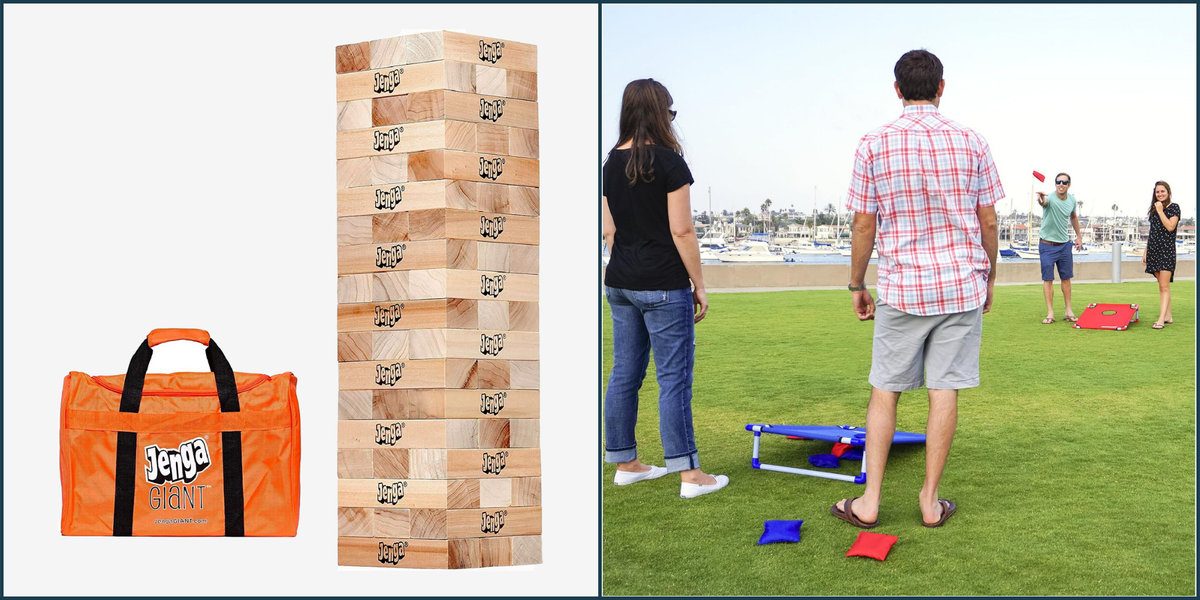
Cornhole remains one of the best lawn games for kids and adults because its basic objective takes approximately five seconds to explain: toss a bag toward the board and try to land it in the hole. A bag on the board traditionally earns one point, while a bag through the hole earns three.
Regulation boards are positioned 27 feet apart for adult competition, but casual players should freely shorten that distance. Children might throw from 10 to 15 feet, while adults can use a separate line. Lightweight or collapsible boards are convenient for travel, although wooden boards generally provide a more predictable playing surface.
Best for: Cookouts, tailgates, family tournaments, and players who enjoy socializing between turns.
2. Bocce
Bocce combines simple mechanics with sneaky amounts of strategy. One player throws a small target ball, often called the pallino, and everyone tries to roll larger balls as close to it as possible. Players may also knock an opponent’s ball away, which is where this peaceful-looking activity reveals its mischievous side.
The game can be played on grass, packed dirt, sand, or a dedicated court. It requires little running, making it accessible to many ages and mobility levels. Give younger children a closer throwing line or let them roll smaller, lighter balls.
Best for: Multigenerational gatherings, relaxed afternoons, and players who prefer precision over speed.
3. Croquet
Croquet turns a lawn into a colorful obstacle course. Players use mallets to guide balls through a sequence of wickets before reaching the finishing stake. A traditional nine-wicket layout is great for larger yards, but casual players can arrange a shorter course in whatever space they have.
Croquet develops aim and planning without demanding athletic speed. Children can use wider wicket spacing and shorter courses, while experienced adults can introduce more formal rules. Just establish a safe swinging zone so nobody accidentally gives Grandpa an extremely memorable haircut.
Best for: Garden parties, family reunions, and groups that enjoy classic outdoor games.
4. Ladder Toss
In ladder toss, players throw bolastwo balls connected by a cordtoward a three-rung target. Points vary depending on which rung catches the bola. Many common rule sets award three points for the top rung, two for the middle, and one for the bottom.
The satisfying wraparound landing makes this game surprisingly addictive. Adults often play from around 15 feet away, but the throwing line can be moved forward for children. Choose a stable ladder with soft or lightweight bolas, and keep everyone behind the active thrower.
Best for: Small teams, camping trips, and yards where a narrow playing lane is easier to create.
5. Kubb
Kubb is sometimes described as Viking chess, although no helmets or dramatic Nordic speeches are required. Two teams throw wooden batons underhand, attempting to knock over the opposing team’s wooden blocks. After clearing those blocks, a team may target the central king piece.
The game rewards accuracy, strategy, and teamwork. It works on grass or sand and can be adjusted by reducing the size of the playing field. Make sure everyone throws underhand and that spectators remain behind the tossing line.
Best for: Strategic players, medium-size groups, and families ready to try something beyond the usual backyard classics.
6. Giant Tumbling Blocks
Giant tumbling blocks bring tabletop stacking drama outdoors. Players remove one block at a time from a tower and place it on top without causing the structure to collapse. As the tower grows, every move becomes more suspensefuland every nearby conversation becomes suspiciously quiet.
Set the tower on level ground and establish a clear area around it. Younger children may need lighter blocks or a shorter starting tower. Because falling wooden pieces can hurt small feet, closed-toe shoes are a sensible choice.
Best for: Parties, small yards, low-impact entertainment, and guests who enjoy equal amounts of skill and luck.
7. Giant Four-in-a-Row
This oversized strategy game asks players to drop colored discs into a standing grid and create a horizontal, vertical, or diagonal line of four. The rules are familiar, matches are short, and players do not need exceptional strength or coordination.
Giant four-in-a-row is especially useful when a gathering includes very young children, older relatives, or guests who do not want to chase a ball across the lawn. Team play can help younger kids learn to recognize patterns while allowing adults to practice pretending they did not overlook an obvious diagonal.
Best for: Small spaces, quiet competition, and broad age ranges.
8. Badminton
Badminton provides more movement while remaining easier on beginners than many ball sports. Players use rackets to hit a lightweight shuttlecock over a net. A formal court is unnecessary for casual backyard matches; a portable net and visible boundary markers are enough.
For mixed-age play, use doubles teams and allow younger children to stand closer to the net. Cooperative ralliescounting how many times the group can keep the shuttlecock airbornecan be more inclusive than strict scoring. Wind is badminton’s natural enemy, so save it for calmer days unless your family enjoys chasing shuttlecocks into neighboring counties.
Best for: Active families, pairs or teams, and medium-to-large lawns.
9. Roundnet
Roundnet, widely recognized through games such as Spikeball, features a small circular net placed near ground level. Two teams alternate hitting a ball onto the net, usually with up to three touches before returning it. Once play begins, participants may move around the target in any direction.
The standard game is quick and athletic, but it can be modified for families. Use a larger or softer ball, allow the ball to bounce once, or let younger players catch and toss it. Clear a generous area around the net because enthusiastic players tend to forget that lawn chairs exist.
Best for: Teenagers, energetic adults, beach trips, and competitive groups.
10. Flying Disc Can Game
Flying disc target games, including the popular Kan Jam format, challenge teams to throw a disc toward a large can-shaped target. One teammate throws while the other may redirect the disc toward the opening. Points depend on whether the disc hits the target, is deflected into it, or passes through a scoring slot.
The combination of throwing and teamwork keeps everyone involved. Shorten the distance for children and use a soft flying disc when beginners are playing. This game works best in open areas away from windows, grills, flowerpots, and anyone carrying a carefully assembled plate of barbecue.
Best for: Teams of two, active gatherings, and players who already enjoy tossing a flying disc.
11. Ring Toss
Ring toss is inexpensive, portable, and simple enough for young children without becoming boring for adults. Players throw rings toward pegs or bottles, earning points based on the target they encircle.
Create multiple throwing lines and assign higher values to smaller or more distant targets. Homemade versions can use painted bottles, wooden stakes, or pool-noodle rings. Soft rings are safer around children and are less likely to damage nearby objects.
Best for: Preschoolers, birthday parties, compact yards, and do-it-yourself game stations.
12. Backyard Bowling
Backyard bowling transforms plastic pins, empty bottles, or lightweight wooden pins into a miniature bowling alley. Players roll a ball across a flat section of lawn and count how many pins they knock down.
This is one of the easiest outdoor games to adapt. Move the starting line, change the ball size, or add water to plastic bottles for greater stability. Younger children can bowl from a few feet away, while adults can attempt curved shots or compete through a full 10-frame game.
Best for: Younger children, casual competitions, and families using equipment they already own.
13. Rubber Horseshoes
Traditional horseshoes involve throwing metal shoes toward stakes, but rubber or plastic sets are better suited to family play. They are lighter, easier to transport, and more forgiving when someone’s aim unexpectedly explores a different part of the yard.
Players earn points by landing a horseshoe around the stake or closest to it. Separate throwing lines allow children and adults to compete fairly. Place the stakes away from walkways and require everyone to stand behind the thrower.
Best for: Classic-game fans, mixed-age groups, parks, and camping trips.
14. Disc Golf Target Challenge
You do not need an 18-hole course to enjoy disc golf. Set up one portable basket, hanging hoop, laundry basket, or marked target and create several throwing stations around the lawn. Players count how many throws they need to reach each target.
Use obstacles such as trees, cones, or lawn chairs to create different “holes.” Children can begin closer to the target, while experienced players attempt curved or longer shots. A soft disc makes the game easier for beginners and safer in crowded backyards.
Best for: Creative course builders, large lawns, parks, and players who enjoy individual challenges.
15. Capture the Flag
Capture the flag is a high-energy team game requiring little more than two flags and enough open space to run safely. Divide the lawn into two territories. Each team protects its flag while attempting to enter the opposing territory, capture the other flag, and return home without being tagged.
For younger children, eliminate holding areas and let tagged players return to their own side. For a less demanding version, players can walk quickly instead of sprinting. Use brightly colored cloth markers and clearly identify boundaries before the game begins.
Best for: Large groups, school-age children, active adults, and spacious lawns.
Tips for Organizing a Safe and Fair Lawn Game Day
Place throwing games in separate lanes so flying objects do not cross paths. Active games should be positioned away from tables, grills, pools, vehicles, windows, and garden beds. Check the lawn for holes, wet patches, exposed roots, sharp objects, and enthusiastic sprinkler heads waiting to become trip hazards.
Mixed-age competition becomes more enjoyable when the rules acknowledge differences in size and experience. Give younger players closer throwing lines, larger targets, extra attempts, or lighter equipment. Teams should be balanced rather than divided into “adults versus children,” a format that often ends with either bored adults or children plotting a revolution.
Provide drinking water, shaded seating, sunscreen, and regular breaks during warm weather. Stop active play during thunderstorms, extreme heat, or poor air-quality conditions. Finally, inspect game pieces before each event and replace cracked, splintered, unstable, or damaged equipment.
Practical Experience: What Makes a Mixed-Age Lawn Game Day Work
The most successful family game days rarely begin with a complicated tournament bracket. They usually start with one familiar activity that guests can join without needing a lecture. Cornhole, ring toss, and backyard bowling are excellent opening games because the rules are obvious and nobody feels embarrassed while learning. Once people become comfortable, more strategic games such as Kubb or croquet can be introduced.
Another useful lesson is that one game will not satisfy every guest. Children may want to run continuously, teenagers may crave competition, and some adults may prefer an activity they can play while holding a conversation. Creating separate activity zones solves this problem. A calm station might include bocce and giant four-in-a-row, while an active zone offers badminton or roundnet. Guests can move between them without feeling trapped in an endless match.
Short rounds generally work better than elimination tournaments. When a player is eliminated early, that person may spend the next 40 minutes investigating the snack table. Instead, play to a lower score, limit games to 10 or 15 minutes, or rotate teams after each round. Fast rotation gives everyone more partners, prevents one skilled player from dominating, and keeps children from losing interest.
Visible instructions also help. Place a small card beside each activity explaining the objective, scoring system, and important safety rule. This saves the host from repeating the same explanation and allows guests to begin playing independently. Keep the instructions brief; nobody came to the backyard hoping to study a laminated legal document.
Equipment placement matters more than many hosts expect. If every game is set up in the middle of the lawn, active players, spectators, pets, and wandering toddlers will constantly interrupt one another. Throwing games should face away from the gathering area. Running games need clear boundaries. Quiet strategy games work well near seating, where grandparents or less-active guests can participate comfortably.
Fairness often requires adjusting distance rather than changing the entire game. A six-year-old can toss beanbags from a closer line while an adult uses the standard line. A younger child can roll bocce balls instead of throwing them. In badminton, an experienced adult can play with the nondominant hand or cover a larger section of the court. These small changes preserve the game’s identity while giving everyone a realistic chance.
It is also wise to provide cooperative options. Not every activity needs a winner. Families can count consecutive badminton hits, build the tallest stable block tower, or complete a disc golf course as a team. Cooperative play is particularly effective at the beginning of an event, when guests are still warming up and children are learning the equipment.
Finally, stop while people are still enjoying themselves. A game day does not need to continue until every participant is exhausted, sunburned, and questioning the strength of their family relationships. End with a final group challenge, announce a few playful awards, and store the equipment while all the pieces are still visible. “Best Comeback,” “Most Creative Throw,” and “Good Sport of the Day” are often more memorable than simply naming one champion.
Conclusion
The best lawn games for kids and adults do more than fill time between hamburgers and dessert. They encourage movement, conversation, teamwork, friendly competition, and plenty of laughter. A good collection should include both energetic options and slower games so every guest has an activity that feels comfortable.
Cornhole, bocce, ring toss, and giant four-in-a-row are excellent choices for beginners and mixed-age groups. Badminton, roundnet, flying disc games, and capture the flag provide more energetic play. Croquet, Kubb, and disc golf introduce strategy for people who enjoy planning their next move almost as much as teasing their opponents.
You do not need a huge yard or expensive equipment to create a memorable outdoor game day. Start with two or three activities, adjust the rules to fit the players, and focus more on participation than perfect scoring. The goal is not to produce the next backyard sports dynasty. The goal is to get everyone outside and give them a reason to ask, “Can we play one more round?”
Note: Use only age-appropriate, family-safe equipment. Pointed metal lawn darts are banned in the United States and should never be used, sold, donated, or given to children.