Note: The phrase “scared to death” is used here as a playful idiom. Nobody needs a medical team because Chad saw a rubber demon and briefly became a human accordion.
There are two kinds of people in this world: the ones who walk into a haunted house saying, “This won’t scare me,” and the ones who are honest. The funniest haunted house reaction photos prove that bravery often lasts exactly until the lights go out, a fog machine starts coughing like an elderly dragon, and something with too many teeth whispers from the left.
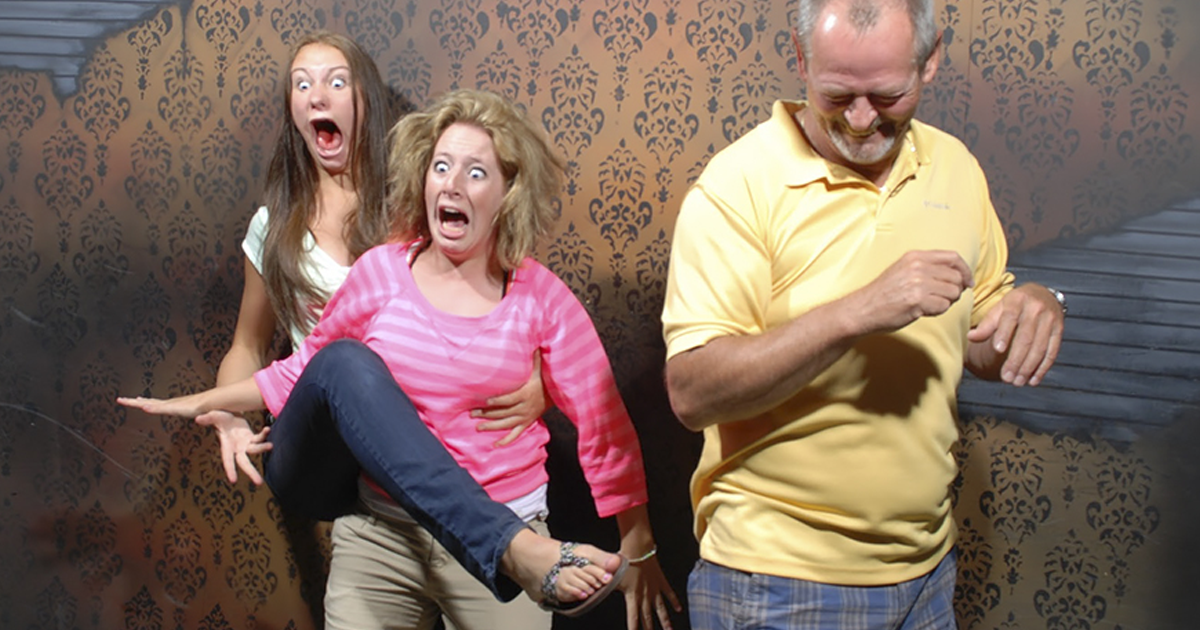
The viral appeal of haunted house secret cam photos is simple: they catch humans at the exact second their dignity leaves the building. These are not polished selfies. These are raw, wide-eyed, mid-scream portraits of people discovering that their fight-or-flight response has selected “grab nearest friend and use them as a shield.”
Collections like “100 hysterical moments when people got scared to death at a haunted house” became internet gold because they turn fear into comedy. In one image, a grown man may be clutching his girlfriend like she is a flotation device. In another, four friends merge into one terrified centipede. Someone is always pointing in the wrong direction. Someone else is laughing, screaming, and regretting every life choice since breakfast.
Why Haunted House Reaction Photos Are So Funny
Haunted house reaction photos work because fear is one of the few emotions that refuses to pose nicely. You can fake a smile for a camera. You can tilt your chin for a family portrait. But when a monster lunges out of the darkness and your nervous system launches into emergency mode, the face you make is not curated. It is prehistoric.
That is why these images feel so universally funny. They reveal the gap between who we think we are and who we become in a haunted maze. Outside the attraction, someone may be a calm accountant, a gym hero, or a person who says things like “I don’t really get scared.” Inside, they are a screaming noodle with shoes.
The Beauty of the Perfect Scare-Cam Moment
A great haunted house scare cam photo depends on timing. The camera must capture the moment after the brain understands danger but before logic returns with the reminder that the werewolf is named Trevor and works weekends. That half-second creates the magic: mouths open, shoulders up, hands flying, eyes enormous, and friendships tested in ways no group chat can repair.
Professional haunted attractions understand this rhythm. The best scares are not only loud noises. They are built from anticipation, darkness, misdirection, narrow spaces, sudden reveals, and group psychology. A scare actor does not simply jump out and yell “boo.” They wait. They listen. They let guests convince themselves everything is fine. Then they appear at exactly the wrong emotional moment.
The Real Attraction Behind Viral Haunted House Photos
One of the most famous examples of viral haunted house reaction photography comes from Nightmares Fear Factory in Niagara Falls, known for capturing visitors at the precise instant they lose their cool. The attraction helped turn hidden-camera fright photos into a recognizable internet genre: people clutching, ducking, screaming, and accidentally creating Renaissance paintings of panic.
Although the attraction is in Canada, the reaction-photo trend has traveled widely across American Halloween culture. U.S. haunted houses, theme parks, scream parks, and pop-up attractions have embraced the same idea: guests do not just want to be scared; they want proof. The photo becomes a trophy, a souvenir, and sometimes a roastable family heirloom.
In the United States, haunted attractions are a serious seasonal business. Industry groups estimate that there are well over a thousand professional paid haunted attractions, plus amusement parks, farms, charity haunts, corn mazes, and local Halloween events that open each fall. Some are simple community fundraisers. Others are huge theatrical productions with trained actors, animatronics, pyrotechnic-style effects, elaborate makeup, sound design, escape-room elements, and queue lines longer than your patience at a DMV.
Why We Love Being Scared When We Know We Are Safe
Fear is not always fun. Real danger is not entertainment. But controlled fear, the kind found in haunted houses, horror movies, roller coasters, and escape rooms, gives many people a thrill because the brain knows there is a safety net. Your body reacts as though something dangerous might be happening, but your rational mind understands that the exit sign is real and the chainsaw has no chain.
That controlled fear can trigger adrenaline and other feel-good chemical responses. Your heart races, your muscles tense, your attention narrows, and for a few seconds, you are completely in the moment. Bills, emails, errands, and that one weird noise your car started making all disappear. The only thing that matters is getting past the clown in the hallway without turning into soup.
Then comes the relief. After the scare, people laugh because the danger was fake. That laugh is the emotional reset button. It says, “I survived. I was ridiculous. Please delete the photo, but also send it to me immediately.”
The 100 Funniest Types of Haunted House Reactions
You do not need to see every single photo to recognize the classic categories. Across countless funny haunted house pictures, certain reaction types appear again and again. Humanity, it turns out, has a limited but magnificent menu of panic poses.
1. The Human Shield
This is the guest who arrives with friends and instantly reassigns one of them as protective equipment. The Human Shield grabs shoulders, jackets, hoodies, ponytails, or whatever fabric is available. In the photo, they are usually hiding behind someone half their size with the confidence of a medieval knight using a napkin as armor.
2. The Accidental Conga Line
Haunted houses turn friend groups into trains. One person screams, the person behind them grabs on, the next person grabs the grabber, and suddenly six adults are moving through the dark like a frightened caterpillar. The secret cam catches them mid-collapse, all leaning in different directions, none of them in charge.
3. The Brave Leader Who Is No Longer Brave
Every group has one. They volunteer to go first. They laugh too loudly in line. They say, “Stay behind me.” Then the scare happens, and the photo shows them trying to reverse through their friends like a shopping cart with anxiety.
4. The Frozen Statue
Some people run. Some people scream. The Frozen Statue simply stops functioning. Their eyes widen, their hands hover in the air, and their body appears to be buffering. If you listen closely, you can almost hear the dial-up internet sound of their survival instincts loading.
5. The Laugh-Screamer
This person is having the best and worst time simultaneously. Their mouth says terror, their eyes say joy, and their body says, “Why did I pay money to be emotionally power-washed?” Laugh-screamers are the heart of haunted house photography because they prove fear and fun can occupy the same facial expression.
6. The Betrayer
The Betrayer is the guest who shoves a loved one forward, not out of cruelty, but out of pure reptile-brain efficiency. Haunted house cameras love this person. One second they are a loyal friend. The next, they are offering their cousin to a basement goblin in exchange for safe passage.
7. The Dramatic Jumper
Some guests do not flinch; they levitate. In the best photos, both feet leave the floor. Arms fly upward. Knees bend. The person appears to be auditioning for a haunted-house ballet called “The Nutcracker, But Everyone Is a Zombie.”
How Haunted Houses Create the Perfect Reaction
Behind every hilarious photo is careful design. The best haunted houses are not random collections of fake blood and rubber bats. They are built like live theater. Designers plan the path, lighting, sound, actor positions, emergency exits, and visual rhythm. The goal is to control attention. When guests look right, the scare comes from the left. When they expect noise, silence becomes suspicious. When they relax, the wall suddenly has opinions.
Modern haunts often blend old-school performance with new technology. Animatronics, projection effects, scent machines, moving floors, claustrophobic tunnels, air blasts, and synchronized lighting all help create sensory overload. But the most powerful tool is still the human scare actor. A good actor can read a group in seconds: who is nervous, who is pretending not to be, who will scream, and who will sacrifice a sibling.
Scare Actors Are Performers, Not Random Goblins
At many professional attractions, scare actors receive training in movement, timing, vocal control, character work, and guest boundaries. Some learn how to drag a foot like a zombie, hiss without destroying their throat, pop out safely, retreat smoothly, and reset before the next group arrives. It is part theater, part athletics, part customer service, and part “how to be a swamp creature for six hours without needing a chiropractor.”
This training matters because guests want intensity without real danger. A scary attraction should feel chaotic while being controlled behind the scenes. That is the difference between a memorable Halloween night and a lawsuit wearing vampire teeth.
Safety: The Serious Side of Scaring People Silly
Although haunted house photos make fear look wild, professional attractions operate under real safety expectations. Fire codes, emergency exits, lighting, crowd control, staff training, and inspections are essential. Many indoor haunts use flame-retardant materials, sprinkler systems, smoke detection, emergency lighting, panic hardware, and clear evacuation routes. The monsters may look unlicensed, but the building should not be.
Safety also includes emotional and physical boundaries. Guests should understand the rules before entering. Some attractions are “no touch,” while others offer more intense experiences with waivers and age restrictions. The best operators are clear about what visitors can expect and how to exit if the experience becomes too much.
For guests, the basic rule is simple: know your limits. If you have a medical condition, are pregnant, have severe anxiety, or simply hate being startled, check the attraction’s warnings before entering. There is no shame in skipping the chainsaw corridor. Courage is wonderful, but so is not turning Halloween into a personal wellness incident.
Why Secret Cam Photos Go Viral
Haunted house reaction photos are perfect for the internet because they tell a complete story instantly. You do not need context. You see the faces and understand everything. Someone has seen something awful, fake, and probably wearing latex. The photo captures fear, friendship, chaos, and comedy in one frame.
They are also wonderfully democratic. Everyone looks ridiculous when startled. Celebrities, athletes, parents, teenagers, tough guys, quiet people, loud people, and that friend who “doesn’t scare easily” all become equal in the eyes of the scare cam. The haunted house is the great emotional equalizer. It does not care about your job title. It cares whether you make a face like a startled raccoon in a thunderstorm.
The shareability also comes from recognition. People tag friends because they know exactly who would react that way. “This is us.” “You would be the one hiding.” “That’s definitely Brian using me as a shield.” The photo becomes a social mirror, except the mirror has fog, screaming, and one suspicious hallway.
What These Photos Reveal About Friendship
Few things reveal group dynamics faster than a haunted house. The secret cam shows who leads, who follows, who laughs, who panics, and who immediately breaks the social contract. Couples discover whether romance survives a jump scare. Friend groups discover who can be trusted in a zombie outbreak. Families discover that Dad’s “military-level courage” is vulnerable to a teenager in clown makeup.
And yet, the fear usually brings people closer. After the scream comes laughter. After the maze comes storytelling. The group replays the best moments: who ducked, who yelled, who ran into a wall, who tried to negotiate with a skeleton. These shared memories are why haunted attractions remain popular. People are not only buying a scare. They are buying a story they can tell for years.
How to Survive a Haunted House Without Becoming the Meme
If you are planning to visit a haunted house and would prefer not to become the next viral face of panic, there are a few strategies. First, do not announce that you are impossible to scare. That sentence is basically a dinner bell for every actor in the building. Second, keep moving. Haunted houses are designed to build fear when you hesitate. Third, remember that the monsters are performers. They want a reaction, not your wallet, your soul, or your left sneaker.
Go with people who enjoy the same level of intensity. A haunted house is less fun when one person wants a playful spooky walk and another wants the emotional equivalent of being chased through a thunderstorm by a dishwasher full of bees. Check the attraction rating, read warnings, and choose accordingly.
Most importantly, embrace the ridiculousness. If a camera catches you screaming like a teakettle, congratulations. You participated correctly. Haunted houses are not about looking cool. They are about letting go, laughing hard, and discovering that your survival instinct has jazz hands.
Extra Experiences: What It Feels Like to Be Inside the Scare-Cam Moment
The funniest haunted house moments usually begin before anyone enters the attraction. The group is still in the parking lot, sipping pumpkin-spice confidence and pretending the screams from inside are “probably speakers.” Someone checks the rules. Someone says, “They can’t touch us, right?” Someone else laughs too loudly, which is the official mating call of a person who will be terrified in under five minutes.
Then the line moves. The building gets closer. The music grows louder. Fog spills from the entrance like the haunted house is exhaling. By the time the staff member gives the final instructions, everyone is suddenly very interested in safety procedures. The bravest person nods seriously, as if preparing for a moon landing. The nervous person asks whether there are emergency exits. The funny friend makes one last joke, unaware that soon they will produce a sound only dolphins can fully appreciate.
Inside, the first room is usually deceptive. Nothing much happens. Maybe there is a flickering lamp, an old portrait, a dusty piano, or a hallway that looks like it was decorated by a ghost with a home-improvement budget. This is where the group relaxes. Terrible decision. Haunted houses love confidence the way cats love knocking cups off tables.
Then comes the first scare. Not the biggest scare, just the warning shot. A door slams. A figure moves. A voice whispers from somewhere it should not be. The group compresses instantly. People who entered with personal space now become one bundled organism. Someone steps on someone’s shoe. Someone says, “I’m done,” despite being twelve feet from the entrance.
The secret camera is usually waiting later, at the premium panic point. By then, the group has been softened up. They have survived the room with the hanging bodies, the hallway with the buzzing light, the actor who crawled too fast, and the suspicious silence that made everyone whisper. Their nerves are fully marinated. One more scare and they are ready to become internet art.
That is when the real moment hits. Maybe a monster lunges from behind a curtain. Maybe an air cannon blasts. Maybe a giant prop moves where a wall was supposed to be. Whatever it is, the body reacts before the brain can file a complaint. Arms fly. Knees buckle. Eyes widen. The camera flashes. For one magnificent instant, everyone is completely honest.
The best part happens after the exit. The group stumbles into normal lighting, laughing with the exhausted relief of people who just survived a fake disaster. They accuse each other immediately. “You pushed me!” “You screamed first!” “You tried to hide behind a child!” Then they see the photo. There it is: proof. Nobody remembers standing that way. Nobody remembers making that face. Nobody remembers grabbing Kevin by the hoodie and using him as a medieval shield. But the camera remembers. The camera always remembers.
That is why haunted house secret cam photos are more than cheap laughs. They capture a tiny human truth: we are all braver in theory than in a hallway full of fog. And that is perfectly fine. The goal is not to stay cool. The goal is to scream, laugh, survive, and leave with a picture so funny it deserves its own frame, preferably in the living room where future guests can ask, “Why does Uncle Mike look like he saw the electric bill come alive?”
Conclusion
The enduring charm of 100 hysterical moments when people got scared to death at a haunted house, caught by a secret cam is not just the screaming. It is the honesty. Haunted house reaction photos catch people in a rare unfiltered state: startled, silly, bonded, and beautifully uncool. They remind us that fear can be fun when it is safe, shared, and followed by laughter.
Whether you love haunted houses or prefer to admire them from a couch with snacks and full lighting, the scare-cam phenomenon has earned its place in Halloween culture. It turns panic into comedy, friends into shields, and ordinary guests into legends of facial expression. The monsters may be fake, but the laughter is very real.