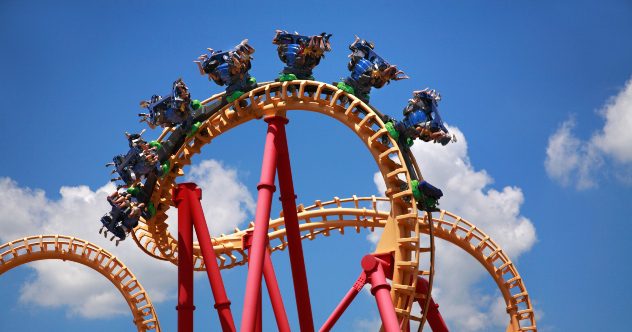
Some roller coasters are built to entertain you. Others appear to have been designed by engineers who looked at gravity, laughed loudly, and asked, “How can we make this feel even less reasonable?”
America’s most extreme roller coasters now combine skyscraping heights, violent acceleration, beyond-vertical drops, rotating seats, prolonged airtime, inversions, and track elements that seem to pause solely so riders can reconsider every decision that brought them there.
This ranking considers more than maximum speed. Height, exposure, launch intensity, drop angle, unusual seating, sustained forces, inversions, and psychological suspense all contribute to how frightening a coaster feels. The result is a collection of rides capable of making even experienced adrenaline junkies tighten their restraints one more timejust in case.
What Makes a Roller Coaster Truly Scary?
The tallest roller coaster is not automatically the scariest. Fear is personal, wonderfully irrational, and occasionally triggered by something as simple as a slow-moving lift hill.
A 400-foot launch may terrify riders who dislike heights, while a lower coaster with spinning seats can destroy the confidence of anyone who needs to know which direction is “up.” Beyond-vertical drops create the sensation of being pulled out of the train, powerful launches remove the comfort of gradual acceleration, and exposed seating makes every turn feel more dramatic.
The following thrill rides use different methods, but they share one important quality: each one is exceptionally good at making grown adults scream complete sentences without using actual words.
10. Skyrush Hersheypark, Pennsylvania
Why It Is Scary: Relentless Airtime in Exposed Wing Seats
Skyrush begins with a rapid cable lift that carries riders 200 feet above Hersheypark. That ascent is followed by a high-speed descent reaching approximately 75 mph, but the first drop is only the beginning of the argument between your body and the laws of motion.
The train’s unusual configuration places some riders in winged seats extending beyond the track. Without track directly beneath them, those outside seats feel especially exposed during the coaster’s high-speed turns and five zero-gravity airtime hills.
Skyrush is not particularly long, which is probably merciful. It delivers its strongest elements quickly, producing abrupt changes in direction and repeated bursts of negative g-forces. Riders who enjoy the feeling of being enthusiastically removed from their seats will consider it brilliant. Everyone else may wonder why chocolate-themed vacations became so aggressive.
Skyrush specifications verified through Hersheypark’s official attraction page.
9. El Toro Six Flags Great Adventure, New Jersey
Why It Is Scary: Wooden-Coaster Character at 70 mph
El Toro looks like a traditional wooden roller coaster, but it behaves like a furious bull that has recently discovered espresso. Its nearly 19-story climb leads to a 176-foot drop at a 76-degree angle, sending riders through the course at speeds reaching 70 mph.
The ride is famous for its forceful airtime. Nine zero-gravity opportunities repeatedly lift riders toward their restraints as the train charges over hills and through aggressive directional changes. El Toro’s wooden structure also amplifies the sense of speed: supports flash past on both sides, producing an enclosed, out-of-control sensation that open steel coasters cannot always duplicate.
Its fear factor comes from the contrast between old-school appearance and modern intensity. You expect nostalgic clattering. You receive a high-speed attempted ejection with excellent carpentry.
El Toro specifications and current attraction details verified through Six Flags Great Adventure.
8. Cannibal Lagoon, Utah
Why It Is Scary: A 116-Degree Underground Plunge
Cannibal’s name is not exactly comforting, and neither is its signature drop. An enclosed vertical lift carries riders 208 feet into a tower, limiting outside views and allowing the suspense to simmer. The train then creeps toward the edge before plunging down a 116-degree beyond-vertical drop into an underground tunnel.
Because the descent curves inward beneath the track, riders cannot easily see where they are going. The first row appears to disappear into the ground, while passengers farther back have additional time to watch the situation become increasingly unacceptable.
Cannibal also includes inversions, a 140-foot-tall loop, tightly engineered maneuvers, and a water feature. However, that first drop remains the headline act. It creates the visual impression that the track has folded underneath itself, which is not something your survival instincts generally applaud.
Cannibal’s height, beyond-vertical drop and major elements verified through Lagoon’s official attraction page.
7. Siren’s Curse Cedar Point, Ohio
Why It Is Scary: The Track Tilts Straight Down
Siren’s Curse proves that a coaster does not need 100-mph speeds to cause a full-scale emotional evacuation. The train climbs a 160-foot tower and stops on what appears to be a disconnected section of track. That section then tilts until riders are facing downward at a 90-degree angle.
The pause is the cruelly effective part. Riders have enough time to stare at the track below, notice how far away the ground is, and remember several urgent appointments they would prefer to attend instead.
Once the track locks into position, the train drops and accelerates through 2,966 feet of track at up to 58 mph. The layout includes 13 airtime moments, two zero-gravity barrel rolls, and a triple-down element. Siren’s Curse is less about overwhelming speed than psychological suspenseand it uses that suspense with the subtlety of a horror-movie villain holding a wrench.
Current Siren’s Curse specifications verified through Cedar Point’s official ride page.
6. Steel Vengeance Cedar Point, Ohio
Why It Is Scary: Nearly 30 Seconds of Airtime
Steel Vengeance combines a wooden support structure with steel track to create a massive hyper-hybrid coaster. It rises 205 feet, drops 200 feet at 90 degrees, reaches 74 mph, and travels across 5,740 feet of track.
The statistics are impressive, but its persistence is what makes the ride intimidating. Steel Vengeance delivers almost 30 seconds of airtime, four inversions, abrupt transitions, and numerous moments when the train dives through or around its own structure. The supports create a visual maze, making the coaster appear faster and the near-misses feel tighter.
Some extreme rides build toward one enormous moment. Steel Vengeance simply keeps attacking. Every time the layout appears ready to relax, another hill, inversion, or sharp turn arrives to restart the screaming. By the final brake run, your legs may be walking normally, but your dignity will require additional processing time.
Steel Vengeance statistics verified through Cedar Point’s official attraction page.
5. Jurassic World VelociCoaster Universal Islands of Adventure, Florida
Why It Is Scary: Two Launches and a Lagoon-Skimming Barrel Roll
VelociCoaster demonstrates what happens when world-class roller coaster engineering receives blockbuster-level theming and a pack of hungry dinosaurs. The coaster sends riders across 4,700 feet of track through two launches, four inversions, close encounters with rockwork, and multiple low-to-the-ground maneuvers.
The faster launch accelerates the train to 70 mph in approximately 2.4 seconds. It then climbs a 155-foot top hat before diving down an 80-degree drop. Later, riders experience the famous heartline roll above the lagoon, which turns the train upside down only a short distance above the water.
The restraint system contributes significantly to the fear. Riders are secured by lap bars rather than bulky over-the-shoulder restraints, creating unusual freedom through the inversions. The system is designed for the ride, but your instincts may still submit several formal complaints.
VelociCoaster height, speed, track length and major elements verified through official Universal sources.
4. Iron Gwazi Busch Gardens Tampa Bay, Florida
Why It Is Scary: A 91-Degree Drop and Savage Pacing
Iron Gwazi climbs to a 206-foot peak before sending riders over a 91-degree drop at speeds reaching 76 mph. As one of the most extreme hybrid roller coasters in the country, it combines enormous scale with the rapid transitions associated with Rocky Mountain Construction designs.
The ride includes three inversions and approximately a dozen airtime moments. Its layout rarely pauses, moving directly from the first drop into overbanked turns, rolls, direction changes, and ejector-style airtime hills.
Iron Gwazi’s intensity is particularly effective because it feels controlled but barely civilized. The train follows the track smoothly, yet the sequence of elements suggests that the coaster is trying to shake loose anything you failed to place in a lockerincluding, perhaps, your last sensible thought.
Iron Gwazi specifications verified through Busch Gardens Tampa Bay’s official attraction page.
3. Fury 325 Carowinds, North Carolina
Why It Is Scary: Gigantic Height With Sustained Speed
Fury 325 is a giga coaster, meaning it exceeds 300 feet in height without crossing into the 400-foot strata category. Its lift hill reaches 325 feet, providing a long, exposed climb before the train drops at an 81-degree angle and accelerates to as much as 95 mph.
The height is intimidating, but Fury 325’s sustained speed makes it exceptional. The track includes sweeping turns, elevated curves, low passes, and airtime hills that preserve momentum across the layout. Instead of relying on several slow setup moments, the coaster moves with the confidence of something that knows brakes are waiting eventually and sees no reason to rush toward them.
Front-row riders face the wind and uninterrupted views. Back-row riders are pulled over the first drop with additional force. There is no truly peaceful seating choiceonly different flavors of spectacular panic.
Fury 325 height, speed and first-drop angle verified through Carowinds’ official attraction page.
2. X2 Six Flags Magic Mountain, California
Why It Is Scary: Independently Rotating Seats
X2 is difficult to describe because ordinary roller coaster vocabulary assumes the seats remain in a predictable orientation. On this fifth-dimension coaster, the seats extend beyond the sides of the track and rotate 360 degrees independently as the train moves through the course.
The ride reaches a height of approximately 200 feet and a maximum speed of 76 mph. Those numbers are formidable, but they do not explain the experience of dropping face-first while the track travels in one direction and your seat rotates in another.
X2 also includes two rare raven turns, head-first dives, flips, and sensory effects. Riders frequently cannot identify the next movement because the seating system disrupts their sense of direction. Traditional coasters let you see the track and prepare. X2 takes that privilege, rotates it backward, and launches it into another dimension.
X2 speed, height, rotating seats and ride elements verified through Six Flags Magic Mountain’s official page.
1. Top Thrill 2 Cedar Point, Ohio
Why It Is Scary: Three Launches Between Two 420-Foot Towers
Top Thrill 2 earns the top position by combining extreme height, extreme speed, backward movement, and repeated anticipation. The coaster uses three launches to send riders between two enormous 420-foot towers.
The first forward launch begins the sequence but does not complete the climb. The train rolls backward, accelerates in reverse, and races high up a vertical spike. Riders then fall forward before the final launch pushes the train toward 120 mph and over the original 420-foot top hat.
The terror is not confined to one drop. Passengers experience acceleration, rollback, backward climbing, vertical free fall, another launch, and a final skyscraping ascent. The open-air trains intensify the exposure, particularly near the tops of the towers where Lake Erie and Cedar Point spread out below.
Top Thrill 2 is brief, enormous, and unmistakably dramatic. It does not gradually negotiate with your courage. It collects all available courage at the station and converts it directly into screaming.
Top Thrill 2’s current operation and triple-launch configuration verified through Cedar Point’s official attraction and 2026 park pages.
How to Prepare for America’s Scariest Roller Coasters
Preparation cannot make a 420-foot tower shorter, but it can make your coaster day safer and considerably more enjoyable.
Check Rider Restrictions Before Traveling
Review the park’s official attraction page for height requirements, medical warnings, accessibility information, loose-article policies, and temporary closures. Ride availability can change because of weather, inspections, maintenance, or operational conditions.
Eat Lightly and Stay Hydrated
A moderate meal is generally friendlier than boarding immediately after a heroic buffet performance. Drink water throughout the day, especially during hot weather, but avoid consuming an enormous amount immediately before a high-intensity ride.
Build Your Confidence Gradually
First-time thrill seekers may prefer to begin with a smaller coaster before moving to launches, giga coasters, rotating seats, or beyond-vertical drops. Gradual exposure helps you understand how your body responds to airtime, inversions, acceleration, and high positive forces.
Respect Medical Warnings
People with cardiovascular disease, certain neurological or musculoskeletal conditions, recent surgery, pregnancy, or other relevant health concerns should follow posted restrictions and seek professional medical guidance when appropriate. A healthy heart may tolerate recreational thrills, but pre-existing cardiovascular conditions can make sudden stress less advisable.
General cardiovascular caution supported by American Heart Association reporting and expert commentary.
What Riding the Scariest Roller Coasters Really Feels Like
The experience begins long before the train leaves the station. You first see the coaster from the parking lot, where it appears large but theoretically manageable. As you walk closer, the lift hill continues growing. Eventually, you realize those tiny moving objects near the top are not decorative lights. They are people who made the same questionable decision you are about to make.
The queue creates its own psychological adventure. Every scream from the track above sounds suspiciously urgent. Signs display medical warnings in serious typefaces. Riders returning to the station laugh with the exhausted expressions of people who have just escaped a highly organized weather event.
Then comes the restraint check. A ride operator presses the lap bar into position, gives it a professional tug, and moves to the next seat. That tiny tug somehow feels like the final signature on a legally binding contract between you and gravity.
Launch coasters produce one of the strangest sensations. There is often a short pause, followed by acceleration so immediate that your body remains mentally at the station while the train is already halfway down the track. Your cheeks move backward, your stomach submits a relocation request, and any clever sentence you planned to shout becomes a noise generally associated with malfunctioning furniture.
Traditional lift hills create fear differently. The slow clicking provides timefar too much timeto examine the ground becoming smaller. Near the top, the horizon replaces the park beneath you. The train then rounds the crest, the front rows begin dropping, and riders in the back remain suspended for a moment before being pulled over with surprising force.
Airtime is another sensation that videos cannot fully communicate. Mild floating airtime feels playful, almost peaceful. Strong ejector airtime feels as though the coaster is attempting to send you home without using the exit. You know the restraint is holding you securely, yet your instincts remain deeply impressed by the train’s enthusiasm.
Rotating coasters such as X2 remove even the comfort of visual prediction. On an ordinary ride, you can brace for a hill or inversion by watching the track. When the seat rotates separately, the track becomes only a suggestion. You may approach a drop facing backward, turn toward the ground, and complete the maneuver wondering which continent is currently above you.
The most surprising moment often occurs after the final brake run. The train slows, everyone looks at one another, and nervous silence becomes laughter. Riders who were bargaining with the universe 30 seconds earlier immediately discuss riding again. Fear turns into relief, relief becomes excitement, and excitement begins editing the memory until the terrifying drop sounds like an excellent idea.
Night rides add another layer. Darkness hides the lower sections of track, removes visual reference points, and makes speed feel greater. Hills appear suddenly, turns become harder to anticipate, and illuminated park structures flash past like scenery from an action movie. A familiar coaster can feel dramatically different after sunset.
Front, middle, and back rows also produce distinct experiences. The front offers unobstructed views and maximum exposure. The back often delivers stronger pulling sensations over major drops. Middle rows can provide a more balanced ride, making them a sensible starting point for visitors who want intensity without immediately selecting the coaster equivalent of hard mode.
Ultimately, the appeal is not simply fear. Extreme roller coasters offer a controlled encounter with uncertainty. Riders experience dramatic forces and apparent danger while sophisticated systems, trained operators, inspections, restraints, and engineered track guide the train through a carefully calculated course. For a few minutes, daily worries disappear because your brain has identified a much simpler priority: surviving the next hill with at least a small amount of composure.
Final Thoughts
The scariest roller coasters use different tools to challenge their riders. Top Thrill 2 relies on enormous towers and repeated launches. X2 destroys spatial awareness with rotating seats. Fury 325 uses height and sustained speed, while Cannibal and Siren’s Curse make anticipation nearly as frightening as the drops themselves.
For true adrenaline junkies, conquering these rides is about more than collecting coaster credits. It is about facing the moment when the train reaches the edge, every survival instinct objects, and curiosity wins anyway.
Just remember to secure your belongings, follow every rider restriction, and smile for the on-ride camera. Panic is temporary. An unflattering ride photo can remain available for purchase all afternoon.