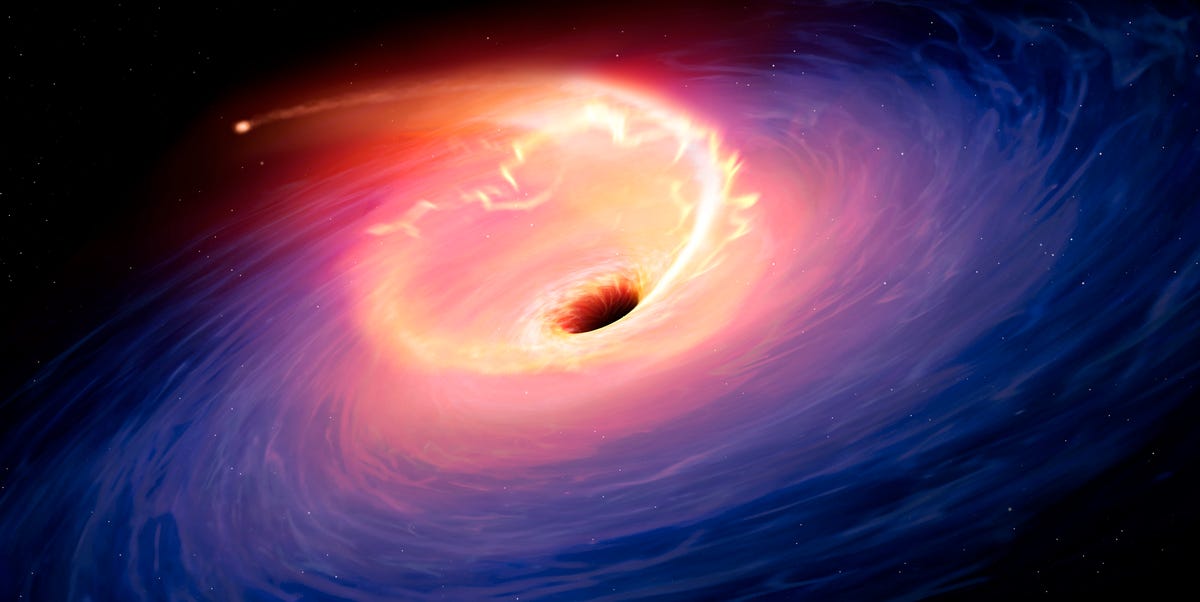
If you’ve ever gone back to the fridge at 2 a.m. to sneak “just one more bite,” congratulations: you now have something in common with a supermassive black hole.
Several years ago, astronomers watched a black hole tear apart an unlucky star in a dramatic tidal disruption event (TDE). Everyone expected the flare to fade and the show to end. Instead, years later, the same region of space lit up again, as if the black hole suddenly decided to belch out the leftovers of its long-digested, spaghettified meal.
This bizarre encore has become one of the strangest black hole feeding stories on record. In this guide, we’ll unpack what “spaghettification” really means, how black holes can “burp” years after a stellar snack, and why this weird behavior is forcing astronomers to rethink how these cosmic heavyweights eat.
What Does It Mean to ‘Spaghettify’ a Star?
“Spaghettification” sounds like a made-up word someone blurted out in a sci-fi writer’s room, but it’s a genuine physics term. It describes what happens when an object gets so close to a black hole that the difference in gravity between its near side and far side becomes extreme.
The side of the star closer to the black hole feels a much stronger pull than the far side. This difference stretches the star along the direction toward the black hole while squeezing it sideways, turning it into a long, thin strand of gas and plasma. Imagine pulling pizza dough so hard it becomes a noodle only this noodle glows incredibly bright in X-rays and ultraviolet light.
In a typical tidal disruption event:
- A star wanders too close to a supermassive black hole at the center of a galaxy.
- Intense tidal forces rip the star apart, spaghettifying it into a stream of stellar debris.
- About half of that debris escapes into space; the other half falls back and forms a hot accretion disk around the black hole.
- The disk heats up, releasing a brilliant flare of light that can outshine the entire host galaxy for weeks or months.
- Then the flare fades, the leftovers settle down, and the black hole goes back to minding its own business. Usually.
In our black hole’s case, the “usually” part went straight out the cosmic window. Years after the first flare, the system roared back to life.
Meet the Messy Eater: A Black Hole with a Delayed Burp
The story behind the headline “This Black Hole Still Wasn’t Done With Its Spaghettified Meal” centers on a tidal disruption event known as AT2018hyz. Astronomers first saw it flare in 2018, when a relatively small star (about a tenth the mass of our Sun) strayed too close to a black hole in a galaxy hundreds of millions of light-years away.
At first, AT2018hyz looked like a fairly standard TDE. The light brightened, then faded as expected. Radio telescopes checked in and, finding nothing unusual, moved on. Case closed… or so everyone thought.
Fast forward about three years. In 2021, radio telescopes picked up a sudden, powerful gush of radio emission from the exact same location. It was as if the black hole had decided to cough up the leftovers of its meal long after the plates were cleared and the lights had been turned off.
Even stranger, the material being ejected appeared to be blasting out at up to half the speed of light far faster than what’s seen in most tidal disruption events. Instead of a polite post-dinner digest, this looked like a violent, late-breaking eruption.
Why This Event Shocked Astronomers
A delayed “burp” years after a tidal disruption event isn’t supposed to happen, at least not according to the standard playbook. Typically:
- The main flare happens within weeks or months of the star being shredded.
- The radio emission (from jets and outflows) shows up early and gradually fades.
- The black hole doesn’t suddenly switch back on years later unless something new falls in.
But in this case, there was no sign of a new star or gas cloud wandering into the danger zone. All the evidence points to the same original star the one that got spaghettified years before as the source of the newly ejected material.
In other words, this black hole wasn’t done with its spaghettified meal. It just took its time finishing the last bites.
How Can a Black Hole ‘Burp’ After the Meal Is Over?
So what’s going on here? Astronomers are still investigating, but several ideas are on the table. Think of them as different “leftover management strategies” for a supermassive black hole.
1. A Delayed Jet Launch
One possibility is that the black hole didn’t launch a powerful jet of material immediately after the star was disrupted. Instead, it might have taken years for the accretion disk and magnetic fields to line up just right so a jet could ignite.
In this scenario, the black hole acts like a picky eater: it swirls the food around its mouth (well, its accretion disk) for a while and then suddenly spits out a high-speed stream of gas long after dessert.
2. Hidden Accretion, Delayed Explosion
Another idea is that the black hole continued to quietly accrete the star’s debris, but something obscured our view of the early radio emission perhaps thick clouds of gas or dust near the galactic center. Only when the outflow expanded and broke through this fog did the radio signal become visible to our telescopes.
From our perspective, it looked like a late surprise. In reality, the black hole might have been actively “chewing” the whole time.
3. Partial Disruption and Recycling
Some tidal disruption events might be “partial,” meaning the black hole only strips off part of the star on the first pass. The surviving core could swing around again on a longer orbit and lose more material on subsequent close approaches. That creates multiple flares and outbursts from the same unfortunate star over several years.
In that case, the black hole isn’t just eating leftovers it’s working through a multi-course tasting menu based on the same star.
A Quick Black Hole & Tidal Disruption Crash Course
If your head is spinning faster than a relativistic jet, here’s a simplified look at the key concepts behind tidal disruption events and spaghettified stars.
Supermassive Black Holes: The Hungry Giants
At the centers of most galaxies lurk supermassive black holes, weighing millions or even billions of times the mass of the Sun. Normally, they’re quiet, especially if there isn’t much gas or dust nearby to feed them. But when a star blunders into their gravitational neighborhood, things get dramatic fast.
Tidal Disruption Events: When Stars Get Too Close
A tidal disruption event happens when a star passes within the black hole’s tidal radius the distance at which tidal forces overwhelm the star’s self-gravity. The result is a spectacular flare of light as the star is shredded and its remains either escape or spiral inward.
In a typical galaxy, this might happen only once every ten thousand years or so. But because we’re watching many galaxies at once, modern sky surveys catch several of these events each year across the universe.
Why Spaghettification Matters
Spaghettification isn’t just a fun visual. The way a star is stretched, shredded, and accreted tells astronomers about the black hole’s mass, spin, and surrounding environment. It’s like a cosmic stress test that reveals how matter behaves in one of the most extreme environments known to physics.
How Astronomers Track a Black Hole’s Cosmic Leftovers
To understand a black hole that keeps snacking on a spaghettified star, astronomers need to track the action across the entire electromagnetic spectrum.
- Optical telescopes spot the original bright flare when the star is torn apart.
- Ultraviolet and X-ray telescopes watch the hottest, most energetic regions near the black hole.
- Radio observatories pick up jets and slower-moving outflows that plow into surrounding gas.
- Infrared telescopes glimpse dust heated by the flare and ejected debris.
In the case of our “not-done-eating” black hole, radio observatories were the heroes of the story. Years after the initial disruption, they detected a powerful new outburst, prompting a flurry of follow-up observations from facilities around the world and in space.
By comparing these data, astronomers can reconstruct a timeline: when the star was disrupted, how the debris moved, when the outflow turned on, and how fast it was screaming through space. It’s a crime-scene investigation, but the “victim” is a star and the suspect is gravity itself.
Why This Weird Black Hole Matters
It’s easy to think of this as just a fun cosmic oddity a black hole that burps late, like the universe’s most dramatic dinner guest. But astronomers care about events like this because they reveal how black holes grow and how they affect their host galaxies.
1. Rethinking Black Hole Feeding Habits
Delayed outbursts suggest that black hole feeding may be more complicated than a simple “eat once, flare once” model. Instead, the accretion process might involve long-term storage of stellar debris, complex magnetic field rearrangements, or multiple episodes of jet launching.
That means our models of how black holes gain mass and how quickly may need updating, especially if these weird, drawn-out meals turn out to be common rather than rare.
2. Feedback into the Galaxy
Powerful outflows from tidal disruption events can slam into surrounding gas, heating it and blowing some of it out of the galactic center. Over millions of years, that kind of feedback helps regulate star formation, controls how much gas remains near the black hole, and shapes the evolution of the galaxy itself.
A delayed blast, years after the initial flare, acts like an extra kick a second shockwave that can further stir and heat the region near the black hole.
3. A Natural Physics Laboratory
These events push matter, radiation, and gravity to extremes that can’t be recreated on Earth. By watching how spaghettified stars fall apart and how black holes respond over time, physicists can test ideas about relativity, magnetohydrodynamics, and high-energy particle acceleration.
In other words, every “weird” event like this is a free experiment the universe runs for us. All we have to do is build the telescopes, gather the data, and figure out what it all means.
Common Questions About Spaghettified Stars and Black Hole Burps
Does the star ever survive?
Sometimes! In partial tidal disruptions, the black hole strips only part of the star on the first pass. The surviving core can slingshot away, orbit the black hole, and come back for another gravitational beating on a later pass. That can produce multiple flares from the same object.
Could this happen to our Sun?
No need to panic. The supermassive black hole at the center of the Milky Way is far, far away from the Sun, and our orbit is stable. Tidal disruption events happen to stars that stray very close to the black hole we’re nowhere near that danger zone.
Would we see a delayed ‘burp’ if it happened in our own galaxy?
If a star were disrupted by our central black hole and produced a delayed jet or outflow, it would likely be extremely bright in radio and X-ray wavelengths. Our telescopes would have a front-row seat to the action, and you’d see a whole lot of excited press releases about it.
Could this explain mysterious repeating flares we’ve seen in other galaxies?
Possibly. A growing number of oddball flares especially events that seem to brighten more than once might be linked to partial disruptions, delayed jets, or long-lived leftovers of earlier stellar meals. The “still-eating” black hole is a key clue that such behaviors really happen in nature, not just in simulations.
Imagining the Experience: Living in a Galaxy with a Still-Eating Black Hole
All this talk about spaghettified stars and late-time burps might feel abstract, like distant math scribbled on a chalkboard. So let’s zoom in and imagine what it would be like if you lived in that host galaxy one whose central black hole still wasn’t done with its meal.
First, the good news: you wouldn’t notice anything in your day-to-day life. Even if the black hole sits at the center of your galaxy, you’re likely tens of thousands of light-years away, orbiting quietly in some spiral arm, arguing about rent and coffee prices just like we do here.
But if your civilization had developed advanced telescopes, your astronomers would be obsessed.
They would remember the original flare years earlier the moment when the galaxy’s core suddenly brightened in X-rays and ultraviolet light. Some of them might have built careers studying that event, teasing out every last photon to understand how the star was shredded. When the flare faded, they would have written their papers, closed their observing campaigns, and moved on to other mysteries.
Then, one night, a radio observatory on a remote plateau would pick up something unexpected: fresh, powerful emission coming from the exact same region near the galactic center. Alarm bells would go off in every control room and Slack channel. “Did something else just fall in?” “Is this a glitch?” “Please tell me we didn’t point at the wrong patch of sky.”
Over the next few days, telescopes across your world would swing back toward the center of the galaxy. X-ray observatories would check in. Optical surveys would compare new images to old ones. Gradually, the story would emerge: no new star, no new intruder. Just the black hole, suddenly pumping out energy again, as if waking up from a long nap with a serious case of indigestion.
In research seminars, theorists would pack rooms to argue about new models. Maybe the jet was delayed. Maybe magnetic fields had been slowly winding up like a spring. Maybe the leftover debris had been quietly swirling, hidden from view, until it finally erupted into a high-speed outflow. Plots of radio brightness versus time would be projected, reprojected, color-coded, and over-analyzed. Graduate students would sigh and reopen their simulation code.
Meanwhile, public interest would spike again. News articles would run with dramatic illustrations of a black hole spitting out glowing streams of gas. Headline writers would lean hard into “cosmic burp” jokes. Kids’ science shows would demonstrate tidal forces using rubber bands and marshmallows. Somewhere, a metal band would name its new album “Spaghettified.”
For you the everyday resident of this galaxy the experience would be mostly emotional rather than physical. On a clear night, you might look up at the hazy glow of your galaxy’s central bulge and think about the invisible monster lurking there, still processing a meal it began years ago. You might feel something halfway between awe and gratitude: awe at the sheer violence and scale of it all, and gratitude that your own star chose a nice, safe orbit far from the action.
Oddly, that’s not so different from our own situation here in the Milky Way. We, too, live with a supermassive black hole in our galactic core. We, too, build telescopes, chase strange flares, and puzzle over delayed outbursts. And when we read headlines about black holes that aren’t done with their spaghettified meals, what we’re really seeing is the universe handing us a new chapter in the story of how gravity, matter, and time dance together on the grandest possible stage.
Conclusion: The Universe’s Messy Eater
The black hole behind the “still wasn’t done with its spaghettified meal” headline is more than just a quirky news story. It’s a sign that black hole feeding is messier, longer-lasting, and more surprising than we once believed.
By watching how a star is torn apart, how its debris falls back in, and how the black hole can light up again years later, astronomers are updating our understanding of some of the most extreme environments in the cosmos. And while we may never see these events with our own eyes, the data they send across millions of light-years give us a front-row seat to the universe’s most dramatic dinner theater.