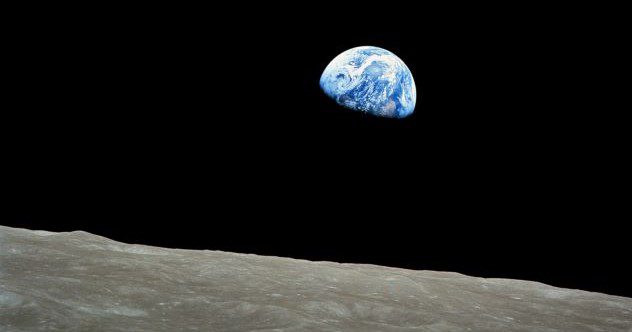
Space exploration is often presented as a clean sequence of countdowns, checklists, and heroic speeches. The reality was much stranger. Apollo astronauts heard ghostly whistles behind the Moon, watched warning codes flash during a landing, smelled something resembling burnt gunpowder, and saw lights with their eyes tightly closed.
None of these events proves that aliens were hiding behind a crater with a welcome banner. Most have reasonable scientific or engineering explanations. Yet each story captures something essential about lunar and planetary missions: explorers regularly encounter phenomena that cannot be understood immediately. Sometimes the mystery is solved by radio engineering. Sometimes it takes laboratory analysis. Occasionally, the question remains open decades later.
Here are 10 puzzling astronaut tales in which the truth is more fascinating than the conspiracy theoryand occasionally almost as weird.
1. Apollo 10 Heard “Music” Behind the Moon
A private concert with no musicians
In May 1969, Apollo 10 performed a full rehearsal for the first Moon landing. Thomas Stafford, John Young, and Eugene Cernan traveled to lunar orbit, separated the command module from the lunar module, and tested nearly everything except the landing itself.
While the spacecraft passed behind the Moon, radio contact with Earth disappeared. That silence was expected. The strange whistling sound in the astronauts’ headsets was not.
The crew compared it to “outer-space-type music” and discussed whether anyone on Earth would believe them. Because sound cannot travel through the vacuum outside the spacecraft, the noise had to be generated inside the communications system or transmitted through the vehicles.
The leading explanation is interference between the VHF radios in the lunar and command modules. Similar effects were familiar to radio engineers, and Apollo 11 astronaut Michael Collins later described hearing a comparable sound after being warned about it. In other words, Apollo 10 probably encountered an electronic duet rather than a lunar orchestra.
Still, imagine hearing that whistle while hidden behind the Moon, completely cut off from Earth. Even a harmless radio squeal could make the universe feel suddenly crowded.
2. Apollo 11 Appeared to Have a Mysterious Companion
Something bright was traveling nearby
During Apollo 11’s journey to the Moon, the crew noticed a bright object that seemed to be moving in the same general direction as their spacecraft. They observed it through an onboard optical instrument but could not immediately identify it.
Rather than announce, “Houston, please confirm whether we are being followed by extraterrestrials,” the astronauts cautiously asked Mission Control about the location of the Saturn V’s discarded S-IVB upper stage. Houston reported that the stage was thousands of miles away, ruling it out as the nearby object.
The best explanation is one of the four spacecraft-lunar-module-adapter panels jettisoned earlier in the mission. These large panels had protected the lunar module during launch. Once released, they continued along broadly similar trajectories, and sunlight reflecting from one could make it appear surprisingly bright.
Buzz Aldrin later emphasized that the crew did not interpret the sighting as an alien spacecraft. They had seen an unidentified flying object only in the literal sense: it was an object, it was moving through space, and they had not yet identified it.
That distinction is less exciting than an alien escort service, but considerably more consistent with orbital mechanics.
3. Apollo 11’s Computer Began Shouting Numbers
The infamous 1201 and 1202 alarms
As Neil Armstrong and Buzz Aldrin descended toward the lunar surface, the guidance computer displayed a 1202 alarm. Neither astronaut could stop to consult a thick troubleshooting manual. They were flying toward the Moon, fuel was limited, and the landing zone was approaching quickly.
Mission Control determined that the computer was overloaded but still functioning. A radar-switch configuration was causing unnecessary rendezvous-radar data to demand processing time. Fortunately, the Apollo Guidance Computer had been designed to discard lower-priority tasks, restart, and continue critical jobs such as navigation and engine control.
More 1201 and 1202 alarms followed. Each time, controllers gave the crew permission to continue.
The episode is puzzling because a computer far less powerful than a modern household appliance behaved with remarkable sophistication. Instead of freezing dramatically like a laptop during an important presentation, it protected its essential workload and resumed operation.
Engineer Jack Garman had studied the alarm codes, while guidance officer Steve Bales quickly evaluated the situation. Their preparation helped prevent an unnecessary abort. Apollo 11 landed safely, demonstrating that robust software is not software that never encounters a problem. It is software that knows what to sacrifice when the problems arrive.
4. Lightning Nearly Ended Apollo 12 in Seconds
The strangest lifesaving switch command
Apollo 12 launched through rainy clouds on November 14, 1969. Shortly after liftoff, the Saturn V triggered a lightning discharge. Another strike followed moments later, scrambling electrical readings and filling the command module with warning lights.
Mission Control suddenly received telemetry that looked less like spacecraft data and more like a robot having an emotional breakdown.
Flight controller John Aaron recognized the pattern from an earlier test. He recommended an obscure command: “Try SCE to AUX.” The Signal Conditioning Electronics system processed data from onboard sensors. Switching it to auxiliary power allowed the system to operate despite the disturbed voltage.
There was one small problem: several people initially had no idea what Aaron meant. Astronaut Alan Bean remembered the switch from training, located it, and flipped it. Normal instrument readings returned, and the mission continued to the Moon.
The launch led NASA to strengthen weather-related launch rules. It also created one of spaceflight’s greatest lessons: the person who saves the mission may be the person who remembers a minor anomaly from a simulation everyone else has forgotten.
5. Apollo 13 Was Doomed by a Hidden Chain of Damage
A problem that began long before launch
The Apollo 13 explosion is famous, but the sequence leading to it reads like an engineering mystery novel.
An oxygen tank intended for an earlier spacecraft had been removed and accidentally dropped during handling. Later, technicians discovered that the tank would not empty normally during ground testing. They used internal heaters to boil off the oxygen, applying ground power for several hours.
A design change had increased the testing voltage, but certain thermostatic switches inside the tank had not been upgraded appropriately. The switches failed to stop the heating process, allowing temperatures to rise far beyond their intended limit. The monitoring gauge could not display the extreme temperature, so the damage remained hidden.
During the flight, a routine command activated fans inside the tank. Damaged electrical insulation allowed a short circuit, starting a fire in the oxygen-rich environment. The tank ruptured, crippling the command module’s electrical and life-support systems nearly 200,000 miles from Earth.
The crew used the lunar module as a lifeboat while engineers developed emergency procedures on the ground. Apollo 13 returned safely, but its greatest mystery was not how the astronauts survived. It was how a collection of individually understandable decisions had assembled itself into a catastrophe.
6. Moon Dust Smelled Like Spent Gunpowder
How can an airless world have a smell?
Several Apollo astronauts reported that lunar dust smelled like spent gunpowder, wet ashes, or the air after a firecracker exploded. This sounds impossible because the Moon has virtually no atmosphere to carry odors.
The astronauts did not smell the surface while standing outside. They noticed the odor after returning to the lunar module, repressurizing the cabin, removing their helmets, and encountering dust carried inside on their suits and equipment.
The exact chemical reason remains uncertain. Fresh lunar particles have sharp, reactive surfaces created by impacts and constant exposure to radiation. When those particles entered an oxygen-rich cabin, chemical reactions may have generated unfamiliar odors. Other explanations involve reactions with moisture or contaminants inside the spacecraft.
The smell disappeared from returned samples after storage on Earth, making it difficult to reproduce in laboratories. Moon dust also scratched visors, clogged seals, stiffened joints, irritated airways, and attached itself to nearly everything. It was less like ordinary household dust and more like microscopic volcanic glass with boundary issues.
For future lunar missions, dust control is not merely a housekeeping problem. It is a major engineering and health challenge.
7. Astronauts Saw Flashes Through Closed Eyes
Cosmic rays knocking on the visual system
Apollo astronauts began reporting brief flashes, streaks, and star-shaped bursts of light while resting in darkness. The effects continued even when their eyes were closed.
NASA did not dismiss the reports as imagination. Later Apollo missions carried experiments designed to investigate them. The leading explanation involves cosmic rayshigh-energy particles traveling through space and penetrating the spacecraft, the astronauts, and occasionally the visual system.
A particle passing through the retina or nearby neural tissue may stimulate a visual response. Another proposed mechanism involves faint Cherenkov radiation generated as charged particles move through the eye. Researchers have continued studying the phenomenon on later space stations.
The flashes were usually harmless as immediate sensory events, but they revealed a serious problem for planetary missions. Earth’s atmosphere and magnetic environment shield people from much of this radiation. Astronauts traveling to the Moon or Mars lose a significant portion of that protection.
What looked like tiny private fireworks was therefore evidence of invisible particles passing through human tissue. Space was not simply outside the window. At the particle level, it was passing through the crew.
8. Edgar Mitchell Conducted a Secret ESP Experiment
Telepathy from deep space?
Apollo 14 astronaut Edgar Mitchell privately carried out an extrasensory-perception experiment during his mission. At prearranged times, he concentrated on symbols while people on Earth attempted to determine which ones he had selected.
The activity was not part of NASA’s official scientific program. Mitchell had a strong personal interest in consciousness and later helped establish an organization devoted to studying human awareness and experiences that seemed difficult to explain through conventional models.
His informal lunar ESP test produced results that he considered interesting, but methodological problems prevented it from establishing evidence for telepathy. Scheduling difficulties, missed sessions, limited controls, and the small amount of data made strong conclusions impossible.
The story remains fascinating because an astronaut trained in engineering and aeronautics used one of humanity’s most technologically advanced expeditions to investigate one of its oldest questions: Can one mind communicate directly with another?
Science requires repeatable evidence, so the experiment did not rewrite psychology textbooks. It did, however, prove that even on a mission packed with geology, navigation, and survival procedures, an astronaut could still find time for an unauthorized cosmic card game.
9. Apollo 17 Found Bright Orange Soil
A sudden splash of color on a gray world
During Apollo 17, geologist-astronaut Harrison Schmitt was working near Shorty Crater when he noticed vivid orange material beneath the gray lunar surface. His excitement was immediate. Mission commander Gene Cernan initially wondered whether the color might have come from the spacecraft or its equipment.
It had not. The orange deposit was genuinely lunar.
Scientists first considered whether the material might indicate relatively recent volcanic activity. Laboratory analysis revealed that it consisted largely of tiny glass beads produced during explosive volcanic eruptions billions of years ago. Droplets of molten material had cooled rapidly during ancient lunar “fire fountains,” preserving their unusual color and chemical composition.
The discovery transformed scientists’ understanding of the Moon’s volcanic history. It also demonstrated the value of sending a trained geologist rather than relying entirely on cameras and remote instruments. Schmitt recognized immediately that the color was unusual, documented the site, and collected valuable samples.
For future planetary missions, the lesson is clear: exploration depends on informed human observation. A robot can measure precisely what its instruments are programmed to detect. A person can look down and say, “That is definitely not supposed to be orange.”
10. Astronauts Saw a Glow Above the Lunar Horizon
A mystery that remains partly unsettled
Apollo astronauts in lunar orbit reported seeing faint bands, streamers, or a glow above the horizon before sunrise. Similar observations had been made by robotic Surveyor landers.
Scientists proposed that electrically charged dust grains might be floating above the surface. Sunlight, solar wind, and changes between daylight and darkness can electrically charge lunar soil. Under certain conditions, tiny particles might lift or move, scattering sunlight and producing a visible glow.
NASA’s Lunar Atmosphere and Dust Environment Explorer, or LADEE, later studied the Moon’s extremely thin exosphere and surrounding dust. It detected dust thrown upward by micrometeoroid impacts but found no evidence of a levitated dust population dense enough to produce the bright effect described by astronauts.
That result did not prove the observations were imaginary. The glow may have been caused by a rarer event, an optical effect, scattered sunlight from another source, or a phenomenon that LADEE was not positioned to observe under identical conditions.
Unlike many Apollo mysteries, the horizon glow has not received a tidy final answer. The Moon keeps at least one lamp switched on after the investigators leave.
What These Astronaut Experiences Teach Future Moon and Mars Crews
Exploration begins where certainty ends
These puzzling astronaut experiences are more than entertaining historical footnotes. Together, they illustrate how humans behave when technology, perception, and an unfamiliar environment collide. That knowledge will become increasingly important as crews return to the Moon and prepare for eventual missions to Mars.
The first lesson is that unfamiliar does not automatically mean inexplicable. Apollo 10’s strange music sounded supernatural because the crew heard it at the most psychologically dramatic location imaginable: behind the Moon, beyond radio contact with Earth. Radio interference was ordinary, but the setting transformed it into something eerie. Future astronauts may encounter unexplained sounds, lights, smells, vibrations, or instrument readings. Training must help them remain curious without jumping to conclusions.
The second lesson is that small technical details can become mission-defining events. Apollo 11’s alarms, Apollo 12’s lightning strike, and Apollo 13’s damaged oxygen tank all emerged from interactions between hardware, software, procedures, and human decisions. None can be understood by blaming a single switch or person. Planetary spacecraft will be even more complex, while communication delays will limit immediate help from Earth. A Mars crew may wait several minutes for a message to reach Mission Control and several more for the reply. They must be capable of diagnosing problems independently.
Human perception is another puzzle. Cosmic-ray flashes were genuine experiences, but the astronauts were not seeing external lights in the conventional sense. Their visual systems were responding to high-energy particles. A future crew member who reports a strange sensation may be detecting an environmental hazard before an instrument provides a clear answer. Mission medicine must therefore treat unusual reports as data, not annoyances.
Lunar dust adds a similarly practical warning. Apollo crews spent only a few days on the surface, yet dust entered cabins, irritated astronauts, damaged equipment, and interfered with seals. Future explorers may live on the Moon for weeks or months. Habitats will need suitports, cleaning systems, filtration, durable materials, and procedures that prevent abrasive particles from turning every doorway into a maintenance project.
The orange soil and horizon glow demonstrate why field observation remains valuable even in an era of advanced robotics. Harrison Schmitt’s geological training helped him recognize an important deposit within seconds. The horizon-glow reports gave later scientists a mystery worth testing with dedicated instruments. Human witnesses are imperfect, but they can notice context, novelty, and relationships that automated systems may overlook.
Finally, these stories reveal the emotional reality of planetary exploration. Astronauts are not emotionless operators packaged inside spacesuits. They experience fear, wonder, confusion, humor, and occasionally the desire to test telepathy while traveling home from the Moon. Successful missions will depend not only on engines and computers but also on psychological resilience, honest communication, and cultures in which crew members can report strange experiences without fearing ridicule.
The next generation of lunar and planetary explorers will carry better sensors, stronger computers, and decades of accumulated knowledge. Yet they will still encounter events nobody predicted. That is not a failure of exploration. It is the reason exploration exists.
Conclusion
The Apollo missions were not polished legends unfolding according to a perfect script. They were real expeditions filled with overloaded computers, damaged hardware, unexplained lights, unusual smells, ancient volcanic surprises, and human beings trying to make sense of all of it.
Most of these astronaut mysteries eventually received convincing explanations. A few remain open to further investigation. None requires inventing secret lunar civilizations to be fascinating. The genuine stories reveal a universe that is physically complex, psychologically overwhelming, and occasionally capable of making a radio system sound like a haunted flute.
As astronauts return to the Moon and prepare for deeper planetary missions, new puzzling tales are inevitable. Some will be solved before breakfast. Others may keep scientists busy for generations.