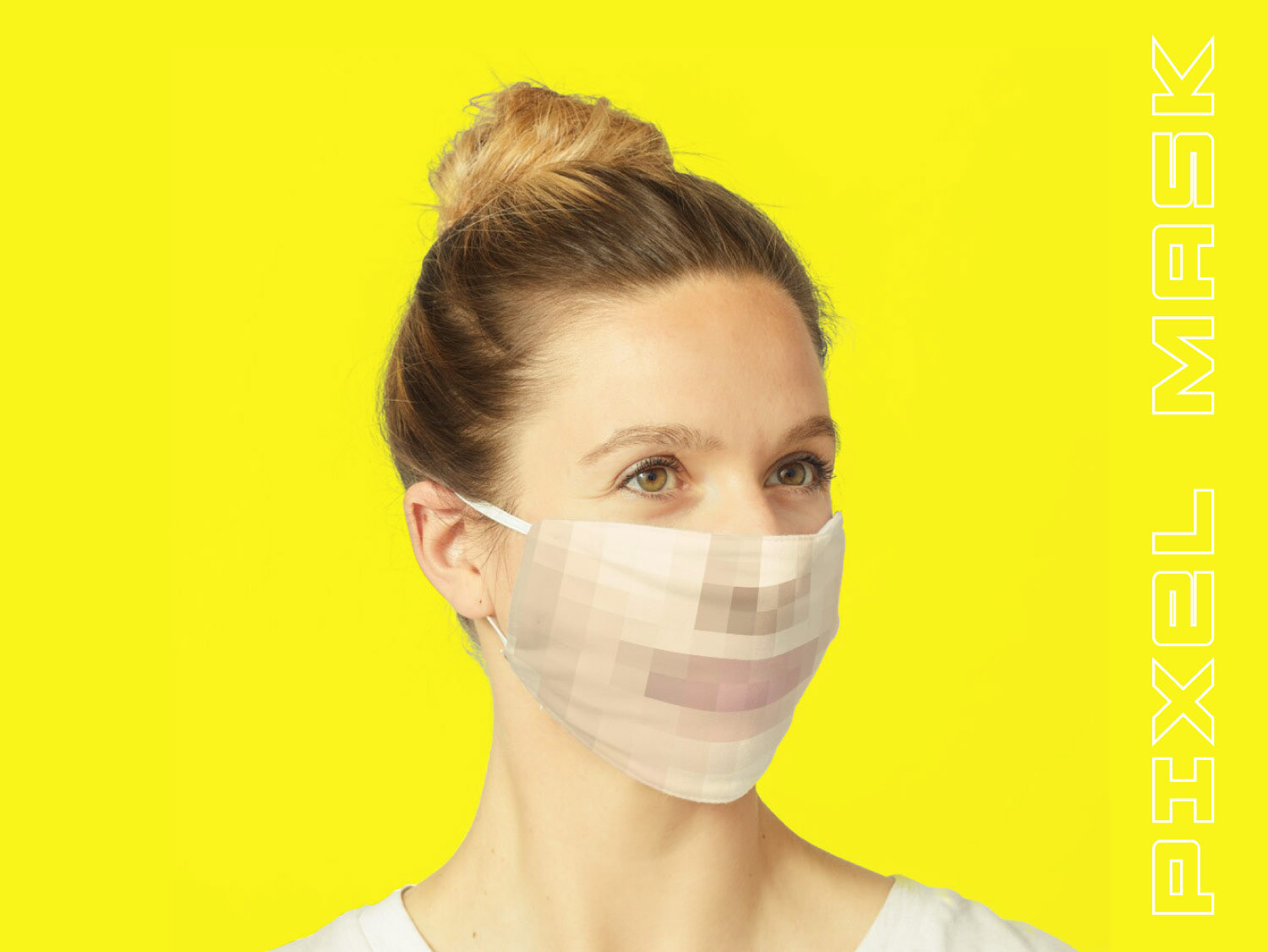
A pixel face mask looks like someone dragged the blur tool out of Photoshop and wrapped it around a human head. It is funny, unsettling, strangely fashionable, and surprisingly effective at starting conversations about who owns your face once a camera captures it.
The best-known example is Pixelhead, a conceptual artwork created by Berlin-based artist and technologist Martin Backes. Designed as “media camouflage,” the full-head covering transforms digital censorship into a physical object. Instead of waiting for a website to blur your face, Pixelhead arrives pre-blurredlike a walking privacy setting with eye holes.
Yet the project is more than a visual joke. It raises serious questions about facial recognition, biometric data, surveillance cameras, digital identity, consent, and the increasingly blurry border between our physical and online lives.
What Is the Pixel Face Mask?
The phrase “pixel face mask” can describe several things, including animated LED masks, augmented-reality filters, pixel-art costume accessories, and privacy-focused face coverings. In the context of digital art and surveillance, however, it most often points to Pixelhead and similar anti-surveillance fashion projects.
Martin Backes’ Original Pixelhead
Backes created the original Pixelhead in 2010. The artwork measured approximately 60 by 30 centimeters and used stretch satin printed with a heavily pixelated photograph of German Interior Minister Thomas de Maizière. Openings around the eyes allowed the wearer to see, while the fabric concealed recognizable facial features from ordinary photographs.
The choice of image was deliberately cheeky. A government official associated with security policy became the raw material for a privacy mask. The result resembled a low-resolution video-game character, a malfunctioning JPEG, and a medieval hood that had accidentally wandered into a computer lab.
A limited edition released later used elastic fabric similar to material found in sportswear. Each piece was numbered, reinforcing the fact that Pixelhead was presented as an artwork and cultural intervention rather than certified security equipment.
Physical Blurring in an Age of Automatic Blurring
Google states that its Street View systems are designed to blur identifiable faces and license plates automatically. Pixelhead reverses that process. Instead of depending on a platform to recognize and obscure a face after the image has been captured, the wearer carries the blur into the physical world.
That reversal is the project’s cleverest move. Digital platforms normally decide when, where, and how anonymity is applied. Pixelhead gives that decisionat least symbolicallyback to the individual.
Why the Design Still Matters
Pixelhead was created before facial recognition became a routine feature in phones, airports, retail stores, social platforms, and law-enforcement investigations. The mask therefore feels even more relevant now than it did at its debut.
Your Face Is More Than a Photograph
A password can be changed after a breach. A credit card can be canceled. Your face is harder to replace unless you are willing to make several expensive appointments and have a very dramatic conversation with your family.
Facial recognition systems can convert visible facial characteristics into biometric templates used for verification or identification. The U.S. Government Accountability Office has documented extensive public- and private-sector uses of facial recognition while also highlighting concerns about accuracy, consent, data security, demographic performance differences, and privacy protections.
The Electronic Frontier Foundation has similarly warned that facial images may be collected, converted into faceprints, and incorporated into large databases without meaningful individual control. Pixelhead turns these abstract concerns into something immediate: a person standing in front of you whose face has apparently been replaced by a buffering icon.
The Mask Makes Invisible Systems Visible
Surveillance infrastructure is usually boring to look at. Cameras resemble small plastic boxes. Databases have no dramatic soundtrack. Algorithms do not announce themselves with flashing neon signs reading, “Your cheekbone geometry is being processed.”
Anti-surveillance fashion makes the hidden process visible. A conspicuous mask reminds observers that cameras are present, images can travel, and a face may become searchable data. In that sense, Pixelhead is less about disappearing and more about revealing the machinery of observation.
Can a Pixel Face Mask Defeat Facial Recognition?
A full-face covering may prevent a conventional camera from capturing the facial landmarks needed by many recognition systems. That does not mean every pixel mask guarantees anonymity, especially as biometric technology continues to improve.
Face Coverings Can Reduce Recognition Accuracy
In 2020, the National Institute of Standards and Technology tested 89 facial recognition algorithms using digitally masked images. Even the strongest systems experienced higher error rates, while many algorithms failed far more frequently when the nose and mouth were covered.
That advantage did not remain static. Later NIST testing found that newer algorithms developed after the beginning of the COVID-19 pandemic became considerably better at processing masked faces. In some cases, error rates improved by roughly a factor of ten compared with earlier versions.
The lesson is simple: concealment and recognition are engaged in an ongoing technological game of cat and mouse. The mouse has cool fabric. The cat has software updates.
A Hidden Face Does Not Make the Whole Person Invisible
Modern surveillance can use more than facial details. Hair, clothing, tattoos, body shape, gait, location, social connections, and movement between cameras may all contribute to identification or tracking. Research covered by WIRED has shown that systems can sometimes recognize people from nonfacial characteristics even when the face is hidden.
A bright pixel hood may also attract human attention. It can hide the wearer’s face while making the wearer the most memorable person in the grocery store. Nobody remembers the customer in a gray sweatshirt, but everyone remembers the person who looked like an uncensored character from an early Nintendo game.
Pixelhead should therefore be understood primarily as provocative art, not a promise of complete anonymity. It challenges surveillance culture, but it does not erase every identifying clue or override local laws and security procedures.
Pixel Face Masks and the Rise of Anti-Surveillance Fashion
Pixelhead belongs to a broader design movement that uses clothing, makeup, reflective materials, patterns, and accessories to question or disrupt machine vision.
CV Dazzle and Facial Camouflage
Artist Adam Harvey’s CV Dazzle project explored asymmetrical hairstyles, makeup, and geometric facial styling intended to interfere with computer-vision systems. The designs broke up familiar facial relationships instead of merely hiding them beneath conventional camouflage. Smithsonian coverage described the project as a form of high-fashion counter-surveillance.
Harvey later developed Hyperface, a textile concept filled with patterns resembling eyes, mouths, and other facial features. Rather than showing a camera no face, Hyperface attempts to show it far too many. The machine enters a crowded party where every square inch of fabric seems eager to have its passport checked.
Glamoflage, Reflective Accessories, and Thermal Clothing
Designer Simone C. Niquille created REALFACE Glamoflage shirts covered with distorted faces intended to distract automated tagging systems. Other designers have experimented with reflective glasses that overwhelm cameras, infrared-blocking accessories, and garments designed to conceal heat signatures from thermal imaging.
These projects do not all work against every system. Their value often lies in experimentation and public debate. They transform privacy from a page of tiny legal text into an object people can wear, photograph, criticize, and occasionally trip over while attempting to put it on.
Digital Identity Becomes Physical Fashion
Pixel aesthetics once suggested technical failure: a low-resolution image, a broken screen, or a video struggling on slow internet. Fashion has gradually turned those imperfections into recognizable visual language.
Designers and luxury brands have created clothing and accessories that appear digitally rendered, blocky, or intentionally artificial. Pixelated garments from major fashion houses have demonstrated how strongly online culture now influences physical products. Clothing no longer needs merely to look attractive in person; it may also be designed to become instantly understandable in a social feed.
Pixelhead pushes that trend in a sharper direction. Its digital appearance is not merely decorative. The pixels represent concealment, censorship, low resolution, platform moderation, and the loss of control that occurs when an image escapes into the internet.
The wearer becomes both anonymous and highly visible. The face disappears, yet the mask demands attention. That contradiction is the heart of the project.
Practical Design Lessons From the Pixel Face Mask
Comfort Matters as Much as Concept
A wearable privacy design must account for heat, breathing, peripheral vision, hearing, fabric movement, and communication. A brilliant mask that fogs glasses, muffles speech, and turns a short walk into a portable sauna will have limited everyday appeal.
Stretch fabrics can fit a wide range of head shapes, but tight material may become uncomfortable around the nose, mouth, or ears. Eye openings must be large enough to preserve useful vision without exposing too much recognizable facial structure. Designers also need to consider whether fabric shifts when the wearer speaks or turns their head.
Social Usability Is a Real Feature
Privacy equipment does not operate in a social vacuum. A full-head pixel mask may be appropriate in a gallery, performance, photo shoot, costume event, or technology conference. It may create alarm or violate rules in airports, banks, government buildings, schools, stores, or other controlled spaces.
A successful consumer interpretation might therefore use modular coverage: a lower-face mask, detachable hood, scarf, visor, or reversible printed accessory. The design could communicate its artistic purpose clearly rather than resembling an improvised disguise.
The Honest Product Description Matters
Companies should avoid claiming that a printed mask makes a wearer “untraceable” or “invisible to AI.” Recognition systems vary, environmental conditions change, and identification can draw on more than the face. A responsible description would present the product as privacy-inspired fashion or conceptual media camouflagenot a magic invisibility cloak with free shipping.
The Bigger Question: Who Controls Your Image?
Pixelhead asks whether appearing in public should automatically mean accepting permanent digital capture. Traditionally, a passerby might notice you and forget you moments later. A networked camera can record, duplicate, analyze, upload, search, and retain an image long after the original encounter.
Public visibility and permanent machine-readable visibility are not identical experiences. That distinction explains why projects like Pixelhead remain culturally powerful. They do not provide a complete technical solution, but they make it difficult to ignore the problem.
The project also challenges the familiar claim that people who value privacy must be hiding something. Privacy is not necessarily secrecy. It is the ability to influence how personal information is collected, interpreted, and reused. Closing a bathroom door does not indicate criminal genius. Sometimes a person simply prefers not to perform every moment for an audience.
Conclusion
The pixel face mask is a perfect artifact for the digital world because it turns a software effect into a physical argument. Martin Backes’ Pixelhead is humorous enough to attract attention, strange enough to remain memorable, and serious enough to provoke discussion about facial recognition and biometric privacy.
It cannot make a person universally invisible. No single fabric pattern can defeat every camera, algorithm, database, or determined observer. What it can do is expose a growing imbalance: cameras are becoming more capable, while individuals often have little understanding of or control over what happens to their images.
Pixelhead does not quietly request privacy. It places privacy over its head, walks into the room, and looks like an eight-bit ghost with excellent media literacy.
Experience Addendum: Living With a Pixel Face in the Real World
The following is a scenario-based user-experience analysis rather than a claim of personally testing the original limited-edition artwork.
The first experience associated with wearing a pixel face mask would probably be physical adjustment. Putting on a conventional mask is quick: loops over the ears, wire over the nose, done. A full-head pixel covering is more theatrical. The fabric must be aligned so the eye openings sit correctly, the printed face appears upright, and the wearer does not spend the afternoon looking through a nostril-shaped section of abstract color.
Once fitted, the mask would immediately change ordinary movement. Peripheral vision could feel narrower. Looking down at a phone might require tilting the entire head rather than moving only the eyes. Warm weather would become an especially persuasive argument for breathable fabric. After several minutes, the wearer might gain a new appreciation for ventilation, moisture control, and every superhero actor who has ever complained about a costume.
The social response would be even stronger. In an art gallery, visitors might recognize the mask as commentary and begin asking questions about surveillance. At a technology conference, it could become an instant networking device. No need for an awkward introduction; the person beside you would probably begin with, “So, why does your head look like a censored news photograph?”
On a public sidewalk, reactions would vary. Some people might laugh. Others might stare, take pictures, or move a few steps away. This produces Pixelhead’s central irony: covering the face to resist photography may encourage more photography. The wearer becomes less identifiable in a traditional portrait but considerably more interesting as content.
That experience reveals an important distinction between anonymity and attention. A plain hood might blend into a crowd, while a brightly pixelated mask becomes a landmark. Friends could identify the wearer by the object itself. Store employees might remember the unusual clothing. Online posts could be connected by matching the same pixel pattern, body shape, backpack, shoes, or location sequence.
Conversation would present another practical challenge. Fabric near the mouth could soften speech, forcing the wearer to speak more loudly or repeat sentences. Facial expressions would disappear, so humor, concern, and friendliness would need to be communicated through voice and gesture. A simple smile would no longer do the work. The wearer might wave more, nod more dramatically, or accidentally resemble a friendly video-game character giving instructions to a confused airport employee.
A video call would create a different experience. The mask would conceal facial expressions while remaining visually compelling on screen. Automatic background effects might struggle around the edges of the head covering. Face-tracking filters could fail, attach virtual glasses to the printed pixels, or place cartoon ears somewhere near the wearer’s shoulder. Such glitches would reinforce the artwork’s theme: software expects a readable human face, and it becomes oddly flustered when the face refuses to cooperate.
After removing the mask, the strongest impression would likely be psychological rather than technical. Wearing it makes cameras more noticeable. Security devices, smartphones, doorbell cameras, store systems, and passing lenses stop blending into the scenery. The wearer begins to think about who is recording, what the image contains, how long it may be stored, and whether consent is meaningful when cameras are everywhere.
That heightened awareness may be Pixelhead’s most important experience. The mask does not need to defeat every recognition system to succeed as art. It succeeds when an ordinary walk becomes a lesson in visibility, identity, and the strange modern fact that showing your face can now mean creating reusable data.

