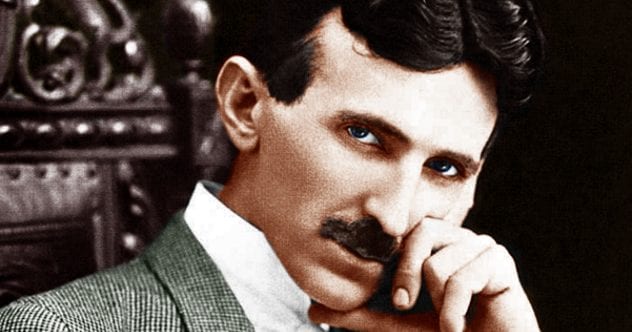
Nikola Tesla was not “mad” in the cartoonish lightning-shooting-from-the-hair sense, although history has certainly tried to plug him into that socket. He was a brilliant Serbian-American inventor, a visionary of alternating current, wireless communication, remote control, and high-voltage experimentation. He also lived with strange fears, intense routines, dramatic claims, financial disasters, and an imagination so powerful it sometimes outran the century he was born into.
This is where the tragedy begins. Tesla’s so-called madness was not simply eccentric behavior for gossip columns. It was the painful collision of genius, ambition, isolation, business failure, and a mind that could see machines before the rest of the world had words for them. His life gave us modern electricity, but it also gave us a cautionary tale: even the brightest bulb can burn alone.
1. The Boy Who Saw Inventions Before They Existed
Tesla described a mind that did not work like an ordinary drafting table. He could visualize machines in detail, run them mentally, adjust their parts, and test them without building a physical prototype. Today, that sounds like elite engineering imagination. In the nineteenth century, it sounded suspiciously close to sorcery with better posture.
The tragic side of this gift was that Tesla’s inner world was often more convincing than the outer one. He trusted mental images so completely that investors, rivals, and even fellow scientists sometimes struggled to follow him. His imagination was his laboratory, but it could also become a locked room. When your brain can build a motor before breakfast, ordinary conversation may feel painfully slow.
2. The Flashing Lights and Hypersensitive Senses
One of the strangest stories about Nikola Tesla concerns his heightened senses. Biographers and historical interviews describe periods when sound, light, and physical sensations seemed amplified. Tesla reportedly claimed he could hear extremely faint noises, and sudden disturbances could overwhelm him.
This sensitivity helped build the myth of Tesla as a man wired directly into the universe. Unfortunately, being “wired into the universe” is less fun when every sound feels like a marching band falling down stairs. His nervous intensity made him seem otherworldly, but it also suggests a man who may have lived with real distress beneath his polished suits and carefully staged demonstrations.
3. The War of Currents Turned Genius Into Public Combat
Tesla’s alternating current system helped make long-distance electrical power practical. Thomas Edison championed direct current, while Tesla and George Westinghouse promoted AC. The resulting War of Currents was not a polite academic disagreement. It was a public brawl with money, reputation, and the future of electricity on the line.
For Tesla, the tragedy was that his scientific victory did not become a personal victory. AC won. Modern grids still depend on principles he helped develop. Yet Tesla himself did not become the enduring business titan of the age. He became the brilliant man behind the curtain while Edison remained the household name. That is enough to make anyone glare dramatically at a light switch.
4. The Showman Who Let Electricity Pass Through His Body
Tesla knew how to impress a crowd. He gave demonstrations with high-frequency currents, glowing tubes, coils, sparks, and enough theatrical danger to make modern safety inspectors faint into a clipboard. Audiences loved it. Scientists were fascinated. Newspapers had a feast.
But showmanship came with a cost. The more spectacular Tesla became, the easier it was for the public to file him under “wizard” rather than “engineer.” His demonstrations were based on real science, but the stagecraft helped create the mad-scientist image that later swallowed his reputation. Tesla dazzled people so successfully that many forgot to take him seriously.
5. Wardenclyffe Tower: The Dream That Became a Monument to Failure
Wardenclyffe Tower may be the greatest symbol of Tesla’s beautiful disaster. Built on Long Island with backing from J.P. Morgan, the project was meant to support a global wireless communication system and, in Tesla’s grander dream, wireless power transmission. In spirit, he was imagining a connected world long before smartphones began ruining dinner conversations.
The problem was money, physics, and timing. Tesla’s vision grew larger than his funding. Morgan declined to keep pouring cash into the project. Meanwhile, competitors advanced in radio. Wardenclyffe became unfinished, then abandoned, and eventually demolished for scrap. For Tesla, it was not merely a failed tower. It was the collapse of his bid to prove that the future had been speaking through him all along.
6. The Obsession With Cleanliness and the Number Three
Among Tesla’s best-known eccentricities were his rituals around cleanliness and numbers. He was said to dislike germs, avoid handshakes, polish dining utensils carefully, and request eighteen napkins at meals because eighteen was divisible by three. He also reportedly developed habits connected to walking, counting, and repeating actions.
It is tempting to laugh at these stories because they sound like the setup to a very niche restaurant complaint: “Sir, your inventor has polished the fork again.” But the more humane reading is that Tesla’s routines may have helped him manage anxiety and control. His life was chaoticfailed deals, unpaid bills, public pressure, and relentless invention. Numbers may have offered a private order in a world that kept short-circuiting.
7. The Pearl, the Perfume, and the Price of Isolation
Tesla reportedly disliked pearls, strong perfumes, jewelry, and even touching hair. He never married and often suggested that celibacy helped his work. Whether that was noble discipline, self-protection, or a convenient explanation, the result was the same: Tesla moved further away from ordinary intimacy.
This is one of the saddest tales about the madness of Nikola Tesla because it is not dramatic in the lightning-and-laboratory sense. It is quiet. His brilliance attracted admirers, but his habits pushed away closeness. He could imagine wireless messages crossing oceans, yet his own emotional life often seemed stuck in a dead zone.
8. The Pigeons of New York
In his later years, Tesla became deeply attached to pigeons. He fed them, cared for injured birds, and reportedly spent money he could scarcely spare on their treatment. Most famously, he described a special white pigeon he claimed to love as one might love a person. When that bird died, Tesla said he felt his life’s work was finished.
This story is often used to make Tesla seem ridiculous, but ridicule misses the tragedy. The pigeons were companionship. They were routine. They were living creatures that came back when people and patrons did not. In a city full of noise, money, and ambition, Tesla found loyalty in birds that most New Yorkers treated as airborne crumbs with opinions.
9. The Death Ray That Fed a Thousand Myths
Late in life, Tesla claimed to have developed a powerful defensive beam weapon, often called a “death ray” by newspapers. He preferred terms such as teleforce and described it as a weapon that could make war impossible by defending borders from attack. The idea fascinated the press, governments, and later conspiracy theorists.
The tragedy is that Tesla’s genuine accomplishments made his extreme claims harder to dismiss. After all, this was the man whose AC work helped electrify the modern world. If he said he had a world-changing weapon, people listenedsome with hope, some with fear, and some with a tin-foil hat already warming up. After his death, rumors spread that the U.S. government or FBI had taken his secret plans, though the FBI has stated it never possessed Tesla’s papers. The myth became bigger than the man.
10. The Lonely Death in Room 3327
Nikola Tesla died in January 1943 at the Hotel New Yorker. By then, he was elderly, in debt, and far removed from the glittering public demonstrations of his prime. His body was found after he had placed a “do not disturb” sign on the door. For a man who helped illuminate cities, the ending feels painfully dim.
Yet Tesla’s legacy did not die in that room. His name returned with force in the twentieth and twenty-first centuries, attached to electric cars, wireless dreams, science museums, documentaries, internet fandom, and endless debates about who truly invented what. The tragedy is that Tesla did not live to see how loudly the future would call him back.
Was Nikola Tesla Really Mad?
The phrase “madness of Nikola Tesla” should be handled carefully. It makes a catchy title, but it can also flatten a complex human being into a spooky poster. Tesla was eccentric, obsessive, visionary, theatrical, and sometimes impractical. He made claims that stretched credibility, especially in his later years. He also made real inventions that changed daily life for billions of people.
Calling him “mad” may say more about society than about Tesla. People often admire genius only after it becomes profitable, packaged, and safe. While Tesla was alive, his ideas could seem too large, too strange, too expensive, or too far ahead. After technology caught up, the same ideas looked prophetic. History has a funny way of calling people crazy right before asking to borrow their blueprint.
Why Tesla’s Tragic Tales Still Matter
Tesla’s life remains powerful because it refuses to fit into a clean success story. He was not simply a forgotten genius cheated by villains, nor was he simply an impractical dreamer lost in fantasy. He was both more useful and more difficult than those labels allow.
His story reminds us that innovation is not only about inventing. It is also about funding, timing, communication, mental endurance, public trust, and the ability to turn a dazzling idea into a working system. Tesla had extraordinary vision, but vision alone does not pay hotel bills, build towers, or negotiate royalties. The future needs dreamers, yesbut dreamers also need accountants, lawyers, friends, and occasionally someone willing to say, “Nikola, maybe do not build the global wireless energy tower until we check the budget.”
Experience and Reflections: What Modern Readers Can Learn From Tesla
Studying Nikola Tesla feels a little like standing in a dark room during a thunderstorm. Every few seconds, lightning reveals something enormous: AC power, wireless communication, robotics, remote control, renewable energy, global information networks. Then the room goes dark again, and you notice the unpaid bills, loneliness, failed projects, and strange rituals. That contrast is what makes Tesla unforgettable.
One experience many readers share when exploring Tesla’s life is the uncomfortable realization that brilliance does not protect people from ordinary human needs. Tesla could think in systems, currents, waves, motors, and planetary possibilities, but he still needed rest, companionship, money, and stability. Modern creators can relate. A designer, engineer, writer, programmer, or entrepreneur may have a brilliant idea at 2 a.m., but the next morning still brings invoices, deadlines, awkward emails, and coffee that tastes like regret.
Tesla also teaches the danger of becoming too attached to one grand vision. Wardenclyffe was not a silly idea; parts of it were astonishingly forward-looking. But Tesla’s refusal to narrow the project into something fundable and practical helped sink it. That lesson applies today to startups, research projects, content businesses, and personal goals. A dream can be too small, but it can also be too large to survive first contact with reality. The trick is not to abandon imagination. The trick is to build a bridge sturdy enough for imagination to cross.
Another lesson is that public image can distort real achievement. Tesla’s theatrical demonstrations made him famous, but they also encouraged people to see him as a magician. In modern terms, he had excellent branding and terrible brand control. Once the public decides you are a “mad genius,” it may ignore the engineering and wait for sparks. Anyone building a public career should pay attention: attention is useful, but spectacle can become a cage.
There is also a compassionate lesson in Tesla’s later years. His pigeon stories are easy to mock, but loneliness often wears strange costumes. People form attachments where they can. Tesla’s care for pigeons may look odd from a distance, yet it reveals tenderness, grief, and a need for connection. A humane reading of history should leave room for that. We can admire the inventor without laughing at the old man who found comfort in birds.
Finally, Tesla’s life encourages intellectual courage with emotional humility. He dared to imagine what others dismissed. Some dreams proved right, some wrong, and some remain tangled in myth. That is the price of aiming far beyond the obvious. The best way to honor him is not to treat every wild claim as truth or every strange habit as comedy. It is to hold both facts together: Nikola Tesla helped electrify the world, and Nikola Tesla was a fragile human being. The spark and the shadow belonged to the same man.
Conclusion
The tragic tales about the madness of Nikola Tesla are not just stories of odd habits, pigeons, failed towers, and newspaper-ready death rays. They are stories about the burden of seeing too far ahead. Tesla’s mind raced into futures that business, science, and society were not always ready to build. Sometimes he was prophetic. Sometimes he was mistaken. Often, he was alone.
His greatest tragedy may be that he gave the world power while struggling to keep power over his own life. Yet his legacy endures every time electricity travels across a grid, every time wireless technology feels ordinary, and every time a strange idea survives long enough to become common sense. Tesla was not merely mad, and he was not merely a genius. He was the storm and the lamp: dangerous, dazzling, and impossible to ignore.