Every few years, the same dramatic headline comes back from the financial attic: the population is aging, therefore the stock market is doomed. It is a clean story, which is exactly why it deserves suspicion. Demographics do matter, but they do not move markets like a giant lever. They work slowly, through savings behavior, retirement withdrawals, labor supply, consumer demand, and the way people allocate money as they age. In the United States, the population is clearly getting older: the Census Bureau says the 65-and-over population grew to 61.2 million in 2024, while the under-18 population slipped to 73.1 million; it also projects that all baby boomers will be over 65 by 2030 and that older adults will outnumber children by 2034.
So yes, demographics matter. But the stock market is not a horoscope written in birth years. The market also listens to earnings, interest rates, inflation, technology, globalization, policy, and sentimentusually louder than it listens to age structure. That is the real tension in the debate: demographics help shape the background music, while markets still dance to the drums of profits and rates. Research from the Federal Reserve, Brookings, NBER, and Vanguard shows that population aging can influence saving, investment demand, asset prices, and expected returns, but the size and timing of those effects are debated.
Why demographics even show up in market conversations
The logic starts with a simple life-cycle idea: people tend to save during their working years and spend more in retirement. The SEC and Investor.gov both explain that asset allocation usually shifts as investors get closer to retirement, with many holding less stock and more bonds and cash equivalents as time horizon shortens. In plain English, younger investors can usually afford more volatility because they have more time to recover, while older investors often prioritize stability and income.
That matters because the stock market is partly a giant matching engine between buyers and sellers. If a large generation is in its accumulation phase, it may create steady demand for equities and funds. If that same generation later shifts toward spending, it may reduce net demand for risky assets. This is the channel many economists study when they ask whether a big cohort like the baby boomers can affect valuations and returns over decades. The NBER and Brookings literature both frames the issue this way: aging may affect household saving, investment demand, and financial market outcomes, though estimates vary a lot.
The U.S. is aging, but not in a cartoonish way
The U.S. workforce and population are changing, but not in a sudden cliff-jump. The Census Bureau’s projections say 2030 is the year when all baby boomers are older than 65, and 2034 is the point when older adults are projected to outnumber children for the first time in U.S. history. More recent Census reporting also shows that the 65-and-over population reached 61.2 million in 2024, reinforcing the long-run aging trend.
At the same time, older Americans are not quietly vanishing from the economy. The Bureau of Labor Statistics reported that 19.5% of people age 65 and older participated in the labor force in 2024, a figure that has risen over time. That matters because it weakens the lazy version of the demographic story. A larger older population does not automatically mean a weaker economy if more older workers stay active, delay retirement, or keep earning income that supports consumption and savings.
How age affects stocks in practice
1) Saving patterns can change valuations
When households save more than they spend, capital becomes abundant. Several studies and reviews argue that population aging can contribute to a “savings glut,” which may push safe rates lower and affect risk premiums. The NBER has discussed the possibility that aging populations reduce returns to capital, while other work suggests the effects differ across asset classes and depend on global capital flows. In other words, demographics can matter for valuations, but they do not write the final chapter alone.
2) Retirement reshapes asset allocation
A market full of near-retirees is not the same as a market full of twenty-somethings dollar-cost averaging into index funds. Investor.gov and the SEC both note that investors closer to retirement commonly reduce stock exposure because their time horizon is shorter and their need for capital preservation is higher. That shift does not cause a crash by itself, but it can change the mix of demand across stocks, bonds, and cash.
3) Labor supply and wages matter too
Aging does not only affect investors; it affects workers, employers, and profit margins. A slower-growing labor force can tighten labor markets, alter wage dynamics, and change the pace of economic growth. The Census Bureau and BLS both point to a U.S. population that is older and increasingly dependent on a larger share of older adults remaining economically active. That can support consumption and offset some of the drag people imagine when they hear “aging society.”
Why demographics are not a stock-market crystal ball
The strongest argument against demographic determinism is that stock prices are forward-looking and multi-causal. Earnings growth, margin trends, interest rates, and innovation can overpower demographic forces for long stretches. The Federal Reserve has noted that household wealth peaks have often coincided with equity booms and housing booms, which is a reminder that asset prices can rise or fall for reasons that have little to do with the age of the population alone.
There is also the issue of ownership. The Federal Reserve’s Survey of Consumer Finances shows that in 2022, 99% of families owned at least one financial asset, including stocks, pooled investment funds, and retirement assets. That means the market is not just “boomers versus everyone else.” It is a broad ecosystem of households with different age brackets, balance sheets, and goals. When stock prices rise, the gains often accrue disproportionately to families that already own more financial assets, which helps explain why market rallies can feel excellent on paper and uneven in real life.
St. Louis Fed research also emphasizes that the standard age-based investing story is not always what U.S. households actually do. In practice, portfolio behavior is shaped by income, education, housing wealth, pensions, risk tolerance, and access to employer plansnot just age. That is why demographic models are useful, but only when they are used with humility.
So what should investors actually watch?
If you are trying to understand whether demographics will help or hurt stocks, the better question is usually: through which channel? Are older households drawing down assets faster than younger households are buying them? Are labor-force trends supporting or weakening corporate revenue growth? Are bond yields moving because of demographic saving patterns, or because the Federal Reserve has changed its stance? Are global investors stepping in with enough capital to swamp local demographic effects? Those are the real questions. Demographics are a map, not the destination.
Vanguard’s research is useful here because it treats demographic trends as relatively reliable over a medium horizon rather than as magic. That is a reasonable way to think about it. Demographics are slow enough to study, but fast enough to matter over a 10- to 15-year window. Still, the market can ignore a slow-moving trend for longer than most people can stay patient, which is one of finance’s favorite practical jokes.
Practical experiences and lessons from watching demographics meet markets
In real market life, demographic effects usually show up as background pressure rather than as a dramatic headline event. You do not wake up one morning and discover that the S&P 500 has politely dropped because a generation had a birthday. What you see instead is a gradual change in who saves, who spends, who borrows, and who needs income. That is why demographic analysis is useful for long-term planning but rarely satisfying for short-term traders. It tends to explain the shape of the wave, not the exact splash.
One practical lesson is that retirement waves change behavior before they change headlines. As people move into retirement, they often become more selective about risk. They may rebalance away from stocks, hold more cash for stability, or focus on dividend income and capital preservation. That behavior does not mean they are “bearish” on the market; it means their financial priorities have changed. In a broad sense, this is exactly what the SEC and Investor.gov describe: asset allocation should match time horizon, risk tolerance, and financial goals.
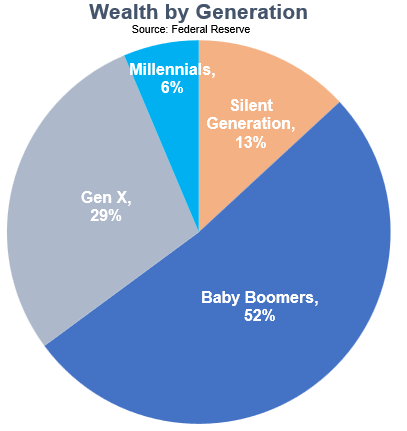
A second lesson is that demographics often affect the market unevenly. Older households may hold more accumulated wealth, while younger households may have more time to compound but less capital to deploy today. The Federal Reserve’s wealth data and related market-reaction research show that gains from asset-price increases are not spread uniformly. So when people say “the market is up,” the deeper question is always “for whom?” That is where demographics becomes more than a macro topic; it becomes a distribution story.
A third lesson is that the market loves a simple narrative and then punishes anyone who overcommits to it. The classic version says an aging population must mean lower returns, because retirees sell stocks and buy nothing in return. That is too neat. Retirees still consume, still invest, still leave money in retirement accounts, still support companies through spending, and often still work. The BLS data on older labor-force participation is a good reminder that “retired” and “economically inactive” are not synonyms anymore.
A fourth lesson is that markets are global, while demographics are local. The United States may age, but capital can flow in from abroad, multinational firms can earn revenue overseas, and companies can adapt with automation, pricing power, and new business models. That is one reason demographic headwinds do not automatically translate into weak equity performance. The evidence base from Brookings and NBER is not saying demographics are irrelevant; it is saying they are only one piece of a very large machine.
A fifth lesson is that the best demographic analysis is patient. It looks at age cohorts, household formation, labor participation, retirement timing, savings rates, and ownership patterns over years, not weeks. It is much more like studying climate than weather. That is why the useful questions are usually boring on the surface and powerful underneath: Who is saving? Who is spending? Who is working longer? Who owns the assets? Who needs income? Once those answers are clearer, the market story gets a lot less mystical.
The final practical takeaway is this: demographics can tilt the playing field, but they do not play the game by themselves. If you are an investor, that means you should treat population trends as one input among many. Use them to set expectations about labor markets, consumption, asset allocation, and long-term valuation pressure. Do not use them as a shortcut to forecast the next quarter. Demographics are a slow drumbeat, not a trading signal.
Conclusion
Demographics versus the stock market is not a winner-take-all fight. It is a long negotiation. Aging populations can influence savings, labor supply, portfolio demand, and eventually returns, but the market is still ruled by earnings, rates, innovation, and capital flows. The smartest view is not that demographics do nothing, or that they control everything. The smartest view is that demographics matter most when you zoom out, and least when you try to use them like a crystal ball.
Note: Educational content only.