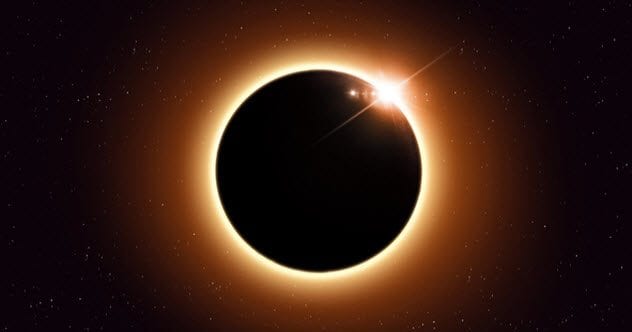
Before solar filters, NASA livestreams, and that one neighbor who suddenly becomes an astronomy professor every eclipse season, people had to explain a solar eclipse with the tools they had: observation, religion, myth, fear, politics, and a truly impressive imagination. One minute the Sun was doing its regular joblighting crops, warming temples, keeping everyone from walking into goatsand the next, it looked as if something had taken a cosmic bite out of it.
Today, we know a solar eclipse happens when the Moon passes between Earth and the Sun, blocking all or part of the Sun’s light from our view. Ancient civilizations did not have modern orbital mechanics, but they were not foolish. Many carefully tracked the skies, recorded patterns, and built calendars around celestial events. Still, when daylight suddenly dimmed, birds went quiet, temperatures dropped, and stars appeared in the afternoon, even the most practical farmer could be forgiven for thinking, “Well, this cannot be good.”
Across ancient China, India, Mesopotamia, Mesoamerica, Scandinavia, the Andes, and beyond, solar eclipse myths turned the darkened sky into a dramatic stage. Dragons ate the Sun. Wolves chased it. Demons swallowed it. Gods issued warnings. Kings worried about their job security. Ordinary people grabbed drums, pots, arrows, prayers, and sometimes unlucky dogs to help bring the Sun back.
Here are the top 10 crazy ways ancient civilizations explained a solar eclipseand what those wild stories reveal about human creativity, fear, science, and survival.
Why Solar Eclipses Terrified Ancient People
A solar eclipse is rare enough to feel special and strange enough to feel personal. In ancient societies, the Sun was not just a ball of plasma 93 million miles away. It was a god, a ruler, a clock, a crop manager, a symbol of justice, and sometimes the celestial equivalent of a security guard keeping chaos away.
When the Sun disappeared, people did not see a neat astronomical alignment. They saw a break in the universe’s routine. The regular order of morning, noon, and evening had been interrupted. For civilizations that depended on seasonal farming, royal omens, and religious calendars, that interruption demanded an explanation.
Some explanations were frightening. Others were surprisingly hopeful. A few were so oddly specific that you have to respect the storytelling. Let’s begin with the most famous eclipse villain of all: the hungry dragon.
1. Ancient China: A Dragon Was Eating the Sun
The myth
In ancient China, one of the most enduring explanations for a solar eclipse was that a celestial dragon had attacked and begun devouring the Sun. The Chinese word historically associated with eclipse has often been linked with the idea of “eating,” which makes the image even more vivid: the sky was not malfunctioning; lunch was happening.
To save the Sun, people made as much noise as possible. Drums, gongs, shouting, and general sky-directed racket were used to scare the dragon away. Imagine an entire community panic-banging cookware at noon. It was not exactly a silent meditation retreat.
Why it mattered
China also developed one of the world’s great astronomical traditions. Eclipses were important state events because they could be interpreted as messages about the emperor’s rule. Ancient records tell of royal astronomers who were expected to predict eclipses. Failing to do so was not a small workplace mistake. It could become a career-ending event in the most literal sense.
The dragon myth combined fear, ritual, and political responsibility. It gave people something to do during a terrifying event: make noise, defend the Sun, and restore cosmic order.
2. Ancient India: Rahu’s Severed Head Swallowed the Sun
The myth
In Hindu mythology, the demon Rahu tried to steal a drink of amrita, the nectar of immortality. The Sun and Moon exposed him, and Vishnu cut off Rahu’s head. Unfortunately for everyone who enjoys calm skies, Rahu had already tasted immortality. His head survived.
Furious at the Sun and Moon for snitching, Rahu chased them across the heavens. When he caught the Sun, he swallowed it, causing a solar eclipse. But since Rahu was only a head, the Sun eventually slipped out again. It is one of mythology’s most efficient explanations: cosmic revenge plus a built-in reason the eclipse does not last forever.
Why it mattered
Rahu and Ketu became important in Indian astrology, connected with eclipse points and the lunar nodes. The myth translated a complicated astronomical relationship into a memorable story. It also made the eclipse feel temporary rather than final. Yes, the demon got the Sun, but do not paniche has no throat.
3. Norse Culture: Wolves Were Chasing the Sun
The myth
In Norse mythology, the Sun and Moon were pursued by monstrous wolves. The wolf Sköll chased the Sun, while Hati pursued the Moon. A solar eclipse occurred when the wolf finally caught up and took a bite.
This was not just a cute “bad dog” moment. In Norse cosmology, the swallowing of the Sun was tied to larger themes of chaos and doom, especially in stories connected with Ragnarök, the final destruction and renewal of the world.
Why it mattered
The Norse explanation reflected a universe full of pursuit, danger, and heroic struggle. The Sun’s daily journey was not effortless; it was a chase scene. A solar eclipse was the terrifying moment when the predator closed the distance.
It is dramatic, memorable, and frankly more exciting than saying, “The Moon’s apparent diameter temporarily exceeded the Sun’s apparent diameter.” Accurate? No. Cinematic? Absolutely.
4. The Maya: The Sun Was Under Attack in a Sky Full of Signs
The myth and the science
The ancient Maya were brilliant sky watchers. Their calendars tracked solar, lunar, and planetary cycles with remarkable attention. Maya inscriptions and codices show deep interest in celestial patterns, including eclipse-related imagery and calculations.
Like many ancient cultures, the Maya did not separate astronomy from religion and politics the way modern people often do. A solar eclipse could signal danger, transition, or divine activity. In some Mesoamerican traditions, eclipses were linked with monstrous forces, celestial conflict, or the possibility that the Sun was being harmed.
Why it mattered
For the Maya, sky events were woven into ritual time. The heavens were not a distant screensaver; they were part of the social and sacred order. Eclipses mattered because they seemed to reveal hidden tension in the cosmos.
The Maya remind us that ancient eclipse explanations were not always simple superstition. They often existed beside careful observation. Myth and math could sit at the same table, even if math probably wished myth would stop bringing jaguars to meetings.
5. The Aztecs: The Sun Needed Blood, Strength, and Serious Attention
The belief
In Aztec civilization, the Sun was central to the survival of the world. The Aztecs believed the cosmos had passed through previous ages, or “suns,” each ending in catastrophe. Their current world required ritual action to keep the Sun moving and prevent cosmic collapse.
A solar eclipse could therefore be understood as a terrifying sign that the Sun was weakened, threatened, or in need of renewal. Some later accounts and interpretations connect Mesoamerican eclipse fears with monstrous beings, jaguars, or star demons that threatened the Sun and humanity.
Why it mattered
The Aztec worldview made the eclipse more than an unusual shadow. It became a possible warning that cosmic maintenance was overdue. If the Sun faltered, life itself was in trouble.
Modern readers may find the idea extreme, but the emotional logic is easy to understand. If your entire civilization sees the Sun as the engine of existence, watching it disappear in daytime is not “interesting.” It is “drop everything, the universe may be resigning.”
6. The Inca and Andean World: A Puma Tried to Devour the Sun
The myth
In Andean mythology, the Sun could be attacked or devoured by a powerful animal, often described as a puma. The Inca worshiped Inti, the Sun god, and regarded the Sun as a divine ancestor of the ruling dynasty. A solar eclipse was therefore deeply serious.
To prevent disaster, communities might make noise, shout, cry out, or involve animals in the uproar to frighten the attacker away. The goal was simple: convince the cosmic predator that this meal was not worth the hassle.
Why it mattered
The puma was not random. In Andean culture, it symbolized power, wilderness, and sacred authority. A puma attacking the Sun turned the eclipse into a battle between divine order and dangerous natural force.
Once again, noise became a human tool against cosmic panic. Ancient eclipse rituals often transformed helpless fear into communal action. When the sky goes wrong, grab a drum. It may not affect orbital mechanics, but it does wonders for morale.
7. Mesopotamia: The Eclipse Was a Royal Warning
The omen
In ancient Mesopotamia, eclipses were not usually explained as random sky monsters. They were read as omens, especially for kings. Babylonian and Assyrian scholars developed sophisticated systems for observing and predicting celestial events, including eclipses. But prediction did not remove fear. It organized it.
A solar eclipse could be interpreted as a warning of danger to the ruler, the kingdom, or the stability of the state. In some cases, Mesopotamian rulers used substitute king rituals. A temporary “king” could be placed on the throne to absorb the evil omen, while the real king stepped aside until the danger passed.
Why it mattered
This may be one of history’s strangest political crisis-management strategies. Today, leaders have press secretaries. Ancient Mesopotamian kings had celestial omen experts and, occasionally, a substitute king.
The Mesopotamian approach shows how astronomy, astrology, and government were deeply connected. The heavens were treated like an official communication system. A solar eclipse was not just a shadow; it was a memo from the universe, and nobody wanted to be the manager who ignored it.
8. Ancient Greece: The Gods Were Sending a Message
The belief
Ancient Greek thinkers eventually helped move eclipse explanations toward natural philosophy. Philosophers and astronomers explored geometry, shadows, and celestial motion. Yet Greek society also preserved older ideas that eclipses were divine signs.
One famous story says that a solar eclipse in 585 B.C. occurred during a battle between the Lydians and the Medes. The sudden darkness was interpreted as a sign that the gods wanted the fighting to stop. The armies reportedly made peace.
Why it mattered
This Greek example is unusual because the eclipse explanation produced a positive result: fewer people stabbing each other. The sky went dark, and everyone on the battlefield apparently decided, “Maybe the universe has a point.”
Greek culture stands at a fascinating crossroads. On one hand, eclipses could be omens. On the other, Greek philosophers pushed toward rational explanations. This tension between myth and science shaped the future of Western astronomy.
9. Ancient Egypt: The Sun God’s Journey Was Interrupted
The interpretation
Ancient Egyptian religion placed enormous importance on the Sun. Ra, the Sun god, traveled across the sky by day and through the underworld by night. Each sunrise represented victory over darkness and chaos.
Although direct ancient Egyptian solar eclipse records are debated, later interpretations often connect eclipse-like darkness with threats to the solar order. The serpent Apophis, or Apep, was the great enemy of Ra, attacking the Sun god’s nightly journey. In an eclipse, it is easy to see how people might imagine chaos briefly gaining the upper hand.
Why it mattered
The Egyptian worldview framed light as order and darkness as danger. A solar eclipse, even if not always recorded in surviving texts, would fit naturally into a cosmic drama: the Sun’s power challenged, darkness rising, order needing restoration.
In other words, the Egyptian version was less “Oops, the Sun disappeared” and more “The eternal battle between order and chaos has scheduled a surprise matinee.”
10. Indigenous and Traditional North American Stories: Bears, Squirrels, Frogs, and Sky Beings
The stories
Many Indigenous and traditional cultures across North America explained eclipses through animal stories, spiritual relationships, or practices of respect. Some traditions described the Sun being bitten by a bear, gnawed by a squirrel, swallowed by a sky creature, or affected by beings beyond ordinary human sight.
In some communities, people made noise to drive the attacker away. In others, people stayed indoors, remained quiet, prayed, or treated the eclipse as a sacred time of renewal. These responses show that not every eclipse myth was about panic. Some were about humility.
Why it mattered
These traditions challenge the modern habit of lumping all ancient eclipse beliefs into “fear.” Some cultures saw the eclipse as a moment to restore balance, avoid disrespecting the Sun, or reflect on humanity’s place in a larger cosmic order.
That may be the most practical lesson of all. When the sky changes, you can scream at a dragonor you can sit quietly and remember that you are very small, which is also useful information.
Common Themes in Ancient Solar Eclipse Myths
Something eats the Sun
The most common ancient solar eclipse explanation is wonderfully direct: something is eating the Sun. Dragons, wolves, demons, pumas, frogs, dogs, bears, squirrels, and bats all appear in eclipse folklore. This makes sense visually. During a partial eclipse, the Sun really does look as if a bite has been taken out of it.
Noise saves the day
Across cultures, people responded by making noise. Drums, shouting, gongs, pots, arrows, and animal cries were all used to scare away whatever creature or spirit threatened the Sun. This ritual gave people agency in a frightening moment.
Kings should be nervous
In many ancient civilizations, eclipses were linked to rulers. If the Sun symbolized order, kingship, and divine favor, then a darkened Sun could suggest political danger. Ancient rulers had good reason to keep astronomers close and omen interpreters closer.
Science and myth often overlapped
Ancient people could track eclipses and still explain them mythologically. Prediction did not always erase sacred meaning. In fact, the ability to predict an eclipse could make it even more powerful, because priests, scholars, or rulers could prepare rituals in advance.
Experiences and Reflections: What Ancient Eclipse Myths Teach Modern Viewers
Watching a solar eclipse today is a strange experience because the modern mind knows the science, but the ancient body still reacts. You can understand perfectly well that the Moon is passing between Earth and the Sun, and still feel your stomach drop when daylight begins to fade at the wrong hour. The birds quiet down. Shadows sharpen. The air cools. People who were laughing a minute ago suddenly whisper. For a brief moment, even the most confident modern viewer becomes emotionally related to an ancient sky watcher.
That is why ancient solar eclipse myths remain powerful. They are not just funny stories about dragons with snack problems. They are emotional maps. They show how people made meaning when the ordinary world stopped behaving normally. Imagine standing in a field 3,000 years ago with no telescope, no eclipse glasses, no weather app, and no friendly space agency explaining the Moon’s shadow. The Sun begins to vanish. Livestock grows restless. Children cry. Adults look to priests, elders, or astronomers for answers. A myth gives shape to the fear. It says, “This is happening because a dragon is attacking,” or “Rahu has swallowed the Sun,” or “the gods are warning the king.”
That explanation may not be scientifically correct, but it is psychologically useful. It turns chaos into a story. Even better, many myths tell people what to do next. Beat the drums. Pray. Stay indoors. Make peace. Respect the sky. Protect the community. In that sense, eclipse myths were not passive beliefs. They were survival scripts.
Modern eclipse experiences still have rituals. We travel to the path of totality. We buy glasses. We check cloud forecasts with the desperation of gamblers watching horse races. We gather in parks, schoolyards, rooftops, deserts, beaches, and parking lots. We count down. We cheer when totality arrives. We take photos that rarely capture what our eyes and emotions are experiencing. We may not bang pots to scare a dragon, but we still behave like a community under a spell.
There is also a humbling lesson in these ancient explanations. Every civilization, no matter how advanced, lives between knowledge and mystery. The ancient Chinese could record eclipses and still tell dragon stories. The Maya could calculate celestial cycles and still place those cycles inside sacred meaning. The Greeks could move toward natural philosophy while still treating an eclipse as a divine message. Humans do not simply want facts; we want facts to live inside stories.
A solar eclipse reminds us that science does not have to destroy wonder. In many ways, it deepens it. Knowing that the Moon is just the right apparent size to cover the Sun makes the event more astonishing, not less. Understanding the geometry does not cancel the goosebumps. The ancient myths add another layer: they let us feel how our ancestors felt when the heavens briefly turned theatrical.
So the next time a solar eclipse crosses the sky, enjoy the astronomy. Wear proper eye protection. Do not stare at the Sun like a mythological overachiever. But also spare a thought for the dragons, wolves, demons, pumas, frogs, and celestial troublemakers of the ancient imagination. They may not explain the eclipse scientifically, but they explain something just as human: our need to turn fear into story, story into ritual, and darkness into the promise that light will return.
Conclusion
The top 10 crazy ways ancient civilizations explained a solar eclipse reveal more than wild imagination. They show how people responded to one of nature’s most dramatic events with creativity, ritual, and meaning. Ancient eclipse myths transformed sudden darkness into a battle, a warning, a chase, a punishment, a love story, or a sacred pause. Whether the Sun was swallowed by a dragon in China, hunted by wolves in Norse myth, attacked by a puma in the Andes, or pursued by Rahu in India, each explanation helped people make sense of a frightening sky.
Today, we know the science behind a solar eclipse, but the wonder remains. The Moon’s shadow still has the power to stop conversations, gather crowds, and make ordinary daylight feel magical. Ancient people may not have had our technology, but they understood one thing beautifully: when the Sun disappears, the whole world pays attention.
Note: This article synthesizes established astronomy, folklore, museum, historical, and cultural research about solar eclipses. It is written for educational web publication and avoids unsupported modern conspiracy claims.