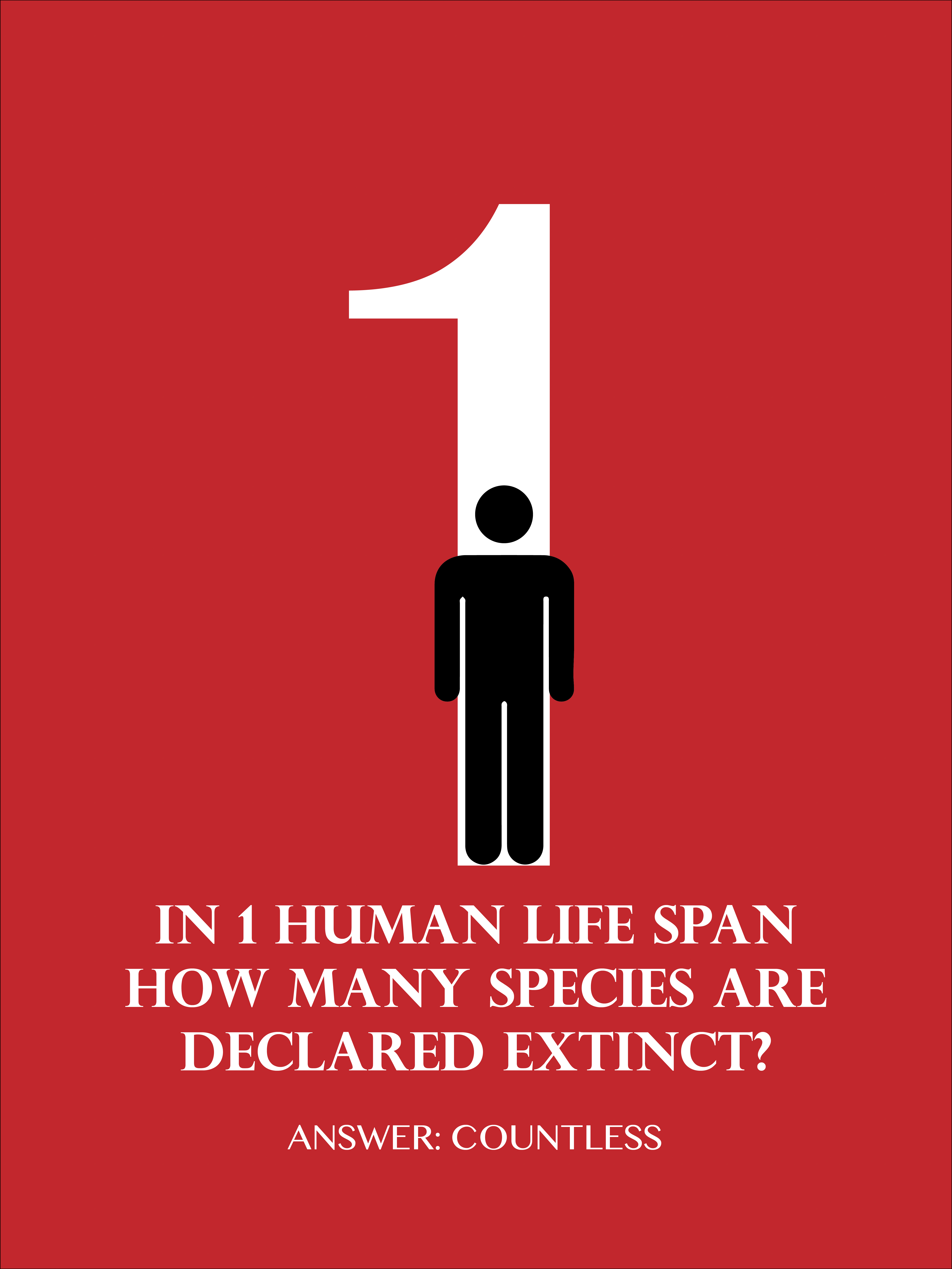
Here is the uncomfortable answer nobody can squeeze onto a coffee mug: it depends on what you mean by declared extinct. If you mean the number of species scientists estimate are lost during one average human life span, the number can soar into the hundreds of thousands or even the low millions. If you mean the number that are formally confirmed and officially moved into the “extinct” column, the tally is much lower. That is not because nature is less dramatic than the headlines suggest. It is because extinction is weirdly hard to prove. A species can be gone, mostly gone, hanging on in one hidden valley, or simply ghosting researchers for decades.
So let’s do the honest thing and give both answers. Using the current U.S. average life expectancy of about 79 years as a practical benchmark, one human lifetime spans roughly 28,800 days. If you apply widely cited extinction estimates of around 24 to 90 species lost per day, you get a rough range of about 691,000 to 2.6 million species over one lifetime. That sounds like a planetary fire alarm because, well, it is. But those are modeled estimates of likely extinctions, not the smaller number of species formally declared extinct after years of surveys, review, and scientific caution.
The Short Answer: Two Different Numbers, Two Very Different Meanings
If you mean estimated species losses during one life span
A reasonable, evidence-based range is that hundreds of thousands to a few million species may disappear over the course of one average human life span, depending on which extinction-rate model you use. That is why extinction stories often sound as if the planet is running a clearance sale nobody asked for. Some estimates are conservative, some are aggressive, and scientists do not all use the same methods. But the shared message is clear: biodiversity is shrinking far faster than natural background rates would suggest.
Put simply, if one lifetime is about 79 years, then even a lower-end estimate of 24 extinctions a day adds up fast. A higher-end estimate of 90 a day rockets the total much higher. This is the math behind the shock value. It is not meant to be theatrical. It is meant to reflect how large the biosphere is, how much of it remains poorly studied, and how easy it is for tiny, localized species to vanish without a primetime farewell special.
If you mean officially declared extinct
The number is far smaller, because formal declarations lag behind reality. Scientists generally need repeated surveys, historical records, habitat assessments, and a lot of caution before they say, “Yes, this species is gone.” That means official extinction counts are usually delayed, conservative, and incomplete. In the United States, for example, the U.S. Fish and Wildlife Service finalized the delisting of 21 species due to extinction in 2023. That was a major official update, but even that announcement came with a sobering detail: many of those species were already likely extinct or down to very low numbers when they were originally listed decades earlier.
In other words, formal extinction declarations are more like coroners’ reports than breaking news. They tell you what has already happened, often long after the ecological crime scene has gone cold.
Why “Declared Extinct” and “Actually Gone” Are Not the Same Thing
This is where the topic gets frustrating, and also where it gets real. Extinction is not always a neat event with a timestamp and a sad violin soundtrack. Some species disappear from one area but survive elsewhere. Some persist in tiny, overlooked populations. Some are last seen decades before anyone is willing to officially close the file. And some, especially insects, freshwater mollusks, plants, amphibians, and island species, can vanish before they were ever studied well enough for the public to learn their names.
That delay is one reason official extinction counts often look “too low” compared with broader extinction estimates. Scientists are not being timid for fun. They are trying not to declare a species extinct if there is still a slim chance it survives. Conservation history has a few Lazarus stories, after all. A species that seems gone can reappear, which is wonderful for biology and mildly embarrassing for certainty.
Still, the cautious pace of formal declarations should not lull anyone into complacency. It mostly tells us that proving absence is hard. It does not tell us the crisis is small.
What Is Driving So Many Species Toward Extinction?
If extinction had a villain origin story, it would be a team effort. Habitat loss is the heavyweight champion. Forests are logged, wetlands are drained, rivers are altered, grasslands are paved, and coastal systems are chopped up by development. When a species loses the one place it knows how to be a species, things tend to go downhill fast.
Then come the accomplices: overexploitation, invasive species, pollution, disease, and climate change. The U.S. Geological Survey identifies habitat loss as the primary cause of higher extinction rates, while also pointing to habitat changes, overuse, harmful nonnative species, pollution, and disease. NOAA adds invasive species to the list of troublemakers that can reduce biodiversity, transform habitats, and even drive native species to extinction. Climate change is increasingly turning the screw tighter, especially for species with narrow ranges, temperature-sensitive habitats, or nowhere cooler to move.
Birds offer a vivid warning sign. Cornell researchers have highlighted broad declines in global bird populations, with habitat loss and degradation, direct overexploitation, and climate change all contributing to the problem. In North America alone, billions of birds have been lost over recent decades. That does not mean billions of species, of course, but it shows how ecosystems can unravel long before a species gets the formal obituary treatment.
What Extinction Looks Like in the Real World
The 2023 U.S. Fish and Wildlife Service action is a brutal snapshot of how extinction often unfolds. The 21 species delisted due to extinction included birds from Hawaiʻi and Guam, freshwater fish, mussels, and a bat. Many were island species or species with extremely limited ranges, which is conservation shorthand for “one disaster away from catastrophe.” Once habitat shrinks, invasive predators arrive, or environmental conditions shift, there may be no backup population waiting in the wings.
The list included species such as the poʻouli, Maui ākepa, San Marcos gambusia, Scioto madtom, and several freshwater mussels. Freshwater species are especially vulnerable because rivers and streams tend to collect the consequences of everything humans do upstream. If land use changes, pollution rises, water flow is altered, or invasive species move in, aquatic life gets the memo immediately.
Marine history offers its own hard lessons. NOAA notes that the Caribbean monk seal was delisted and declared extinct in 2008 after not being seen since 1952. That gap between disappearance and declaration is exactly the point. A species can be effectively gone long before the paperwork catches up.
And extinction is not always a clean all-or-nothing story. Sometimes a species becomes extirpated from a region, meaning it disappears locally but survives elsewhere. National parks and protected landscapes still show these scars. Everglades National Park, for instance, tracks several federally listed species that are now extirpated from the park. That matters because local disappearances can be early warnings. Before a species goes globally extinct, it often starts blinking out one landscape at a time.
Why This Matters to Humans, Who Are Supposedly Very Busy
It is easy to hear extinction statistics and think, “That is sad, but I still have to answer emails.” Fair. But biodiversity is not decorative trim on the planet. It underpins food systems, water quality, soil fertility, pollination, fisheries, climate resilience, and disease balance. Cornell researchers have even linked species loss to increased risks of infectious disease transmission, because the species most likely to disappear are often the ones that help buffer ecosystems against disease spread.
So when biodiversity erodes, this is not just an emotional loss for birders, botanists, and people who get misty-eyed about frogs. It is a practical problem for agriculture, public health, local economies, and ecosystem stability. Lose enough species, and you do not just lose beauty. You lose backup systems, redundancy, and resilience. Nature stops being a well-woven net and starts looking like a sweater with too many loose threads.
Can We Still Change the Story?
Yes, and this is the part where the article refuses to become an emotional sinkhole. Conservation works. The same federal system that documents extinction also documents recovery. The U.S. Fish and Wildlife Service points to species that have been brought back from the brink, and NOAA’s delisting framework exists not only for extinction but also for recovery. Protected habitat, invasive-species control, breeding programs, restoration, tougher regulation, and sustained funding can make the difference between “nearly gone” and “still here.”
That does not mean every species can be saved once it is down to the ecological last minute. The 2023 extinction delistings are proof of that. But they also carry a sharper lesson: waiting until a species is famous, photogenic, or one press release away from disappearing is a terrible conservation strategy. The real wins happen earlier, when habitat is still intact, populations are still viable, and action is still cheaper than regret.
So, In One Average Human Life Span, How Many Species Are Declared Extinct?
If you want the cleanest possible answer, here it is: during one average human life span, the number of species estimated to disappear may range from roughly 691,000 to 2.6 million or more, but the number formally declared extinct is far smaller and lags behind reality. Official declarations happen slowly. Estimated losses happen continuously. Both numbers matter, but they are not interchangeable.
That distinction is the whole story. The first number tells us the scale of the crisis. The second tells us how cautiously science confirms the dead. If that feels unsettling, good. It should. The planet is not only losing species; it is losing them faster than our naming, counting, and grieving systems can keep up.
And maybe that is the strangest part of all. In one ordinary human life, you can grow up, pay taxes, forget passwords, discover back pain, become weirdly opinionated about kitchen storage, and still live through an era in which an astonishing amount of Earth’s living variety quietly disappears. No asteroid required. Just us, deadlines, bulldozers, warming oceans, invasive species, and the kind of gradual damage that never looks dramatic enough until suddenly it does.
Experience Section: What It Feels Like to Live Through a Quiet Extinction
Most people do not experience extinction as a headline. They experience it as a missing sound.
Maybe it is the summer chorus that used to rise from a ditch or a pond near your childhood home. Maybe it is fewer butterflies over the same patch of flowers your grandmother planted every spring. Maybe it is the fishing story that gets retold at family dinners, except every version now includes the phrase, “You should have seen it back then.” Extinction often enters ordinary life not as drama, but as subtraction.
That is part of why the topic can feel slippery. A species rarely vanishes in front of a full audience. Instead, you notice that the fireflies are not as thick as they once were. You realize the bird you used to hear at dawn has become a special occasion. The marsh looks normal enough until someone points out that the frogs have gone quiet. Even in places that still look green, something essential can be thinning out behind the scenery.
People who work outdoors tend to describe biodiversity loss in deeply practical language. Farmers talk about pollinators not showing up on schedule. Anglers talk about streams warming and familiar fish becoming harder to find. Hikers talk about forests changing character over time, as if the place still has the same skeleton but a different soul. Scientists may use charts and models, but many of them also talk about loss in sensory terms: fewer calls, fewer sightings, fewer signs, fewer chances.
There is also a strange emotional whiplash to it. On one hand, extinction can feel abstract because the numbers are so large. On the other hand, it becomes painfully personal the moment a favorite place changes. A child who grows up with fewer birds may never know what was missing. An older adult may carry a private inventory of absences everywhere they go. Neither experience is imaginary. They are just different positions on the same timeline of decline.
And yet, people also describe the opposite experience: the shock of recovery. A species returns to a restored wetland. A creek runs cleaner. Native plants bring insects back. A bird once considered rare becomes visible again. Those moments matter because they remind us that ecological damage is not always a one-way march. Nature can rebound when given room, protection, and time. It can be stubborn in the best possible way.
So the lived experience of extinction is not just grief. It is grief mixed with responsibility. It is the uneasy knowledge that human choices shape what remains common, what becomes rare, and what slips beyond recall. It is also hope with work boots on. Not magical hope. Not “everything will be fine” hope. More like the kind of hope that plants native flowers, supports habitat restoration, respects science, and understands that saving species is not about nostalgia. It is about keeping the world biologically alive enough for future generations to inherit more than a list of what used to be here.
That may be the most human part of the whole subject. We are the species asking the question, doing the counting, causing much of the damage, and still capable of changing course. That is a heavy role. But it beats pretending the silence is normal.
Conclusion
One average human life span is long enough to witness stunning technological progress, cultural change, and personal reinvention. It is also long enough to overlap with a heartbreaking amount of biodiversity loss. The best estimate for species lost during one lifetime can reach into the hundreds of thousands or more, while the number formally declared extinct stays much lower because scientific confirmation takes time. That gap should not confuse us. It should wake us up.
The planet does not need us to become amateur zoologists overnight. It does need us to understand that extinction is not an ancient event reserved for dinosaurs and museum gift shops. It is a modern process unfolding within human time, human institutions, and human responsibility. Once you see that clearly, the question stops being just how many species disappear in one lifetime. The bigger question becomes how many we are willing to let vanish during ours.