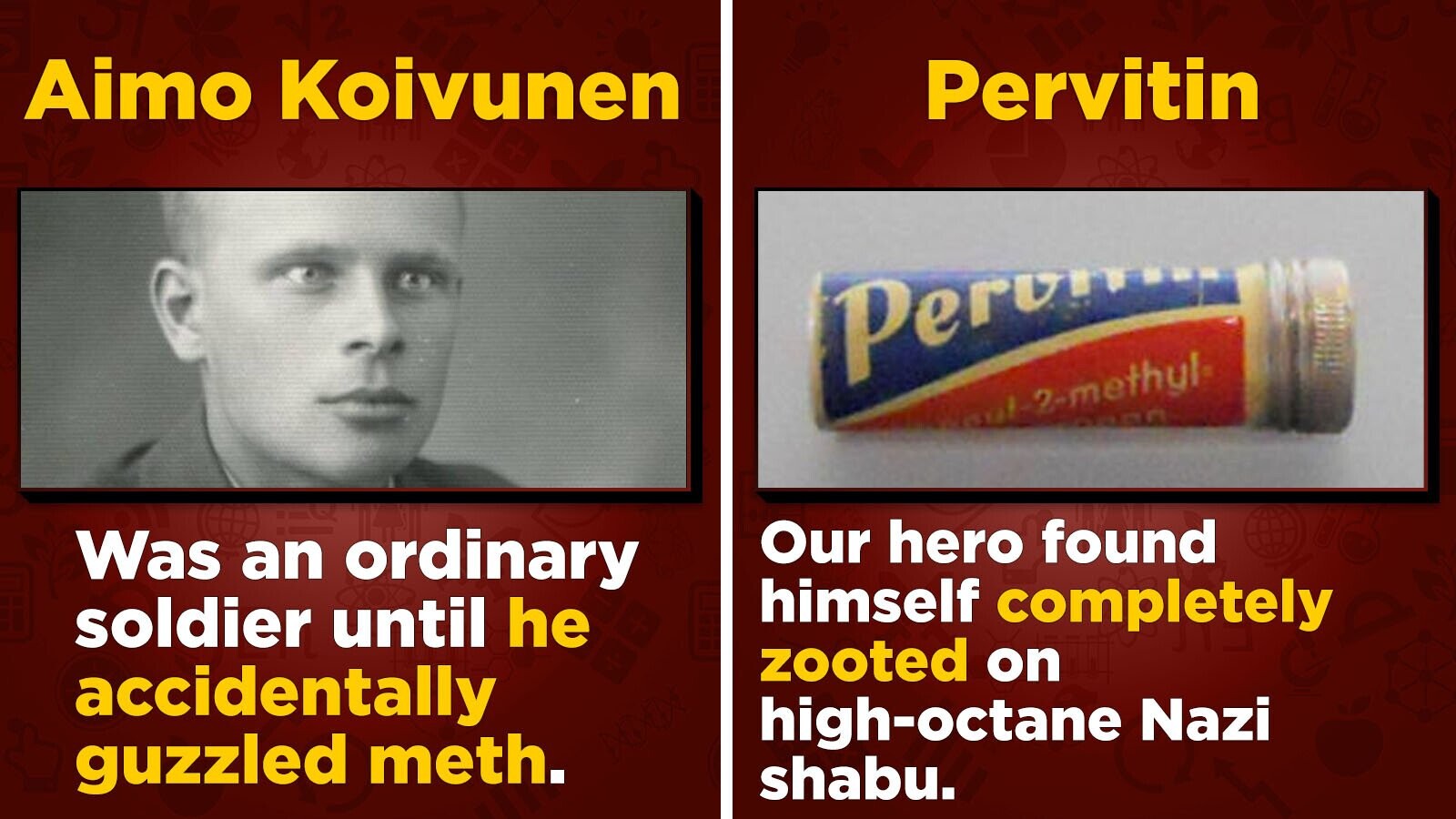
World War II produced plenty of strange survival stories: pilots landing shattered aircraft, sailors floating for weeks, spies escaping through sewers, and entire armies trying to outsmart winter with wool socks and optimism. But few stories are as bizarre, terrifying, darkly comic, and strangely human as the ordeal of Aimo Koivunen, a Finnish soldier who accidentally swallowed his patrol’s supply of Pervitin, a methamphetamine-based stimulant, while fleeing Soviet forces in March 1944.
That sentence sounds like the setup to an absurd war movie: exhausted ski commando, frozen wilderness, enemy soldiers closing in, mysterious German pills, and a survival journey that makes “bad camping trip” feel like ordering room service. Yet the broad outline is real. Koivunen’s own later account, Finnish reporting, military history discussions, and research into wartime stimulant use all point to one of the most unusual episodes in the history of drugs in warfare.
This is not a “cool drugs in war” story. It is a story about exhaustion, fear, poor medical understanding, chemical shortcuts, and one man’s ridiculous will to live. Also, yes, there are skis. Because Finland.
Who Was Aimo Koivunen?
Aimo Allan Koivunen was a Finnish soldier who fought in World War II, including the Winter War and the Continuation War. By 1944, he was serving as a corporal in a Finnish long-range patrol unit. These patrols were not casual forest walks with sandwiches. They were dangerous reconnaissance missions behind enemy lines, often through deep snow, extreme cold, and territory where getting lost could be just as deadly as getting shot.
Finland’s geography made skiing an essential military skill. Finnish troops could move across frozen forests and remote terrain in ways that motorized vehicles could not. Long-range patrolmen were expected to be tough, quiet, disciplined, and comfortable with the kind of cold that makes your eyelashes question their career choices.
Koivunen was one of these men. He was not famous at the time. He was not a superhero. He was a soldier carrying out a brutal assignment in a brutal war. Then, during one desperate retreat, he became the first widely documented case of a soldier overdosing on methamphetamine in combat.
The WWII Context: Why Soldiers Had Pervitin at All
To understand Koivunen’s accidental drug trip, we need to talk about Pervitin. Pervitin was the trade name for a methamphetamine tablet developed in Germany before World War II. It was marketed as a stimulant that could fight fatigue, suppress hunger, improve alertness, and keep people moving when their bodies were screaming, “Please stop, you absolute lunatic.”
At the time, the dangers of methamphetamine were not understood in the way they are today. In the late 1930s and early 1940s, stimulants were often presented as modern medical tools. German soldiers used Pervitin during fast-moving campaigns, and other militaries used related substances, such as Benzedrine, to fight fatigue. The logic was simple and very wartime: tired soldiers slow down; pills keep soldiers awake; therefore pills are useful. The long-term consequences were treated as tomorrow’s problem, and tomorrow was already busy being bombed.
Finland, fighting the Soviet Union and receiving German support during the Continuation War, also had access to Pervitin. It was issued in certain military contexts, especially where exhaustion could threaten a mission. In Koivunen’s patrol, he was reportedly entrusted with the supply. According to later accounts, one reason he may have been trusted with it was that he did not particularly like the substance. In other words, the man least excited about the pills ended up carrying them. History enjoys irony almost as much as it enjoys paperwork.
The Mission That Went Very, Very Wrong
In March 1944, Koivunen’s ski patrol was operating in the harsh northern landscape near the Soviet front. The patrol’s job was the kind of dangerous reconnaissance work that required stealth, endurance, and nerves made of reinforced steel. Then the group encountered Soviet forces and had to flee.
Imagine the scene: deep snow, freezing air, soldiers pushing forward on skis, fear doing push-ups in everyone’s chest, and the enemy somewhere behind them. Koivunen grew dangerously exhausted. In this kind of environment, stopping could mean capture, death, or freezing in place like a badly dressed garden statue.
So he reached for Pervitin. He intended to take a small amount to keep moving. But the conditions were terrible. He was wearing gloves or mittens. The tablets were reportedly stuck together. He could not easily separate one pill from the rest. In the chaos of skiing for his life, he swallowed far more than intended. Later accounts describe him consuming the patrol’s entire supply, commonly reported as 30 tablets.
That was not a “quick boost.” That was a chemical cannonball.
The Initial Effect: Supercharged, Then Shattered
At first, the Pervitin worked in the most frightening way possible. Koivunen suddenly had energy. He could ski fast. Too fast. He surged ahead of his patrol and began to separate from them. The stimulant gave him motion, but it did not give him judgment, orientation, or a friendly little map app saying, “Turn left at the frozen nightmare.”
His comrades reportedly became concerned enough to remove ammunition from his weapon, fearing that he might become dangerous under the drug’s influence. That detail is important because it reminds us that this was not an action-hero power-up. It was a medical emergency unfolding in the middle of enemy territory.
After the burst of speed came confusion, delirium, and memory gaps. Koivunen later recalled waking up alone, separated from his unit, without proper supplies. He had no easy way to know exactly where he was. He had no comfortable shelter. He had no normal food. He did have the Finnish wilderness, Soviet danger, brutal weather, and a body pushed beyond reasonable limits by methamphetamine.
The “Epic Drug Trip” Was Actually a Survival Nightmare
The phrase “epic drug trip” makes the story sound funny, and in a very dark historical-comedy sense, it is absurd. But Koivunen’s experience was not psychedelic sightseeing. It was more like being trapped inside a broken survival simulator set to “Arctic Combat: Impossible Mode.”
He hallucinated. He lost track of time. He believed he encountered enemies. He continued moving through the snow, trying to orient himself by the stars and the landscape. He slept in snow shelters. He searched for anything edible. He existed in that strange borderland where the human body is both incredibly resilient and obviously filing a formal complaint.
Accounts say he ate pine buds. At one point, he reportedly killed and ate a Siberian jay raw because there was no practical way to cook it. That is not dinner. That is desperation with feathers.
Meanwhile, the weather was punishing. Temperatures in the region could drop far below freezing. Koivunen had to keep moving, but movement risked further disorientation. Rest could mean freezing. Hunger weakened him. The stimulant may have suppressed appetite and fatigue for a time, but it also drove his body into dangerous overexertion.
The Landmine and the Snow Pit
As if the situation needed one more dramatic plot twist, Koivunen eventually reached an abandoned German position. Unfortunately, abandoned wartime positions often came with unpleasant surprises, and this one was mined. Koivunen stepped on a landmine.
The explosion badly injured him. Later retellings describe severe damage to his leg and foot, torn clothing, and Koivunen being thrown into the snow. He was now alone, wounded, starving, freezing, and still dealing with the aftereffects of a massive stimulant overdose.
For many people, this would be the end of the story. For Koivunen, it became another miserable chapter. He lay in a snow pit or ditch for days, trying not to die. He improvised protection from the cold. He endured pain and hunger. He had no proper supplies. The survival checklist at this point was basically: breathe, do not freeze, do not bleed out, do not give up, repeat.
How Was He Finally Rescued?
Koivunen’s rescue came after searchers eventually spotted signs of the explosion area and found him alive. He was brought to a field hospital in Salla around April 1, 1944, nearly two weeks after he had been separated from his patrol.
By the time he arrived, he was in shocking condition. Accounts commonly state that he weighed only about 43 kilograms, or roughly 95 pounds, and that his heart rate was around 200 beats per minute. Those numbers are staggering. A resting heart rate like that is not “a little excited.” It is your cardiovascular system playing heavy metal drums in a burning building.
Koivunen survived, but he was permanently affected. He lost toes to frostbite and suffered long-term injury. He did not simply pop out of the hospital, dust snow off his shoulders, and say, “Well, that was lively.” The ordeal left physical consequences. Still, he lived through the war, later married, had a family, and spent the rest of his life in Finland.
Why This Story Still Grabs People
The Aimo Koivunen story has become popular online because it sits at the strange intersection of military history, survival horror, medical cautionary tale, and “you will not believe this actually happened” storytelling. It has all the elements of viral history: a vivid character, an extreme situation, a shocking mistake, and a survival outcome so unlikely that it feels fictional.
But the most interesting part is not simply that Koivunen survived an overdose. It is that his story reveals how war changes the boundaries of what people consider acceptable. In peacetime, giving soldiers methamphetamine would raise every red flag in the warehouse. In wartime, military planners looked at exhaustion, fear, hunger, and cold and asked whether chemistry could make human limits more flexible.
The answer was yes, but only in the short term and at great risk. Stimulants could keep soldiers awake. They could improve confidence. They could delay fatigue. They could also cause paranoia, hallucinations, cardiovascular strain, dependence, poor judgment, and collapse. Koivunen’s survival shows both sides of that ugly bargain. The drug may have helped him keep moving, but it also helped separate him from his unit and push him into a disaster.
Was Koivunen a “Super Soldier”?
No. That label is fun for headlines but misleading. Koivunen was not turned into Captain Finland by a magic pill. He was a trained soldier with exceptional endurance who found himself in a catastrophic situation made worse by a massive accidental overdose.
Calling him a “super soldier” misses the more human truth. His survival depended on training, instinct, luck, cold-weather experience, physical toughness, and rescue. The Pervitin was not a gift from the gods. It was more like being handed a rocket engine when what you really needed was a compass, food, and a calm Tuesday.
The real lesson is not “drugs made him unstoppable.” The real lesson is that human beings are astonishingly hard to kill under some circumstances, and astonishingly easy to endanger when institutions underestimate the consequences of powerful substances.
The Bigger History of Drugs in Warfare
Koivunen’s story is famous because it is extreme, but it was not isolated from the broader history of wartime drug use. Armies have long used substances to manage pain, fear, boredom, fatigue, and morale. Alcohol, tobacco, caffeine, morphine, amphetamines, and other drugs have all had military roles at different times.
During World War II, stimulants became especially attractive because modern warfare demanded long periods of wakefulness and rapid movement. German forces used Pervitin. Allied forces used Benzedrine. Japanese forces used methamphetamine under other names. Military leaders hoped these substances could stretch the human body beyond normal limits.
But bodies are not machines. They do not simply run longer because someone adds chemical fuel. There is always a bill. Sometimes the bill arrives as addiction. Sometimes as psychosis. Sometimes as poor battlefield decisions. Sometimes as a lone soldier hallucinating in the snow after swallowing enough stimulant for an entire patrol.
Experiences and Lessons From Koivunen’s WWII Ordeal
Koivunen’s experience is powerful because it forces us to think about survival beyond the usual heroic clichés. Most survival stories are told as neat lessons: stay calm, build shelter, find water, signal for help. Koivunen’s story contains those elements, but they are buried under chaos. He was not operating from a tidy checklist. He was injured, starving, freezing, disoriented, and chemically overwhelmed. Yet he still made small decisions that kept him alive.
One lesson is that training matters even when the mind is under pressure. Koivunen knew how to move through snow, how to use the landscape, how to endure cold, and how to improvise shelter. Those skills did not make his ordeal comfortable, but they gave him a fighting chance. In modern terms, preparation is not glamorous until everything goes wrong. Then it becomes the difference between “terrible story” and “last story.”
Another lesson is that endurance is not just physical. Koivunen’s body was pushed to extremes, but his survival also required psychological stubbornness. He had moments of despair. He was badly wounded. He had little food and almost no control over his situation. Still, he kept responding to the next immediate problem. That is a practical survival mindset: do not solve the whole nightmare at once; solve the next five minutes.
There is also a lesson about technology and medicine. Wartime systems often reward anything that appears to create faster, stronger, more alert soldiers. But Koivunen’s case shows the danger of treating human limits as engineering flaws. Fatigue is not just an inconvenience. It is a biological warning. Hunger, sleep, and rest are not optional software updates. Ignore them long enough, and the system crashes in spectacular fashion.
His story also explains why historical context matters. Today, calling Pervitin “meth” immediately triggers modern understanding of addiction and danger. In the 1940s, however, many powerful drugs circulated through military and civilian medicine with far less caution. That does not make the choices wise, but it helps explain how a Finnish patrol could have a methamphetamine supply in the first place. History is often less about people being foolish and more about people making decisions inside the limits of what they think they know.
Finally, Koivunen’s ordeal reminds us that survival stories are rarely clean victories. He lived, but he suffered. He returned from the wilderness, but not unchanged. The internet may laugh at the absurdity of “the Finnish soldier who skied on meth,” yet the human story is far heavier: a young man in a freezing war zone, pushed beyond the edge, accidentally thrown into a medical crisis, and saved by endurance, luck, and rescue teams who eventually found him.
Conclusion: The Wildest WWII Survival Story With a Serious Warning
Aimo Koivunen’s accidental Pervitin overdose remains one of the strangest survival stories of World War II. It has the rhythm of a tall tale, but its core is rooted in real wartime practice: soldiers were given stimulants to fight exhaustion, and sometimes those substances created disasters as dramatic as anything the battlefield itself could produce.
Koivunen did not survive because drugs made him invincible. He survived because he was trained, stubborn, lucky, and eventually rescued. The Pervitin may have kept him moving, but it also helped turn a dangerous retreat into a two-week nightmare of hallucinations, injury, hunger, and frostbite.
So yes, meet the soldier who accidentally had an epic drug trip in the middle of WWII. But meet him properly: not as a meme, not as a cartoon superman, and definitely not as a recommendation. Meet him as a reminder that war can make terrible ideas seem practical, that the human body has limits for a reason, and that sometimes history is so strange it arrives wearing skis.
SEO Metadata
Note: This article discusses historical wartime drug use for educational purposes only and does not encourage or promote the use of illegal or dangerous substances.