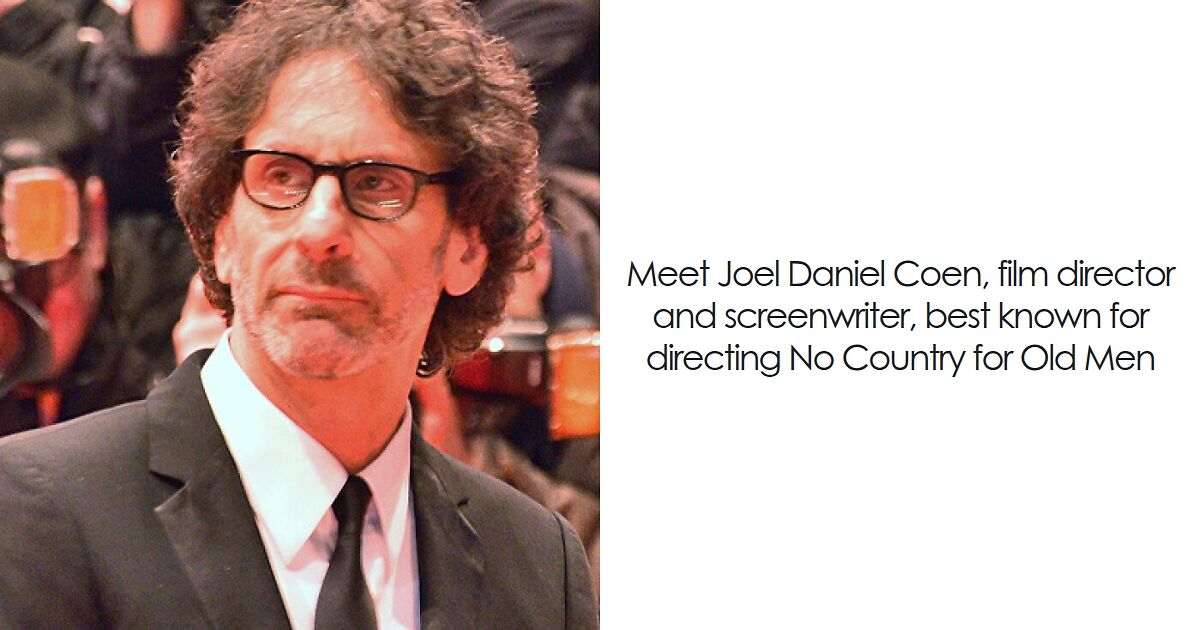
Joel Coen has spent more than four decades turning bad decisions, eccentric accents, criminal incompetence, philosophical panic, and extremely questionable haircuts into great American cinema. Best known as one half of the Coen brothers, he is an Oscar-winning director, screenwriter, producer, and editor whose films move effortlessly between film noir, slapstick comedy, Western drama, musical fantasy, and existential nightmare.
From the low-budget menace of Blood Simple to the windswept moral darkness of No Country for Old Men and the stark Shakespearean world of The Tragedy of Macbeth, Joel Coen’s career has been remarkably consistent without ever becoming predictable. His movies may involve kidnappers, bowling leagues, folk singers, gangsters, cowboys, Hollywood fixers, or men who deeply regret finding a suitcase full of money. What connects them is a distinctive belief that human beings are fascinating, funny, and spectacularly unprepared for the universe.
Joel Coen’s Early Life and Education
Joel Daniel Coen was born on November 29, 1954, in St. Louis Park, Minnesota, a suburb of Minneapolis. His parents worked in academia: his father, Edward Coen, was an economics professor at the University of Minnesota, while his mother, Rena Coen, taught art history. Joel grew up with his younger brother Ethan and their older sister, Deborah, in an environment where intellectual curiosity was apparently encouraged and ordinary Midwestern life provided plenty of material for later dark comedy.
The brothers became fascinated by movies while they were children. Joel reportedly saved money from mowing lawns to buy a Super 8 camera, after which he and Ethan began remaking films they had watched on television. These early productions were not exactly competing with David Lean for technical grandeur, but they established the creative partnership that would eventually reshape American independent cinema.
Joel attended Bard College at Simon’s Rock before studying filmmaking at New York University. At NYU, he completed a thesis film called Soundings. His formal education gave him technical grounding, but his later work suggests that he learned just as much from crime novels, classic Hollywood comedies, European art films, Westerns, and the realization that nearly every serious situation becomes funny when everyone involved is slightly confused.
From Film Editor to First-Time Director
Before becoming a director, Joel Coen worked in film editing and production. One of his early professional jobs was as an assistant editor on Sam Raimi’s low-budget horror film The Evil Dead. The experience offered a practical education in inventive filmmaking: small budgets, elaborate camera movement, homemade effects, and the cheerful understanding that a movie crew may occasionally need to solve a major technical problem with lumber, rope, and stubbornness.
Raimi also influenced the financing strategy for Joel and Ethan’s first feature. Instead of approaching investors with only a screenplay and optimism, the brothers created a short proof-of-concept trailer for Blood Simple. They screened it for potential backers and raised enough independent financing to make the movie. It was essentially crowdfunding before the internet, except that the filmmakers had to enter people’s living rooms and operate a projector.
Blood Simple Announces a New Filmmaking Voice
Released in 1984, Blood Simple was a tightly controlled neo-noir about adultery, jealousy, murder, and a collection of people who repeatedly misunderstand what is happening. Joel received the directing credit, Ethan was credited as producer, and the brothers co-wrote the screenplay. The film also marked the screen debut of Frances McDormand, who would become one of their most important collaborators and Joel’s wife.
Blood Simple established several qualities that would define Joel Coen movies: precise visual storytelling, genre awareness, regional settings, sudden violence, dry humor, and plots driven by incomplete information. Its characters do not fail because they lack plans. They fail because each person is operating with a different, equally incorrect version of the plan.
The Joel and Ethan Coen Partnership
For decades, Joel and Ethan Coen functioned as an unusually integrated filmmaking team. They wrote together, planned scenes together, directed actors together, and frequently edited their films under the shared pseudonym Roderick Jaynes. The imaginary Mr. Jaynes even received Academy Award nominations for editing, making him one of cinema’s most successful professionals never to attend a production meeting.
Because of earlier Directors Guild rules, Joel was initially listed as director while Ethan was credited as producer, even though their creative responsibilities overlapped. Beginning with The Ladykillers in 2004, both brothers were officially credited as directors. Their collaboration was so seamless that actors and crew members often described them as completing one another’s thoughts or giving essentially identical instructions.
Their creative partnership worked partly because they resisted becoming trapped in one genre. A Coen brothers film could be a gangster drama, screwball comedy, crime thriller, folk-music character study, Western anthology, or biblical suburban nightmare. Sometimes it could be several of those things before lunch.
Career Highlights: The Rise of the Coen Brothers
Raising Arizona and Miller’s Crossing
After the controlled menace of Blood Simple, Joel and Ethan made Raising Arizona in 1987. Starring Nicolas Cage and Holly Hunter, the film follows a former criminal and a police officer who kidnap a baby because they cannot have one of their own. The premise is criminal, emotionally sincere, and structurally ridiculousan ideal Coen combination.
Its rapid dialogue, exaggerated action, eccentric characters, and cartoon energy revealed that the brothers were not limited to noir. The Writers Guild of America later placed Raising Arizona among its funniest screenplays, recognizing the highly stylized language that became a Coen trademark.
They followed it with Miller’s Crossing in 1990, a complicated Prohibition-era gangster story filled with divided loyalties, political maneuvering, and hats that carry almost metaphysical importance. Although not initially a major commercial success, the film developed a reputation as one of the most elegant and literate gangster movies of its era.
Barton Fink and International Recognition
Barton Fink, released in 1991, centers on a serious New York playwright who arrives in Hollywood to write a wrestling picture and rapidly discovers that his artistic problems are the least alarming thing in his hotel. The movie blends satire, psychological horror, show-business comedy, and surrealism.
At the Cannes Film Festival, Barton Fink achieved an extraordinary sweep, winning the Palme d’Or, the Best Director award for Joel Coen, and Best Actor for John Turturro. The victory confirmed that the brothers’ peculiar sensibility had international appeal. Apparently, writer’s block becomes prestigious when accompanied by peeling wallpaper and John Goodman shouting in a hallway.
Fargo Becomes a Modern Classic
The 1996 film Fargo became one of the defining achievements of Joel Coen’s career. Set against the snowy landscapes of Minnesota and North Dakota, it follows a desperate car salesman whose kidnapping scheme falls apart with impressive speed. Frances McDormand plays Marge Gunderson, a pregnant police chief whose calm intelligence contrasts with the panic, greed, and incompetence surrounding her.
Fargo earned Joel an Academy Award nomination for directing, while Joel and Ethan won the Oscar for Best Original Screenplay. McDormand won Best Actress. The Directors Guild of America later included the film among its best-directed movies, and its mixture of regional humor, emotional warmth, and brutal crime remains enormously influential.
Marge is especially important to the film’s enduring power. She is neither cynical nor naïve. She understands that the world contains terrible behavior but refuses to let that knowledge destroy her decency. In the Coen universe, basic kindness can look almost heroic.
The Big Lebowski and the Birth of a Cult Phenomenon
Released in 1998, The Big Lebowski initially received a mixed commercial and critical response. Over time, however, the movie became one of the most quoted and celebrated cult films in American cinema. The Library of Congress added it to the National Film Registry in 2014, recognizing its cultural and aesthetic importance.
Jeff Bridges stars as Jeffrey “The Dude” Lebowski, an unemployed Los Angeles bowler who is mistaken for a millionaire with the same name. What follows resembles a Raymond Chandler mystery after the detective has misplaced the clues and decided to wear sandals.
The movie’s lasting appeal comes from its combination of elaborate plotting and complete narrative relaxation. The Dude wanders through kidnappings, nihilists, performance art, dream sequences, and Walter Sobchak’s military anecdotes without becoming noticeably more informed. Its dialogue has inspired festivals, fan communities, philosophical discussions, themed cocktails, and many bathrobes worn outside the home.
O Brother, Where Art Thou? and Musical Reinvention
In 2000, Joel and Ethan released O Brother, Where Art Thou?, a comic odyssey set in Depression-era Mississippi. George Clooney plays escaped convict Ulysses Everett McGill, a fast-talking optimist whose confidence generally arrives several miles ahead of his judgment.
The film loosely draws on Homer’s Odyssey while incorporating Southern folklore, political satire, chain gangs, bank robbers, religious rituals, and old-time music. Its soundtrack became a major cultural success, introducing traditional American roots music to a broad new audience.
The movie also demonstrated the filmmakers’ talent for creating heightened regional language. Their characters rarely speak in plain functional sentences when an extravagant declaration, legalistic argument, or bizarre metaphor is available. In ordinary life, this would make a trip to the grocery store exhausting. In a Coen film, it is poetry.
No Country for Old Men: Joel Coen’s Oscar Triumph
Joel Coen reached another career peak with No Country for Old Men in 2007. Adapted from Cormac McCarthy’s novel, the film follows Llewelyn Moss, a hunter who discovers drug money in the Texas desert; Anton Chigurh, the relentless killer pursuing him; and Sheriff Ed Tom Bell, an aging lawman struggling to understand the violence unfolding around him.
The movie strips away many conventional thriller comforts. Music is used sparingly, violence often arrives without warning, and crucial events may occur outside the expected dramatic frame. The result is tense, bleak, and philosophically unsettling. Anton Chigurh, played by Javier Bardem, became one of modern cinema’s most memorable villains, assisted by a captive-bolt weapon and a hairstyle that appears to have its own moral agenda.
No Country for Old Men won four Academy Awards, including Best Picture. Joel and Ethan won Oscars for directing and adapted screenplay, while Bardem won Best Supporting Actor. Combined with Joel’s earlier screenplay Oscar for Fargo, the film brought his personal Academy Award total to four.
The Writers Guild of America later ranked the screenplay among the greatest of the 21st century, praising its restraint and the dramatic power of what remains unsaid. The film was also selected for the National Film Registry, reinforcing its status as a landmark of contemporary American cinema.
Later Career Highlights
The Coens followed their Oscar triumph with the intelligence-agency farce Burn After Reading, in which nearly every character assumes a level of importance unsupported by the evidence. They then made A Serious Man, a darkly comic story about a Midwestern physics professor whose orderly life collapses in increasingly mysterious ways. The film earned Academy Award nominations for Best Picture and Best Original Screenplay.
Their 2010 adaptation of True Grit became one of their biggest commercial successes. Rather than remake the earlier John Wayne movie scene by scene, the filmmakers returned to Charles Portis’s novel, emphasizing the formal language, harsh landscape, and determination of young Mattie Ross. The film received ten Oscar nominations.
Inside Llewyn Davis, released in 2013, follows a talented but difficult folk singer moving through the Greenwich Village music scene of the early 1960s. It is one of the Coens’ most melancholy films, examining the uncomfortable gap between artistic ability and professional success. Llewyn may be good enough to recognize greatness, which does not necessarily mean greatness has plans for him.
Hail, Caesar! celebrated and mocked the machinery of classical Hollywood, while The Ballad of Buster Scruggs presented six Western stories connected by mortality, chance, violence, and the suspicion that the frontier was not designed with customer safety in mind.
Joel Coen’s Solo Directing Career
After decades of joint filmmaking, Joel and Ethan began pursuing separate directorial projects. Joel’s first solo feature was The Tragedy of Macbeth, released in 2021. He wrote and directed the adaptation, with Denzel Washington as Macbeth and Frances McDormand as Lady Macbeth.
Shot in stark black and white by cinematographer Bruno Delbonnel, the film uses minimalist sets, severe geometry, fog, shadow, and theatrical space to create a world that feels both ancient and dreamlike. Rather than attempting conventional historical realism, Joel treated Shakespeare’s tragedy as a psychological chamber piece.
The production opened the 59th New York Film Festival and received three Academy Award nominations. It also proved that Joel’s visual and dramatic instincts remained recognizable outside the official Coen brothers partnership. The humor was quieter, the architecture was sharper, and the body count remained discouraging.
As of mid-2026, industry reports have identified Joel’s next solo feature as Jack of Spades, a Gothic mystery associated with performers including Josh O’Connor and Frances McDormand. The project suggests that his independent directing career is continuing rather than functioning as a one-film experiment.
What Makes Joel Coen’s Filmmaking Style Distinctive?
Genre Mixing Without Easy Labels
Joel Coen rarely treats genre rules as restrictions. Instead, he uses familiar forms as starting points. Fargo is a crime film with a deeply humane center. The Big Lebowski is detective fiction whose detective would prefer not to investigate. No Country for Old Men is a thriller that gradually becomes a meditation on age, evil, and historical change.
Language as Music
Coen dialogue is instantly recognizable. Characters speak in regional rhythms, formal declarations, repeated phrases, half-remembered expressions, and elaborate verbal structures. Their speech can be funny without sounding like a comedian has entered the scene to deliver a prepared joke.
Fate, Chance, and Moral Confusion
Many Joel Coen films ask whether people control their lives or simply invent explanations after events occur. A coin toss may decide survival. A briefcase may destroy several families. A misunderstood conversation may generate an entire criminal conspiracy. The universe, in a Coen film, has a filing system, and it has misplaced your paperwork.
Precision Behind Apparent Chaos
Although the stories often involve confusion, the filmmaking is highly controlled. Camera placement, editing, production design, sound, and performance are carefully coordinated. Joel Coen’s direction makes disorder feel spontaneous while ensuring that every reaction, pause, doorway, hat, and ominous landscape serves the larger design.
Important Creative Collaborators
Joel Coen’s career is inseparable from the artists who helped build the visual and musical identity of his films. Composer Carter Burwell began working with the Coens on Blood Simple and became a recurring collaborator. His scores can be mournful, restrained, playful, or ominous without overwhelming the characters.
Cinematographer Roger Deakins photographed many major Coen films, including Fargo, The Big Lebowski, O Brother, Where Art Thou?, No Country for Old Men, and True Grit. Their partnership produced images ranging from endless snow and empty Texas roads to sepia-tinted Southern landscapes.
Recurring performers have included Frances McDormand, John Goodman, Steve Buscemi, John Turturro, George Clooney, Holly Hunter, and Tim Blake Nelson. These actors understand the delicate Coen balance: a character can be absurd without knowing it, terrifying without shouting, and heartbreaking while discussing something completely ridiculous.
Joel Coen’s Personal Life
Joel Coen met Frances McDormand when she auditioned for Blood Simple. They married in 1984 and later adopted their son, Pedro McDormand Coen, from Paraguay in 1995. Despite their prominence, the family has generally maintained a private life outside Hollywood’s constant publicity circuit.
McDormand has appeared in numerous Coen films, including Blood Simple, Raising Arizona, Fargo, The Man Who Wasn’t There, Burn After Reading, and Hail, Caesar!. Their marriage is also one of modern cinema’s most productive creative partnerships. Fortunately, their domestic life appears calmer than the marriages portrayed in several of those movies.
Experiencing Joel Coen’s Work: Viewing and Creative Lessons
A rewarding way to experience Joel Coen’s career is to avoid watching the films only in release order. Instead, viewers can create small thematic journeys through his work. Begin with the crime trilogy of Blood Simple, Fargo, and No Country for Old Men. These movies show how his treatment of crime evolved from tightly wound noir to humane black comedy and finally to a nearly biblical confrontation with violence. All three involve money, poor decisions, and wide landscapes, yet their emotional effects are completely different.
For a comedy-focused experience, pair Raising Arizona, The Big Lebowski, and Burn After Reading. Pay attention to how much humor comes from rhythm rather than punch lines. A delayed reaction, a repeated phrase, an unnecessary explanation, or a character’s absolute confidence in a terrible idea often creates the biggest laugh. Aspiring screenwriters can learn that funny dialogue is not merely a collection of jokes. It reveals how characters see themselves, especially when that self-image has almost no relationship to reality.
A third viewing path can focus on artists and performers: Barton Fink, Inside Llewyn Davis, and Hail, Caesar!. Together, these films offer three sharply different experiences of creative labor. Barton wants to make important art but cannot write the assigned screenplay. Llewyn possesses real talent but repeatedly damages his own prospects. The Hollywood professionals of Hail, Caesar! produce artificial entertainment through enormous effort, elaborate machinery, and occasional kidnapping. The shared lesson is uncomfortable but useful: artistic identity does not exempt anyone from work, compromise, luck, or failure.
What Filmmakers Can Learn from Joel Coen
One practical lesson is the value of preparation. Coen films often feel unpredictable, but their visual construction is extremely deliberate. Filmmakers can study how establishing shots define geography, how reaction shots change a joke, and how silence creates tension. The camera does not move simply because movement looks impressive. It moves because the story has created a reason.
Another lesson is to respect supporting characters. Even a person who appears for a few minutes may have a distinctive vocabulary, physical behavior, private history, and complete theory of the universe. This attention makes the fictional world feel larger than the plot. It also gives actors something specific to play beyond “helpful clerk,” “angry neighbor,” or “person who will soon regret entering the room.”
Joel Coen’s career also demonstrates the usefulness of tonal courage. Many writers fear placing comedy near violence, sadness near absurdity, or philosophy near slapstick. The Coen approach shows that these elements can strengthen one another when the characters remain emotionally believable. Life rarely organizes itself into a single genre, and neither do the best Coen films.
Why Rewatching Matters
Joel Coen movies often improve with repeated viewing because the first watch is dominated by plot. On a second or third viewing, the structure becomes less urgent and smaller details emerge: a repeated visual motif, an oddly formal sentence, a musical cue, or a background character silently reacting to disaster. The Big Lebowski becomes funnier once the mystery no longer demands solving. A Serious Man becomes more unsettling when its patterns become visible. No Country for Old Men becomes sadder when it is viewed less as a chase and more as Sheriff Bell’s realization that the world has moved beyond his understanding.
The most satisfying experience is therefore not simply discovering which Joel Coen film is “best.” It is recognizing how the films speak to one another. Snow, deserts, hats, suitcases, dreams, old songs, confused criminals, weary lawmen, and people searching for answers recur across the career. The answers rarely arrive, but the search produces some remarkable cinema.
Conclusion
Joel Coen’s biography is the story of a Minnesota movie enthusiast who became one of the most respected filmmakers of his generation. Working with Ethan Coen, he helped create an extraordinary body of films that combined classical storytelling, literary intelligence, visual precision, regional character, and a very specific appreciation for human foolishness.
His career highlights include the independent breakthrough of Blood Simple, the Cannes triumph of Barton Fink, the Oscar-winning screenplay of Fargo, the cult legacy of The Big Lebowski, the Best Picture victory of No Country for Old Men, and the bold solo achievement of The Tragedy of Macbeth. Few filmmakers have moved so comfortably between comedy and tragedyor demonstrated so convincingly that the distance between them may be only one misplaced briefcase.