Note: This article is based on established atmospheric science from NASA Earth Observatory, NOAA, the National Weather Service, the FAA, the EPA, NCAR/UCAR, and peer-reviewed cloud microphysics research.
Introduction: When the Sky Looks Like It Has a Missing Puzzle Piece
Every now and then, the sky decides to be dramatic. You look up expecting ordinary clouds, maybe a soft cotton-ball parade, and suddenly there it is: a perfect circular or oval hole punched through a cloud layer, often with wispy strands falling from the center like the sky forgot to finish loading. This strange formation is commonly called a hole punch cloud, a fallstreak hole, or, in modern cloud-classification language, a cavum cloud.
Because hole punch clouds can appear suddenly and often occur near aircraft flight paths, they have become a favorite exhibit in online arguments about chemtrails. Someone posts a photo, someone else says, “That does not look natural,” and before you can say “supercooled water droplets,” the comment section has put on a tinfoil hat and started sprinting.
So what is really happening? The short answer: hole punch clouds are real, fascinating, and scientifically explainable. They form through ice nucleation, a process where tiny liquid water droplets in clouds freeze into ice crystals. Aircraft can trigger this process under the right atmospheric conditions, but that does not mean secret spraying is involved. In fact, the science is much cooler than the conspiracy theoryliterally.
This guide explains what hole punch clouds are, how ice nucleation works, why airplanes can create these sky holes, and whether chemtrails are real. Spoiler alert: the clouds are real, the physics is real, and the “secret chemical spraying program” part has the evidence level of a sandwich claiming to be a submarine.
What Are Hole Punch Clouds?
A hole punch cloud is a large circular, elliptical, or sometimes streak-like gap that appears in a thin layer of mid-level cloud, usually altocumulus or cirrocumulus. These clouds often contain water droplets that remain liquid even though the air temperature is below freezing. That unusual condition is called supercooling.
From the ground, a hole punch cloud may look like someone took a giant cookie cutter to the sky. The center may contain delicate falling streaks known as virga, which is precipitation that evaporates before reaching the ground. Sometimes the falling ice crystals create a feathery curtain, giving the cloud an almost theatrical appearance. The sky, apparently, enjoys special effects.
These formations are not new. Pilots, meteorologists, and cloud watchers have observed them for decades. Satellite imagery has made them easier to identify, especially when they appear in long rows near busy air routes or around airports. In some cases, aircraft produce round holes; in other cases, they create long channels called canal clouds.
The Secret Ingredient: Supercooled Water
Most of us learn that water freezes at 32°F or 0°C. That is true for everyday life, such as ice cubes, frozen puddles, and the tragic moment you forget a soda can in the freezer. But in the atmosphere, water can remain liquid below freezing if it lacks particles that help ice form.
Cloud droplets are tiny. If they do not contain enough dust, pollen, soot, mineral particles, or other ice-friendly surfaces, they can stay liquid at temperatures well below freezing. These are supercooled water droplets. They are common in mid-level clouds, especially altocumulus clouds at temperatures around -5°C to -20°C.
Supercooled droplets are unstable in the way a crowded inbox is unstable: everything looks calm until one little trigger starts a chain reaction. When ice crystals appear, they grow quickly at the expense of surrounding liquid droplets. The droplets evaporate, the ice crystals enlarge, and the cloud begins to clear in that area. That clearing becomes the famous “hole.”
What Is Ice Nucleation?
Ice nucleation is the process by which ice begins to form. In clouds, this can happen in two main ways: heterogeneous nucleation and homogeneous nucleation.
Heterogeneous Ice Nucleation
Heterogeneous nucleation occurs when water freezes around a particle, such as dust, mineral fragments, biological material, or pollution particles. These particles act like tiny construction sites where ice crystals can begin building themselves.
Homogeneous Ice Nucleation
Homogeneous nucleation happens when droplets freeze without needing a special particle. This usually requires very cold temperatures. In the case of hole punch clouds, aircraft can cause rapid cooling around wings or propellers, briefly pushing already supercooled droplets into conditions where freezing becomes much easier.
Once freezing begins, the new ice crystals grow fast. Water vapor prefers to deposit onto ice rather than remain as liquid droplets under certain cloud conditions. This is part of the Bergeron-Findeisen process, a classic cloud microphysics mechanism that sounds like a law firm but is actually one of the reasons snowflakes exist.
How Aircraft Can Create Hole Punch Clouds
Aircraft can trigger hole punch clouds when they fly through a cloud layer rich in supercooled droplets. The aircraft does not need to spray anything mysterious. Its wings, propellers, or aerodynamic surfaces can create rapid pressure and temperature changes. As air flows over wings or through propeller tips, it expands and cools. That sudden cooling can be enough to freeze supercooled droplets.
Research has shown that both jet aircraft and turboprop planes can produce these effects. Propellers can be especially effective because the pressure drop near blade tips can be intense. When droplets freeze behind the aircraft, the resulting ice crystals spread and fall. As they fall, they draw moisture from nearby liquid droplets, causing those droplets to evaporate. The cloud thins, then clears, leaving a hole or channel.
The process is sometimes described as inadvertent cloud seeding. That phrase does not mean secret weather control. It simply means that aircraft accidentally create conditions that seed ice formation in a suitable cloud. Think of it as atmospheric dominoes: the cloud was already ready, the plane just bumped the first tile.
Why Do Some Hole Punch Clouds Have Wispy Streaks?
The wispy strands inside or below a hole punch cloud are usually falling ice crystals. These streaks are called fallstreaks or virga. They may never reach the ground because the air below the cloud can be dry enough to evaporate or sublimate the precipitation before it lands.
From below, this falling ice can look like a ghostly jellyfish, a brush stroke, or a cloud with a dramatic haircut. From satellites, it may appear as a bright ice patch surrounded by a darker or clearer hole. Meteorologists can distinguish these ice regions from surrounding liquid cloud using visible and infrared satellite imagery.
Hole Punch Clouds vs. Contrails: What Is the Difference?
Contrails, short for condensation trails, are line-shaped ice clouds that form behind aircraft flying through cold, humid air at high altitudes. Hot, moist exhaust from jet engines mixes with cold air, and water vapor freezes into tiny ice crystals. If the surrounding air is dry, the contrail disappears quickly. If the air is humid, the contrail can persist and spread into cirrus-like cloud.
Hole punch clouds are different. They form when an aircraft passes through an existing supercooled cloud layer and triggers freezing inside that cloud. Instead of adding a visible line behind the plane, the aircraft creates a gap in the cloud deck by turning liquid droplets into falling ice crystals.
In simple terms: a contrail is a cloud trail created behind an aircraft; a hole punch cloud is a cloud gap created when aircraft-induced ice formation clears part of an existing cloud. One draws a line. The other erases a patch. The sky is apparently both a pen and an eraser.
Are Hole Punch Clouds Dangerous?
Hole punch clouds are not dangerous to people on the ground. They may occasionally produce light snow or rain beneath the cloud, but usually the precipitation evaporates before reaching the surface. Their main effect is visual: they look strange, surprising, and extremely shareable.
For aviation, the important issue is not the hole itself but the cloud environment. Supercooled liquid water can contribute to aircraft icing, which pilots and weather forecasters take seriously. Aircraft are designed and operated with icing risks in mind, and aviation weather services monitor conditions where supercooled droplets may exist.
For climate science, aircraft-induced cloud changes are more complicated. Persistent contrails can affect Earth’s radiation balance by trapping outgoing heat and reflecting incoming sunlight. Hole punch clouds, by contrast, are usually localized and short-lived. They are scientifically interesting, but they are not evidence of a hidden global spraying operation.
So, Are Chemtrails Real?
If by “chemtrails” you mean the conspiracy theory that ordinary aircraft trails are actually deliberate secret chemical sprays used for population control, weather manipulation, or other hidden programs, the answer is no. There is no credible scientific evidence supporting the existence of a secret large-scale chemtrail program.
What is real? Aircraft emissions are real. Contrails are real. Aviation’s climate impacts are real. Cloud seeding exists in some places as a regulated weather-modification practice, usually involving specific aircraft or ground-based generators targeting particular cloud systems. Atmospheric research into geoengineering also exists as a debated scientific and policy topic. But these real subjects are not the same as the chemtrail conspiracy theory.
The confusion often comes from mixing separate facts into one dramatic blender. Yes, planes emit exhaust. Yes, contrails can persist. Yes, cloud seeding has been used for weather modification. Yes, governments and companies have conducted environmental programs in the past that deserve scrutiny. But none of that proves that passenger jets are secretly spraying the sky. Evidence matters. A white streak behind a plane is not a confession note written in vapor.
Why Do People Think Chemtrails Are Real?
Chemtrail beliefs often grow from three understandable reactions: people notice changes in the sky, distrust institutions, and struggle to interpret technical atmospheric science. A persistent contrail can look unnatural if you expect aircraft trails to vanish quickly. A hole punch cloud can look artificial because it has a clean, geometric shape. Add a few viral posts, dramatic music, and someone saying “they do not want you to know,” and suddenly cloud physics is wearing a villain costume.
Another reason is that the atmosphere is genuinely complex. Contrails can last for minutes or hours depending on humidity and temperature. They can spread, merge, and resemble thin cloud cover. Flight paths can create repeated patterns because aircraft follow organized routes. None of this requires secret spraying; it requires cold air, moisture, aircraft, and physics doing physics things.
How to Tell a Hole Punch Cloud from Ordinary Cloud Weirdness
You can identify a likely hole punch cloud by looking for several features. First, it usually appears within a thin, uniform layer of altocumulus or cirrocumulus clouds. Second, the gap is often round, oval, or elongated. Third, there may be a streaky, feathery patch of falling ice in the center. Fourth, the event may occur near airports or beneath common flight paths.
Timing matters too. Hole punch clouds may expand after the aircraft passes because ice formation and evaporation continue. The aircraft may be long gone by the time you notice the hole. That delay can make the formation seem mysterious, but the atmosphere does not always work on social-media attention spans.
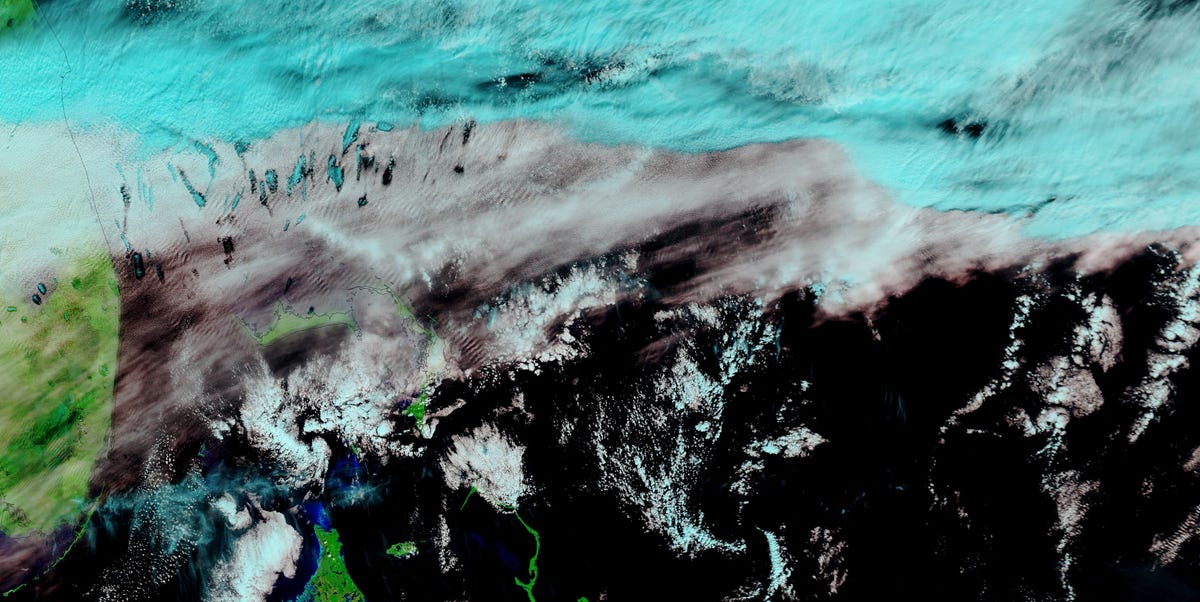
Real-World Example: Florida Cloud Holes Seen from Space
One famous example involved satellite images over Florida showing circular and channel-like openings in altocumulus cloud decks. Scientists connected these formations to aircraft activity near major airports. The clouds contained supercooled water droplets, and aircraft passing through the layers triggered ice formation. Satellite imagery revealed ice clouds inside the holes, confirming that the missing cloud areas were linked to freezing and precipitation processes rather than chemicals or lasers or whatever the internet was serving that week.
Similar observations have been documented using radar, lidar, aircraft measurements, and satellite data. These tools allow scientists to study cloud particles, precipitation streaks, temperature profiles, and wind patterns. In other words, hole punch clouds are not explained by someone squinting at the sky and guessing. They are explained by measurements.
Why the Science Is More Interesting Than the Conspiracy
The chemtrail story is simple: “They are spraying something.” The real story is more interesting: microscopic droplets remain liquid below freezing; aircraft briefly change pressure and temperature; droplets freeze into ice; ice crystals grow; liquid droplets evaporate; precipitation falls; a hole opens in the cloud; satellites can see the difference between water and ice from space.
That is not boring. That is a tiny weather machine unfolding overhead. It involves thermodynamics, fluid dynamics, microphysics, aviation, remote sensing, and the strange personality of water. Water is the only everyday substance that can casually ignore the freezing point under the right conditions and then suddenly turn into ice because a propeller disturbed it. If water had a dating profile, it would say, “Complicated, but worth understanding.”
Common Myths About Hole Punch Clouds and Chemtrails
Myth 1: “Clouds Cannot Have Perfect Holes Naturally.”
They can. The shape comes from how ice formation spreads through a relatively uniform cloud layer. Wind shear, cloud thickness, aircraft angle, and temperature all influence whether the result is round, oval, or streak-like.
Myth 2: “If a Plane Caused It, It Must Be Chemicals.”
No. Aircraft can affect clouds through pressure, temperature, and airflow. The trigger is physical, not necessarily chemical. The plane is not “spraying a hole”; it is disturbing supercooled droplets enough to freeze them.
Myth 3: “Persistent Contrails Prove Chemtrails.”
Contrail persistence depends on atmospheric humidity and temperature. Some trails vanish quickly; others spread into cirrus-like clouds. Duration alone does not prove chemical spraying.
Myth 4: “Cloud Seeding Means Chemtrails Are Real.”
Cloud seeding is a real, regulated weather-modification technique used in specific contexts. It is not the same thing as claiming commercial aircraft are secretly spraying populations through normal flight routes.
Experience Section: Watching the Sky Without Falling Into the Rabbit Hole
The first time you see a hole punch cloud, it is completely reasonable to stare at it like the sky just opened a secret door. A normal person does not look up, see a circular gap in the clouds, and calmly say, “Ah yes, a lovely example of aircraft-induced ice nucleation in a supercooled altocumulus layer.” A normal person says, “What on Earth is that?” and takes 47 photos, including one blurry shot of their own thumb.
One of the best ways to experience this topic is to become a patient sky watcher. Look up on days when the sky has a thin sheet of small, patchy mid-level clouds. These clouds often look like ripples, scales, or soft gray-white tiles. If aircraft are passing through the layer, especially near an airport, you may eventually notice a gap forming. It may begin as a small clearing, then widen into a round or oval opening. In the center, a faint veil may appear, as if the cloud is quietly raining into itself.
What makes the experience memorable is the contrast between appearance and explanation. Visually, the cloud can feel mysterious, almost cinematic. Scientifically, it is a beautiful chain reaction. The aircraft provides a brief cooling trigger. Supercooled droplets freeze. Ice crystals grow and fall. The surrounding droplets evaporate. A clean opening appears. Once you understand that, the cloud becomes even more impressive, not less.
This is also a good lesson in how to handle strange things online. A photo of a hole punch cloud can be real while the caption underneath it can be completely wrong. The image may show a genuine atmospheric event, but that does not mean the explanation “secret chemicals” is true. The sky does not come with labels, so people often bring their own. Some bring curiosity. Some bring fear. Some bring a 90-minute video with ominous piano music. Choose curiosity.
When you see unusual aircraft trails or cloud holes, try asking better questions before jumping to conclusions. What was the weather like? Was the air cold and humid at altitude? Were there aircraft nearby? Did the feature appear in an existing cloud layer or behind a plane in clear sky? Did it spread like a contrail or open like a gap? These questions turn sky watching into observation instead of panic.
Families, teachers, and amateur weather fans can use hole punch clouds as a fun science moment. Kids already love weird clouds, and this one comes with a built-in “wow” factor. You can explain that water can stay liquid below freezing, that ice crystals can grow by stealing vapor from droplets, and that airplanes sometimes trigger cloud changes without needing any secret villain plot. It is a science lesson floating overhead, and admission is free.
There is also a humbling part to the experience. The atmosphere is sensitive. A single aircraft passing through the right cloud at the right temperature can leave a visible mark. That does not mean the sky is being controlled; it means the sky is a dynamic system where small disturbances can matter. Understanding that helps us talk more honestly about aviation, climate, weather modification, and environmental responsibility without wandering into conspiracy fog.
So the next time you see a strange hole in the clouds, enjoy the mystery for a moment. Take the photo. Send it to a friend. Then give the real explanation the spotlight it deserves. Hole punch clouds are not proof that chemtrails are real. They are proof that water is weird, aircraft are powerful enough to disturb delicate cloud layers, and the atmosphere is far more entertaining than most people realize.
Conclusion: The Sky Is Strange Enough Without Chemtrails
Hole punch clouds are real atmospheric formations caused by ice nucleation in supercooled cloud layers. Aircraft can trigger them by creating rapid cooling around wings or propellers, causing liquid droplets to freeze into ice crystals. Those ice crystals grow, fall, and leave behind circular or elongated gaps in the cloud deck.
Chemtrails, as a secret large-scale spraying conspiracy, are not supported by credible scientific evidence. Contrails, aircraft emissions, cloud seeding, and aviation climate impacts are real topics worthy of serious discussion. But hole punch clouds do not prove hidden chemical spraying. They prove that cloud physics is wonderfully strange.
The next time the sky looks like someone punched a hole in it, you do not need to panic. You are probably looking at a natural-looking but aircraft-triggered cloud microphysics event: supercooled water, ice nucleation, and gravity teaming up for a brief performance. Honestly, for a science show, the special effects are excellent.