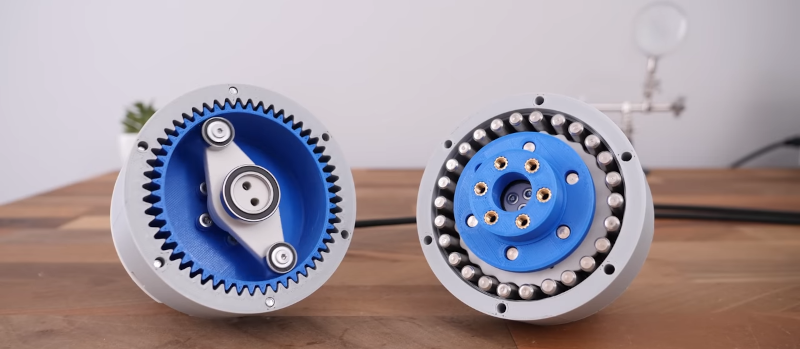
In the world of precision motion, few mechanical arguments get engineers leaning over the table faster than the classic harmonic vs cycloidal drive debate. It sounds like a battle between a jazz band and a geometry textbook, but the stakes are very real: robot joints, automation systems, medical devices, machine tools, camera platforms, and compact actuators all depend on gear reducers that can turn fast motor speed into slow, controlled, powerful motion.
Both harmonic drives and cycloidal drives are designed to solve the same big problem: how do you create high reduction ratios, strong torque output, accurate positioning, and compact packaging without turning the machine into a noisy, sloppy metal blender? The short answer is that both technologies are excellent. The better answer is that each one is excellent in a different way.
A harmonic drive, also called a strain wave gear, is famous for precision, compactness, and very low or zero backlash. A cycloidal drive is famous for rugged torque delivery, shock-load resistance, stiffness, and durability. One is the graceful surgeon. The other is the heavyweight boxer who also happens to know calculus.
What Is a Harmonic Drive?
A harmonic drive uses three main parts: a wave generator, a flexspline, and a circular spline. The wave generator is usually an elliptical bearing assembly attached to the motor input. It pushes the flexible spline into an oval shape, forcing its teeth to engage with the outer circular spline at two opposite zones. Because the flexspline typically has slightly fewer teeth than the circular spline, each rotation of the wave generator causes a small relative movement between the splines. That small difference creates a large reduction ratio.
The magic is in the controlled elastic deformation. The flexspline bends, but it does not simply flop around like a tired soda can. In a properly designed unit, it flexes predictably, transfers torque smoothly, and returns to shape continuously. This is why harmonic drives are widely used in robotic arms, aerospace mechanisms, semiconductor equipment, optical positioning systems, and medical robotics.
Why Engineers Like Harmonic Drives
The biggest advantage is precision. Harmonic drives are known for extremely low backlash, and many commercial units are marketed as zero-backlash solutions. Backlash is the small lost motion that occurs when gears reverse direction. In a robot arm, backlash can make the end effector miss its target. In a telescope mount, it can make tracking less smooth. In a surgical robot, even a tiny positioning error is not invited to the party.
Harmonic drives also provide high reduction ratios in a compact package. A ratio such as 50:1, 100:1, or even higher can fit into a relatively small housing. Since the input and output are coaxial, the layout is clean and convenient for robot joints. That is one reason strain wave gearing appears so often in compact actuators where every gram and millimeter matters.
Where Harmonic Drives Struggle
The same flexing action that makes harmonic drives elegant also creates their main limitation. The flexspline is repeatedly deformed during operation, which means fatigue life, material quality, lubrication, heat, and loading conditions matter a lot. Push a harmonic drive beyond its design limits and it may not fail dramatically at first; it may simply lose accuracy, heat up, wear faster, or develop performance issues over time.
Efficiency can also vary. Harmonic drives are not always as efficient as simple gear trains because energy is consumed by flexing, bearing friction, and tooth engagement behavior. They are wonderful for precision, but they are not magical perpetual-motion pancakes. They must be sized correctly, installed carefully, and treated with mechanical respect.
What Is a Cycloidal Drive?
A cycloidal drive uses an eccentric input bearing to move one or more cycloidal discs around a ring of pins or rollers. Instead of ordinary gear teeth meshing in a standard involute pattern, the cycloidal disc rolls and engages with many pins at once. This distributes load across multiple contact points, which is one reason cycloidal reducers can handle high torque and shock loads so well.
The output is usually taken through pins, rollers, or a carrier connected to the disc motion. The geometry looks unusual the first time you see it. A beginner might look inside and say, “Is this gearbox dancing?” Actually, yes. It is dancing very precisely, and the dance has excellent torque density.
Why Engineers Like Cycloidal Drives
Cycloidal reducers are loved for toughness. They can deliver high torque in compact spaces, tolerate heavy loads, and survive demanding industrial environments. Because load is shared across many contact points, cycloidal designs are often more resistant to shock loading than many traditional gear systems. This makes them attractive for industrial robots, rotary tables, packaging machinery, indexing equipment, conveyors, automation lines, and heavy-duty motion control.
They can also achieve low backlash, especially in high-precision versions. Some modern cycloidal reducers offer lost motion below one arc-minute, which is excellent for many robotics and automation applications. They are not just brute-force reducers; they can be accurate, smooth, and impressively refined when manufactured well.
Where Cycloidal Drives Struggle
Cycloidal drives can be more complex to manufacture and assemble than they appear. The cycloidal disc profile, eccentric bearing, rollers, output pins, clearances, and lubrication all need attention. Poor tolerances can create vibration, uneven motion, noise, or backlash. If you have ever seen a homemade cycloidal reducer wobble like a washing machine full of sneakers, you already understand the problem.
They may also be bulkier than harmonic drives in small robotic joints. For applications where weight and slim packaging are the top priorities, a harmonic drive may fit better. Cycloidal reducers usually win when stiffness, overload capacity, and rugged torque are more important than absolute miniaturization.
Harmonic Vs Cycloidal: The Core Comparison
| Category | Harmonic Drive | Cycloidal Drive |
|---|---|---|
| Best Known For | Precision, compactness, low backlash | Torque, stiffness, shock-load capacity |
| Main Mechanism | Flexible spline deformed by elliptical wave generator | Eccentric cycloidal disc engaging pins or rollers |
| Backlash | Very low to zero backlash | Low backlash in precision designs |
| Torque Capacity | High for size, but limited by flexspline stress | Very high due to distributed load contact |
| Shock Load Resistance | Good when properly sized | Excellent in many heavy-duty designs |
| Packaging | Very compact and lightweight | Compact, but often heavier for small joints |
| Typical Applications | Robotics, aerospace, optics, medical devices | Industrial robots, automation, rotary tables, conveyors |
Round One: Precision and Backlash
If the contest is pure positioning precision, harmonic drives usually enter the ring with confidence. Their zero-backlash reputation is well earned in applications where small reverse-direction errors are unacceptable. Robot arms, camera stabilizers, inspection systems, and medical devices benefit from this predictable motion.
Cycloidal reducers can also be extremely precise, especially high-end units designed for robotics. However, their precision depends heavily on manufacturing quality, preload strategy, roller design, and assembly control. A premium cycloidal reducer can perform beautifully. A cheap one can remind you that geometry is not enough; tolerances are the adult supervision.
Winner for ultra-compact precision: harmonic drive.
Round Two: Torque and Shock Loads
When the job involves heavy loads, sudden starts, impacts, or aggressive duty cycles, cycloidal drives often take the lead. Their multiple contact points spread force through the mechanism, helping them handle torque spikes and shock loads. This is why cycloidal technology is common in industrial automation and heavy robotic joints.
Harmonic drives can deliver impressive torque for their size, but the flexspline remains the critical component. Repeated overloads can shorten life. A harmonic reducer is not fragile when properly used, but it does not enjoy being treated like a demolition hammer.
Winner for overload toughness: cycloidal drive.
Round Three: Size, Weight, and Integration
Harmonic drives are hard to beat when the design needs a slim, lightweight, coaxial reducer. Their three-part architecture allows high reduction in a neat package. For humanoid robot arms, collaborative robot wrists, aerospace mechanisms, and compact actuator modules, that matters.
Cycloidal reducers can also be compact, especially compared with traditional gearboxes, but they often need more radial space, larger bearings, or heavier components when torque rises. In exchange, they provide stiffness and durability. It is less “tiny ballerina” and more “compact forklift with manners.”
Winner for lightweight compact joints: harmonic drive.
Round Four: Stiffness and Load Support
Stiffness is where cycloidal reducers often look very strong. In robot axes with long lever arms, bending moments and torsional stiffness matter as much as backlash. A gearbox that is accurate under no load but twists under real load will not produce accurate work.
Cycloidal reducers, especially designs with strong output bearings and robust housings, can provide excellent moment rigidity. This is useful for industrial robot arms, positioners, welding cells, and machinery that must hold a load without elastic “squish.” Harmonic drives can be stiff too, but the flexspline introduces compliance by design.
Winner for rigidity under heavy load: cycloidal drive.
Round Five: Efficiency, Heat, and Life
Efficiency is not a simple one-size-fits-all answer. Both reducer types can be efficient when well designed, lubricated, and operated within their ideal range. However, harmonic drives lose some energy through flexspline deformation and internal friction. Cycloidal drives involve rolling and sliding contact, eccentric motion, and bearing losses, so their efficiency also depends on design details.
In life expectancy, the question becomes: what fails first? In harmonic drives, the flexspline is the part engineers watch closely. In cycloidal drives, bearings, rollers, pins, lubrication, and wear surfaces become important. Neither system is maintenance-free by divine blessing. Good selection, proper lubrication, alignment, and realistic loading are what make the gearbox live a long and useful life.
Application Examples: Which One Should You Choose?
Robotic Arm Wrist
For a compact robot wrist where space is tight and positioning accuracy is critical, a harmonic drive is often the natural choice. It fits neatly, keeps backlash extremely low, and supports smooth controlled motion.
Industrial Robot Shoulder Axis
For a larger joint carrying heavier loads, a cycloidal reducer may be better. The shoulder axis must handle high torque, bending loads, and continuous duty. Cycloidal stiffness and shock resistance become valuable.
Camera Gimbal or Optical System
Harmonic drives are attractive here because smooth motion, low backlash, and compact packaging matter more than brute-force overload capacity.
Conveyor, Mixer, or Rotary Indexer
A cycloidal reducer is often a strong choice because industrial equipment needs durability, torque, and resistance to occasional abuse. Factory machines are not always gentle. Sometimes they wake up and choose violence.
The Real Answer: It Depends on the Job
The harmonic vs cycloidal showdown does not end with one technology standing over the other in a cloud of gearbox dust. It ends with a selection chart, a load calculation, and an engineer muttering, “Well, it depends,” which is the official mating call of mechanical design.
Choose a harmonic drive when you need compact size, very low backlash, smooth precision, and clean integration into a lightweight actuator. Choose a cycloidal drive when you need high torque, strong shock-load resistance, stiffness, and rugged operation under demanding loads.
The best gearbox is not the one with the flashiest brochure. It is the one that matches the torque curve, duty cycle, allowable backlash, expected life, thermal limits, mounting constraints, and budget of the machine. Ignore those details and any reducer can become an expensive paperweight with bearings.
Practical Buying and Design Tips
First, calculate real output torque, not just ideal torque. Include acceleration, payload, external forces, gravity loads, emergency stops, and safety factors. Gear reducers usually fail because someone believed the spreadsheet was a motivational poster.
Second, check peak torque and moment loads. A reducer may handle nominal torque but struggle with bending moments or sudden impacts. This is especially important in robot joints and cantilevered arms.
Third, look at lost motion, torsional stiffness, repeatability, and rated life together. Backlash alone does not tell the full story. A gearbox with low backlash but low stiffness may still produce poor endpoint accuracy under load.
Fourth, consider serviceability. Harmonic drives may require careful handling because of the flexspline. Cycloidal reducers may require attention to bearings, seals, and lubrication. In production equipment, maintenance access can matter as much as theoretical performance.
Finally, test under real conditions. A gearbox that behaves beautifully on a bench may sound different after ten hours of reversing motion under load. Real machines have vibration, heat, alignment error, dust, impatient operators, and Monday mornings.
Experience Notes: What the Harmonic Vs Cycloidal Show Down Looks Like in Real Projects
In practical engineering discussions, the harmonic vs cycloidal debate usually begins with enthusiasm and ends with a whiteboard full of numbers. The most common mistake is starting with brand loyalty instead of requirements. Someone says, “Harmonic drives are best,” because they saw them in a robot arm. Someone else says, “Cycloidal drives are tougher,” because they watched one survive a brutal industrial duty cycle. Both are right, and both are incomplete.
A useful experience from prototype work is that small harmonic drives can make a compact robot joint feel wonderfully precise. When the motor reverses direction, the output responds cleanly. That makes control loops easier to tune, especially when the load is moderate and the motion profile is smooth. For lightweight arms, lab automation, pan-tilt systems, and educational robots, that low-backlash feeling is addictive. It is the mechanical equivalent of a perfectly sharpened pencil.
However, the same prototype can reveal the limits quickly. If the joint is overloaded, if the housing is misaligned, or if the duty cycle creates heat, performance can degrade. The reducer may still move, but accuracy, noise, and temperature begin sending little warning emails to your engineering conscience. Harmonic drives reward careful design. They are precise instruments, not gym equipment.
Cycloidal prototypes create a different impression. They may look more complicated at first, especially when tuning clearances between the disc, pins, rollers, and output mechanism. But once built properly, they feel strong. There is a satisfying mechanical confidence when a cycloidal reducer handles a load without sounding worried. In applications with impacts, repeated starts and stops, or heavier arms, that confidence matters.
The lesson from many design conversations is simple: test stiffness, not just backlash. A reducer can have impressively low lost motion and still flex under load. For robot arms, the endpoint accuracy depends on the entire joint system: reducer, bearings, housing, motor shaft, fasteners, frame, and control software. Blaming the gearbox alone is tempting, but machines prefer teamwork, even when the team is made of metal.
Another field lesson is that manufacturing quality changes everything. A precision harmonic drive from a serious supplier and a budget no-name strain wave reducer are not the same animal. The same is true for cycloidal reducers. Excellent cycloidal units can deliver smooth, accurate motion; poorly made ones can vibrate, rattle, or create uneven output. Geometry opens the door, but machining quality walks through it.
For DIY builders and small robotics teams, cycloidal drives can be more forgiving in some homemade builds because the concept tolerates robust materials and larger contact areas. But achieving truly low backlash still takes precision. Harmonic drives are harder to fabricate casually because the flexspline must deform predictably without cracking or wasting too much energy. A 3D-printed harmonic drive can teach a lot, including humility.
The best real-world habit is to build a decision matrix before buying. Rate the project on precision, torque, stiffness, weight, shock load, duty cycle, cost, noise, and available space. If precision and compactness dominate, harmonic is usually ahead. If torque, stiffness, and punishment dominate, cycloidal often wins. If all categories are equally important, congratulations: you have discovered why engineering meetings have coffee.
Conclusion
The Harmonic Vs Cycloidal Show Down is not a fight with a universal champion. It is a smart comparison between two brilliant reducer technologies. Harmonic drives offer compact, low-backlash precision that makes them ideal for refined motion control. Cycloidal drives offer torque density, rigidity, and shock-load strength that make them excellent for demanding automation and industrial robotics.
Use harmonic drives when the design needs slim packaging, clean coaxial motion, and highly accurate positioning. Use cycloidal reducers when the application demands torque, durability, stiffness, and the ability to handle real-world mechanical punishment. In the end, the winning reducer is the one that keeps your machine accurate, reliable, cool, and boring. In engineering, “boring” is often the highest compliment.
Note: This article is written for web publishing and synthesized from established engineering knowledge about harmonic strain wave gearing, cycloidal reducer design, robotics actuators, motion control, torque transmission, backlash, stiffness, and industrial automation use cases.