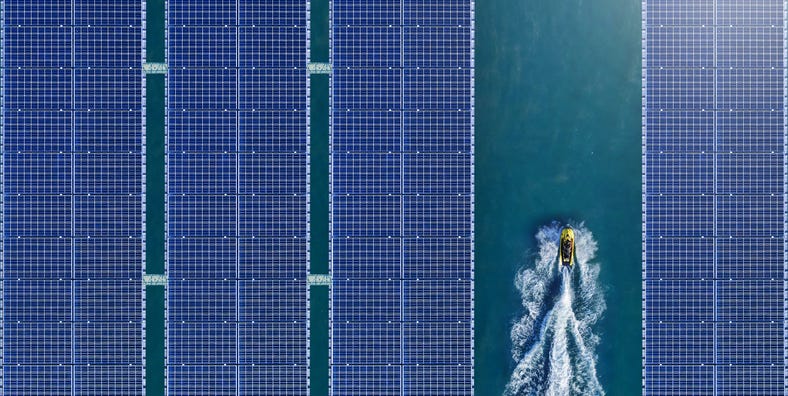
Imagine a future where the world’s next great power plant does not sit on a desert, a rooftop, or a windy ridge. Instead, it quietly floats on calm tropical water, soaking up sunlight near the Equator like a very productive vacationer. That is the big idea behind offshore floating solar panels: huge arrays of photovoltaic modules placed on low-wave, low-wind seas in sun-rich regions close to the equator.
The phrase “unlimited energy” sounds like something a villain says right before the laboratory explodes. But in this case, researchers are using it in a practical sense: the technical solar potential in some equatorial marine regions is so enormous that it could meet electricity needs many times over if engineering, financing, environmental safeguards, and grid connections catch up. Floating solar panels at the Equator are not magic. They are solar panels, floats, anchors, cables, inverters, substations, maintenance crews, and spreadsheets. Lots of spreadsheets. But the opportunity is real, and it is getting harder to ignore.
What Are Floating Solar Panels?
Floating solar panels, also called floating photovoltaics or FPV, are solar power systems installed on buoyant platforms instead of land. Most current projects are built on reservoirs, lakes, irrigation ponds, wastewater basins, and hydropower dams. The panels generate electricity the same way rooftop or ground-mounted solar panels do: sunlight hits photovoltaic cells, electrons get excited, and a power engineer somewhere gets to say, “Yes, that is working.”
The difference is the setting. A floating solar farm uses floats, mooring lines, anchoring systems, marine-grade electrical equipment, and walkways designed to survive movement, moisture, corrosion, and changing water levels. On reservoirs, floating solar can reduce land-use conflict, conserve water by shading the surface, and pair neatly with existing hydropower infrastructure. Offshore floating solar pushes the idea further by moving panels into near-coastal marine zones where land is scarce but sunlight is abundant.
Why the Equator Is Such a Big Deal
The Equator receives strong and consistent solar radiation throughout the year. Unlike higher-latitude regions, equatorial areas do not experience dramatic seasonal swings in daylight. That means a floating solar project near the Equator can produce power more steadily across the calendar. In energy terms, consistency is a very attractive personality trait.
The key is not simply sunshine. It is sunshine combined with relatively calm seas. Most open-ocean environments are rough, stormy, salty, and generally rude to delicate electrical equipment. But researchers have identified equatorial marine regions with lower historical wind speeds, smaller wave heights, and fewer tropical storms. These calmer waters reduce the engineering demands on floating structures, which could make large-scale offshore solar more feasible.
The Research Behind the “Unlimited Energy” Claim
A major study on marine floating solar potential analyzed decades of wind and wave data to locate suitable offshore regions. The research highlighted calm tropical maritime zones, especially near Southeast Asia and West Africa, as potential hotspots for offshore floating solar. One headline-grabbing example is Indonesia, where offshore solar potential has been estimated at tens of thousands of terawatt-hours per year. For context, global electricity generation is measured in the same scale, which is why energy writers suddenly began using words like “limitless,” “vast,” and “please pass the coffee.”
This does not mean one country will cover its seas with panels next Tuesday. Technical potential is not the same as buildable, affordable, permitted, connected, publicly accepted power. It is the upper boundary of what physics and geography suggest might be possible. Still, the scale matters. It shows that floating solar panels at the Equator could become a serious clean energy pathway for densely populated coastal countries where land is expensive, agriculture is essential, and electricity demand is growing fast.
Why Floating Solar Can Beat Land-Based Solar in Some Places
It Saves Land for Food, Housing, and Nature
Traditional utility-scale solar farms need land. That is not always a problem in dry, open regions, but it becomes complicated in countries with dense populations, mountainous terrain, valuable farmland, or fragile ecosystems. Floating solar moves generation onto water surfaces that may already be part of human-managed infrastructure, such as reservoirs or nearshore zones. For island nations and archipelagos, that matters enormously.
Water Can Improve Panel Performance
Solar panels lose efficiency when they get too hot. Floating solar arrays often benefit from cooler operating temperatures because they sit above water. The cooling effect is not a miracle boost, but it can improve energy yield, especially in hot climates. In other words, panels like sunshine, but they do not enjoy baking like cookies.
It Can Reduce Evaporation
On reservoirs and freshwater bodies, floating solar can shade water surfaces and reduce evaporation. This is particularly valuable in drought-prone regions or places where water storage supports drinking water, agriculture, or hydropower. The benefit varies by location, coverage area, climate, and system design, but the water-saving argument is one reason floating solar attracts interest beyond electricity generation.
It Can Pair With Hydropower
Hydropower reservoirs are especially interesting because they already have grid connections, access roads, power infrastructure, and energy-sector management experience. Adding floating solar to a hydropower facility can increase total power output without building a separate land-based solar plant. During sunny days, solar can produce electricity while hydropower saves water for nighttime or peak-demand periods. That is not just clean energy; that is teamwork with a transmission line.
Why Offshore Floating Solar Is Harder Than Reservoir Solar
Reservoir-based floating solar is already a commercial technology. Offshore floating solar is more complicated. Saltwater corrodes equipment. Waves stress platforms. Wind loads can damage moorings. Marine growth can cling to floats and cables. Maintenance crews need safe access. Storm planning becomes non-negotiable. If land solar is like parking a car in a driveway, offshore floating solar is like parking it on a trampoline during a weather forecast.
This is why calm equatorial seas matter. Lower wind and wave conditions reduce structural requirements and may lower costs. Projects still need robust engineering, but they may not require the extreme design standards necessary for rougher offshore environments. The goal is not to defeat the ocean everywhere; it is to choose places where the ocean is already in a cooperative mood.
Best Regions for Equatorial Floating Solar
The strongest candidates are coastal and island regions near the Equator with high solar resources, low wave activity, limited land availability, and growing electricity demand. Southeast Asia stands out because of its archipelagos, hydropower reservoirs, aquaculture activity, and rapidly expanding energy needs. Indonesia is frequently mentioned because it has thousands of islands, dense coastal populations, and enormous maritime space.
West Africa also appears promising in research discussions, particularly where coastal cities need more electricity but land availability and grid reliability remain constraints. Parts of northern South America and tropical island regions may also become candidates as floating solar technology matures. However, every site needs local evaluation. A map may say “great solar potential,” while a fisherman, port authority, coral reef, shipping lane, or military zone may respond, “Not so fast, sunshine.”
Environmental Questions That Must Be Answered
Floating solar is clean energy, but clean does not mean impact-free. Covering water changes light penetration, temperature patterns, oxygen levels, algae growth, and habitat conditions. On reservoirs, these changes can be positive, negative, or mixed depending on the ecosystem. In marine environments, the stakes may include fish movement, coral reefs, seabirds, navigation, coastal livelihoods, and underwater cables.
Responsible floating solar development must include environmental monitoring before, during, and after construction. Developers should avoid sensitive habitats, marine protected areas, major fishing zones, coral ecosystems, and important bird areas. They must also use durable materials that do not shed pollutants or microplastics into the water. The best version of floating solar is not “cover everything blue.” It is careful siting, modest coverage where appropriate, transparent permitting, and adaptive management.
The Grid Challenge: Making Sunshine Useful After Sunset
Solar panels generate power when the sun shines. People, factories, ports, hospitals, and data centers use power whenever they feel like it, which is inconsiderate but understandable. Therefore, large-scale equatorial floating solar must be paired with transmission upgrades, battery storage, pumped hydro, demand response, green hydrogen, or other grid-balancing solutions.
Equatorial solar has one advantage: its generation profile can be more stable across seasons. But daily variation remains. Batteries can shift midday solar into evening hours. Hydropower hybrids can save water while solar is strong. Regional power grids can move electricity from sunny coastal zones to demand centers. Without grid planning, floating solar farms risk becoming beautiful engineering islands that produce power nobody can fully use.
Could Floating Solar Panels Really Power the World?
Technically, solar energy is abundant enough to power civilization many times over. The limiting factors are not sunlight; they are materials, economics, storage, transmission, policy, ecological safeguards, and public acceptance. Floating solar panels at the Equator could play a major role, especially for countries where land-based solar is difficult. But no single technology should be expected to carry the entire energy transition on its floating back.
The more realistic future is a clean energy mix: land solar, rooftop solar, floating solar, offshore wind, onshore wind, geothermal, hydropower, batteries, long-duration storage, smarter grids, and energy efficiency. Floating solar’s special contribution is that it opens new surfaces for power generation without taking as much land. Near the Equator, where solar resources are strong and coastal demand is rising, that contribution could be huge.
Real-World Examples Pointing Toward the Future
Floating solar is no longer a science fair project with a suspicious extension cord. Large projects already operate in Asia, Europe, and other regions. Reservoir-based systems in China, India, Japan, South Korea, Singapore, and Thailand have demonstrated that floating PV can be built at meaningful scale. In the United States, researchers have found significant potential on federally controlled reservoirs, though large installations remain limited compared with Asia.
Thailand’s hydropower-linked floating solar projects show how solar can be combined with existing dam infrastructure. Singapore has used floating solar to expand clean energy despite limited land. Japan’s experience demonstrates both the promise and the risks, including the need to design for storms and long-term maintenance. Each project adds lessons about anchoring, float durability, electrical safety, cleaning, biodiversity, and grid integration.
What Needs to Happen Next
For equatorial offshore floating solar to scale, several things must happen at once. First, pilot projects need to prove that systems can survive marine conditions for years, not just press-release season. Second, governments need clear rules for leasing water space, protecting ecosystems, connecting projects to grids, and sharing benefits with coastal communities. Third, manufacturers must improve floats, moorings, corrosion-resistant components, and recyclable materials. Fourth, investors need bankable data showing realistic costs, risks, insurance terms, and maintenance requirements.
Finally, communities must be included early. Coastal waters are not empty. They are workplaces, food sources, transport routes, cultural spaces, and ecosystems. The fastest way to ruin a good clean energy idea is to treat local people like decorative background scenery. The best projects will involve fishermen, coastal residents, scientists, utilities, and regulators from the beginning.
Experience-Based Perspective: What Floating Solar Teaches Us About the Energy Future
The most useful way to think about floating solar panels at the Equator is not as a silver bullet, but as a “silver platform.” It gives countries another surface on which to build the clean energy future. That may sound simple, but in real-world energy planning, surface area is everything. A city may want more solar power, but rooftops might be shaded, land might be expensive, farms might be politically sensitive, and forests should obviously not be bulldozed so someone can claim to be green. Floating solar changes the conversation by asking: what if some of the power plant could go where the sunlight is strong and the land conflict is lower?
From a practical perspective, the most exciting experience with floating solar comes from hybrid thinking. When floating panels are placed near hydropower dams, they can use existing grid connections and help conserve water. When they are placed near aquaculture zones, they may support energy needs for pumps, cold storage, sensors, and processing facilities. When they are located near island communities, they can reduce dependence on imported diesel fuel. That last point is especially important. Many islands pay high electricity prices because fuel must be shipped in. Floating solar plus batteries could reduce costs, pollution, and vulnerability to fuel supply disruptions.
There is also a psychological lesson here. People often imagine clean energy as a land battle: solar farms versus farmland, wind turbines versus views, transmission lines versus neighborhoods. Floating solar does not eliminate these conflicts, but it expands the design space. It reminds planners that the energy transition is not only about inventing new technology; it is about placing proven technology in smarter locations. Sometimes innovation is not a new panel chemistry. Sometimes it is a better float, a calmer bay, a stronger cable, and a permitting office that answers emails before the next century.
Still, experience from early floating PV projects shows that optimism must come with maintenance boots. Water is harsh. Saltwater is harsher. Electrical systems dislike moisture with the passion of a cat avoiding bath time. Panels must be cleaned, floats inspected, anchors checked, inverters protected, and cables monitored. Storms, biofouling, corrosion, and wildlife interactions can turn a beautiful design into a very expensive lesson. That is why early offshore projects should start small, collect data, and scale carefully.
The biggest takeaway is that floating solar at the Equator could become one of the most important clean energy opportunities of the next few decades if it is developed with discipline. The sunlight is there. The demand is there. The need for low-carbon electricity is definitely there, waving both arms. But success depends on engineering reliability, ecological humility, and smart grid integration. Done badly, floating solar could create conflicts and maintenance headaches. Done well, it could help power fast-growing regions while preserving land for food, homes, and nature. That is not quite “unlimited energy” in the comic-book sense. It is better: a realistic, scalable, sun-powered tool hiding in plain sight on calm tropical water.
Conclusion
Floating solar panels at the Equator could reshape how the world thinks about renewable energy. The idea combines abundant sunlight, calm tropical waters, land-saving design, and the falling cost of solar photovoltaics. It is especially promising for island nations, coastal cities, and densely populated countries where electricity demand is rising but land is limited.
However, “unlimited energy” should be understood as enormous technical potential, not a free pass from engineering reality. Offshore floating solar must overcome saltwater corrosion, wave stress, grid limitations, environmental concerns, financing hurdles, and community acceptance. The opportunity is massive, but it requires careful planning rather than hype in a hard hat.
If researchers, governments, developers, and local communities get it right, equatorial floating solar could become a major pillar of the clean energy transition. It may not power the planet alone, but it could help deliver reliable renewable electricity where it is needed most. And if the future of energy involves solar panels gently bobbing in tropical sunshine, that is one climate solution with surprisingly good beach energy.