Some Christmas movies age like mulled cider. Others age like someone spiked the eggnog, hid the keys in a glass bowl, and asked the production designer to make every building look like it was flirting with a candy cane. Ron Howard’s 2000 live-action How the Grinch Stole Christmas belongs firmly in the second category.
For many people, the Jim Carrey Grinch movie was a childhood holiday staple: a green goblin in a Santa suit, a tiny Taylor Momsen singing “Where Are You Christmas?,” and enough Whoville prosthetics to make a dermatologist weep into a stocking. But revisit it as an adult and a startling realization arrives faster than the Grinch’s sleigh: this family movie is weirdly, aggressively, unmistakably horny.
No, not in a graphic way. This is still a PG-rated Christmas comedy based on Dr. Seuss. But the 2000 film pads a slim children’s book into a 104-minute live-action spectacle by adding crushes, romantic rivalry, sultry costume choices, adult jokes, and a town full of Whos who seem one mistletoe sprig away from turning the Whobilation into a singles mixer. The result is a movie that looks like a gingerbread village, sounds like a moral lesson, and occasionally behaves like a holiday office party after the boss leaves.
From Sweet Seuss Story to Chaotic Live-Action Fever Dream
Dr. Seuss’s original How the Grinch Stole Christmas!, published in 1957, is elegantly simple. The Grinch hates Christmas, steals the gifts, realizes Christmas is more than stuff, and his heart grows three sizes. The 1966 animated special, narrated by Boris Karloff, keeps that simplicity and adds unforgettable music, especially “You’re a Mean One, Mr. Grinch.”
The 2000 version had a much trickier job. A short picture book cannot simply be stretched into a feature film without extra stuffing. So Ron Howard’s adaptation gives the Grinch a tragic childhood, turns Cindy Lou Who into a moral detective, makes Whoville a consumerist circus, and adds a full romantic backstory involving Martha May Whovier, Mayor Augustus May Who, and the Grinch himself.
That expansion is where the movie starts getting spicy. The Grinch is no longer just a cranky loner offended by noise. He is a wounded outsider whose romantic humiliation becomes part of his origin story. Suddenly, Christmas resentment is not just about jingling bells and roast beast. It is about rejection, vanity, beauty standards, unresolved childhood longing, and one extremely glamorous Who woman who decorates her house like she is auditioning for The Real Housewives of Whoville.
Martha May Whovier: The Glamorous Center of Whoville’s Tension
If the 2000 Grinch has an unexpected secret weapon, it is Christine Baranski as Martha May Whovier. She floats through the film in sculpted hair, glittering gowns, immaculate posture, and the confidence of someone who knows she could stop Christmas traffic by adjusting one ornament. In a movie full of exaggerated Whos, Martha May is exaggerated in a very specific direction: old-Hollywood bombshell with a snowblower.
The film treats Martha as both comic spectacle and genuine romantic ideal. Young Grinch has a crush on her at school. Adult Grinch still reacts to her like his heart is doing parkour inside his chest. Mayor Augustus May Who, played with puffed-up arrogance by Jeffrey Tambor, wants to marry her as part of his status-obsessed public image. Martha, meanwhile, seems less interested in the mayor’s expensive gifts than in the Grinch’s wounded weirdness.
This creates a surprisingly adult love triangle inside a children’s Christmas movie. The Grinch is not merely jealous of Christmas; he is jealous of the polished, socially accepted masculinity represented by the mayor. Augustus has the title, the car, the town approval, and the proposal ceremony. The Grinch has cave furniture, trauma, and a dog named Max. Yet the movie clearly understands that Martha’s attention gives the Grinch emotional stakes beyond “I dislike caroling.”
The Cleavage Heard Round Whoville
One of the funniest behind-the-scenes details is that Audrey Geisel, Dr. Seuss’s widow, reportedly approved the film after multiple script revisions but still had reservations about Martha May Whovier’s revealing costuming. That tells you almost everything. When the guardian of the Seuss legacy watches your Christmas movie and says, essentially, “The jokes are acceptable, but what is happening with this neckline?” you have made a very particular artistic choice.
The costuming is not accidental. Rita Ryack’s Oscar-nominated costumes push Whoville into a candy-colored world of theatrical excess. The Whos are not dressed like normal townspeople. They are holiday ornaments with credit limits. Martha May’s wardrobe, however, stands apart because it is designed to signal glamour, desirability, and competition. She is Christmas as a perfume commercial.
The Baby Grinch Scene Has an Adult Joke Hiding in Plain Sight
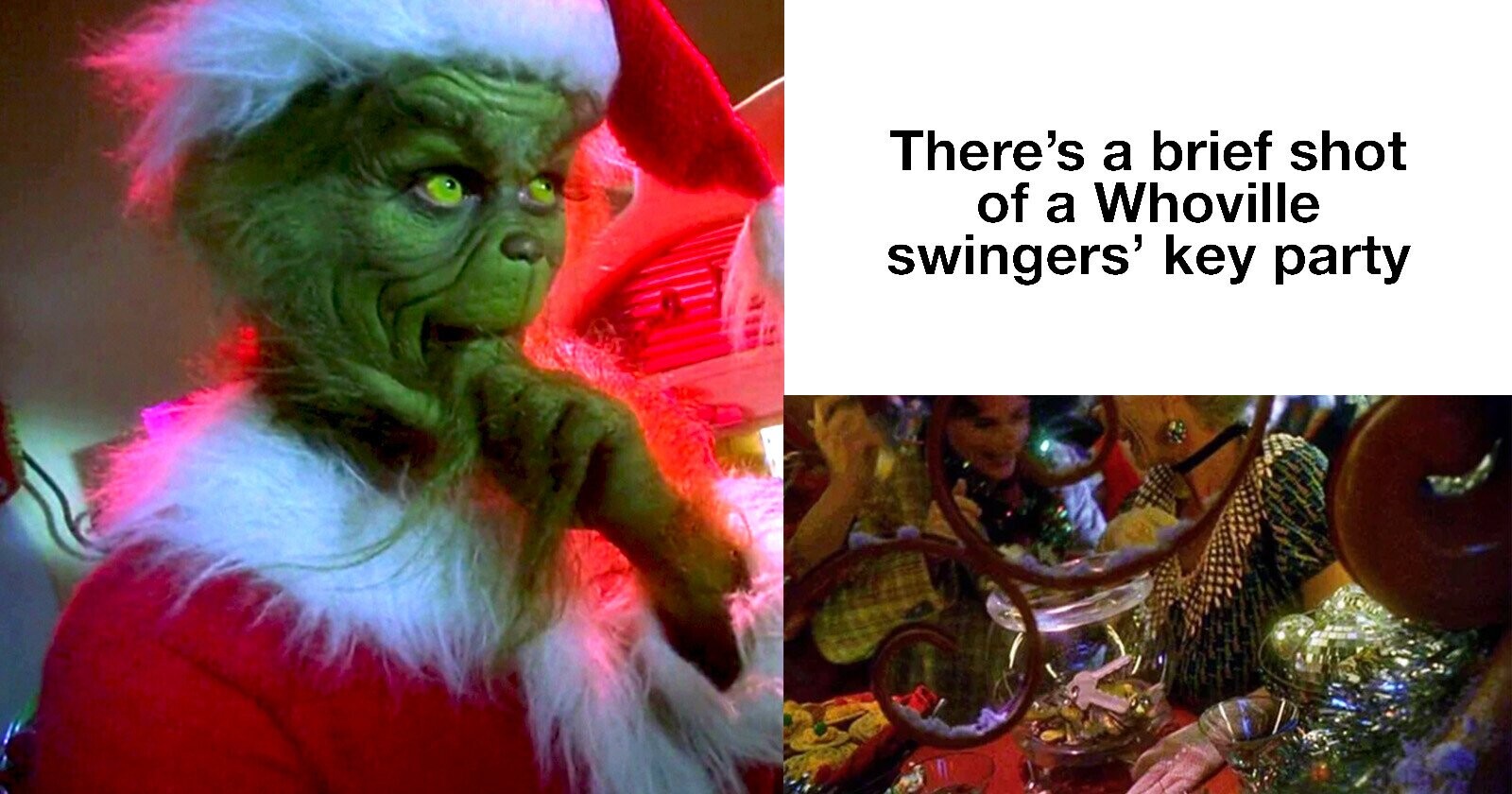
Then there is the infamous baby Grinch scene. In the film’s expanded mythology, Who babies arrive from the sky in little baskets. This whimsical idea sounds harmless enough until baby Grinch’s basket lands outside a house where adults are having a very festive party. Look closely, and the scene includes a bowl of keys, widely interpreted as a cheeky reference to a “key party,” an old pop-culture shorthand for partner-swapping.
Children miss it because children are busy processing the idea of airborne babies and tiny green Jim Carrey. Adults notice it and suddenly the whole room tilts. Why is this in a Dr. Seuss movie? Who approved the key bowl? Was Whoville always this socially adventurous? Does the town’s obsession with Christmas cheer have… other applications?
The joke is brief, but it changes the rewatch experience because it proves the movie is fully aware of its adult audience. Like many family comedies from the late 1990s and early 2000s, How the Grinch Stole Christmas sneaks in jokes that sail over children’s heads and land directly in the laps of parents who thought they were just renting a holiday movie. It is not subtle, exactly. It is just wrapped in enough tinsel to pass as innocent.
Jim Carrey’s Grinch Is Basically a Flirty Chaos Goblin
Jim Carrey’s performance is the reason the movie works, even when it absolutely should not. Under Rick Baker’s Oscar-winning makeup, Carrey turns the Grinch into a rubber-faced, growling, twitching, self-loathing vaudeville monster. He is bitter, yes, but he is also theatrical. He poses. He purrs. He lounges. He insults people like a nightclub comic trapped in a compost bin.
The performance is not “horny” in the simple sense. It is more like the Grinch has too much physical energy and no healthy place to put it. He flirts with danger, attention, applause, Martha, and his own reflection. During the Holiday Cheermeister sequence, he reenters Whoville and becomes the center of a bizarre public celebration. He eats, performs, dances, receives gifts, gets humiliated, and snaps. It is part awards-show parody, part trauma trigger, part emotional striptease in green fur.
The famous makeup process also adds another layer to the performance. Carrey endured heavy prosthetics, dyed yak hair, painful contacts, and long application sessions. Stories from the production describe the transformation as physically punishing, with the actor struggling through discomfort to deliver one of his most extreme performances. Knowing that makes the Grinch’s restless energy feel even more intense. He is literally trapped in a body that looks like a Christmas cryptid and performing as if escape depends on the next punchline.
Whoville Is a Consumerist Utopia With Bedroom Eyes
The 2000 film’s Whoville is one of the strangest holiday settings ever built for a major studio comedy. Production designer Michael Corenblith created a world with almost no straight lines, all curls, slopes, swirls, bulges, and frosting-like architecture. The sets reportedly took up multiple soundstages and turned Seuss’s simple drawings into a full-scale theme park of excess.
That visual design matters because the movie’s adult energy is not only in the dialogue. It is in the curves, colors, costumes, and competitive decorating. The houses lean and preen. The hairstyles rise like sculpted desserts. The Christmas lights are not simply hung; they are deployed like weapons in a suburban glamour war. Betty Lou Who and Martha May Whovier’s decorating rivalry turns homemaking into combat sport, and Martha’s light cannon is one of the most hilariously extra displays of domestic dominance ever put in a Christmas film.
Whoville is supposed to represent everything excessive about commercial Christmas. Yet it also becomes a town powered by vanity, display, social climbing, and romantic rivalry. Everyone is performing. Everyone is decorating. Everyone wants to be seen. That is why the Grinch’s outsider status cuts deeper in this version. He is not just excluded from Christmas; he is excluded from a whole culture of beauty, status, courtship, and public approval.
Why Adults Notice the Horniness More Now
When viewers watched How the Grinch Stole Christmas as kids, the adult jokes were background noise. Martha May was “the pretty lady.” The key bowl was just a bowl. The Grinch’s crush was a silly subplot. Mayor Augustus was a mean guy with hair that looked like it had its own tax bracket.
As adults, viewers bring more cultural context. They understand the key-party joke. They see how Martha is framed as an object of desire. They catch the way the film uses jealousy and romantic rejection to motivate the Grinch’s bitterness. They notice how many jokes depend on double meanings, body language, and social performance. Suddenly, a movie remembered as “the one with Jim Carrey yelling in green makeup” becomes “the one where Whoville has more sexual tension than several actual romantic comedies.”
This is also why the film has become a rewatch favorite despite mixed critical reception. Critics in 2000 often found it loud, grotesque, and overstuffed. They were not wrong. The movie is all of those things. But modern audiences often enjoy precisely that excess. It is not a delicate holiday ornament; it is an entire Christmas tree launched through a department-store window. Its weirdness gives it staying power.
Critical Reception vs. Holiday Legacy
When How the Grinch Stole Christmas opened in November 2000, reviews were divided. Many critics admired Carrey’s commitment but complained that the film was visually cluttered, tonally uneven, or too far removed from Seuss’s clean simplicity. Still, audiences showed up in huge numbers. The movie became a major box office hit, earning more than $350 million worldwide against a reported $123 million production budget.
It also won the Academy Award for Best Makeup, honoring Rick Baker and Gail Rowell-Ryan’s elaborate transformation work. That win makes perfect sense. Whatever one thinks of the movie’s tone, the makeup is unforgettable. It turns Carrey into a living cartoon while allowing enough facial movement for his expressions to punch through the latex, fur, and green rage.
Over time, the film’s reputation has softened. It is still not as universally beloved as the 1966 animated special, but it has become a holiday tradition for viewers who like their Christmas movies loud, strange, quotable, and slightly unhinged. In the streaming era, where nostalgia rewatches drive seasonal viewing, the movie’s adult jokes have become part of its appeal.
The Movie’s Real Theme: Desire, Rejection, and Belonging
Under the jokes, the camp, and the eyebrow-raising Whoville behavior, the 2000 Grinch is still about a familiar emotional wound: wanting to belong and pretending not to care. That is why the Martha subplot, silly as it is, actually works. The Grinch does not hate Christmas only because it is loud. He hates it because it reminds him of the community that rejected him.
His desire is not purely romantic. He wants Martha, yes, but he also wants recognition, apology, acceptance, and a way back into town without admitting he was hurt. Carrey plays that contradiction beautifully. The Grinch sneers at Whoville but watches it obsessively. He mocks the Whos but imitates them. He claims to despise their celebration but cannot stop staging his own private performances in the cave.
That emotional contradiction gives the film its surprising adult power. Many holiday movies say “Christmas is about love,” but this one adds, “Also, love is embarrassing, rejection is brutal, and sometimes you cope by building gadgets in a trash cave while roasting everyone’s fashion choices.” Honestly, relatable.
Is the Horniness a Flaw or the Secret Ingredient?
The strange adult energy of How the Grinch Stole Christmas can feel jarring because the source material is so pure. But it also gives the live-action version its identity. Without the romantic rivalry, the key-party gag, Martha’s glamour, Carrey’s body-language chaos, and Whoville’s theatrical vanity, the film might have been just another padded adaptation of a beloved book.
Instead, it became something much stranger: a family Christmas blockbuster that critiques consumerism while looking like a mall exploded, celebrates kindness while indulging in mean jokes, and teaches children about the true meaning of Christmas while giving adults a side quest in Whoville social psychology.
That does not make it better than the original book or the 1966 special. It makes it different. The live-action Grinch is not a clean cup of cocoa. It is cocoa with whipped cream, sprinkles, espresso, peppermint schnapps, and a suspicious lipstick mark on the mug.
Adult Rewatch Experience: The Grinch Hits Different After Childhood
Rewatching How the Grinch Stole Christmas as an adult is a uniquely chaotic holiday experience. The first ten minutes usually feel familiar and cozy. The snowflake appears. Anthony Hopkins narrates. Whoville glows like a candy store having a nervous breakdown. Then Jim Carrey arrives, and the childhood memory begins to mutate. The jokes are louder. The faces are weirder. The costumes are more dramatic. And somewhere between Martha May’s entrance and the baby Grinch flashback, the viewer realizes this movie was never as innocent as memory made it.
That is part of the fun. Childhood viewing is about surface-level wonder: the sleigh, Max, Cindy Lou Who’s hair, the mountain cave, the giant bag of stolen gifts. Adult viewing is about subtext. Why is the mayor proposing in public with a car? Why does Martha May look dressed for a Christmas gala no one else was invited to? Why are the Whos so competitive about decorations? Why does the Grinch behave like a bitter ex-theater kid who got banished from community college improv?
The rewatch experience also reveals how much of the movie’s humor depends on discomfort. The Grinch is uncomfortable in his body, uncomfortable with attention, uncomfortable with rejection, and uncomfortable with sincerity. Whoville is uncomfortable too, but in the opposite way: it is too polished, too bright, too eager to turn every feeling into a ceremony. The adult viewer sees that the movie is not just loud for the sake of being loud. Its noise is emotional camouflage.
There is also a generational pleasure in discovering the jokes parents probably noticed years ago. Many viewers who first saw the movie on VHS or cable now watch it with friends, partners, or their own families and experience a double reaction: nostalgia followed by disbelief. The key-bowl gag becomes a group pause-and-rewind moment. Martha’s styling becomes a full conversation. Carrey’s line deliveries suddenly sound less like random cartoon business and more like a comedian smuggling nightclub energy into a children’s film.
That makes the movie ideal for modern holiday culture, where audiences love revisiting supposedly innocent classics through adult eyes. It is not about ruining childhood. It is about discovering that the movies we grew up with were built for multiple audiences at once. Kids got the slapstick. Adults got the innuendo. Everyone got Max being adorable and underpaid.
In the end, the adult rewatch does not make How the Grinch Stole Christmas less magical. It makes it more bizarre, more textured, and somehow more entertaining. The film is still about a lonely creature learning that Christmas means more than presents. But it is also about beauty, jealousy, performance, flirtation, social pressure, and the deeply funny fact that Whoville may have been the most emotionally overcaffeinated town in Christmas cinema. The Grinch’s heart grew three sizes, yes. But the movie’s weirdness? That was always fully grown.
Conclusion
How the Grinch Stole Christmas is hornier than you remember because adulthood gives viewers the decoder ring. The Martha May Whovier subplot, the key-party wink, the romantic rivalry, the glamorous costumes, and Jim Carrey’s feral physical comedy all transform a simple Christmas fable into a campy, overdecorated, surprisingly adult holiday spectacle.
That is why the movie endures. It is messy, loud, sentimental, cynical, creepy, funny, and oddly romantic. It may not be the purest version of Dr. Seuss’s story, but it is unquestionably the version most likely to make an adult viewer spit cocoa across the room and ask, “Wait, was Whoville always like this?”
Note: This article is an original synthesis based on real film history, production reporting, box office records, critical reception, and widely discussed adult-viewer interpretations of Ron Howard’s 2000 live-action adaptation.