Every week in SaaS feels like someone shook a snow globe full of ARR targets, customer success dashboards, marketing funnels, and sales forecasts. One minute you are calmly checking pipeline coverage. The next, you are wondering whether your product-led growth motion needs an enterprise sales team, whether customer success should report to sales, and why your “simple” go-to-market plan now has seventeen tabs and a nervous-looking spreadsheet.
That is exactly why a strong SaaStr weekly roundup is useful. It gives founders, CEOs, CROs, CMOs, product leaders, and startup operators a fast way to catch up on the conversations that actually matter: scaling revenue, building durable teams, keeping customers, expanding upmarket, and learning from people who have already walked through the fire without pretending the fire was “a learning-friendly sauna.”
This week’s standout SaaStr content brings together lessons from Loom CEO Joe Thomas, Gainsight CEO Nick Mehta, Airtable CMO Archana Agrawal, Zoom CRO Ryan Azus, Postman CEO Abhinav Asthana, Upwork CEO Hayden Brown, and more. The common thread is simple: modern SaaS growth is no longer about one magic channel, one perfect hire, or one heroic founder speech. It is about systems. It is about discipline. And yes, it is also about not confusing “we are being scrappy” with “we forgot to build a real operating model.”
Why This SaaStr Weekly Roundup Matters
The best SaaStr content usually works because it is practical. It does not float above the clouds talking about “synergy” while founders are trying to figure out whether they can afford two more account executives. Instead, it focuses on the unglamorous but essential questions: How many sales reps do you really need? When should a SaaS company move upmarket? How do you build a marketing engine that scales? What does customer success look like when investors care about retention as much as new logo growth?
This week’s collection is especially valuable because it touches the full SaaS growth machine. Blog posts cover sales and marketing headcount, upmarket motion, internal career dynamics, SEO, and Twilio’s growth lessons. Podcasts cover product-led growth, async work, customer success, remote and freelance talent, and Postman’s product-led flywheel. Videos focus on marketing engines, sales velocity, hyper-growth marketing, team building, and scaling sales teams.
In plain English: this is not one topic. It is a map of what happens after a SaaS company survives the early chaos and needs to become a real business. The hoodie can stay. The random processes cannot.
The Big Theme: SaaS Growth Gets More Operational as You Scale
One of the strongest ideas in this week’s SaaStr content is that scale changes everything. Early-stage founders often think growth is mostly about product, hustle, and founder-led sales. That is true for a while. Then the company grows, and suddenly the calendar is full of pipeline reviews, customer success escalations, compensation planning, onboarding gaps, marketing attribution debates, and one very tired person asking, “Who owns this?”
SaaStr’s discussion around sales and marketing headcount is a useful reality check. As SaaS companies scale, sales and marketing can become a major share of both team size and cost structure. That may sound heavy, but for many sales-led SaaS businesses, it is simply the math of growth. If bookings depend on trained sales capacity, then a company cannot magically hit aggressive targets with three reps, a motivational Slack message, and vibes.
Sales and Marketing Are Not Optional Decorations
Many founders love the idea of “efficient growth,” but some secretly translate that into “let’s under-hire revenue roles and hope the product becomes famous on a Tuesday.” A product can be excellent and still need distribution. A category can be hot and still need positioning. A pipeline can look healthy and still collapse if there are not enough skilled people moving deals forward.
The lesson is not to hire randomly. The lesson is to model revenue capacity honestly. If a company wants to grow new ARR, it needs to understand quota capacity, ramp time, conversion rates, marketing-sourced pipeline, expansion motion, and churn risk. Otherwise, the annual plan becomes business fan fiction.
Lesson From Loom: Async Work Is a Growth Strategy, Not Just a Calendar Hack
Loom’s story fits perfectly into the modern SaaS conversation because it reflects a shift in how teams communicate. Async video is not just about avoiding meetings, although let’s be honest, avoiding a few meetings can feel like discovering indoor plumbing. The deeper idea is that teams need better ways to transfer context across time zones, departments, and increasingly distributed organizations.
Joe Thomas and Loom’s rise highlight a powerful SaaS principle: when a product removes friction from a daily workflow, adoption can spread quickly. Loom made it easier for people to explain, demo, teach, update, and unblock without forcing everyone into the same live call. That matters in product teams, sales teams, support teams, onboarding, leadership communication, and customer education.
The broader takeaway for SaaS founders is that workflow products win when they reduce coordination cost. The best tools do not merely add another dashboard. They make work feel lighter. They help teams move faster without making everyone live inside a calendar invite called “Quick Sync,” which, as history shows, is rarely quick.
Lesson From Gainsight: Customer Success Is Now Core Revenue Strategy
Nick Mehta and Gainsight have long been associated with the rise of customer success as a board-level SaaS discipline. That is important because SaaS companies do not win only when customers sign. They win when customers stay, expand, adopt more deeply, and become proof that the product creates durable value.
This week’s Gainsight-related content reinforces a key point: customer success is not a support function with nicer slide decks. It is part of the growth engine. Investors and executives care about net revenue retention, gross retention, adoption signals, time to value, expansion potential, and early warning indicators. In other words, customer success has moved from “make customers happy” to “make value measurable, repeatable, and expandable.”
Retention Is the Quiet Compounder
New customers are exciting. Retained customers are powerful. Expanded customers are where SaaS math starts putting on sunglasses indoors. A company with strong retention can build a much more durable business than one constantly replacing churned customers with expensive new logos.
The practical lesson is clear: customer success should be designed early, not patched in later like a software update after a bug report. That means clear onboarding, health scoring, executive business reviews where appropriate, product usage visibility, and a shared definition of customer value. If your customer success team is only learning about problems when the renewal is already on fire, the process needs work.
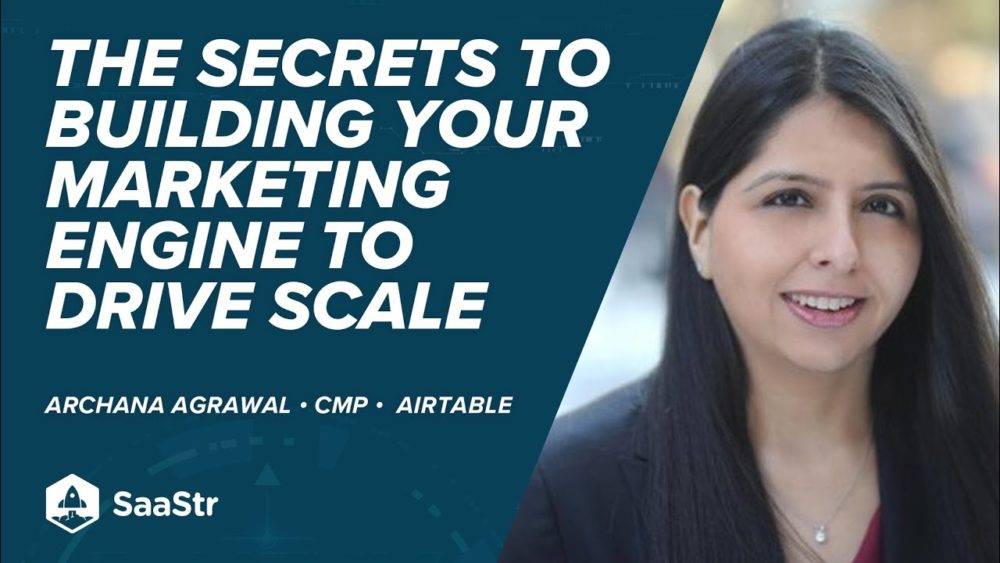
Lesson From Airtable: Build a Marketing Engine, Not a Confetti Cannon
Airtable CMO Archana Agrawal’s SaaStr video points to one of the most misunderstood areas in SaaS: marketing at scale. Early marketing can look like launches, campaigns, content experiments, founder posts, and a lot of creative improvisation. But as a company grows, marketing needs to become an engine.
A real SaaS marketing engine connects positioning, demand generation, lifecycle marketing, product education, sales enablement, customer stories, events, community, and brand. That is a lot. It is also why “just publish more content” is not a strategy. That is a treadmill with a newsletter.
Airtable’s broader market position also makes this lesson interesting. The company has evolved beyond a simple “spreadsheet-plus-database” explanation into a platform for workflows, apps, automation, and AI-powered work. That kind of category evolution requires careful messaging. When a product can serve many teams, marketing has to make the value feel specific, not vague.
The Best Marketing Makes Complexity Feel Simple
Great SaaS marketing does not list every feature like a restaurant menu written by an engineer. It helps the buyer understand why the product matters now, what problem it solves, how it fits into existing work, and what outcome it creates. Airtable is a strong example of a product that can be used by marketing, product, operations, sales, and project teams, which means the messaging must be flexible without becoming mushy.
The takeaway for SaaS leaders: the more powerful your product becomes, the more disciplined your marketing must be. Complexity may impress internal teams, but clarity sells.
Lesson From Zoom CRO Ryan Azus: Scaling Sales Requires Focus, Not Just Headcount
Zoom’s growth story remains one of the most memorable examples in modern SaaS, especially because the company had to scale demand, infrastructure, support, and revenue operations under intense pressure. Ryan Azus, who served as Zoom’s CRO, is often associated with the company’s rapid sales expansion and operational discipline.
The SaaStr video on scaling sales teams points to a lesson that every founder eventually learns: adding reps is not the same as scaling sales. A real sales organization needs segmentation, enablement, forecasting, management layers, compensation design, customer handoff processes, and a clear understanding of which deals are actually worth chasing.
The painful version of this lesson arrives when a company hires aggressively before it has a repeatable motion. Then the team gets bigger, burn increases, win rates wobble, and everyone starts using phrases like “pipeline hygiene” with the facial expression of someone reading a medical bill.
The Four Sales Questions Leaders Should Ask
Before scaling sales, SaaS leaders should ask four simple questions. First, do we know our ideal customer profile? Second, can we repeatedly convert that customer through a defined sales motion? Third, do reps ramp predictably? Fourth, does the customer stay and expand after the sale?
If the answer is yes, sales hiring can accelerate growth. If the answer is no, hiring more reps may simply multiply confusion. Zoom’s sales lessons are useful because they emphasize execution, not theater. A polished sales deck is nice. A repeatable revenue machine is better.
Product-Led Growth: Powerful, But Not Magical
The roundup also highlights product-led growth through SaaStr CEO Jason Lemkin and Postman CEO Abhinav Asthana. Product-led growth is one of the most important SaaS motions of the last decade, but it is often oversimplified. Some teams treat PLG as if the product will acquire, educate, convert, retain, and expand users while the company watches approvingly from a beanbag chair.
In reality, great PLG requires intentional product design, onboarding, activation loops, usage-based signals, pricing strategy, community, developer or user advocacy, and often a sales-assist motion when accounts become larger. Postman is a strong example because it grew from deep user adoption among developers into a broader API platform used across teams and organizations.
The lesson is that PLG is not the absence of go-to-market. It is a different kind of go-to-market. The product carries more of the burden, but the company still needs strategy, packaging, lifecycle communication, and a plan for expansion.
Twilio, Upwork, Klaviyo, and Waze: Different Models, Same Discipline
This SaaStr roundup also includes lessons from companies with very different growth motions. Twilio represents API-first infrastructure and developer adoption. Upwork represents marketplace dynamics and flexible talent. Klaviyo represents marketing automation and B2C customer engagement. Waze brings sales lessons from SMB motion and enablement.
What ties them together is operational discipline. Twilio’s growth shows how developer-first adoption can become a major business when usage, reliability, and platform expansion align. Upwork’s story shows that workforce flexibility is not a side topic; it can become the core of a company’s operating model. Klaviyo’s marketing growth demonstrates the value of deeply understanding a customer segment and building channels around measurable outcomes.
For SaaS operators, the useful insight is not to copy another company’s playbook blindly. Twilio’s playbook is not Airtable’s playbook. Zoom’s playbook is not Gainsight’s playbook. The point is to understand the principles underneath: clear customer value, repeatable distribution, strong retention, disciplined leadership, and the ability to evolve as the market changes.
Why Moving Upmarket Keeps Appearing in SaaS
Another major theme in the SaaStr content is the tendency for many SaaS companies to move upmarket over time. This happens because larger customers can offer bigger contracts, stronger expansion potential, and more predictable revenue. But upmarket growth also brings heavier requirements: security reviews, procurement, implementation support, integrations, admin controls, compliance, and executive-level selling.
For founders, this is both exciting and mildly terrifying. A small business may buy with a credit card. An enterprise buyer may bring legal, security, finance, IT, procurement, and someone named Dennis who has strong opinions about single sign-on. The revenue can be larger, but the organization must mature to support it.
The best SaaS companies do not stumble upmarket accidentally. They adapt pricing, packaging, customer success, support, product roadmap, and sales process. They also protect what made the product attractive in the first place. Moving upmarket should not turn a simple product into a bloated creature that frightens its original users.
The Career Lesson Hidden in the Roundup
One of the listed blog posts asks what to do when your boss may hire a VP above you. That may sound like a personal career issue, but it is also a scaling issue. As startups grow, roles change. The person who built the first version of a function may not always be the person who leads it at 10x complexity.
This is difficult, but it is normal. Strong operators do not treat every senior hire as an insult. They ask better questions: What can I learn from this person? Will this help the company grow? Is my role expanding or shrinking? Can I own a clearer area of impact? Am I being layered because the company is scaling, or because I am not keeping up?
That last question is uncomfortable, but useful. Startup careers grow fastest when people stay honest about the gap between current skill and next-stage needs. Sometimes the right move is to learn under a more experienced leader. Sometimes it is to negotiate scope. Sometimes it is to find a company stage that fits better. The key is not to panic just because the org chart learned a new trick.
SEO Still Matters, Even in the Age of AI and Social Noise
The SaaStr roundup also includes a post about SEO still working its magic. That point deserves attention because SaaS teams often chase whatever channel is loudest this quarter. Paid ads get expensive. Social algorithms change moods like cats. Events can work, but they require serious effort. SEO, meanwhile, keeps quietly compounding when done well.
Good SEO for SaaS is not keyword stuffing. It is helpful content mapped to real buyer questions. It includes educational pages, comparison content, integration pages, templates, use cases, technical documentation, thought leadership, and customer stories. The best SaaS SEO strategy helps users solve problems while creating durable search visibility.
In a market crowded with AI-generated sameness, original expertise matters more, not less. The winning content will be specific, credible, experience-based, and useful. In other words, content should sound like it came from someone who has actually been in the meeting, not someone who summarized the meeting agenda.
Practical Experiences: How to Use This SaaStr Roundup Like an Operator
The most useful way to read a SaaStr roundup is not to skim the headlines and say, “Interesting,” before returning to twelve browser tabs and a cold coffee. The better approach is to turn each piece of content into an operating question for your own business.
Start with the sales and marketing headcount lesson. Open your revenue plan and ask whether your hiring model matches your ARR target. If the plan assumes five reps can do the work of ten, do not call that efficiency. Call it what it is: a future board meeting with dramatic lighting. Look at ramp times, quota capacity, pipeline sources, win rates, and manager bandwidth. A sales plan should survive contact with reality.
Next, use the Loom lesson to audit communication. How many meetings exist only because documentation is weak? How many customer handoffs could be improved with short async videos? How many product updates disappear because they were explained once on a call nobody can find? Async work is not about eliminating human connection. It is about reserving live time for the work that truly needs live discussion.
Then apply the Gainsight lesson to customer success. Pick five recent churned or unhappy accounts and trace the warning signs. Did usage decline? Did the champion leave? Was onboarding incomplete? Did the customer never reach the promised business outcome? This exercise is not glamorous, but it is powerful. Churn usually leaves footprints before it kicks down the door.
For marketing, borrow from the Airtable theme and ask whether your message is clear enough for a busy buyer. Can a visitor understand your product, audience, use case, and value within seconds? Are your campaigns connected to pipeline and retention, or are they just making noise in professionally designed colors? A marketing engine should create momentum across the full funnel, not just applause for launch week.
For sales leadership, use the Zoom CRO lesson to inspect your scaling readiness. Do reps know which accounts to prioritize? Is enablement practical? Are managers coaching or only forecasting? Is the handoff from sales to customer success clean? Growth exposes weak systems. The sooner you fix them, the less expensive they become.
For product-led growth, study Postman and remember that user love is only the beginning. Activation, collaboration, team adoption, admin value, and expansion paths must be intentionally designed. A great free or self-serve product can create massive reach, but revenue comes from converting usage into organizational value.
Finally, use the upmarket discussion carefully. Do not chase enterprise customers just because the contract sizes look handsome in a spreadsheet. Ask whether your product, support, security, integrations, and implementation motion are ready. Enterprise revenue is wonderful, but enterprise expectations arrive wearing steel-toed boots.
The best experience-based lesson from this roundup is simple: SaaS growth is a series of tradeoffs. More sales capacity can increase revenue, but only if the motion works. PLG can lower friction, but only if activation is strong. Enterprise can expand ACV, but only if the company can serve larger customers. Customer success can drive retention, but only if value is visible and measurable. Marketing can scale demand, but only if positioning is sharp.
That is why SaaStr content remains useful for operators. It does not offer a fantasy where one tactic saves the company. It shows the messy, connected reality of SaaS growth. The companies featured in this week’s roundup succeeded in different ways, but they all point toward the same conclusion: growth is not magic. It is disciplined learning, repeated until the business gets stronger.
Conclusion
This week’s top SaaStr content is a compact masterclass in how SaaS companies grow beyond the early stage. Loom shows the power of async communication. Gainsight reinforces the importance of customer success and retention. Airtable demonstrates why marketing must become a scalable engine. Zoom’s revenue leadership lessons show that sales growth requires structure, not just hiring. Postman, Twilio, Upwork, Klaviyo, and others add more proof that successful SaaS companies win by building systems around real customer behavior.
For founders and operators, the message is both encouraging and inconvenient. There is no single shortcut. But there are patterns. Understand your customer. Build repeatable distribution. Invest in retention. Hire for the stage you are entering, not only the stage you survived. Keep messaging clear. Make growth measurable. And when in doubt, remember that “we will figure it out later” is not a strategy; it is a calendar invite from future pain.
Note: This article is an original editorial synthesis based on publicly available SaaStr weekly content and related company/operator information. It is written for web publishing and does not reproduce source material.