Note: This article is based on public, non-operational information about U.S. Army modernization, NATO defense posture, and Stryker armored vehicle upgrades. It is written for general readers and avoids tactical instructions.
The U.S. Army’s Stryker armored vehicles have always occupied an interesting middle lane in modern warfare. They are not hulking main battle tanks, and they are not light pickup trucks with camouflage paint and big dreams. They are fast, eight-wheeled armored vehicles designed to move infantry quickly, survive rough conditions, and give commanders flexible options across a sprawling battlefield. In Europe, where roads, borders, forests, towns, and NATO logistics all matter, that flexibility is not a small thing. It is the whole sales pitch.
Now the Army is making Strykers more lethal, more protected, and more relevant for a security environment shaped by Russia’s aggression in Ukraine, renewed concern on NATO’s eastern flank, and the uncomfortable return of large-scale land warfare to Europe. The phrase “deadlier Stryker armored vehicles” may sound like a movie trailer voice-over, but the shift is real: bigger cannons, better sensors, anti-armor capability, short-range air defense variants, and upgraded survivability are all part of the broader modernization push.
The goal is not simply to create a louder vehicle. Any teenager with a subwoofer can do that. The real objective is deterrence. A stronger Stryker force in Europe tells Moscow that NATO’s forward-deployed and rapidly reinforcing units are not symbolic traffic cones. They can move, see, communicate, defend themselves, and hit harder than older versions could.
Why the Stryker Matters in Europe
The Stryker family was designed to give the Army a medium-weight force: more protected and better armed than light infantry, but easier to deploy and sustain than heavy armored brigades built around tanks and Bradley fighting vehicles. That balance matters in Europe because NATO defense is not only about who has the biggest vehicle. It is also about who can move across bridges, railheads, highways, border crossings, and training areas quickly enough to be useful before a crisis becomes a catastrophe.
Europe is a geography problem wearing a military uniform. A unit may need to move from Germany to Poland, train in the Baltics, support allies in Romania, or operate with multinational forces in North Macedonia. Wheeled armored vehicles have advantages in that environment. They can cover long distances on roads with less logistical strain than heavier tracked vehicles, and they can plug into allied exercises without turning every paved route into a maintenance soap opera.
The 2nd Cavalry Regiment, based in Germany, has long been one of the most visible U.S. Stryker formations in Europe. Its mission has included reassuring NATO allies, participating in exercises across the continent, and showing that the United States can keep credible land power forward in Europe even after the huge Cold War garrisons disappeared. But reassurance works better when the reassuring force has teeth. That is why the Army began looking at how to give Stryker formations more punch.
From Mobile Infantry Carrier to Heavier Hitter
Earlier Stryker infantry carrier vehicles were useful, but their weapons fit a different era. They were designed mainly to move soldiers under armor and provide supporting fire, not to duel with heavily armored threats. As Russia modernized parts of its ground forces and demonstrated a willingness to use military power near NATO borders, the Army faced an obvious question: should a forward-deployed Stryker unit in Europe carry more firepower?
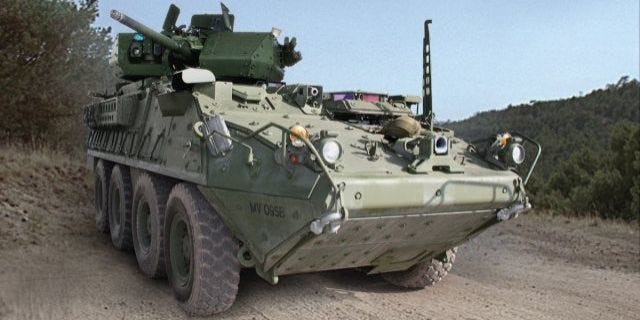
The answer was yes, followed closely by, “and please hurry.” The Army responded with up-gunned Stryker variants, most famously the Infantry Carrier Vehicle-Dragoon, which added a 30mm cannon to give Stryker units a much stronger direct-fire capability. The difference is not cosmetic. A heavier cannon changes what the vehicle can do against light armor, fortified positions, and battlefield obstacles. It also gives crews more options at a distance, without pretending the Stryker has magically become an Abrams tank after drinking a protein shake.
Some Stryker modernization efforts have also included anti-armor missile integration and improved remote weapon systems. The strategic logic is clear: if U.S. soldiers in Europe may face a battlefield with armored vehicles, drones, artillery, electronic warfare, and fast-moving threats, their vehicles need more than yesterday’s tool kit.
The 30mm Cannon: Why Bigger Firepower Changes the Equation
The 30mm cannon is one of the most important upgrades because it gives the Stryker a stronger bite while preserving the vehicle’s core mobility. Instead of relying mainly on lighter weapons, the up-gunned Stryker can deliver more effective fire against a wider set of battlefield targets. That matters for units expected to screen, scout, maneuver, and protect infantry in complex terrain.
In practical terms, the upgrade gives commanders more flexibility. A Stryker platoon with 30mm firepower can respond to threats that older vehicles were less suited to handle. It can support dismounted soldiers more effectively and contribute to a larger defensive plan. It also complicates an adversary’s calculations. A force that once looked relatively light begins to look more expensive to challenge.
That is the heart of deterrence: not promising that one vehicle can win a war, but making every step of aggression look riskier, slower, and more costly. A better-armed Stryker does not need to be invincible. It only needs to make the opponent’s plan uglier.
M-SHORAD: The Stryker Gets an Air Defense Job
One of the most important lessons from recent conflicts is that the sky above the battlefield is crowded. Drones, helicopters, loitering munitions, cruise missiles, and low-flying aircraft have made short-range air defense a front-line concern again. For years after the Cold War, the U.S. Army reduced many of its short-range air defense capabilities because it often operated with overwhelming air superiority. Europe forced a rethink.
The Maneuver Short Range Air Defense system, commonly called M-SHORAD, uses the Stryker A1 platform as the base for a mobile air defense vehicle. Instead of asking maneuver forces to hope the skies stay friendly, M-SHORAD gives units a way to defend themselves against certain aerial threats while keeping pace with ground formations. In plain English: it is air defense that can move with the people who need defending.
This matters enormously in Europe. Russian forces have used drones extensively in Ukraine for reconnaissance, targeting, and attacks. NATO planners are paying attention. A Stryker formation that can only think horizontally is incomplete; modern forces must think vertically too. The threat may come from a road, a treeline, a ridge, or a small unmanned aircraft overhead doing the world’s least welcome weather report.
Protection Upgrades: Surviving the Battlefield’s Bad Mood
Firepower gets attention because it photographs well. Protection is less glamorous but equally important. The Stryker A1 and double-V hull upgrades reflect years of battlefield experience, especially the need to improve crew survivability against mines and roadside bombs. The vehicle family has evolved because the Army learned, sometimes painfully, that mobility alone is not enough.
In Europe, protection has a different context than in Iraq or Afghanistan, but the principle remains the same: soldiers need vehicles that can absorb punishment, move through danger, and keep crews alive long enough to complete the mission. Upgraded power systems, improved suspension, better hull designs, and enhanced sensors all contribute to that goal.
Modern armored vehicles are no longer just engines wrapped in steel. They are rolling networks of cameras, radios, computers, sensors, weapons stations, and protection systems. The Stryker’s future depends on how well it can carry that digital burden without losing the mobility that made it valuable in the first place.
Why Russia Is the Strategic Driver
Russia’s annexation of Crimea in 2014 and full-scale invasion of Ukraine in 2022 changed the European security conversation. NATO members that once treated large conventional war as a dusty Cold War memory suddenly had to face a modern version of it on the continent. Tanks, artillery, trenches, drones, air defense, logistics, and mass mobilization all returned to the front page.
For the U.S. Army, that means European deterrence is no longer a ceremonial deployment with nice flags and awkward group photos. It is a serious readiness problem. Units must train with allies, move across borders, integrate communications, and prepare for a fight that could be fast, chaotic, and technologically dense.
Upgraded Strykers support that strategy. They give U.S. Army Europe and Africa a mobile armored force that can operate with NATO partners and respond quickly to regional crises. They also show that the United States is not only sending speeches across the Atlantic. It is sending capability.
NATO Interoperability: The Boring Word That Wins Wars
Interoperability is one of those words that sounds like it was invented by a committee trapped in a conference room. But it matters. NATO forces need to communicate, refuel, repair, transport, and fight together. If one country’s vehicles, radios, ammunition, and procedures cannot work with another’s, an alliance becomes a group chat with wheels.
Stryker units in Europe frequently train with allied forces in multinational exercises. These events are not just military theater. They help commanders understand how units move, how logistics hold up, how communications perform, and how different national forces coordinate under pressure. The more capable the Stryker becomes, the more useful it is inside that NATO framework.
The Stryker is also relevant because some NATO members have purchased or considered U.S.-made armored vehicles as they modernize older Soviet-era fleets. This does not make every allied army a clone of the U.S. Army, but it does support a broader trend: NATO countries want equipment that can plug into alliance operations more easily.
Lessons From Ukraine: Drones, Artillery, and the Need to Adapt
The war in Ukraine has reinforced several hard truths. First, armored vehicles remain important, but they cannot operate alone. Second, drones have changed how forces are seen, targeted, and attacked. Third, artillery and long-range fires can punish anything that sits still too long. Fourth, logistics is not the boring back office of war; it is the bloodstream.
For Stryker modernization, these lessons point in the same direction: better sensors, stronger communications, mobile air defense, improved protection, and more lethal weapons. A vehicle that cannot detect threats, share information, or defend itself against modern battlefield dangers becomes a very expensive appointment with trouble.
At the same time, no upgrade turns the Stryker into a miracle machine. It is still a wheeled armored vehicle with trade-offs. It is more mobile than heavier tracked armor in many conditions, but it is not built to replace tanks in the heaviest fights. The Army’s challenge is to use Strykers where their strengths matter and avoid pretending they are something they are not.
The Limits of a Deadlier Stryker
Every military platform has limits. The Stryker’s great strength is mobility, but its protection and firepower are still different from heavy armored vehicles. Adding a 30mm cannon and air defense systems makes the vehicle more capable, not magical. It will still depend on infantry, engineers, artillery, aviation, electronic warfare support, logistics, and allied coordination.
This is why the phrase “deadlier Stryker” should be understood carefully. It does not mean the Army is building a one-vehicle solution to Russia. It means the Army is improving a platform that already fits Europe’s mobility requirements and giving it tools better suited to the threats of 2026 and beyond.
The smartest modernization programs do not chase shiny technology for its own sake. They solve real operational gaps. In this case, those gaps include direct-fire lethality, short-range air defense, battlefield awareness, and survivability. The Stryker upgrades are not flashy science fiction. They are practical responses to an increasingly dangerous neighborhood.
Why This Matters for Deterrence
Deterrence is often misunderstood. It is not just about having weapons. It is about convincing a potential aggressor that the cost of attack would be too high, the outcome too uncertain, and the response too coordinated. In Europe, deterrence depends on visible forces, credible readiness, and the ability to reinforce quickly.
Upgraded Strykers help with all three. They are visible in exercises. They are credible because they bring improved firepower and air defense. They support reinforcement because wheeled formations can move across Europe’s road networks faster and with a smaller logistical footprint than many heavier formations.
For NATO allies near Russia, that visibility matters. A Stryker convoy rolling through a training area in Poland or Germany is not just a collection of vehicles. It is a message: the alliance is present, practicing, and improving. In deterrence, the message is part of the mission.
What Readers Should Watch Next
The future of the Stryker in Europe will likely depend on several trends. The first is the continued spread of drones and counter-drone systems. The second is how quickly the Army can field and sustain upgraded variants across units. The third is whether the Stryker can keep enough mobility while carrying more sensors, armor, weapons, and power demands. The fourth is how well these vehicles integrate into NATO’s larger defense plans.
Another question is whether the Army will keep refining the balance between medium forces and heavy armor. Europe needs both. Tanks and heavy infantry fighting vehicles still matter in high-intensity combat. But medium forces like Stryker brigades give commanders speed and flexibility. The best defense posture is not one tool. It is a toolbox where the hammer, wrench, and very expensive armored screwdriver all know their jobs.
Experience-Based Reflections: What the Deadlier Stryker Story Feels Like on the Ground
To understand why upgraded Strykers matter, imagine the experience from several angles: the soldier inside the vehicle, the allied officer watching a multinational exercise, the civilian seeing a convoy pass through a European town, and the planner trying to move forces across a continent. Each perspective reveals something different about why the Army is investing in a deadlier, more survivable Stryker fleet.
For soldiers, the upgrade is not an abstract defense-budget paragraph. It changes confidence. A crew that knows its vehicle has stronger sensors, better protection, and more useful firepower can focus on teamwork rather than quietly wondering whether the equipment belongs to a previous decade. Soldiers do not need a vehicle to be perfect. They need it to be reliable, understandable, maintainable, and capable enough to give them a fair chance in a dangerous environment.
Training with a modernized Stryker also changes the rhythm of a unit. Crews must learn how the vehicle sees, communicates, moves, and supports dismounted infantry. Maintenance teams must understand new systems. Leaders must practice how to combine Strykers with scouts, infantry, air defense, engineers, and allied units. None of that sounds glamorous, but military readiness is often built from unglamorous repetition. The parade photo is the easy part. The real work happens when something breaks in the rain and everyone still has to make the schedule.
For NATO partners, the upgraded Stryker is a sign that the United States is adapting to European realities. Allies do not only listen to speeches; they watch exercises, equipment, logistics, and follow-through. When U.S. units arrive with better-protected and better-armed vehicles, it signals that Washington understands the threat environment has changed. That helps reassure allies who live much closer to Russia than most Americans do.
For civilians in Europe, Stryker convoys can be both ordinary and symbolic. In parts of Germany, Poland, and the Baltics, military movement is not new. Still, seeing U.S. armored vehicles on roads or training grounds reminds people that security is not theoretical. It has tires, radios, soldiers, fuel trucks, and paperwork. Probably too much paperwork. But it also represents a promise that NATO defense is more than a treaty in a folder.
For planners, the Stryker offers a practical compromise. Heavy armor is powerful but demanding. Light infantry is flexible but vulnerable. Stryker units sit between those extremes. In a crisis, being able to move quickly across roads, integrate with allies, and arrive with meaningful protection and firepower can make the difference between a symbolic response and a useful one.
The experience of watching Stryker modernization is also a reminder that armies learn slowly, then suddenly. For years, short-range air defense looked less urgent. Then drones and modern aerial threats made it urgent again. For years, medium armored vehicles seemed adequate with lighter weapons. Then Russia’s behavior in Europe made more firepower look necessary. The Stryker story is not about one vehicle becoming famous. It is about an army relearning what a dangerous continent demands.
The best way to view the deadlier Stryker is not as a superhero vehicle, but as a serious upgrade to a serious tool. It will not solve every problem in Europe. It will not replace tanks, aircraft, artillery, logistics, or diplomacy. But it makes U.S. ground forces in Europe more credible, more flexible, and harder to ignore. In deterrence, that is exactly the point.
Conclusion
The Army’s push to field deadlier Stryker armored vehicles in Europe reflects a larger shift in U.S. defense thinking. Russia’s actions have reminded NATO that land power still matters, armored mobility still matters, and readiness cannot be improvised after a crisis begins. Up-gunned Strykers, M-SHORAD air defense variants, improved protection, and better sensors all contribute to a stronger forward posture.
The Stryker remains a vehicle of trade-offs. It is not a tank, and it should not be judged as one. Its value lies in mobility, adaptability, and the ability to give medium forces more credible combat power. In Europe, where speed, roads, alliances, and deterrence all intersect, that value is significant.
Ultimately, the deadlier Stryker is less about chasing firepower for its own sake and more about making deterrence believable. A better-armed, better-protected, better-connected force is harder to intimidate. And in a Europe facing renewed Russian pressure, that may be the most important upgrade of all.