The 2021 Hackaday Prize: Rethink, Refresh, And Rebuild arrived at exactly the kind of moment when hardware hackers do their best work: everything was slightly broken, everyone had a drawer full of parts, and nobody could agree whether the dining table was still a dining table or now a full-time electronics bench. In other words, it was perfect.
Launched in May 2021, the eighth Hackaday Prize challenged the global open-source hardware community to look at familiar problems with fresh eyes. Instead of asking makers to build gadgets for the sake of gadgetry, the contest pushed them toward impact: better displays, better work-from-home tools, more accessible supportive technology, more imaginative robots, and wildcard inventions that did not fit neatly into a labeled storage bin. Every good hackerspace has at least one of those bins. It is usually marked “miscellaneous,” which is engineer-speak for “future Nobel Prize or mild fire hazard.”
The result was a hardware design competition that felt very much like its year. The world had been forced to rethink communication, education, home offices, health, mobility, accessibility, and resilience. The 2021 Hackaday Prize turned that pressure into a creative prompt: do not simply restore the old system; rebuild it smarter.
What Was the 2021 Hackaday Prize?
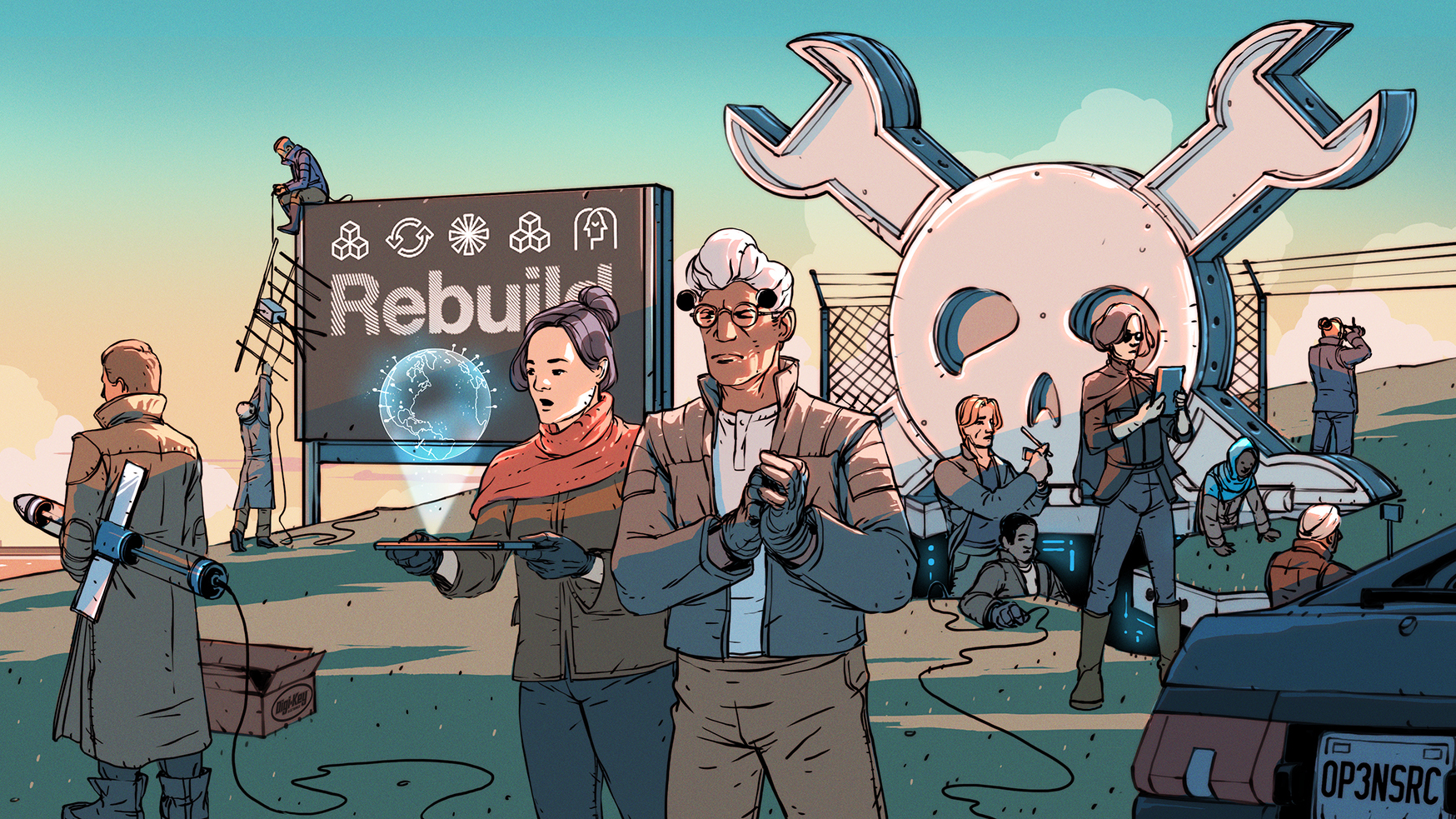
The Hackaday Prize is one of the best-known open hardware competitions for engineers, designers, scientists, students, artists, tinkerers, and wonderfully stubborn people who believe a prototype is just a conversation starter with wires. The 2021 edition centered on the theme “Rethink, Refresh, Rebuild,” a call to revisit everyday technologies and redesign them for a world that had changed dramatically.
Open-source hardware was central to the spirit of the contest. In practical terms, that means more than posting a glamour shot of a circuit board and saying, “Trust me, it works.” Strong open hardware projects share design files, documentation, software, build notes, material choices, and enough context for others to study, modify, reproduce, and improve the work. The best entries did not just say, “Look what I made.” They said, “Here is how you can make it better.”
The competition structure was straightforward but ambitious. There were five themed challenges, each with ten finalists. Those finalists each received a cash award and moved into consideration for the overall prize. At the top, the grand prize offered $25,000 and a Supplyframe DesignLab residency, with additional prizes for second through fifth place. The money mattered, of course; parts are not free, and neither are replacement soldering iron tips after someone uses them on acrylic. But the bigger reward was visibility, feedback, and a chance to turn a promising project into something durable.
The Five Challenges: A Tour of the Hardware Playground
1. Rethink Displays
Displays are everywhere, but most of them follow the same basic logic: shine rectangles at human eyeballs until someone checks a notification they did not need. The Rethink Displays challenge asked makers to imagine more useful, subtle, playful, or accessible ways to communicate information.
Projects in this category explored ideas such as volumetric displays, infrared mirrors, laser-based display systems, augmented-reality concepts, and unconventional visual interfaces. The key idea was not merely to make another screen. It was to ask what information actually needs to be displayed, where it should live, how much attention it should demand, and whether a wall, mirror, sculpture, fabric, or object could communicate better than a glowing slab.
This is where the 2021 theme really started to shine. “Rethink” did not mean “add Wi-Fi to a toaster and call it a day.” It meant questioning habits. Does every reminder need to arrive as a phone alert? Could a room communicate air quality? Could a decorative object also deliver useful data? Could an old display technology gain a second life instead of becoming e-waste with a sad ribbon cable?
2. Refresh Work-From-Home Life
By 2021, many people had learned that working from home was less “freedom in sweatpants” and more “why is my laptop balanced on a cookbook?” The Refresh Work-From-Home Life challenge focused on tools that improved productivity, comfort, communication, lighting, presence, ergonomics, and sanity.
Finalist projects included ideas around air quality monitoring, meeting availability indicators, improved lighting, custom input devices, electronics workbench tools, and productivity aids. This category was practical in the best possible way. A clever work-from-home device does not need to look like science fiction. Sometimes it just needs to stop family members from walking behind you during a video call while carrying laundry like a dramatic flag of surrender.
The broader lesson was that home became infrastructure. A bedroom corner became an office. A garage became a lab. A kitchen table became a classroom. Hardware hackers responded by building small systems that made those hybrid spaces easier to use.
3. Reimagine Supportive Tech
The Reimagine Supportive Tech challenge may have been the most human-centered part of the 2021 Hackaday Prize. Supportive and assistive technologies help people communicate, move, learn, sense, create, and participate more independently. Good design here is not about showing off; it is about listening.
Finalists included projects such as portable Braille reading concepts, communication boards, eye-to-speech systems, bio-signal platforms, accessible input devices, spectrometers for education, and FlowIO, the eventual grand prize winner. The category showed how open hardware can reduce barriers. When a design is documented and adaptable, it can be modified for specific bodies, budgets, environments, and needs.
This matters because assistive technology is not a niche concern. People of all ages may need supportive devices temporarily or permanently, whether because of disability, injury, illness, aging, or changing work and learning conditions. The best supportive tech does not make users adapt to the machine; it makes the machine adapt to the user. That is not just good ethics. It is good engineering.
4. Redefine Robots
The Redefine Robots challenge asked a wonderfully dangerous question: what even counts as a robot? Is it a wheeled assistant? A soft actuator system? A machine that cleans, senses, sorts, carries, or gestures? Does it need a face? Does it need to look cute? If it does look cute, will it get away with more bugs? Almost certainly.
Projects in this category ranged from companion robots and assistive manipulators to autonomous litter detection, 3D-printer automation, UV sanitizing robots, and experimental robotic platforms. The challenge reflected a shift in robotics away from one-size-fits-all machines toward specialized helpers that solve specific problems.
One standout from the overall winners was Stack-chan, a small open-source companion robot built around the M5Stack ecosystem. Its charm was not only in its tiny desktop personality, but also in its openness. A hackable robot becomes a platform, and a platform becomes a classroom, a toy, a research tool, or a suspiciously expressive desk friend that silently judges your solder joints.
5. Reactivate Wildcard
Every serious innovation contest needs a wildcard category because inventors are allergic to boxes. The Reactivate Wildcard challenge welcomed projects that fit the spirit of reinvention but did not belong comfortably in the other four themes.
Finalists included open tools, sensing platforms, CNC concepts, energy ideas, ventilation systems, near-infrared spectroscopy, creative electronics modules, and plastic-processing tools. This category celebrated the reality of hardware development: some of the most useful inventions begin as “I do not know what category this is, but it works.”
Wildcard projects often reveal gaps in existing systems. They may not sound flashy at first, but they can become the enabling tools that help other makers build better things. A small CNC mill, a practical extruder, a sensor board, or a ventilation monitor can become part of someone else’s breakthrough. In open hardware, the supporting cast often steals the show.
FlowIO Platform: Why the Grand Prize Winner Mattered
The grand prize went to FlowIO Platform, a modular pneumatics controller designed for soft robotics and smart material projects. That may sound intimidating, but the core idea is refreshingly approachable: make pneumatics easier to use, combine, control, and prototype.
Traditional robots often rely on rigid frames, motors, gears, and hard actuators. Soft robotics explores a different path, using air pressure, flexible structures, textiles, elastomers, and compliant materials to create movement that can be safer and more adaptable around people. The catch is that pneumatic systems can be messy. Pumps, valves, tubes, sensors, and controllers have a way of turning a clean workbench into an octopus audition.
FlowIO addressed that problem by offering modular pneumatic channels and control hardware that could support pumps, valves, sensors, and input/output modules. Its promise was similar to what Arduino did for microcontroller experimentation: reduce the friction between idea and prototype. Instead of spending all weekend wrestling with plumbing and control electronics, a builder could focus on the interaction, the actuator, the garment, the robot, or the research question.
That is why FlowIO fit the 2021 theme so well. It did not simply make one device. It made a class of devices easier to explore. It refreshed the toolkit itself.
Other Top Winners and What They Reveal
The top five winners showed the range of the 2021 Hackaday Prize. Stack-chan took second place with a playful, open-source companion robot. Flexible Circuit Wind Generator took third with an unusual approach to wind energy using flexible films and electrostatic principles. Raspberry Pi Spectrometer took fourth by making spectroscopy more affordable and accessible for students and hobbyists. Direct Granules Extruder took fifth by exploring a way to print directly from plastic granules, including recycled plastic.
Together, these projects tell a bigger story. Innovation is not always a sleek product reveal with dramatic lighting and a CEO wearing expensive sneakers. Sometimes it is a soft robotics platform, a tiny robot head, a folded film generator, a camera pointed at a diffraction grating, or a 3D printer extruder that looks at plastic waste and says, “You are filament now.”
Why “Rethink, Refresh, Rebuild” Was the Right Theme
The power of the 2021 Hackaday Prize was not just in the individual builds. It was in the framing. The theme recognized that technology often fails not because we lack components, but because we inherit assumptions.
We assume displays must be screens. We assume work happens in offices. We assume assistive technology must be expensive or specialized. We assume robots must look like robots. We assume waste is waste. The contest invited makers to poke those assumptions with a multimeter until they beeped.
That approach is especially important for open-source hardware. When designs are shared, a single project can become a seed. Someone in another city can modify it for local materials. A student can learn from it. A researcher can validate it. A hobbyist can fork it. A small business can build around it. The original creator does not lose impact by sharing; the project gains a future.
Lessons for Makers, Engineers, and Future Contest Entrants
Documentation Is Part of the Invention
A brilliant prototype with no documentation is like a treasure map drawn on toast. Interesting, but not very durable. The strongest Hackaday Prize projects tend to explain the design process, trade-offs, failures, cost estimates, build steps, and next milestones. Good documentation turns a project from a one-person miracle into a community resource.
Usefulness Beats Complexity
The 2021 finalists proved that a project does not need to be complicated to be valuable. A better meeting indicator, a low-cost scientific instrument, or a more accessible input device may have more real-world impact than a technically impressive machine that solves no urgent problem except “what if this had more LEDs?” Admittedly, more LEDs can still be emotionally valid.
Open Hardware Thrives on Iteration
Many great hardware projects start as ugly prototypes. That is normal. Foam board, zip ties, jumper wires, and questionable tape choices are all part of the journey. What matters is whether the builder learns, improves, measures, shares, and invites feedback. The 2021 Hackaday Prize rewarded not only finished polish but also thoughtful engineering progress.
Experience Notes: Building in the Spirit of the 2021 Hackaday Prize
Anyone who has tried to build a Hackaday Prize-style project quickly learns that the theme “Rethink, Refresh, Rebuild” is not just poetic branding. It is basically the emotional arc of prototyping. First you rethink the problem. Then you refresh your design because the first version overheated, underperformed, or communicated exclusively through smoke. Then you rebuild, ideally after labeling the wires this time.
A realistic experience begins with narrowing the problem. Suppose you want to create a work-from-home status display. The lazy version is a red LED that turns on during meetings. The better version asks more questions: Who needs the information? How visible should it be? Can it respect privacy? Can it integrate with existing habits? Should it be silent, glanceable, decorative, or impossible to ignore because someone in the house treats closed doors as gentle suggestions?
Next comes the prototype. This is where open hardware thinking helps. You sketch the circuit, list the parts, choose a microcontroller, write a basic firmware loop, and test the simplest possible behavior. Maybe the first enclosure is cardboard. Maybe the diffuser is cut from a milk jug. Maybe your “temporary” breadboard survives for six months and develops the legal rights of a permanent resident. That is fine. The key is to document what changed and why.
The hardest part is often not the electronics. It is the interface. A device that technically works can still be annoying. A display can be too bright. A robot can be too loud. A wearable can be uncomfortable. An assistive tool can solve the wrong problem because the designer never asked the user what mattered. The 2021 Hackaday Prize highlighted the importance of human-centered engineering: build with people, not merely for them.
Testing also humbles every maker. Batteries drain faster than expected. Sensors lie with confidence. Wi-Fi fails at the exact moment you show the project to someone important. 3D prints warp. Screws disappear into alternate dimensions. But these failures are not proof that the idea is bad. They are data, occasionally delivered with slapstick timing.
The most rewarding moment is when the project becomes understandable to someone else. A clean wiring diagram, a readable README, a bill of materials, photos of assembly steps, and honest notes about limitations can transform a personal experiment into a shared platform. That is the real Hackaday magic. You are not just building an object; you are building a path for the next person.
In that sense, the 2021 Hackaday Prize remains relevant beyond 2021. The world still needs better assistive devices, more repairable tools, smarter energy ideas, accessible science instruments, sustainable fabrication methods, and home technologies that do not make everyday life feel like beta testing a haunted appliance. The contest showed that innovation does not always begin in a corporate lab. Sometimes it begins with a stubborn question, a half-working prototype, and the dangerous sentence: “I think I can make this better.”
Conclusion
The 2021 Hackaday Prize: Rethink, Refresh, And Rebuild captured a unique moment in maker culture. It asked open-source hardware creators to respond to real changes in how people live, work, communicate, move, and solve problems. Its five challenges turned broad social shifts into practical engineering prompts, while its winners demonstrated how diverse hardware innovation can be.
From FlowIO’s modular pneumatics for soft robotics to Stack-chan’s charming open robot platform, from accessible spectroscopy to plastic reuse and unconventional energy harvesting, the 2021 Prize proved that “building a better future” does not have to be a vague slogan. It can be documented, prototyped, tested, shared, forked, and improved. Preferably with fewer loose jumper wires, but let us not demand miracles.
At its best, Hackaday-style innovation is optimistic without being naïve. It knows hardware is hard. It knows prototypes fail. It knows the last 20 percent of a project can eat 80 percent of your snacks and patience. But it also knows that open design, community feedback, and practical imagination can turn strange ideas into useful tools. That is why the 2021 Hackaday Prize still matters: it reminded makers everywhere that when systems stop working well, the answer is not always to go back. Sometimes the answer is to rethink, refresh, and rebuild.