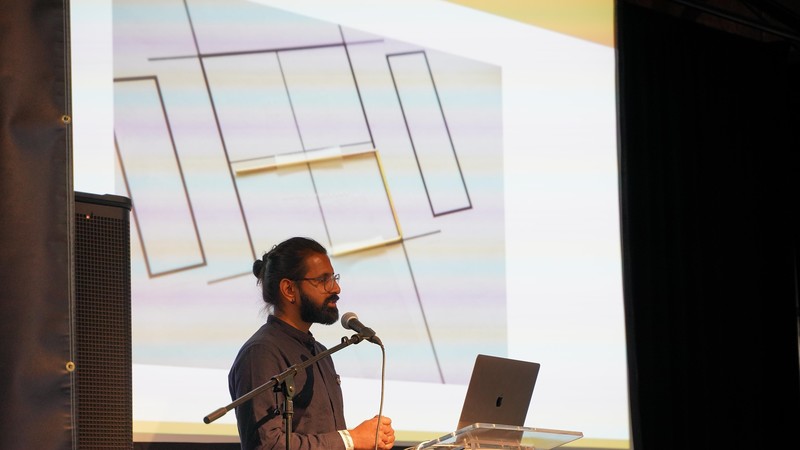
For most people, a circuit board is about as glamorous as the back of a microwave. It is flat, green, rectangular, and usually hiding inside a plastic box, doing its job like a tiny electronic accountant. But then comes Mohit Bhoite, armed with brass wire, solder, sensors, LEDs, and the kind of patience normally reserved for watchmakers and people who alphabetize spice racks. Suddenly, circuits are not just functional. They stand up. They lean forward. They glow. They look back at you with tiny digital faces as if they are politely asking whether you have finally appreciated the beauty of Ohm’s law.
“Bend It Like Bhoite” is more than a clever headline. It captures a real shift in how makers, engineers, artists, and electronics hobbyists think about hardware. Instead of treating the printed circuit board as the final stage of design, Bhoite’s freeform circuit sculptures ask a more delightful question: what happens when the wiring itself becomes the sculpture?
The answer is part engineering, part art, part tiny robot personality test. His work breaks electronics out of “flatland,” the two-dimensional world of PCB traces and right-angle layouts, and turns circuits into three-dimensional objects with character, motion, light, and sometimes even internet-connected behavior. It is hardware with posture. It is circuitry that forgot it was supposed to stay on the floor.
Who Is Mohit Bhoite?
Mohit Bhoite is an engineer and artist best known for creating freeform electronic sculptures using brass, copper, electronic components, LEDs, sensors, microcontrollers, and clever structural wiring. By day, he has worked as a senior hardware engineer at Particle, a company known for connected Internet of Things products. By night, he builds small, polished sculptures that sit somewhere between functional electronics, kinetic art, miniature architecture, and adorable space hardware.
His background in robotics and hardware design matters because his sculptures are not just decorative doodads with blinking lights. They are usually working circuits. Some blink. Some sense the environment. Some display data. Some connect to the internet. Some look like satellites, landers, tiny terminals, audio meters, LED matrices, or mechanical creatures from a friendly future where robots have excellent manners and a deep respect for symmetry.
Bhoite’s style is instantly recognizable: clean brass lines, floating components, balanced proportions, carefully bent conductors, and a warm handmade quality that still feels precise. The pieces often include anthropomorphic details, such as small displays that resemble faces. They are not literally alive, of course, but they have enough personality to make you feel slightly rude for unplugging them.
What Are Circuit Sculptures?
Circuit sculpture is the practice of building functional electronic circuits in three-dimensional space, often using soldered metal rods or wires as both electrical connections and physical structure. Instead of mounting every part to a traditional PCB, the maker arranges components in the air, connecting them with carefully shaped conductive material. Brass rods, copper wire, component leads, resistors, LEDs, sensors, and microcontroller boards can all become visible parts of the design.
Think of it as “electronics with the skeleton on the outside,” except much prettier and less like something that escaped from a haunted laboratory. In a normal circuit, traces are hidden or flattened. In a circuit sculpture, traces become beams, arms, antennae, legs, frames, rails, and architectural elements. The electricity still flows, but now the path it takes is part of the visual story.
The roots of this approach overlap with older electronics building techniques such as dead-bug construction, Manhattan-style prototyping, cordwood assembly, and BEAM robotics. These methods often exposed components and wiring for practical reasons. Bhoite’s work pushes the idea further by treating the exposed structure as a design language. The result is not messy prototyping. It is a polished form of electronic craft.
Why “Flatland” Matters in Electronics
Modern electronics are dominated by flat design. Engineers use schematic tools, route traces on PCB layouts, export manufacturing files, and send them to board houses. The resulting board may be technically brilliant, but physically it usually lives within a few millimeters of a flat surface. That makes sense for mass production, reliability, and compact consumer devices. Your phone would be less convenient if its circuits unfolded like a brass spider every time you opened an app.
But flatness also creates a visual habit. We start to imagine circuits as things that belong on boards, behind panels, under solder masks, and inside enclosures. Bhoite’s sculptures challenge that assumption. His work says: what if the signal path is beautiful? What if power rails can become architecture? What if a sensor does not need to hide in a box to be useful? What if the “inside” of a device is the artwork?
That is the magic of breaking out of flatland. A circuit sculpture makes the invisible logic of electronics visible. It turns function into form. Instead of seeing a finished gadget and wondering what is inside, you see the circuit itself, standing there in its brass shoes, doing the job in public.
The Materials: Brass, Copper, Solder, and Patience
The tools behind circuit sculpture are surprisingly ordinary. Makers often use brass rods, copper wire, flush cutters, pliers, soldering irons, helping hands, machinist squares, printed templates, and sometimes 3D-printed jigs. The difficulty is not that the tool list is exotic. The difficulty is that the tool list does not forgive sloppy work.
A small bend in a brass rod can shift the whole composition. A solder joint can be electrically sound but visually lumpy. A display can sit half a millimeter off and suddenly the sculpture looks like it has had one espresso too many. This is why Bhoite’s work stands out. The pieces look calm, clean, and intentional. That kind of simplicity usually means somebody worked very hard to hide the struggle.
Brass is especially useful because it is stiff enough to support small structures, conductive enough for many low-power circuits, and attractive enough to look like it belongs in a tiny museum of future artifacts. Copper wire is also common, especially when the structural and electrical needs call for it. Components such as LEDs, resistors, sensors, bar graph displays, OLED screens, and microcontroller boards then become both electronic parts and visual features.
Function Is Not Optional
The best circuit sculptures are not merely electronic jewelry. They do something. This is a key reason Bhoite’s work resonates with engineers and makers. The sculptures may be beautiful, but they also function as circuits. They blink, count, sense temperature, react to sound, display air quality, animate tiny faces, show data, or behave like small interactive devices.
One example often discussed in maker circles is Bhoite’s VU meter sculpture. A VU meter measures audio signal level, but in freeform form it becomes a miniature stage performance: the microphone hears sound, the amplifier and driver circuit process it, and the LED display responds in real time. In a plastic box, it would be a useful gadget. In Bhoite’s style, it becomes a tiny electronic creature that listens to the room and politely dances with light.
His space-themed sculptures are another strong example. Landers, satellites, and cube-like forms borrow from aerospace imagery while still carrying real electronics. These pieces work because the design language matches the circuit structure. Brass rods resemble landing legs, antenna frames, solar supports, and instrument booms. In other words, the wiring does not just connect the design. It explains it.
Why Bhoite’s Sculptures Feel Alive
One of the most interesting things about Bhoite’s circuit sculptures is their emotional effect. They are small, but they have presence. Part of that comes from proportion. Part comes from movement or light. Part comes from the use of displays and LEDs in ways that suggest eyes, expressions, or attention.
Humans are extremely good at finding personality in objects. Put two dots on a rectangle and suddenly we see a face. Add a slight tilt and now the rectangle is curious, skeptical, or judging our cable management. Bhoite uses this tendency beautifully. Many of his sculptures seem to observe, react, or wait. They do not need fur, plastic shells, or cartoon eyebrows. A tiny OLED display and a careful stance can do the job.
This is where circuit sculpture becomes more than a technical exercise. It becomes storytelling. A small temperature monitor can look like a field robot taking measurements on a distant moon. A VU meter can feel like a cheerful audio companion. A satellite sculpture can suggest communication, exploration, and orbit, even while sitting on a desk next to a coffee mug and a suspicious number of USB cables.
The Engineering Challenge Behind the Beauty
Freeform electronics may look whimsical, but building them well requires disciplined engineering. A maker has to think about circuit behavior, mechanical stability, heat, power, spacing, polarity, shorts, component placement, and assembly sequence. Unlike a PCB, where software helps define exact trace paths and clearances, a freeform sculpture depends heavily on planning and hand skill.
There is also a practical reason many experienced builders recommend breadboarding first. A circuit that fails on a breadboard is annoying. A circuit that fails after being turned into a delicate brass sculpture is a tiny tragedy with flux residue. Testing the electronics before sculpting saves time, prevents heartbreak, and reduces the urge to stare silently at a resistor as if it has betrayed the family.
Another challenge is that structure and signal are often the same thing. In a normal device, mechanical support and electrical connection can be separate. In a freeform sculpture, the conductor may also be the leg, frame, antenna, or visual line. That means every design choice carries multiple responsibilities. The piece has to stand, conduct, look good, avoid shorts, and survive handling. It is basically a group project where every part actually has to do its work.
Why Makers Love Freeform Circuit Art
Circuit sculpture has grown in popularity because it offers something many makers crave: a way to slow down and reconnect with the physical side of electronics. PCB design is powerful, but it can feel abstract. Ordering a board is efficient, but it removes some of the tactile feedback. Freeform building brings back the hand, the eye, and the satisfying terror of bending something exactly once because bending it twice may ruin the geometry.
It is also accessible in spirit. Beginners can start with simple LED circuits, coin-cell batteries, touch sensors, or small microcontroller boards. A first project does not need to be a museum-ready satellite sculpture. A simple glowing heart, a tiny blinker, or a basic light-reactive circuit can teach the core skills: cutting, bending, tinning, soldering, aligning, testing, and not touching the hot end of the soldering iron even though everyone learns this lesson with suspiciously memorable speed.
For advanced makers, the field remains wide open. Sensors, displays, wireless modules, audio circuits, solar cells, mechanical motion, capacitive touch, and data visualization can all become part of the sculpture. The challenge is not simply “can you make it work?” It is “can you make it work beautifully?”
From PCB Thinking to Sculptural Thinking
Traditional PCB design rewards compactness, manufacturability, and electrical efficiency. Sculptural circuit design rewards those things too, but adds visual rhythm, balance, silhouette, and narrative. A good freeform circuit is not just a schematic lifted off the page. It is a translation from diagram to object.
That translation changes the design process. The maker has to ask questions that rarely appear in ordinary electronics tutorials. Should the resistor stand vertically or lie like a bridge? Should the display sit forward like a face? Can the power rail become a horizon line? Can the ground connection become a stable base? Where should the viewer’s eye travel first? Does the sculpture look balanced from the side, or only from the hero photo angle that makes everything look suspiciously perfect?
Bhoite’s work succeeds because it answers these questions with restraint. The sculptures are detailed, but not chaotic. They reveal complexity without becoming visual spaghetti. That is harder than it looks. Anyone can make a tangle of wires. Making a circuit look inevitable is the real flex.
The Role of Jigs, Templates, and Repeatable Craft
Although circuit sculpture has a handmade feel, precision often depends on repeatable aids. Paper templates help guide bends. Machinist squares help keep rods aligned. 3D-printed jigs can hold LEDs in a perfect matrix or support repeated shapes. These tools do not reduce the artistry. They protect it.
In fact, this is one of the most useful lessons from Bhoite’s approach: careful preparation creates freedom. When the basic geometry is controlled, the maker can focus on expression. When parts are aligned, the eye can enjoy the form instead of noticing small errors. When joints are clean, the sculpture feels intentional rather than improvised under a desk lamp at 2 a.m., although, to be fair, many great maker projects are born exactly there.
Circuit Sculpture as STEAM Education
Circuit sculpture is a perfect example of STEAM thinking: science, technology, engineering, art, and mathematics working together instead of sitting in separate classrooms pretending not to know each other. It can teach electricity, design, geometry, soldering, prototyping, programming, and visual composition in a single project.
For students, this matters because the result is tangible and expressive. A blinking LED on a breadboard is useful, but it may not feel personal. A blinking LED arranged as part of a tiny brass creature feels like something the student made, not just something they assembled. That emotional connection can make electronics less intimidating and more memorable.
For educators, circuit sculpture also encourages iteration. Students can sketch, prototype, test, bend, solder, debug, and refine. They learn that mistakes are not failures; they are design feedback with better lighting. They also learn that beauty and function do not have to be enemies. In Bhoite’s world, the circuit works better when the maker cares about how it stands.
The Larger Maker Culture Around Circuit Sculptures
Bhoite is one of the most recognizable figures in this style, but he is also part of a broader maker movement that celebrates visible electronics. Hackaday contests, Adafruit learning projects, Digi-Key maker features, Hackster builds, Instructables tutorials, and hardware conferences have helped spread the idea that circuits can be art.
This community aspect matters. Circuit sculpture is wonderfully photogenic, which makes it easy to share online, but the best examples also invite people to learn. Makers publish build notes, schematics, parts lists, templates, and lessons learned. That turns a beautiful object into a starting point for someone else’s experiment. A single sculpture can inspire dozens of variations: a satellite becomes a temperature monitor, a VU meter becomes a desk companion, an LED matrix becomes a tiny game, and suddenly the flat PCB is looking at the party through the window.
Why This Art Form Feels So Modern
Freeform circuit sculpture feels especially relevant because so much of modern technology is hidden. Phones, laptops, smart speakers, wearables, routers, and connected devices arrive sealed, polished, and deliberately mysterious. Consumers see smooth surfaces, not the circuitry that makes them work. Bhoite’s sculptures reverse that relationship. They make technology visible again.
That visibility is refreshing. It reminds us that electronics are physical. Signals travel through material. Sensors occupy space. Light comes from components. Data needs a body. Even the internet, which often feels weightless, depends on hardware somewhere. A connected sculpture makes that truth charmingly obvious. It says, “Yes, I am a circuit. Yes, I am also a little object with attitude. Please admire my solder joints.”
Experiences Inspired by “Bend It Like Bhoite”
Spending time with the idea of Bhoite-style circuit sculpture changes how you look at electronics. A resistor stops being just a beige cylinder with stripes and starts looking like a tiny architectural column. A capacitor becomes a water tower. Brass rod becomes scaffolding. Even a humble LED begins to look like a lantern waiting for a village. This is dangerous knowledge. Once you start seeing components as sculptural material, your junk drawer becomes an art supply store with poor inventory management.
The first experience many beginners have with circuit sculpture is a mixture of excitement and comic humility. On a breadboard, a simple LED circuit feels easy. On the workbench, with brass rods and solder, the same circuit suddenly demands calm hands, planning, and the emotional strength to admit that “close enough” is not always close enough. The LED may work perfectly, but the frame leans like a tired street sign. The solder joint may conduct electricity, but it looks like a silver potato. This is where the craft begins.
A good beginner approach is to start small: one LED, one resistor, one switch, and one battery holder. Instead of trying to build a futuristic lunar lander on day one, build a tiny glowing stand. Practice cutting equal lengths of rod. Practice making clean 90-degree bends. Practice tinning the metal before joining it. Practice holding two pieces steady without inventing new vocabulary that cannot be printed in a family-friendly electronics blog.
As skill improves, the experience becomes meditative. Measuring, bending, aligning, and soldering create a rhythm. You begin to understand why Bhoite describes this kind of work as a different mental space from conventional engineering. It is not faster than PCB design. It is not easier than PCB design. That is the point. It slows the maker down enough to notice form, proportion, balance, and surface. The work becomes both technical and tactile.
There is also a satisfying moment when the sculpture finally powers on. A small LED glows. A display wakes up. A sensor reports a number. The structure is no longer just a pretty arrangement of metal. It is alive in the limited but magical way electronics can be alive: responding, emitting, measuring, and transforming energy into behavior. For anyone who has spent years hiding circuits inside boxes, that moment feels like opening a window.
The biggest lesson from Bhoite’s work is not that every maker should abandon PCBs. Flat circuit boards are essential, efficient, and absolutely not going anywhere. The lesson is that electronics have more expressive range than we often allow. A circuit can be a product, a prototype, a teaching tool, a sculpture, a character, or a conversation starter. It can sit inside a device, or it can stand proudly on a desk with its components exposed like a tiny brass manifesto.
Conclusion: The Future Has Better Wiring
Mohit Bhoite’s circuit sculptures shatter the bounds of flatland by proving that electronics can be functional, expressive, and physically beautiful at the same time. His work makes hardware feel human without hiding what it is. Brass rods become traces. Components become characters. Sensors become storytellers. The circuit does not disappear inside a box; it steps forward and takes a bow.
For makers, Bhoite’s work is an invitation to experiment. For artists, it is proof that technology can be a sculptural medium. For engineers, it is a reminder that elegance is not only found in efficient layouts and clean schematics, but also in the physical experience of an object. And for everyone else, it is a very good reason to stop calling electronics boring. After all, any circuit that can stand up, glow, listen, and look adorable has clearly earned its place outside the enclosure.
Note: This article is an original, publication-ready synthesis based on publicly available information about Mohit Bhoite, freeform circuit sculpture, maker electronics, and modern hardware art.