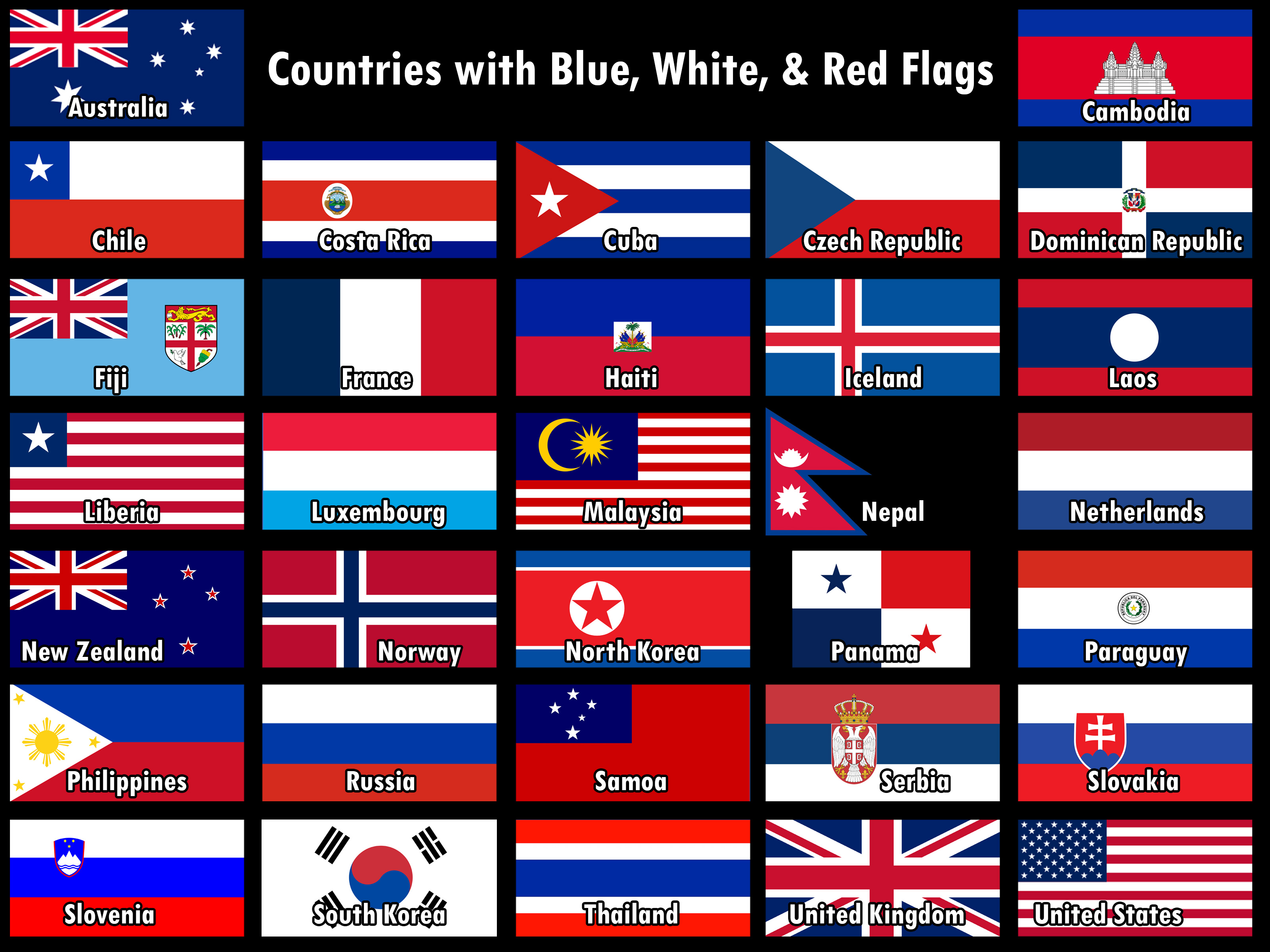
Red, white, and blue flags are basically the celebrities of the vexillology world. They show up at Olympic ceremonies, outside embassies, over parliament buildings, and in more quiz nights than anyone asked for. Some are simple tricolors. Some pile on stars, coats of arms, crosses, or entire buildings. A few look so similar that they seem like cousins who borrowed each other’s closets.
Still, there’s a reason this color combo keeps popping up. Red, white, and blue became especially influential through European revolutions, maritime traditions, Pan-Slavic symbolism, and the long reach of empires and alliances. That does not mean every country uses the colors the same way. In one flag, blue may hint at royalty. In another, it may suggest liberty, the sea, or national unity. Red can mean bravery, revolution, bloodshed, or sacrifice. White often points to peace, faith, or honesty. Same colors, very different backstories.
This guide walks through 32 national flags that all feature red, white, and blue. Some use only those three colors. Others add a little extra flair, like a yellow sun, a coat of arms, or a sacred temple silhouette. The goal here is simple: help you recognize the flags, remember what makes each one distinct, and avoid confusing Luxembourg with the Netherlands at your next trivia game.
Why Red, White, and Blue Show Up So Often
Part of the answer is history doing what history does best: showing up everywhere. The Netherlands helped popularize the red-white-blue tricolor in Europe, while France turned the palette into a revolutionary statement. The United States gave the combination enormous global visibility, especially as its flag became one of the world’s most recognized national symbols. Meanwhile, Slavic nations embraced white, blue, and red as Pan-Slavic colors, which is why several flags in Central and Eastern Europe can look like siblings with different accessories.
Maritime influence matters too. Blue fields, stars, crosses, and ensign-style layouts traveled widely through naval power and colonial history. That helps explain why countries such as Australia, New Zealand, and Fiji all have a British family resemblance. In short, red, white, and blue flags are not one big copy-and-paste job. They are more like a giant historical group chat.
32 Red, White, & Blue Flags to Know
Classic Tricolors and Strong Stripe Energy
- France — One of the world’s best-known flags, France uses three vertical bands of blue, white, and red. Clean, bold, and impossible to overdress, it became a lasting symbol of citizenship, revolution, and republican identity.
- The Netherlands — The Dutch flag has three horizontal stripes of red, white, and blue. It looks deceptively simple, but it carries serious historical clout because Dutch use of this color trio influenced later red-white-blue flag traditions elsewhere in Europe.
- Luxembourg — Luxembourg’s flag also uses horizontal red, white, and blue stripes, but the blue is lighter than the Netherlands’ version. If the two were in a lineup, Luxembourg would be the one wearing the softer sky-blue shirt.
- Russia — Russia’s white-blue-red tricolor is hugely influential because it helped shape the Pan-Slavic palette later used by several other Slavic nations. It is one of those flags that quietly started a very large visual trend.
- Thailand — Thailand’s flag has five horizontal stripes in red, white, blue, white, and red, with the central blue band wider than the others. The result is symmetrical, memorable, and much easier to spot than to forget.
- Costa Rica — Costa Rica flips the usual tricolor formula by using blue, white, red, white, and blue, with a broad red center stripe. It feels like a flag that decided normal stripes were fine, but drama would be better.
- Croatia — Croatia uses horizontal red, white, and blue stripes with its striking checkered coat of arms in the center. Even if you forget the order of the stripes, that red-and-white checkerboard usually saves the day.
- Serbia — Serbia’s flag features red, blue, and white horizontal stripes, usually with the national coat of arms near the hoist. It shares Pan-Slavic roots with neighboring flags but stands out thanks to its heraldic detail.
- Slovakia — Slovakia uses the classic white, blue, and red horizontal arrangement, plus a shield with a double cross over stylized mountains. Without the coat of arms, people would confuse it with several other flags before lunch.
- Slovenia — Slovenia also uses white, blue, and red stripes, but its coat of arms includes Mount Triglav, waves, and stars. It is a neat example of how geography sneaks into flag design without yelling about it.
- Paraguay — Paraguay’s red, white, and blue horizontal tricolor is distinctive because the emblems on the front and back are different. That little quirk makes it a favorite fun fact for anyone who loves flags more than is socially expected.
- Laos — Laos uses red-blue-red horizontal stripes with a large white disc at the center. The wide blue stripe and centered white circle make it look calm, balanced, and far more minimalist than many of its neighbors.
Crosses, Angles, and Designs You Recognize Instantly
- Norway — Norway’s red flag with a blue Nordic cross outlined in white is one of Scandinavia’s most recognizable designs. It takes the regional cross format and gives it an especially crisp red-white-blue identity.
- Iceland — Iceland uses a blue field with a red Nordic cross outlined in white. It shares the same cross tradition as Norway but swaps the dominant background color, which changes the whole mood from bold to cool and Arctic.
- Czechia — Czechia combines white over red with a blue triangle at the hoist. The shape does a lot of heavy lifting here, giving the flag a sharp, modern look while separating it from simpler horizontal bicolors.
- United Kingdom — The Union Flag layers red and white crosses over a blue field, combining symbols associated with England, Scotland, and Ireland. It is busy, iconic, and somehow still cleaner than many logos made last week.
Stars, Seals, and Symbol-Packed Showstoppers
- United States — The Stars and Stripes uses red and white stripes plus a blue canton filled with white stars. It is one of the most globally recognized national flags, partly because the design is simple and partly because it gets around.
- Liberia — Liberia’s flag clearly echoes the U.S. model, with red and white stripes and a blue canton, but it uses a single white star. The resemblance is no accident and reflects deep historical ties to the country’s founding story.
- Chile — Chile’s flag combines white over red with a blue square containing a white star. The layout is compact, balanced, and so sharp-looking that it often wins points for simplicity without being boring.
- Panama — Panama’s flag is quartered into white, red, and blue sections, with a blue star in one white quarter and a red star in the other. It manages to look both formal and festive, like a national flag dressed for a ceremony.
- Cuba — Cuba uses blue and white stripes with a red triangle and a white star. The triangle gives the design strong motion, so the whole flag looks like it is leaning forward even when the wind is taking a break.
- Dominican Republic — This flag features a white cross dividing blue and red quarters, with the national coat of arms at the center. It is one of the easiest Caribbean flags to recognize because the layout is structured and the emblem is prominent.
- Nepal — Nepal is the only national flag that is not a rectangle, and yes, it understood the assignment. Its double-pennon red field has a blue border and white celestial symbols, making it one of the most distinctive flags on Earth.
- Philippines — The Philippines uses blue and red horizontal bands with a white triangle, golden sun, and stars. Even though gold joins the party, the red-white-blue foundation remains central to the flag’s instantly recognizable design.
- North Korea — North Korea’s flag uses a broad red center stripe bordered by white lines and blue bands, plus a red star inside a white circle. It is bold, highly structured, and impossible to confuse with a minimalist tricolor.
- Cambodia — Cambodia’s flag places a red central band between two blue stripes and features a white depiction of Angkor Wat. That temple silhouette does what great flag symbols should do: it turns national identity into one quick visual.
- Haiti — Haiti’s national flag uses blue over red with a centered white panel containing the coat of arms. It is straightforward from a distance and more intricate up close, which is a good trick for any flag trying to be both symbolic and memorable.
- Samoa — Samoa uses a red field with a blue canton containing white stars representing the Southern Cross. It is clean, bold, and a nice reminder that star groupings do not belong exclusively to Australia and New Zealand.
Blue Ensign Relatives and Ocean-Influenced Designs
- Fiji — Fiji’s light blue flag includes the Union Flag in the canton and the national shield on the fly side. It blends British colonial heritage with local identity, which makes it historically layered and visually easy to pick out.
- Australia — Australia’s flag uses a blue field, the Union Flag in the canton, and white stars representing the Commonwealth Star and the Southern Cross. It is familiar worldwide and still fuels the occasional design debate.
- New Zealand — New Zealand’s flag also uses the Union Flag on a blue field, but its four red stars with white borders set it apart from Australia. If you mix them up, you are not alone, but New Zealand would still like a word.
- Kiribati — Kiribati may not be the first country people name here, but it qualifies beautifully. Its flag includes a red upper half, blue-and-white wavy stripes below, and a golden sun with a frigatebird, creating one of the most distinctive tropical designs in the world.
How to Tell Similar Red, White, and Blue Flags Apart
Some of these flags are easy. Nepal is out here being the only non-rectangular national flag, so that one is not shy. The real troublemakers are the similar tricolors. Here are a few quick memory aids:
- Netherlands vs. Luxembourg: Luxembourg uses a lighter blue.
- Slovakia vs. Slovenia: Both use white, blue, and red with coats of arms, but Slovenia’s shield features a mountain and stars, while Slovakia’s shows a double cross on hills.
- Australia vs. New Zealand: Australia has more stars and includes the large Commonwealth Star; New Zealand uses four red stars with white borders.
- Chile vs. Texas: Different category entirely, but people still mix them up online with astonishing confidence.
- Thailand vs. Costa Rica: Both use five horizontal stripes, but Thailand has a broad blue center band and Costa Rica has a broad red center band.
What These Flags Say About History
Flags are tiny history books with excellent wind resistance. When you line up 32 red, white, and blue national flags, patterns emerge fast. You see the spread of revolutionary ideas. You see Pan-Slavic identity. You see colonial influence, especially in ensign-based designs. You see religion in crosses, monarchy in royal symbolism, and nation-building in stars, shields, and carefully chosen stripe orders.
That is what makes this group so interesting. On the surface, the flags share a familiar palette. Underneath, they tell very different stories about independence, unity, geography, ideology, and cultural memory. Same three colors, wildly different national biographies.
Experiences Related to Red, White, & Blue Flags Around the World
There is something strangely satisfying about recognizing a flag in the wild. Maybe you spot one outside an embassy, during an international soccer match, or in the opening parade of the Olympics. At first, it feels like a small win, the kind that makes your brain do a tiny victory dance. Then you realize how tricky the red, white, and blue group can be. You confidently point at Luxembourg and say, “Netherlands,” or glance at Australia and New Zealand and suddenly discover humility. Flags have a way of making everyone a little smarter and a little more modest.
Travelers often notice that flags feel different when seen in their home setting. The Union Flag on a souvenir mug is one thing; the same design flying above a government building in London feels weightier. Thailand’s striped flag in a Bangkok streetscape feels tied to daily life, not just textbook symbolism. In the Caribbean, the flags of Cuba, the Dominican Republic, and Haiti do more than identify a state. They help frame music, politics, architecture, public memory, and pride. A flag can go from “pretty design” to “oh, this means something here” in about two seconds.
Sporting events create another memorable experience. Red, white, and blue flags absolutely dominate international competitions, which means television broadcasts can look like one giant color-coordinated family reunion. During the World Cup, the Olympics, or even regional tournaments, fans drape themselves in flags, paint them on faces, wave them from balconies, and turn color combinations into emotional weather systems. You quickly learn that the same palette can signal very different loyalties. One section sings. Another shouts. A third cries. Suddenly those stripes and stars are not abstract design choices anymore. They are identity in motion.
Museums and history exhibits make the experience even richer because they slow everything down. Instead of seeing a flag flutter past, you get context: who designed it, when it changed, why a star was added, why a coat of arms moved, why a certain shade of blue matters. That is when the red, white, and blue category becomes genuinely fascinating. The U.S. flag and the French tricolor may look universally familiar, but place them beside Liberia’s flag, Serbia’s, or Kiribati’s and the differences start telling bigger stories. You stop seeing “same colors” and start seeing migrations of ideas, revolutions, alliances, and local identity.
Even in everyday life, flags sneak into memory through schools, travel guides, airport terminals, postage stamps, and trivia nights where one person takes the whole thing far too seriously. Kids often learn countries through flags before they learn capitals. Adults rediscover them while planning trips, watching the news, or falling into an internet rabbit hole that begins with “Why does this flag look familiar?” and ends an hour later with Pan-Slavic colors, naval ensigns, and a new respect for Nepal’s refusal to be rectangular. That is the charm of red, white, and blue flags. They are common enough to feel familiar, but distinctive enough to reward a closer look. The more you notice them, the more the world starts to feel connected, layered, and wonderfully specific.
Conclusion
Red, white, and blue may be one of the most common flag color combinations on Earth, but these 32 examples prove that common does not mean boring. From France’s elegant tricolor to Nepal’s daring shape, from Panama’s stars to Kiribati’s ocean waves, each flag turns a familiar palette into a different national story. Once you know what to look for, these designs become easier to identify and much more fun to compare.