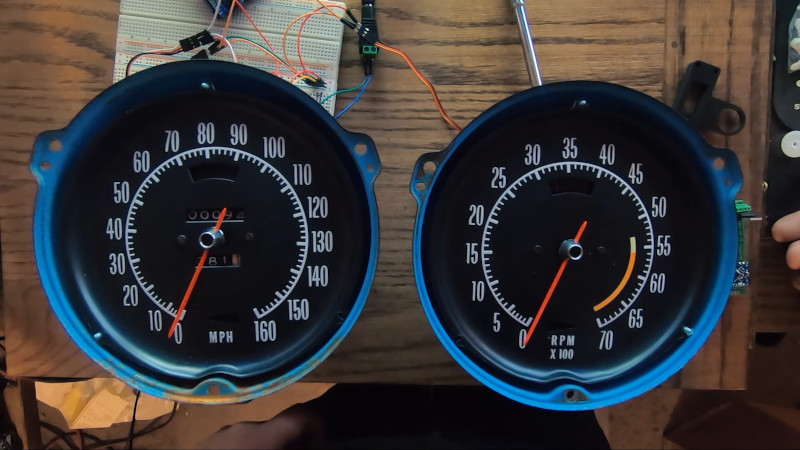
A V12 Corvette is already the kind of project that makes car people stop mid-sip and say, “Wait, a what?” But when that same build also gets a clever electronic gauge mod that keeps the classic Corvette dashboard alive, the story moves from wild engine swap to full-on garage engineering poetry. This is not just about stuffing twelve cylinders into America’s fiberglass sports car and calling it a day. It is about solving the less glamorous, very real problems that show up after the big idea becomes a real car.
The build that inspired this topic centers on a 1973 C3 Corvette undergoing a V12 engine swap. Because the original driveline was being replaced, the factory mechanical speedometer and tachometer could no longer rely on their old-school cable and distributor-driven inputs. Instead of tossing the original cluster into the “cool but useless” parts pile, the builder created an electronic conversion using servos, 3D-printed gearing, GPS data, ignition signals, and an Arduino-style control setup. In plain English: the gauges still look vintage, but their brains have gone digital.
That combination is exactly why this V12 Corvette electronic gauge mod is so interesting. It respects the car’s original cockpit feel while adapting it to a completely different powertrain. It is restomod thinking at its best: modern function hidden behind classic charm. Think of it as giving your grandpa’s wristwatch atomic-clock accuracy without replacing the face with a smartwatch screen the size of a cracker.
Why a V12 Corvette Needs a Gauge Mod in the First Place
The Chevrolet Corvette has long been associated with V8 power. From small-block legends to big-block thunder and today’s high-tech performance engines, the Corvette formula has usually been simple: lightweight body, strong V8, rear-wheel drive, and just enough attitude to make the neighbors peek through the curtains. A V12 swap changes that entire equation.
A V12 engine has twelve cylinders arranged in two banks of six. It is known for smooth power delivery, a distinctive exhaust note, and packaging headaches that can make even experienced fabricators quietly question their life choices. In a C3 Corvette, the challenge is even more dramatic because the car was never designed around that kind of engine architecture. Mounting the engine is only the opening act. After that come cooling, wiring, fuel delivery, transmission fitment, driveshaft alignment, exhaust routing, and, of course, instrumentation.
The gauge issue might sound small compared with building mounts or fitting exhaust headers in a space where your knuckles already have legal representation. But gauges matter. The speedometer tells the driver how fast the car is moving. The tachometer tells the driver what the engine is doing. The odometer tracks mileage. Without accurate readings, the car may run, but the driver is partly flying blind.
The Original C3 Corvette Dashboard: Too Cool to Throw Away
The 1973 Corvette belongs to the C3 generation, a body style famous for its long hood, Coke-bottle curves, driver-focused cockpit, and dramatic sports-car personality. Inside, the dashboard layout gave the driver a large speedometer and tachometer directly ahead, with auxiliary gauges nearby for vital information such as fuel, oil pressure, coolant temperature, and electrical status.
That cockpit has character. It does not look like a modern tablet bolted to a dashboard. It looks mechanical, purposeful, and slightly theatrical, as if the car is preparing for a NASA mission but got distracted by side pipes and tire smoke. Replacing that entire cluster with a generic digital screen would be easier in some ways, but it would also remove part of the car’s soul.
This is where the electronic gauge conversion becomes smart. The mod keeps the original gauge faces and needles, preserving the vintage interior vibe, while changing how the needles are driven behind the scenes. The result is not “new gauges in an old car.” It is “old gauges with new nervous systems.”
How the Electronic Gauge Mod Works
The basic idea behind the V12 Corvette gauge mod is wonderfully practical. The original speedometer and tachometer expected mechanical inputs. The speedometer would normally be driven by a cable connected to the transmission. The tachometer in many early Corvette applications could be driven mechanically from the distributor. Once the original drivetrain and ignition setup are gone, those old inputs disappear.
To solve this, the builder installed servos behind the original gauges. A servo is a small motor that can move to a controlled position. In this application, the servo moves the gauge needle to the correct reading. A 3D-printed gear train helps translate servo movement into gauge needle motion, while a separate continuous-rotation servo can be used to drive the odometer mechanism.
The speed signal comes from GPS data rather than the original transmission cable. That makes sense in a heavily modified vehicle because GPS speed does not care what transmission, rear-end ratio, tire size, or V12 madness is happening under the car. The tachometer can be driven using an ignition signal, allowing engine RPM to be translated into needle movement. An Arduino Nano-style controller processes the information and commands the servos.
In simple terms, the system does four jobs:
- Reads vehicle speed from a GPS module.
- Reads engine RPM from the ignition system.
- Uses a microcontroller to interpret those signals.
- Moves the original gauge needles with servos and 3D-printed parts.
That may sound like a science fair project with horsepower, but it is actually an elegant solution. Instead of forcing the new drivetrain to imitate the old mechanical outputs, the mod lets modern electronics speak the old dashboard’s language.
Why Not Just Install Modern Digital Gauges?
Aftermarket gauges are everywhere. You can buy digital clusters, GPS speedometers, CAN-bus displays, race dashes, programmable screens, and enough illuminated needles to make your dashboard look like a small airport runway. So why go through the trouble of modifying the original C3 Corvette instruments?
The answer is identity. A classic Corvette is not only a performance platform; it is a design object. The dashboard, steering wheel, console, gauge layout, and driving position all contribute to how the car feels. A V12 engine swap already changes the personality of the car in a major way. Keeping the factory-looking instruments helps anchor the build to its Corvette roots.
There is also a craftsmanship factor. Anyone can order a shiny gauge set. Not everyone can design a servo-driven conversion, print custom gear components, calibrate needle sweep, and make the whole thing appear factory-ish from the driver’s seat. That is the kind of detail that separates a thoughtful restomod from a parts-catalog thunderstorm.
The Beauty of Hidden Technology
The best restomods often hide their cleverest work. You may see a classic steering wheel, analog gauges, chrome trim, and old-school shapes. But underneath, there might be fuel injection, upgraded suspension, better brakes, electronic control modules, modern wiring, and sensors quietly doing their jobs.
This V12 Corvette electronic gauge mod fits that philosophy perfectly. The driver still sees a classic gauge cluster. The needles still sweep across familiar faces. The cabin still feels like a 1970s Corvette cockpit. But the information behind those needles is gathered and processed electronically.
That is especially useful in an engine-swapped car. Once the original engine and transmission are gone, factory assumptions no longer apply. The electronics become a translator between old hardware and new mechanical reality. It is like hiring a very tiny interpreter who speaks fluent Corvette, Arduino, GPS, and V12.
Advantages of an Electronic Gauge Conversion
1. It preserves the original look
The biggest advantage is visual continuity. The dashboard does not look hacked apart, and the car keeps the character of a C3 Corvette. For builders who care about interior style, that is a major win.
2. It works with non-original drivetrains
A V12 swap can eliminate the factory mechanical speedometer and tachometer drives. Electronic control makes the gauges compatible with a custom drivetrain setup without forcing awkward mechanical adapters into the build.
3. It allows calibration
With a programmable controller, the gauge response can be tuned. Needle position, sweep behavior, speed scaling, RPM range, and update smoothing can all be adjusted. Mechanical systems are charming, but they are not exactly famous for asking politely if you would like to change their calibration curve.
4. It supports future upgrades
Once a car has an electronic gauge interface, future updates become easier. A builder can refine the code, change signal sources, improve response time, or add additional sensor inputs as the project evolves.
Challenges Behind the Mod
Of course, this kind of project is not plug-and-play. The first challenge is accuracy. A speedometer that looks great but reads wrong is not a speedometer; it is dashboard decoration with legal consequences. The system must be calibrated so GPS speed and needle position match reliably.
The tachometer has its own challenges. Engine RPM changes quickly, so the needle response must be fast enough to feel natural but smooth enough to avoid nervous twitching. A V12 engine can rev with a different character than the original V8, so the gauge behavior needs to match the new engine’s personality.
Then there is packaging. The space behind a classic gauge cluster is not a luxury condo. Servos, brackets, gear trains, wiring, and the controller all need to fit without interfering with the original mechanisms or dashboard structure. Add heat, vibration, electrical noise, and the general chaos of an old car, and suddenly the “simple little gauge project” becomes a proper engineering exercise.
Why GPS Speed Makes Sense
GPS-based speed measurement is popular in custom builds because it avoids many drivetrain-related complications. Traditional speedometers depend on mechanical gearing, tire diameter, transmission output, and axle ratio. Change any of those, and the speed reading may become inaccurate unless corrected.
In a V12-swapped Corvette, nearly everything that affects a traditional speedometer may be different from stock. GPS speed sidesteps those changes. It measures movement using satellite positioning rather than a spinning cable. That makes it attractive for builds with custom transmissions, unusual tire sizes, or non-factory driveline combinations.
However, GPS is not perfect. It may lag slightly, struggle in tunnels, or lose accuracy in areas with poor signal reception. For most road use, it can work very well, but a builder still has to decide whether GPS-only speed is acceptable or whether a wheel-speed or transmission sensor should be added later for redundancy.
The Role of 3D Printing in Custom Car Builds
One of the most interesting parts of this gauge mod is the use of 3D-printed components. Not long ago, making a custom gear train or gauge adapter required machining, hand fabrication, or a friendly local wizard with a lathe. Today, builders can design parts digitally, print prototypes, test fit them, revise the design, and print again.
For a one-off V12 Corvette, that flexibility is huge. The project does not need a mass-produced kit. It needs exactly the right bracket, gear, mount, or adapter for one specific car. 3D printing lets the builder create those pieces without waiting for an aftermarket company to decide there are enough V12-swapped 1973 Corvettes in the world to justify tooling. Spoiler alert: there probably are not.
That is the modern magic of custom car culture. The garage is no longer limited to wrenches, welders, and hammers. It now includes CAD software, microcontrollers, sensors, and printers that turn digital ideas into usable parts.
What This Mod Says About Modern Restomod Culture
The V12 Corvette electronic gauge mod reflects a bigger trend in the automotive world. Builders are no longer choosing strictly between restoration and modification. Many are blending both. They want the look, emotion, and presence of a classic car, but they also want the reliability, flexibility, and performance of modern systems.
That approach is especially common in restomod Corvettes. A C3 Corvette has dramatic styling and strong enthusiast support, but modern expectations are different from 1973 expectations. Today’s builders may upgrade brakes, steering, suspension, cooling, wiring, lighting, and instrumentation while keeping the body and interior recognizable.
The best examples do not erase history. They collaborate with it. This gauge mod does exactly that. It does not laugh at the original Corvette instruments and replace them with a glowing rectangle. It says, “You still look great. Let’s just get you some modern inputs.”
Specific Example: The Speedometer and Tachometer Problem
Imagine the car is finally assembled. The V12 starts. The exhaust note is smooth, exotic, and deeply confusing to anyone expecting small-block rumble. The car moves under its own power. Everything feels triumphantuntil the speedometer sits at zero and the tachometer has the enthusiasm of a sleeping houseplant.
That is the practical problem this mod solves. The speedometer cannot depend on the old transmission cable because the transmission setup is no longer original. The tachometer cannot rely on the original mechanical drive because the engine and ignition arrangement have changed. The gauges need new input sources.
By using GPS and ignition data, the builder creates new electronic sources for the same old visual outputs. The original needles still tell the story, but the story is now written by sensors and code instead of cables and spinning shafts.
Is This Kind of Mod Worth Doing?
For most casual classic car owners, probably not. If your original drivetrain is still in place and your gauges work, there is no urgent reason to reinvent the instrument cluster. Sometimes the smartest modification is leaving a good thing alone and spending the weekend driving instead of debugging.
But for major engine swaps, especially unusual ones, an electronic gauge conversion can be absolutely worth it. It solves compatibility problems, improves flexibility, and keeps the interior design intact. For a V12 Corvette, it makes perfect sense because the entire drivetrain concept has moved far beyond factory assumptions.
The mod also has educational value. It shows how classic car problems can be solved with accessible electronics. A microcontroller, sensors, servos, printed parts, and careful calibration can bridge a fifty-year technology gap. That is not just a repair; it is a conversation between eras.
Experience Section: Living With the Idea of a V12 Corvette Electronic Gauge Mod
Spending time around custom builds teaches one lesson quickly: the headline modification gets the attention, but the small systems determine whether the car feels finished. A V12 swap is the headline. It is the thing people ask about first. It is the part that makes the car show crowd form a semicircle. But the gauge mod is the kind of detail that makes the car usable, believable, and satisfying from the driver’s seat.
From a practical experience standpoint, electronic gauge conversions require patience more than brute force. The first test rarely behaves perfectly. A needle may move in the wrong direction. The sweep may be too jumpy. The speed reading may lag. The tach may need filtering so it does not bounce like it drank three coffees and saw a ghost. This is normal. Custom electronics in cars live in a harsh environment, and every signal needs to be treated with respect.
One of the most valuable habits in a project like this is bench testing before installation. It is much easier to test a servo, controller, GPS module, and gauge on a workbench than upside down under a Corvette dashboard with one arm wedged near the steering column. Bench testing lets the builder confirm the code, check movement range, inspect gear mesh, and identify weak points before the parts disappear behind the dash.
Another experience-based lesson is that the gauge should feel natural, not merely accurate. A speedometer that snaps instantly from 20 to 45 mph might be technically responsive, but it will look strange in a vintage cluster. A tach needle that jitters with every tiny ignition fluctuation will distract the driver. Good calibration includes smoothing, response rate, and needle behavior. The goal is not just data; the goal is believable motion.
Durability also matters. A show car can survive with delicate prototype parts, but a road-driven build needs stronger thinking. Printed gears should be made from appropriate material, mounted securely, and tested under vibration. Wiring should be protected, labeled, fused, and routed away from heat. Grounds should be clean. Connectors should not depend on hope and electrical tape. Hope is not a wiring strategy, even though many old project cars appear to have been assembled around that philosophy.
The best part of this kind of mod is the moment when the dashboard comes alive. The engine starts, the tach rises, and the needle moves like it belongs there. The car rolls forward, the speedometer responds, and suddenly the old Corvette cockpit feels connected to the new drivetrain. That moment is deeply satisfying because it proves the build is more than a collection of impressive parts. It is becoming a complete machine.
For enthusiasts considering a similar project, the takeaway is simple: think beyond the engine swap. Plan the instruments early. Decide where speed, RPM, fuel, temperature, oil pressure, and voltage data will come from. Consider whether the car needs analog-style gauges, digital displays, or a hybrid setup. Most importantly, build the system so it can be serviced later. Future you will be grateful, and future you may already be tired.
A V12 Corvette with an electronic gauge mod is exciting because it combines imagination with problem-solving. It has the drama of a rare engine swap and the satisfaction of thoughtful detail work. It proves that the coolest builds are not just loud, fast, or unusual. They are the ones where every system, even the humble speedometer, gets a proper seat at the engineering table.
Conclusion
The story of a V12 Corvette getting an electronic gauge mod is more than a quirky garage update. It is a perfect example of how modern builders solve old-car problems without sacrificing classic style. By using servos, GPS data, ignition input, 3D-printed parts, and a microcontroller, the builder keeps the original C3 Corvette gauge aesthetic while making it compatible with a wildly non-original drivetrain.
That balance is what makes the project special. The V12 engine provides the spectacle, but the electronic gauges provide the polish. Together, they turn a bold swap into a more complete and thoughtful machine. In the world of custom Corvettes, that is the difference between “Look what fits” and “Look how well it works.”
Note: This article is written for web publication and is based on real-world automotive modification concepts, known C3 Corvette instrumentation layouts, and documented electronic gauge conversion practices used in custom engine-swap projects.