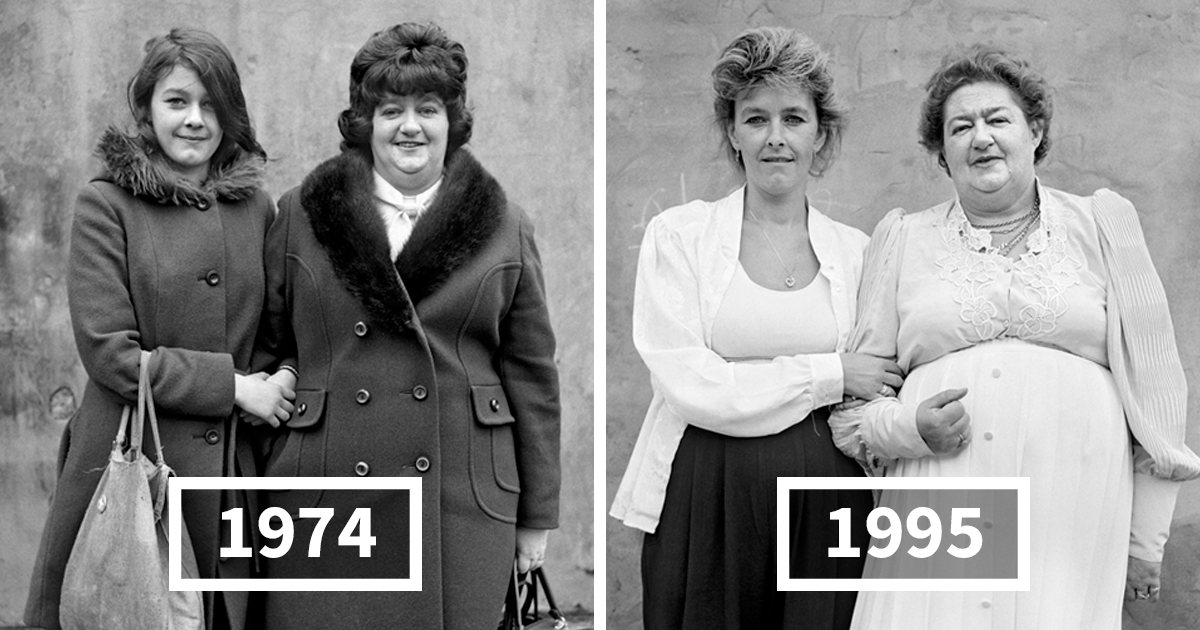
Some photographs politely ask for your attention. Daniel Meadows’ before and after portraits grab you by the collar, sit you down, and whisper, “Look what time does.” His famous Now and Then series pairs portraits taken in the 1970s with follow-up images made more than two decades later. The result is not just a gallery of aging faces, changed hairstyles, and gloriously questionable 1970s trousers. It is a moving documentary record of real people, real communities, and the strange magic of seeing a life in two frames.
These 17 before and after pictures by Daniel Meadows became widely loved because they do something social media often tries to do but rarely manages: they show transformation without turning people into products. There are no dramatic makeover captions, no “you won’t believe what happened next,” and no airbrushed miracle. Just ordinary people from England, photographed honestly, then found again years later. And somehow, that is far more powerful.
Who Is Daniel Meadows?
Daniel Meadows is a British documentary photographer, social documentarist, teacher, and digital storyteller known for recording the lives of ordinary people with warmth and respect. Born in 1952, Meadows emerged from the world of British documentary photography in the 1970s, a period when artists and photographers were increasingly interested in working-class life, regional identity, and everyday culture.
His work is often described as collaborative because he did not simply point a camera at strangers and vanish. He met people, listened to them, gave them prints, recorded stories, and returned to those stories later. That last part matters. Anyone can take a picture of a person in a moment. Meadows built a practice around wondering what happened after the shutter clicked.
The Free Photographic Omnibus: A Studio on Wheels
The heart of this story is the Free Photographic Omnibus, one of the most charmingly ambitious photography projects of the 1970s. In 1973, Meadows bought a double-decker bus and converted it into a mobile home, darkroom, gallery, and portrait studio. Imagine a food truck, but instead of tacos, it served black-and-white portraits and existential reflections. Honestly, not a bad business model.
For about 14 months, Meadows traveled across England, offering free portrait sessions to anyone who wanted one. He visited 22 towns and cities and photographed 958 people, either alone or in groups. Sitters could return the next day and collect their portrait without paying. This simple exchange created a rare kind of trust. The project was not about celebrity, status, or polish. It was about giving people a place in the visual record.
Why the “Now and Then” Portraits Are So Powerful
Decades later, Meadows became curious about the people he had photographed. Who had they become? Were the children still in the same towns? Were the friends still friends? Had couples stayed together? Had life been kind? Had it been, as life tends to be, a mixed bag with a suspiciously heavy handle?
With help from regional newspapers and local communities, he tracked down some of his original sitters in places such as Barrow-in-Furness, Hartlepool, and Southampton. He then photographed them again in the 1990s and around 2000, creating paired images separated by roughly 20 to 25 years. The finished works became known as National Portraits: Now and Then and later formed part of the broader book and exhibition Now and Then: England 1970–2015.
The photographs work because they are plainspoken. They do not shout. They let viewers notice changes slowly: the softening of a face, the confidence of adulthood, the absence of someone who once stood in the first frame, the stubborn survival of a hairstyle that clearly signed a lifetime lease.
17 Before and After Portraits That Tell Bigger Stories
1. May and Melody “Molly” Gower
The portrait of May and Melody “Molly” Gower is one of the most emotional examples because it shows how family photography can carry love, loss, and memory in the same frame. The original image captures a relationship in the 1970s; the later image reminds us that time does not preserve every person equally. In a pair like this, the “after” photograph is not only about who changed. It is also about who is remembered.
2. Florence Alma Snoad
Florence Alma Snoad’s then-and-now pairing demonstrates one of the quiet strengths of Meadows’ approach: dignity. The later portrait does not treat age as a punchline or a tragedy. Instead, it allows the viewer to see continuity. The person is older, yes, but the self is still present. The face changes; the presence remains.
3. David and Mary Ingram
David and Mary Ingram’s photographs invite viewers to think about relationships across decades. A paired portrait of two people is never just about two faces. It is about posture, space, closeness, and the little clues that suggest how people have weathered time together. The comparison feels like opening a family album belonging to strangers and realizing you understand more than expected.
4. Michael and Peter McParland
Michael and Peter McParland, twin brothers from Barrow-in-Furness, make a fascinating subject because twins naturally sharpen our attention to difference. In the earlier portrait, viewers may focus on similarity. In the later one, life has had decades to write separate footnotes on each face. The result is less “before and after” and more “same beginning, different chapters.”
5. Christine Staunton and Christine Loughran
The two Christines show how friendship photographs age differently from solo portraits. Friends often pose with a shared energy: jokes just outside the frame, confidence borrowed from one another, the sense that the world is easier to face in pairs. Years later, the viewer looks for that same spark. Meadows’ genius is that he gives us enough visual information to search for it ourselves.
6. Dave, Maggie, and Steve Summerton
Group portraits are especially rich in the Now and Then series. Dave, Maggie, and Steve Summerton’s images reveal how family roles shift over decades. The young become adults; adults become older adults; the old furniture of identity gets rearranged. What once looked casual becomes historical. Even clothing becomes evidence. Never underestimate the storytelling power of a 1970s collar.
7. Lyn and Stella Brasher
Lyn and Stella Brasher’s portraits are among the most memorable because they show the long arc of sisterhood. There is something instantly readable about siblings in a photograph: shared history, shared expressions, and sometimes shared hair decisions. Their paired images show both change and loyalty, reminding us that family resemblance is not only physical. It can also be emotional.
8. Peter and Susie Gates
Peter and Susie Gates offer one of those comparisons where viewers instinctively search for the child inside the adult. It is a strange thing we all do with old photos. We look at a grown person and ask, “Where did the younger version go?” Meadows’ portraits answer gently: nowhere. The younger self is still there, just layered under bills, jobs, weather, responsibility, and possibly a better haircut.
9. Karen Cubin and Barbara Taylor
The portrait of Karen Cubin and Barbara Taylor, a daughter and mother from Barrow-in-Furness, speaks to generational change. Parent-child photographs are emotional time machines because the balance between dependence and independence shifts so visibly. A child grows into an adult. A parent grows older. The camera records not a single relationship but a relationship in motion.
10. David and Maureen Wade
David and Maureen Wade’s paired images show how couples can become visual records of shared years. Viewers may notice the obvious signs of aging first, but then subtler details appear: body language, facial rhythm, the way two people occupy the frame together. In Meadows’ work, the question is never simply “Do they look different?” It is “What has life done around them?”
11. Martin and Debbie Pout
Martin and Debbie Pout’s portraits underline another important theme: identity is not frozen in youth. People change style, attitude, confidence, and sometimes the whole mood they bring to the camera. The second portrait can feel like a reply to the first, as if the older self is saying, “Yes, that was me. But keep reading.”
12. Ken Emery and Ed Murphy
Ken Emery and Ed Murphy, friends from Southampton, are a perfect example of why these images became so shareable online. Friendship across decades is both ordinary and miraculous. Many people lose touch; some reconnect; a lucky few remain part of each other’s story. Their portraits make viewers think about old classmates, former neighbors, and the friends they swore they would call back in 1998.
13. Mary Clarke
Mary Clarke’s portrait pairing is beautifully direct. A solo portrait strips away the supporting cast and asks us to look closely. Meadows does not overdramatize the transformation. He lets the face carry the story. In doing so, he reminds us that every person has a private history larger than any caption can hold.
14. Angela Hendley, Dot Rooney, and Kim Hillman
Angela Hendley, Dot Rooney, and Kim Hillman’s images demonstrate how group portraits can become bittersweet over time. When people are missing from a later image, the absence becomes part of the composition. That is one reason these before and after portraits feel more serious than simple internet nostalgia. They do not pretend that time is harmless.
15. Robin Jones
Robin Jones’ pairing captures the classic transformation from youth to adulthood. These images are often the easiest for viewers to respond to because they mirror a universal experience. We all have old photos where our younger selves look wildly confident for someone with no idea what taxes are. Meadows turns that universal awkwardness into documentary art.
16. Brian Morgan, Martin Tebay, Paul McMillan, Phil Tickle, and Mike Comish
This group portrait is a terrific reminder that fashion is history wearing shoes. The 1974 image carries the visual language of its decade: trousers, hair, stance, attitude. The later photograph does not erase that youthful identity; it places it beside adulthood. Together, the images feel like a small reunion between past and present selves.
17. Phil Thompson
Phil Thompson’s before and after images close the set with the same quiet force that runs throughout the series. A single person, two moments, more than 20 years between them. That is all Meadows needs. The viewer supplies the rest: curiosity, empathy, memory, and maybe the sudden urge to organize old photo albums before they become a shoebox archaeology project.
What These Photos Reveal About Time
The first obvious theme is aging, but stopping there would be like calling a novel “paper with ink.” Meadows’ portraits reveal social change, class identity, regional character, family ties, friendship, loss, resilience, and the everyday performance of self. In the 1970s images, people often appear in the visual codes of that decade: long hair, bold collars, patterned clothing, serious faces, and poses shaped by a time before everyone had practiced smiling into a front-facing camera.
The later images show a different England. The people have changed, but so have the cultural signals around them. Clothing is quieter. Faces are older. The camera itself means something different. In the 1970s, receiving a free portrait from a photographer in a bus was unusual and exciting. By the 1990s, the return portrait carried memory, recognition, and the emotional weight of comparison.
Why Daniel Meadows’ Work Still Matters Online
The internet loves transformation. Weight loss, home renovation, rescued pets, restored furniture, celebrity glow-upswe click because change is satisfying. But Daniel Meadows’ before and after portraits offer a more human kind of transformation. They do not say, “Look how much better.” They say, “Look how much happened.”
That distinction is important. Meadows does not frame aging as failure or improvement. His photographs resist the shallow logic of makeover culture. Nobody is “fixed.” Nobody is reduced to a dramatic reveal. Instead, each person is allowed to remain complicated, ordinary, and worthy of attention. That is why the images still feel fresh in the age of filters, face tuning, and suspiciously smooth foreheads.
Photography Lessons From the Now and Then Series
1. Ordinary People Are Extraordinary Subjects
Meadows proves that documentary photography does not need famous faces to be meaningful. A thoughtful portrait of an unknown person can become historically valuable when it is made with care. The so-called ordinary life is not ordinary to the person living it.
2. Context Makes a Portrait Stronger
The Free Photographic Omnibus was more than a camera project. It was a social encounter. The bus, the free print, the local setting, and the later search for sitters all add meaning to the images. Great photography often begins before the picture and continues after it.
3. Time Is the Best Editor
Many of Meadows’ portraits became more powerful years after they were made. That is one of photography’s strange gifts. A picture can look simple today and priceless tomorrow. Time adds emotional contrast, historical texture, and the occasional reminder that nobody should permanently trust a trendy haircut.
Experiences Related to Daniel Meadows’ Before and After Portraits
Looking at Daniel Meadows’ 17 before and after pictures feels a lot like opening an old family album at a dinner table where everyone suddenly gets quiet. At first, people laugh. Someone points at the clothes. Someone says, “Were glasses really that big?” Someone else defends the glasses because, apparently, every family has one brave historian of questionable accessories. But after the laughter, a different feeling arrives. You start noticing the people behind the fashion. You see confidence, awkwardness, tenderness, fatigue, pride, and the small emotional fingerprints that survive across decades.
That is the experience many viewers have with Meadows’ work. The photos begin as visual curiosity and slowly become personal reflection. Even if the sitters are strangers from England, the structure is familiar. We all have a “then” version somewhere: a school picture, a wedding snapshot, a holiday photo, a blurry image from a birthday party where the cake looked better than the lighting. We also have an “after,” even if we have not photographed it yet. Meadows’ portraits make us wonder what our own paired image would reveal.
One of the strongest experiences connected to this topic is the realization that change is not always dramatic from the inside. People often feel like themselves day after day. The mirror changes slowly. Life piles up quietly. Then a photograph from 20 years ago appears, and suddenly the distance becomes visible. The younger version looks both familiar and impossible. You may remember what shoes you wore, who made you laugh, what you worried about, and what you thought adulthood would be. Then you look at the present and realize the plot took several unexpected turns.
Another relatable experience is reconnecting with old friends after many years. The first few minutes can be odd. Faces have changed. Voices may be deeper, softer, or wrapped in new accents. People have jobs, children, losses, opinions about back pain, and surprisingly strong feelings about kitchen appliances. Yet after a while, old rhythms return. A joke lands exactly where it used to. A nickname comes back. For a moment, the distance between then and now collapses. Meadows’ friend and sibling portraits capture that feeling beautifully.
There is also the experience of seeing absence. In group photos, not everyone always returns. Some people move away. Some relationships fade. Some lives end. Meadows’ work does not hide that truth. This is why the series feels emotionally honest. A before and after photograph is never only about survival; it is also about memory. The missing person, the changed relationship, the empty spacethese details matter because they are part of life’s record.
For photographers, the project offers a practical lesson: take the picture now. Do not wait for the perfect outfit, perfect weight, perfect house, perfect face, or perfect mood. Future you will not care that the room was messy or that your hair was negotiating with gravity. Future you will care that the moment exists. Meadows’ work reminds us that today’s casual photo can become tomorrow’s emotional artifact.
For families, the lesson is even simpler: preserve names, dates, and stories. A photo without context can still be beautiful, but a photo with a story becomes a bridge. Write down who is in the frame. Record the place. Ask older relatives what happened before and after the picture was taken. The stories may seem small now, but in 20 years, small details become treasure.
Ultimately, the experience of viewing Daniel Meadows’ before and after portraits is not sadness, exactly. It is recognition. Time changes everyone, but it does not erase everything. A face ages, but a glance remains. A friendship shifts, but a spark survives. A child becomes an adult, but the original self still flickers somewhere behind the eyes. Meadows gives viewers permission to see aging not as a loss of value, but as evidence of living.
Conclusion
Daniel Meadows’ Now and Then portraits endure because they turn ordinary lives into historical evidence without draining them of personality. The 17 before and after pictures show people changed by 20 or more years, but they also show something deeper: the continuity of self. His Free Photographic Omnibus began as a generous experiment in public portraiture, yet it became a landmark documentary project about memory, community, aging, and social change.
In a world obsessed with fast images, Meadows’ work asks us to slow down. Look once for the differences. Look again for what stayed. Somewhere between the two, the real story appears.
Note: This article is a fully rewritten, original synthesis based on public information about Daniel Meadows, the Free Photographic Omnibus, the Now and Then portraits, related exhibition materials, archive descriptions, and reputable photography coverage.