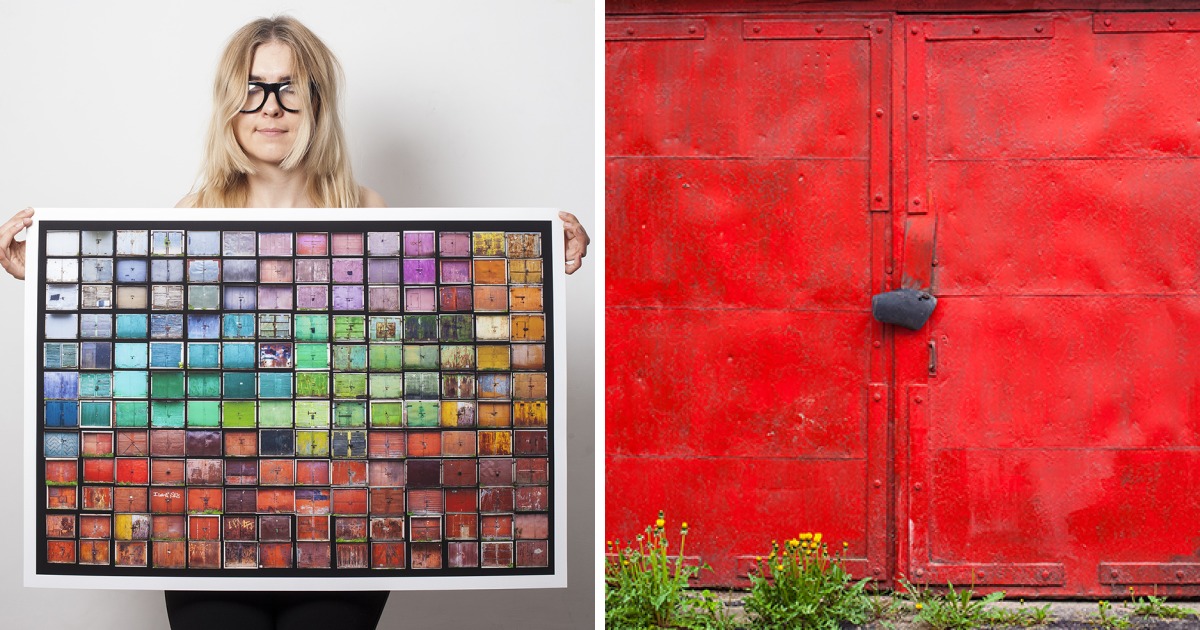
Some people go to Lithuania for medieval castles, amber jewelry, dense forests, or the dreamy cobblestone streets of Vilnius Old Town. I went looking for garage doors. Yes, garage doors. Not the glossy suburban kind that politely opens with a remote and hides a suspicious number of holiday decorations. I mean old, stubborn, Soviet-era garage doors: dented metal panels, peeling wooden planks, rusty hinges, handwritten repairs, and colors so bold they look like they escaped from a box of crayons during a thunderstorm.
At first glance, Lithuania’s old garage towns may seem like ordinary storage zones pushed to the edges of the city. Look longer, though, and they become open-air museums of personality. Every door carries a story. A turquoise door might be flaking into three different decades. A red one may have faded into dusty coral under years of rain and snow. A green one may look as if it has been patched with leftover paint from a fishing boat, a kitchen cabinet, and somebody’s cousin’s fence. Together, they form a living mosaic of Lithuanian urban history.
This photography journey was inspired by the overlooked beauty of Lithuania’s aging garage landscapes, especially the colorful garage towns around Vilnius. These places are connected to the country’s Soviet-era urban planning, when car ownership, private storage, and small workshop spaces created a practical world outside apartment blocks. Today, many of these structures are weathered, disappearing, or being replaced by newer development. But before they vanish completely, their surfaces still speak loudlyin orange, blue, green, yellow, maroon, and rust.
The Accidental Beauty Of Lithuania’s Old Garage Towns
The old garage door may be one of the most underrated subjects in street photography. It does not smile, pose, complain about lighting, or ask whether you got its good side. It simply stands there, aging with spectacular confidence. In Lithuania, many of these garage doors were built for function, not beauty. They protected cars, tools, spare tires, jars of pickled vegetables, mechanical parts, and the occasional mystery object nobody in the family wants to identify.
But time has a strange sense of design. Paint cracks. Metal oxidizes. Wooden panels warp. Sunlight bleaches a once-bright blue into a smoky sky color. Rain drags rust downward in painterly streaks. Snow softens the edges. Owners repaint one panel but not another. A hinge gets replaced. A padlock appears. A number is hand-painted, then half erased by weather. Slowly, the ordinary garage door becomes abstract art.
That is what makes Lithuania’s colorful old garage doors so fascinating. They were not made to be decorative, yet many look more expressive than objects designed for galleries. Some resemble minimalist paintings. Others look like street murals created by weather instead of spray paint. A row of doors can feel like a quilt sewn from industrial leftovers, private memory, and Baltic climate.
Why Garage Doors Matter More Than They Seem
It is easy to romanticize old things simply because they are old. A rusty spoon is still a rusty spoon. But Lithuania’s garage doors are different because they connect everyday life with a complicated historical landscape. During the Soviet period, urban neighborhoods across Lithuania and the Baltic region included garage blocks and garage towns where residents stored vehicles and worked on repairs. These spaces often sat away from apartment buildings, forming their own small communities of metal, brick, concrete, and routine.
In an era when consumer choice was limited and repairs mattered, garages were not just parking spaces. They were workshops, storage rooms, meeting points, escape pods, and private corners in a society where private space could feel scarce. A garage could hold a car, but it could also hold tools, potatoes, spare parts, a radio, family memories, and the quiet pride of making something last longer than it was supposed to.
That history is visible in the doors. Their colors are not polished branding. They are practical decisions made by real people. Someone had a can of green paint. Someone mixed leftover blue with whatever was on hand. Someone cared enough to repaint a dented door even when the structure around it was aging. Someone decided that a garage did not have to be gray just because life sometimes was.
A Photographer’s Dream: Texture, Pattern, And Imperfection
Modern photography is often obsessed with perfection: clean lines, balanced symmetry, sharp products, soft lighting, and backgrounds so tidy they look allergic to human life. Lithuania’s old garage doors offer the opposite. They are crooked, loud, scarred, mismatched, and gloriously imperfect. In other words, they are perfect.
Color That Refuses To Behave
The first thing that hits you is the color. Not neat designer color, but lived-in color. A yellow door may have turned mustard at the top and lemon near the bottom. A blue door may carry patches of navy, powder blue, and bare metal. A red door may be sunburned into pink and rust at the same time. The colors are layered with weather, memory, and repair.
For a photographer, this is gold. The camera loves contrast: saturated paint against crumbling concrete, a bright panel beside dark rust, a fresh repair next to decades of decay. The best images are not just colorful; they are complicated. They show beauty and wear fighting for the same square inch.
Repetition With Personality
Garage towns often contain rows upon rows of doors, which creates a powerful visual rhythm. From a distance, the doors appear repetitive. Up close, every one is different. One has diagonal planks. Another has three padlocks. One is painted in careful stripes. Another looks like it survived a wrestling match with a tractor. This mix of repetition and individuality gives the photographs their charm.
The effect is similar to looking at apartment windows, mailboxes, or market stalls. The structure is shared, but the details reveal personality. These doors show how people personalize even the most practical parts of life. A garage door becomes a name tag, a mood, a flag, and occasionally a cry for help from a very tired hinge.
Weather As The Co-Artist
No painter could fake these surfaces convincingly. The Baltic seasons have done too much honest work. Lithuania’s cold winters, wet weather, shifting sunlight, and years of neglect have turned paint into geography. Rust creeps like rivers. Cracks form tiny maps. Peeling layers reveal previous colors underneath, like archaeological evidence with better visual taste.
This is why old garage door photography feels so emotional. The subject is static, but the surface is alive. It shows time moving slowly, patiently, and without asking permission.
The Human Story Behind The Doors
What surprised me most was how human these old garage doors felt. A door is technically a barrier, but these doors felt oddly revealing. They hinted at the people behind them: the careful owner, the improvisor, the mechanic, the dreamer, the person who painted everything bright green because green was what existed in the shed.
Some doors seemed proud. Some looked exhausted. Some had been patched with such determination that they appeared to be held together by optimism and two bolts. Others had tiny design choices that made me smile: a painted number, a decorative pattern, a handle placed slightly too high, or a color combination that would make an interior designer slowly back out of the room.
Yet that is the point. These doors were never trying to impress anyone. Their beauty is accidental, and accidental beauty often feels more honest than planned beauty. It is the same reason people love old signs, faded storefronts, handwritten menus, and family recipes with stains on the page. They are not polished. They are real.
Lithuania’s Urban Past In Plain Sight
Lithuania is a country with deep historical layers. Vilnius alone carries traces of medieval power, Baroque architecture, Jewish heritage, Polish and Russian influence, Soviet occupation, and modern European reinvention. Tourists often focus on the grand landmarks, and for good reason. Vilnius Old Town is stunning. Lithuanian castles, churches, forests, and lakes deserve every camera pointed at them.
But the garage doors reveal a quieter kind of history. They belong to everyday Lithuania: not the postcard version, but the practical version. They speak of apartment life, limited resources, car culture, weekend repairs, improvised storage, and the stubborn creativity of ordinary residents. This kind of history rarely gets a bronze statue, but it may tell us more about daily life than a monument ever could.
In many post-Soviet cities, older industrial and utilitarian spaces are being demolished, renovated, or repurposed. That transformation is natural. Cities change. People need housing, offices, roads, and cleaner public spaces. Still, when these garage towns disappear, something textured disappears with them. The photographs become a record of a visual language that may not exist much longer.
How I Approached Photographing The Garage Doors
Photographing old garage doors sounds simple until you try it. Then you realize that every door wants a different kind of attention. Some work best straight-on, like formal portraits. Others need a wider frame to show the rhythm of the row. Some detailsa rusty latch, a brushstroke, a number, a peeled cornerdeserve close-up shots.
Looking For Light, Not Perfection
Bright midday light can flatten texture, while softer morning or late-afternoon light can bring out the grooves, dents, and shadows. Cloudy days are especially useful because they reduce harsh glare on metal surfaces. Lithuania’s gray skies, which some travelers unfairly accuse of being “moody,” can actually be a photographer’s best assistant. A cloudy sky makes saturated doors pop without turning reflections into a wrestling match.
Respecting Private Spaces
Even when a garage door looks like a public artwork, it is still attached to someone’s property. Good urban photography requires respect. I avoided interfering with locks, entering private areas, or treating the place like a theme park. The goal was to document, not disturb. A camera should observe history, not stomp through it wearing muddy boots.
Finding Order In Chaos
The most satisfying images came from finding small patterns in visual chaos. Three green doors in a row. A red door between two blue ones. A bright yellow panel surrounded by gray concrete. A row where every door seemed to belong to the same family but none wanted to admit it. Composition turned disorder into rhythm.
Why The Photos Feel Like Abstract Art
Many viewers compare these garage doors to abstract paintings, and it is easy to see why. When you remove the context and focus on the surface, the doors become blocks of color, texture, line, and movement. A rust stain becomes a brushstroke. A dent becomes a shadow. A repair seam becomes a horizon. Weather turns function into composition.
That is the magic of this subject. It changes depending on how you look at it. From one angle, it is just a garage. From another, it is a painting. From another, it is a historical document. From another, it is a joke told by time: “You thought this was ugly? Look again.”
This is also why colorful old garage doors work so well for SEO-friendly travel and photography content. They combine several interests at once: Lithuania travel, urban exploration, street photography, Soviet-era architecture, color inspiration, and cultural storytelling. They are visually striking and historically meaningful, which is the sweet spot between “pretty picture” and “actually worth reading about.”
What These Doors Teach Us About Beauty
The biggest lesson from photographing Lithuania’s old garage doors is that beauty does not always arrive wearing polished shoes. Sometimes it has rust on its elbows. Sometimes it squeaks. Sometimes it is locked with a chain and painted in a shade of orange that should probably come with a warning label.
These doors remind us that ordinary places deserve attention. Beauty is not limited to museums, castles, beaches, luxury hotels, or perfectly renovated streets. It can appear in neglected corners, industrial edges, and forgotten rows of storage units. All it needs is time, light, and a viewer willing to slow down.
They also challenge the way we think about preservation. Not everything can or should be frozen in place. Cities need to evolve. But photography can preserve the emotional texture of places before they change. A photograph says: this existed, this mattered, and someone noticed.
Field Experience: Walking Among Lithuania’s Colorful Old Garage Doors
The experience of photographing these garage doors was stranger and more rewarding than I expected. I arrived thinking I would take a few interesting pictures and leave with a tidy little collection of urban textures. Instead, I found myself walking slowly from door to door as if I were reading a neighborhood written in paint. Every few steps, the mood changed. A row of deep greens felt calm and forest-like. Then a sudden burst of red made the whole scene feel theatrical. A pale blue door beside a rusty brown one looked like summer standing next to November.
There was also a quietness to the place that made the colors feel louder. Many garage towns sit away from the polished routes visitors usually follow. You do not hear tour guides waving umbrellas or souvenir sellers calling out prices. You hear gravel under your shoes, a distant car, maybe a bird, maybe the metal groan of a door being opened somewhere down the row. The atmosphere is practical, not romantic. That makes the visual surprise even stronger.
At times, I felt like I was photographing portraits rather than architecture. One door had a tiny patch of fresh paint that did not match the rest, like a bandage applied by someone in a hurry. Another had numbers so faded they looked embarrassed to still be there. One bright green door had rust dripping from the top in long, dramatic streaks, as if it had spent years crying iron tears. I know that sounds dramatic for a garage door, but spend enough time with old metal in Lithuania and you start giving it a personality. This is normal. Probably.
The challenge was deciding how much context to include. A close-up of peeling paint made the image feel abstract and elegant. A wider shot revealed the rough ground, the uneven roofline, and the ordinary surroundings. Both were truthful. The close-up showed the beauty; the wide shot showed the life around it. I learned to take both whenever possible, because the story lived in the contrast.
Another memorable part of the experience was realizing how quickly my eye adjusted. At first, I looked for the brightest doors. After a while, I noticed quieter details: the shadow under a handle, the difference between old and new screws, the way two similar blues changed under different light. The more I looked, the less “ugly” the place became. It was not ugly at all. It was layered, functional, damaged, colorful, and deeply human.
By the end, I understood why old garage doors in Lithuania have captured the imagination of photographers and design lovers. They are not just interesting backgrounds. They are proof that time is one of the greatest artists, though admittedly a messy one. It never cleans up after itself, but it leaves behind excellent textures.
Conclusion
Photographing the most colorful old garage doors of Lithuania was not just an exercise in finding pretty colors on rusty metal. It was a journey into overlooked urban history, everyday creativity, and the accidental art created by time. These garage doors tell stories about Soviet-era planning, personal space, repair culture, practical design, and the Lithuanian ability to make even a storage unit look unexpectedly poetic.
In a world obsessed with newness, the old garage doors of Lithuania offer a refreshing reminder: not everything beautiful is clean, expensive, or intentional. Some beauty is dented. Some beauty is patched. Some beauty has three padlocks and a suspicious squeak. And sometimes, the most unforgettable gallery is a row of aging doors on the edge of Vilnius, quietly glowing in colors no design committee would ever approvebut every camera secretly loves.
Note: This article is an original, publication-ready rewrite based on publicly available information about Lithuania’s colorful garage towns, Soviet-era urban spaces, Vilnius photography culture, and the documented artistic interest in Agnė Gintalaitė’s Beauty Remains garage door photography project. No source links or citation placeholders are embedded in the article body.