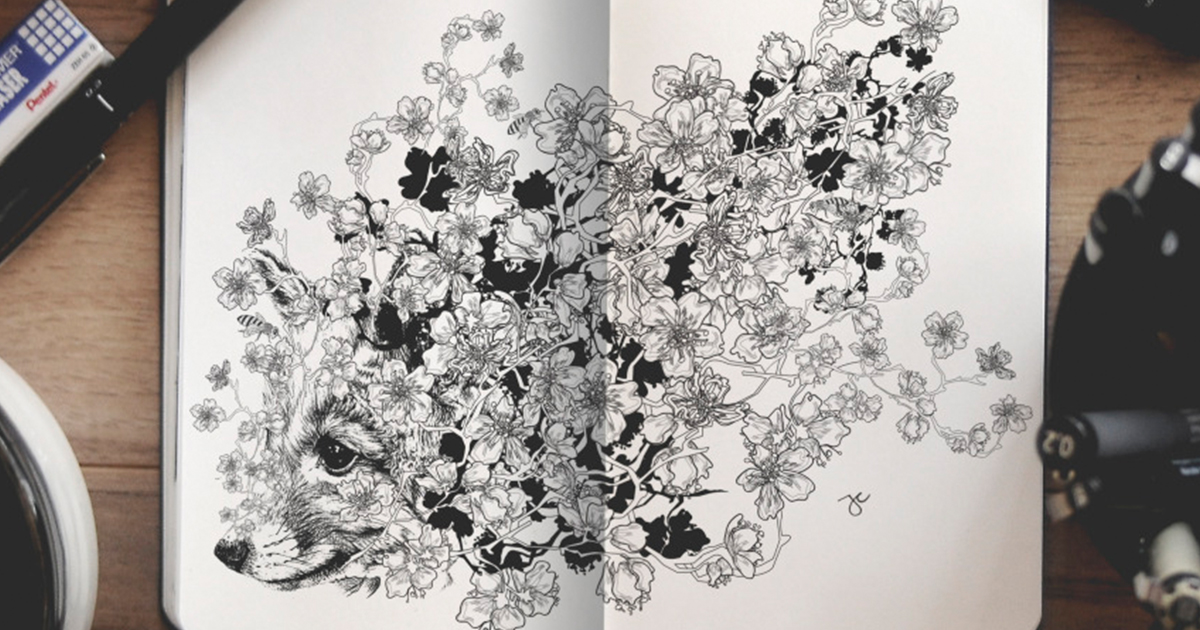
Some sketchbooks behave politely. They sit on a desk, hold a few grocery lists, maybe a half-hearted coffee cup drawing, and never cause trouble. Mine, apparently, missed that memo. Open one page and a fox may be growing antlers made of vines. Turn another and a whale may be carrying a tiny forest on its back. By the time the ink dries, the sketchbook has become less of a notebook and more of a little zoo with questionable zoning permits.
Surreal creatures in a sketchbook have a special kind of magic because they do not need permission from reality. They can borrow the jaw of a wolf, the wings of a moth, the roots of an old tree, and the attitude of a cat that has just knocked over your water cup on purpose. This is where surreal illustration thrives: in the playful space between observation and imagination, between the world we recognize and the dream world that keeps adding extra legs.
The title Surreal Creatures Bloom And Burst Across My Sketchbook captures a style of drawing that feels alive, organic, detailed, and slightly mischievous. It brings together black-and-white ink drawing, nature-inspired illustration, fantasy creature design, and the long artistic tradition of Surrealism. It also reflects a very modern creative habit: using the sketchbook not as a place for perfect finished art, but as a laboratory where ideas hatch, molt, and occasionally stare back.
What Makes a Creature “Surreal”?
A surreal creature is not simply a made-up monster. A dragon is fantasy. A turtle with a mountain village on its shell is fantasy with real estate potential. But a bird whose feathers become falling leaves, whose eye contains a moon, and whose body dissolves into a landscape? That is surreal. It feels symbolic, dreamlike, and emotionally familiar even when it makes no literal sense.
Surrealism grew from the belief that art could reveal the hidden logic of dreams, memories, fears, jokes, and the unconscious mind. In practical terms, this means the artist does not always begin with a strict plan. A line may become a horn. A horn may become a branch. A branch may become a doorway. Before long, the drawing has wandered into a forest no GPS app can handle.
In sketchbook art, surrealism often appears through transformation. Animals merge with plants. Human faces become landscapes. Tiny buildings sprout from shells. Fish swim through clouds. The point is not to trick the viewer, but to invite them to look twice. Good surreal illustration whispers, “You know what this is,” and then immediately adds, “Actually, do you?”
The Sketchbook as a Wild Habitat
A sketchbook is one of the most honest places an artist can work. Unlike a polished gallery piece, it does not demand perfect lighting, a dramatic wall label, or a person in black clothing nodding seriously nearby. It can hold mistakes, experiments, half-ideas, strange little creatures, and that one page where the hand forgot how elbows work.
For artists who draw surreal creatures, the sketchbook becomes a habitat. The paper is the soil. The ink is the weather. The creatures grow from repeated marks, crosshatching, dots, spirals, and textures. A page may begin with a simple animal silhouette, but as detail builds, the creature blooms into something more complex. Feathers become petals. Fur becomes waves. A tail becomes a river. The drawing bursts outward because the artist keeps asking, “What else could this become?”
This is why black-and-white sketchbook illustration can be so powerful. Without color, every decision depends on line, contrast, rhythm, and texture. Dense ink can create mystery. Empty space can create breath. A single clean outline can make a creature feel iconic, while thousands of tiny marks can make it feel ancient, like it wandered out of a forgotten folktale and demanded snacks.
Nature Is the Best Weird Art Teacher
Surreal creature drawings often look impossible, but their building blocks come from the real world. Nature is already strange enough to make an illustrator feel underqualified. Seahorses look like punctuation marks that learned to swim. Mushrooms appear overnight like tiny umbrellas for woodland accountants. Octopuses are basically soft escape artists with excellent problem-solving skills. Even a common leaf, viewed closely, has veins like a map of a city nobody has discovered yet.
Artists who grew up around farms, forests, rivers, gardens, or animals often carry those visual memories into their work. A rooster’s posture, a goat’s stubborn expression, a beetle’s armor, or the twisting shape of roots can become part of an imaginary creature. The surreal effect happens when these real observations are recombined in unexpected ways.
For example, a deer may begin as a memory of an animal seen in the distance. Then the antlers become coral. The body fills with tiny birds. The legs dissolve into grass. Suddenly the deer is no longer just a deer; it is a walking ecosystem. That transformation gives the drawing emotional weight. It can suggest fragility, abundance, loneliness, growth, or the quiet fact that everything living is connected, whether or not it has antlers.
Why Black-and-White Ink Feels So Dreamlike
Color can be beautiful, but black-and-white ink has a special authority. It feels direct, timeless, and a little dangerous, like the drawing was carved out of moonlight by someone who owns too many pens. Fine-line illustration also rewards patience. The viewer can explore the page slowly, finding small patterns hidden inside larger forms.
Ink creates drama through contrast. A creature can burst from a white page because dark lines give it structure and gravity. Crosshatching can turn a simple wing into a storm cloud. Stippling can make a shell look ancient. Repeated curved lines can suggest feathers, fur, water, or motion. When these textures pile up, the drawing begins to feel alive.
In surreal sketchbook art, detail is more than decoration. It is storytelling. A fish filled with tiny windows may suggest memory. A wolf with flowers growing from its ribs may suggest healing. A bird made of pages may suggest language, migration, or the dramatic life of an overdue library book. The viewer does not need a single official interpretation. In fact, the best surreal drawings keep some secrets for themselves.
Surrealism, Automatism, and the Joy of Not Knowing Yet
One reason surreal sketchbook creatures feel fresh is that they often come from a loose, exploratory process. Artists may begin with automatic drawing, free association, or spontaneous doodling. Instead of forcing a finished idea from the first line, they allow the image to reveal itself gradually. This can feel less like building a drawing and more like discovering a fossil in reverse.
Automatic drawing has deep roots in Surrealist practice. The goal is to loosen control and let the unconscious mind participate. That does not mean the artist abandons skill. The hand still needs training, balance, and discipline. But the imagination gets a vote, and sometimes it votes for a rabbit with cathedral ears.
This balance between control and surprise is essential. Too much control can make a drawing stiff. Too little control can make it look like a spaghetti incident. The sweet spot is where the artist guides the image but still leaves room for accidents. A random blot may become a shadow. A crooked line may become a vine. A mistake may become the best part of the page, which is rude but useful.
Biomorphic Forms: When Shapes Feel Alive
Many surreal creatures rely on biomorphic forms, meaning shapes that feel organic, living, or body-like without being strictly realistic. These forms curve, swell, stretch, and morph. They may remind viewers of shells, bones, seeds, organs, clouds, insects, or underwater plants. Biomorphic shapes are powerful because they sit between abstraction and recognition. They feel alive before we know what they are.
In a sketchbook, biomorphic drawing can make a creature feel as if it is transforming in real time. A wing may become a leaf. A jaw may become a cave. A spine may become a row of mountains. This constant metamorphosis gives the work movement. The page does not simply display a creature; it stages an event.
Artists like Joan Miró, Arshile Gorky, Adolph Gottlieb, and others explored mysterious organic shapes that hovered between symbol, body, and dream. Modern sketchbook artists continue that spirit in a more intimate format. Instead of monumental canvases, they use notebooks, ink pens, and portable imagination. The scale is smaller, but the world-building can be enormous.
How Surreal Creatures Tell Stories Without Words
A surreal creature does not need a caption to tell a story. Its posture, textures, and transformations can suggest an entire narrative. A bear carrying stars in its fur may feel protective. A fox dissolving into smoke may feel elusive. A turtle with a forest on its shell may feel ancient and patient. A bird bursting into flowers may feel like grief becoming beauty.
This is why surreal sketchbook art connects so strongly with viewers online. People enjoy finding meaning inside details. They zoom in, inspect tiny marks, and invent their own interpretations. The drawing becomes interactive without needing buttons, pop-ups, or a software update that breaks everything.
For artists, this is also liberating. You do not have to explain every symbol. You can let the creature carry ambiguity. Maybe the blooming wolf means resilience. Maybe it means spring. Maybe it means the artist had three cups of coffee and a complicated relationship with botanical anatomy. The mystery is part of the charm.
Building a Surreal Creature: A Practical Creative Process
Start With a Real Animal
Choose an animal with a strong silhouette: owl, deer, fox, whale, octopus, moth, fish, cat, horse, or raven. A recognizable base gives the viewer something to hold onto before the drawing becomes delightfully unreasonable.
Add a Natural Element
Introduce flowers, roots, clouds, mushrooms, coral, leaves, shells, rivers, mountains, or stars. The goal is not to paste decoration onto the animal, but to make the two forms grow into each other.
Use Contrast and Repetition
Repeat small marks to create rhythm. Dense textures can sit beside open white space. Sharp lines can meet soft curves. This contrast helps the creature feel designed rather than chaotic.
Hide Small Surprises
Add tiny details that reward close looking: a miniature doorway, a moon inside an eye, a bird hidden in a feather, or a small house balanced on a horn. These details make the drawing feel like a world, not just an object.
Why This Style Works So Well Online
Surreal creature sketchbook art is extremely shareable because it combines instant visual appeal with slow discovery. The first glance gives viewers a striking animal or fantasy form. The second glance reveals hidden landscapes, delicate textures, and symbolic details. The third glance usually involves whispering, “Wait, is that a tiny fish inside the moon?”
It also photographs beautifully. A sketchbook page has a handmade intimacy that digital art sometimes struggles to imitate. Viewers can imagine the artist’s hand moving across the paper. They can sense the hours of work behind the final image. That human touch makes the art feel personal, even when the creature looks like it belongs to a forest council that meets only during eclipses.
In an age of fast-scrolling content, detailed sketchbook drawings invite people to slow down. They are not loud in the usual internet way. They do not shout. They unfold. That quiet complexity is part of their power.
Experience: What It Feels Like When Creatures Take Over the Page
Drawing surreal creatures in a sketchbook feels a little like hosting a dinner party where none of the guests are human and several have roots. The first few minutes are always awkward. I might draw a circle, then a curve, then stare at it as if it owes me rent. The page looks blank, the pen feels too serious, and the creature refuses to introduce itself.
Then something changes. A line bends the wrong way and suddenly becomes a beak. A shadow near the eye turns into a cluster of leaves. The body, which was supposed to be a simple fox, starts asking for moth wings. At that point, the artist has two choices: fight the drawing or follow it. Following is usually better. The creature is weird, yes, but it seems confident, and confidence counts.
The best moments happen when observation and imagination begin working together. I may remember the way tree roots grip the ground after rain, or how fish scales catch light, or how a sleeping dog curls into a shape that looks almost like a comma. Those memories slip into the drawing without announcing themselves. They become textures, patterns, and little visual jokes.
There is also a meditative quality to the process. Repeating tiny marks can be calming, even when the subject is a bird with a galaxy for a stomach. Crosshatching, stippling, and fine-line patterns slow the hand down. The mind stops racing. The creature grows one mark at a time. It is not instant, and that is the point. The page becomes proof that patience can look wild.
Of course, not every drawing works. Some creatures arrive looking majestic. Others arrive looking like a confused potato with feathers. That is part of sketchbook life. The sketchbook forgives bad ideas because bad ideas are often just good ideas wearing terrible shoes. A failed page can teach proportion, texture, balance, or when to stop adding mushrooms. Especially that last one. There is always a moment when the artist must ask, “Is this enough mushrooms?” The answer is usually yes, but emotionally difficult.
What keeps the process exciting is the sense of discovery. A surreal creature drawing does not simply document imagination; it expands it. By the end, the page may contain an animal that could never exist in nature but still feels emotionally true. It may carry a forest, shed stars, bloom from its own bones, or burst into birds. And somehow, there it is: impossible, detailed, and strangely familiar.
That is the real pleasure of surreal sketchbook illustration. It reminds us that creativity is not always about inventing something from nothing. Sometimes it is about listening closely to what is already around usthe animals, plants, weather, memories, and odd little thoughts that wander through the dayand letting them combine until they become something new. The sketchbook is not just a place to draw creatures. It is where creatures come to become themselves.
Conclusion
Surreal Creatures Bloom And Burst Across My Sketchbook is more than a catchy title. It describes a creative world where animals, plants, dreams, and memories collide in detailed black-and-white ink. This kind of surreal illustration works because it feels both strange and sincere. It uses real textures from nature, dream logic from Surrealism, and the intimate freedom of sketchbook practice to create images that invite curiosity.
Whether you are an artist, collector, blogger, or late-night doodler with suspiciously many pens, surreal creature drawing offers a reminder that imagination does not have to behave. It can bloom. It can burst. It can grow antlers made of flowers and still make perfect emotional sense. And if one of those creatures stares back from the page, congratulations. Your sketchbook is alive now. Please feed it ink.