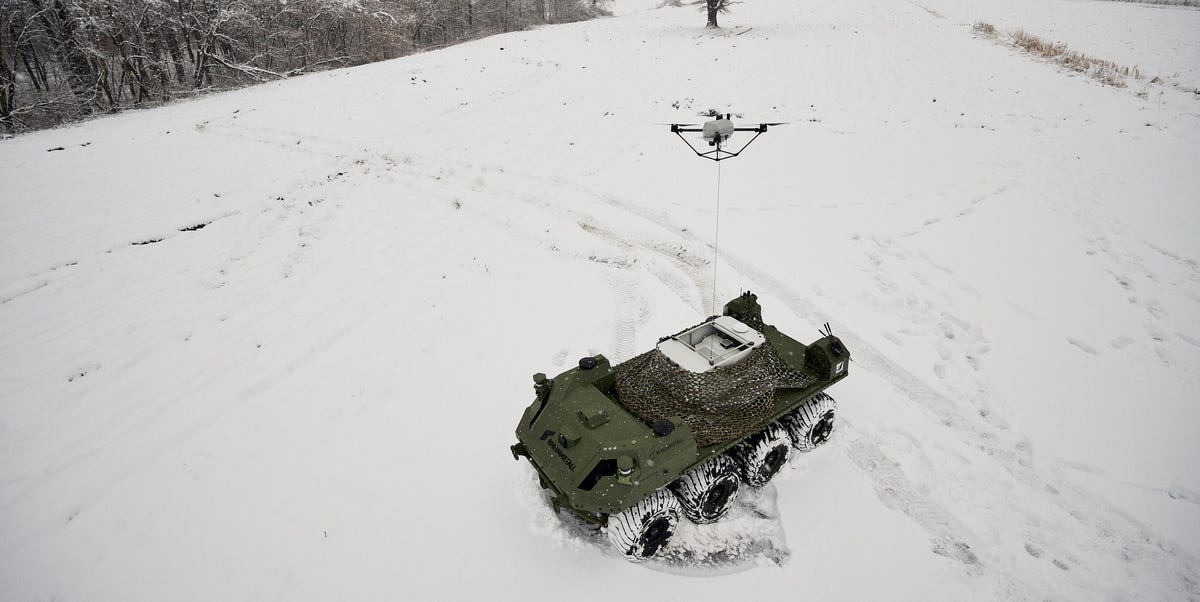
For more than a century, the word “trench” has carried a grim image: mud, fear, artillery, exhaustion, and human beings asked to do the impossible while history grinds overhead. Now add something unexpected to that picture: a small, boxy robot carrying water, ammunition, medical supplies, or even a wounded soldier. It may not look heroic. It may not have a cinematic soundtrack. It may, frankly, resemble a cooler on tank tracks. But on today’s battlefields, that humble machine can be the difference between life and death.
Robots in the trenches are reshaping warfare not only because they can fight, but because they can help people avoid fighting, avoid walking into minefields, avoid driving down drone-watched roads, and avoid dragging the wounded through lethal open ground. The most important battlefield robots are not always the dramatic ones with weapons bolted on top. Many are “peaceful” in purpose: logistics carriers, medical evacuation platforms, demining machines, reconnaissance crawlers, and rescue tools built to keep human beings out of places where the survival odds are rude enough to require a written apology.
This new era of unmanned ground vehicles, or UGVs, has been accelerated by the war in Ukraine, where drones and robots have turned the front line into a brutal laboratory for military innovation. But the lessons are bigger than one war. They point toward a future where the question is not simply whether robots will appear in combat, but what moral, tactical, and humanitarian roles they should play once they get there.
What Are Trench Robots?
Trench robots are a broad category of unmanned systems designed to operate close to the front line. Some move on tracks like miniature armored vehicles. Others roll on wheels, crawl through rough terrain, or work alongside aerial drones that scout ahead. They may be remote-controlled, semi-autonomous, or equipped with software that helps them navigate, detect obstacles, map hazards, and send video back to an operator.
The term “robot” can make people imagine chrome humanoids marching in formation, but the real world is much less shiny and much more practical. A battlefield robot may be a rugged cart with batteries, cameras, encrypted communications, and a cargo bed. Its job might be to take a box of medical supplies to a trench at night, move anti-drone equipment, carry food and water, retrieve the injured, or drag a damaged drone back for repair.
In other words, these machines are not replacing soldiers in some science-fiction sense. They are replacing the worst errands in war. And if you have ever complained about carrying groceries from the car in one trip, imagine doing it across shell-cratered farmland while drones circle overhead. Suddenly, the little robot cart deserves a medal and maybe a tiny parade.
Why Robots Are Showing Up in the Trenches Now
The biggest reason is that modern battlefields have become more visible and more dangerous. Small drones, thermal cameras, artillery sensors, electronic warfare systems, and constant surveillance make movement risky. In earlier wars, soldiers could often move supplies under cover of darkness or behind terrain. Today, even a small vehicle, a heat signature, or a careless radio transmission can attract attention.
That has created a painful problem: armies still need food, batteries, ammunition, medicine, water, and evacuation routes, but the people delivering those essentials are increasingly exposed. The old military truth remains unchanged: logistics wins wars. The new military truth is less poetic: logistics needs a robot friend.
Unmanned ground vehicles answer that need by giving commanders a way to move supplies without sending a driver or stretcher team into the most dangerous areas. A robot can be lost without a family receiving a knock at the door. It can be repaired, replaced, upgraded, or redesigned after a failed mission. That does not make war clean, and it certainly does not make it harmless. But it can reduce the number of humans forced into predictable, high-risk movements.
The “Peaceful” Jobs Robots Do in War
1. Carrying Supplies When Roads Become Traps
One of the most practical uses for trench robots is simple resupply. Soldiers in forward positions may need ammunition, water, food, medical kits, batteries, radios, blankets, and tools. In drone-saturated areas, sending a truck or even a small vehicle may be too obvious. Sending a person on foot can be worse.
A small UGV can creep forward with supplies, especially at night or in poor visibility. It can follow a preplanned route, respond to operator commands, and deliver cargo to a trench or fighting position. These systems may not move fast, but speed is not always the point. In a place where being seen can be fatal, quiet persistence matters more than dramatic horsepower.
2. Evacuating the Wounded
Medical evacuation is one of the most emotionally powerful reasons for battlefield robotics. Traditionally, recovering the wounded requires other soldiers or medics to expose themselves to the same fire, drones, and artillery that caused the injury in the first place. That is courage, but it is also a terrible bargain.
Robotic casualty evacuation systems offer another option. A tracked vehicle can carry a stretcher, shield an injured person with light armor, or bring medical supplies to a point where a human medic cannot safely go. These machines are not magic ambulances. They can get stuck, lose signal, run out of battery, or be destroyed. But when the alternative is leaving someone stranded because the evacuation route is under constant observation, even an imperfect robot can become a lifeline.
3. Clearing Mines and Unexploded Ordnance
Minefields are among war’s cruelest leftovers. They do not care whether a peace agreement has been signed, whether a farmer needs to plant crops, or whether a child has wandered into the wrong field. Robots used for demining and explosive ordnance disposal are therefore some of the clearest examples of machines “coming in peace.”
Remote-controlled diggers, mine-clearing vehicles, drones with sensors, and AI-assisted mapping tools can help locate dangerous objects and reduce the risk to human deminers. Human expertise remains essential because explosive hazards are complex and unpredictable. Still, every meter checked by a machine before a person steps forward is a small victory for common sense.
4. Reconnaissance Without a Human Scout
Reconnaissance robots can investigate trenches, tree lines, abandoned structures, roads, and suspected mine belts. They can send video back to operators and help units understand what lies ahead. In some cases, ground robots work with aerial drones: the drone sees the larger picture from above, while the ground robot investigates what the drone cannot safely confirm.
This is especially useful in environments where buildings are damaged, basements are unstable, or fields are covered with debris. Aerial drones changed warfare by making the sky transparent. Ground robots are beginning to do something similar for the mud, rubble, and blind corners below.
5. Civilian Rescue Under Fire
Some of the most striking recent battlefield robot stories involve civilian rescue. When a conventional evacuation vehicle cannot safely enter a contested area, a ground robot can sometimes move into places too dangerous for people. That same machine that hauls ammunition in the morning may help evacuate an elderly civilian in the afternoon. War is rarely tidy; dual-use technology is even less tidy. But in these moments, the robot’s purpose is unmistakably humane.
Ukraine and the Acceleration of Ground Robotics
The war in Ukraine has pushed unmanned ground vehicles from experiments into practical front-line tools. Ukrainian forces have used robots for resupply, casualty evacuation, mine-clearing, reconnaissance, and in some cases direct combat support. The rapid pace of innovation comes from urgent need: when roads are watched by drones and artillery, the army that can move supplies with fewer exposed humans gains a real advantage.
Ukraine’s approach has also been shaped by a fast feedback loop between soldiers, engineers, startups, volunteers, and procurement systems. A unit identifies a problem. A workshop or company produces a prototype. Soldiers test it. The design is changed. Then the next version goes back to the front. That cycle can happen far faster than traditional defense procurement, which sometimes moves with the enthusiasm of a sleepy printer queue.
This does not mean every robot succeeds. Many break. Some are jammed. Some cannot handle mud, craters, snow, water, or broken terrain. Some have too little battery life. Some lose communications at exactly the moment when everyone involved begins using colorful language. But failure is part of the learning process. The battlefield is an unforgiving product tester, and Ukraine has shown how quickly unmanned systems can evolve when the need is immediate.
Why the “Killer Robot” Image Is Misleading
The public conversation about military robotics often jumps straight to autonomous weapons. That debate matters, especially when artificial intelligence and lethal force are involved. But the image of a fully autonomous killer robot roaming the battlefield is not the whole story, and in many current ground operations it is not even the most useful story.
Many front-line UGVs are remote-controlled machines with practical jobs. The logistics carrier may have more strategic value than the flashy armed platform because soldiers need supplies every day. The evacuation robot may save lives more directly than a robotic gun. The demining machine may protect civilians long after a battle ends. In the real world, the robot that brings batteries may be more important than the robot that looks good in a defense expo video.
That is the paradox: robots are reshaping warfare by making some parts of war less dependent on human exposure. They do not make war peaceful. But they can make certain missions less deadly for medics, drivers, sappers, and infantry soldiers who would otherwise do the job themselves.
Human Control Still Matters
As AI becomes more capable, the question of human oversight becomes more urgent. Navigation assistance, target recognition, obstacle detection, and route planning can help operators manage complex missions. But military leaders and policymakers continue to emphasize that the use of force must remain governed by human judgment, the law of war, and clear rules of engagement.
This distinction is important. A robot that can drive through rough terrain with limited help is not the same as a machine making life-and-death decisions on its own. A drone that uses AI to identify a road hazard is not the same as an autonomous weapon selecting and engaging targets without meaningful human control. The technology is moving quickly, but responsible use depends on doctrine, training, testing, accountability, and restraint.
The best future for battlefield robotics is not one where machines make war easier to start. It is one where machines make the most dangerous necessary tasks less fatal for humans. That may sound like a narrow goal, but in war, narrow mercy can still matter.
The Technology Behind the Trench Robot Revolution
Modern UGVs combine several technologies that have matured at the same time. Better batteries allow longer missions. Compact cameras and thermal sensors help operators see in darkness or smoke. Commercial robotics components lower costs. Satellite navigation, mesh networks, and relay drones extend communication. AI-assisted software can help with mapping, navigation, object detection, and route planning.
At the same time, the battlefield pushes back. Electronic warfare can jam signals. Mud can swallow wheels. Shell craters can trap tracks. Water can destroy electronics. Snow can reduce battery performance. A route that looked safe yesterday may be cratered today. Robots must be rugged, repairable, cheap enough to lose, and simple enough for exhausted soldiers to operate under pressure.
That is why the most successful battlefield robots are not necessarily the most elegant. They are the ones that work after being bounced in a pickup truck, repaired with basic tools, driven through mud, and operated by someone who has not slept enough. In a trench, “user experience” means the button works while artillery is landing. Silicon Valley could learn a thing or two from that product review.
How Robots Change Military Strategy
Robots change strategy by changing risk. If a unit can send a machine to scout a route, it may avoid an ambush. If it can send a UGV to deliver supplies, it may hold a position longer. If it can evacuate casualties remotely, it may reduce the pressure on medics and rescue teams. If it can clear hazards before people enter, it may speed operations and protect lives.
Robots also change the economics of war. A low-cost unmanned vehicle can take on a mission that might otherwise require a truck, armored vehicle, or team of soldiers. Losing a robot is still a loss, but it is not the same as losing trained personnel. This matters especially for countries facing manpower shortages or trying to protect highly trained specialists.
However, robots also create new vulnerabilities. They need supply chains, spare parts, software updates, batteries, secure communications, and trained operators. They can be hacked, jammed, captured, studied, or copied. The side that uses robots must also defend against them. The future battlefield will not simply be humans versus robots. It will be human-machine teams competing against other human-machine teams.
The Humanitarian Promise and the Ethical Warning
There is a humanitarian promise in trench robotics: fewer soldiers exposed during resupply, fewer medics forced into impossible rescues, safer demining, better reconnaissance before entering dangerous areas, and more options for civilian evacuation. These uses deserve attention because they show that military technology does not always fit neatly into the category of destruction.
But there is also an ethical warning. Any system that can carry medicine can often carry munitions. Any robot that can scout for survivors can also scout for targets. Dual-use technology demands serious oversight. The same innovation that saves lives in one mission could increase lethality in another. That is why policy, law, command responsibility, and public scrutiny matter.
The central question is not whether robots are good or bad. Tools rarely come with moral labels printed on the box. The question is how they are used, who controls them, what safeguards exist, and whether they reduce human suffering or simply make violence easier to automate.
What Comes Next for Robots in the Trenches?
The next generation of trench robots will likely be more modular, more autonomous in navigation, and more integrated with aerial drones. Expect more robots designed for casualty evacuation, mine detection, electronic warfare support, sensor placement, communications relay, and cargo movement. Some will be small and disposable. Others will be larger, reusable platforms with swappable payloads.
Artificial intelligence will improve navigation and reduce operator workload, but full autonomy in complex combat environments will remain difficult. Trenches, forests, destroyed towns, and minefields are messy places. A robot may recognize a road in a test range, then meet a Ukrainian spring mud season and reconsider its career choices.
The most valuable systems will be those that combine reliability, affordability, repairability, and mission flexibility. A robot that performs one task beautifully but breaks after one bad pothole may be less useful than an ugly machine that hauls cargo every night for a month. War rewards the practical.
Experience-Based Reflections: What This Shift Feels Like on the Ground
To understand why robots in the trenches matter, imagine the experience from the perspective of a small unit holding a forward position. The soldiers are tired. Their supplies are low. The road behind them is watched. Every engine noise feels like an announcement. Every movement must be planned. A simple delivery of water becomes a mission that could cost lives.
Now imagine a small ground robot arriving after dark. It is not glamorous. It may move slowly, bumping over ruts and debris like a stubborn lawn mower with classified ambitions. But in its cargo bed are batteries, bandages, food, and ammunition. Nobody had to drive a truck into a drone kill zone. Nobody had to crawl across open ground with a heavy pack. The robot does not remove fear from the trench, but it removes one reason for a person to step into danger.
The same emotional shift applies to casualty evacuation. In older battlefield logic, rescuing the wounded often meant sending more people into the same danger. That tradition is built on bravery, but bravery should not be confused with efficiency. A robot stretcher platform changes the calculation. It gives commanders one more option between “risk more lives immediately” and “wait until conditions improve.” In war, waiting can be fatal. A machine that can move when people cannot may preserve the golden minutes that matter most.
There is also a psychological effect. Soldiers who know a robot can bring supplies or attempt evacuation may feel less abandoned in exposed positions. Families may someday take comfort in knowing that technology is being used not only to strike targets but to bring people home. Medics may be able to focus more on treatment and less on impossible movement under fire. Deminers may be able to inspect more ground before stepping into it. Civilians trapped near front lines may get one more chance to leave.
Of course, no one should romanticize this. A robot in a trench is still a sign that human beings have failed to solve conflict peacefully. The machine exists because the environment is too dangerous for people, and that is not exactly a victory lap for civilization. But within that harsh reality, there is room for practical mercy. If a robot carries water instead of a soldier carrying it under fire, that matters. If it retrieves the wounded, that matters. If it clears a path through explosives so a village can be farmed again, that matters.
The most honest way to describe this revolution is not “robots are replacing soldiers.” They are replacing some of the worst moments soldiers face. They are becoming mechanical mules, scouts, medics’ assistants, and minefield helpers. They come without speeches, without fear, and without families waiting at home. In the trenches, that may be the closest thing technology can offer to peace.
Conclusion
Robots in the trenches are reshaping warfare because they change who must take the risk. They can deliver supplies, evacuate casualties, map danger, clear explosive hazards, and help civilians escape contested areas. Their most important role may not be replacing human judgment, but protecting human life from the most predictable dangers of modern combat.
The future of warfare will include more unmanned ground vehicles, more AI-assisted systems, and more human-machine teamwork. That future is not automatically safer or more ethical. It will depend on how armies design, control, and use these machines. But one lesson is already clear: not every robot arriving at the front line comes to destroy. Some come carrying water, medicine, and a way home.
Note: This article is based on synthesized public information from reputable defense, technology, and news sources. It is written for web publication and intentionally excludes inline source links or citation placeholders.