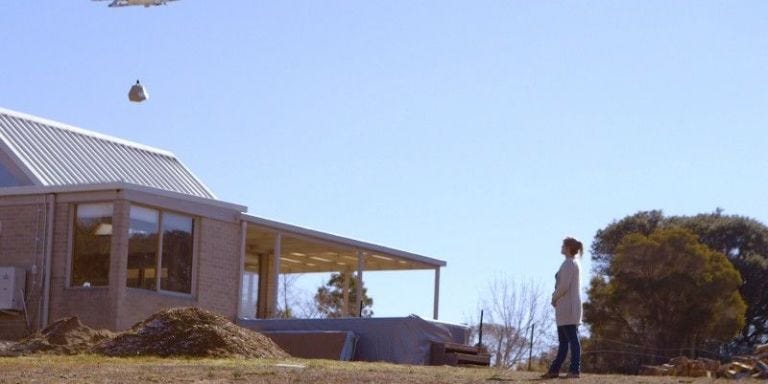
Imagine ordering toothpaste, coffee, medicine, or a last-minute snack and, instead of a driver pulling into your driveway, a small aircraft buzzes overhead like a very determined mechanical hummingbird. Then comes the fun part: your purchase gently descends from the sky on a string. No parachute. No dramatic crash landing. No tiny robot kicking your fries across the lawn. Just a package, a tether, and a futuristic moment that makes your neighbor peek through the blinds.
That is the basic idea behind Wing, the drone delivery company that began as Google X’s Project Wing and now operates under Alphabet, Google’s parent company. The company has spent years developing delivery drones that can carry small purchases, fly autonomously to a customer’s home, hover above a chosen drop-off spot, and lower the package using a tether-and-hook system. It sounds like science fiction with a shopping cart, but it is already moving from test flights into real-world commercial delivery programs in parts of the United States and beyond.
The headline-grabbing detail is the string. Technically, it is a tether, but “your burrito arrives on a tether” does not have the same backyard-theater energy. The tether matters because it solves one of the biggest questions in drone delivery: how does a flying machine safely hand something to a human without landing, crashing, dropping, or frightening the family dog into a personal vendetta against technology?
What Is Google’s Delivery Drone Project?
Google’s original drone delivery work began inside X, the company’s “moonshot” factory, where unusual ideas are tested to see whether they can become serious businesses. Project Wing was one of those ideas. The goal was simple to describe and extremely difficult to execute: use small autonomous aircraft to move lightweight goods quickly from local businesses to nearby customers.
Over time, Project Wing became Wing, an independent Alphabet business. While many people still casually call it “Google’s drone delivery project,” the modern operation belongs to Alphabet’s broader family of companies. Wing has tested and operated services in places including Australia, Finland, Virginia, Texas, and other U.S. markets. Its partnerships have included retailers, restaurants, pharmacies, and delivery platforms.
The company’s pitch is not that drones will replace every delivery van. Nobody is sending a refrigerator by backyard drone unless the drone has been eating protein powder. Instead, Wing focuses on small, urgent, lightweight orders: medicine, snacks, household basics, coffee, quick meals, and items people often want now rather than later.
How the String Delivery System Works
The most interesting part of the system is what happens at the customer’s home. A Wing drone does not need to land in the yard. Instead, it flies to the delivery address, identifies a safe delivery area, hovers above the ground, and lowers the order on a tether. Once the package touches down, the hook releases it, the tether retracts, and the drone flies away.
This approach avoids several messy delivery problems. If a drone lands, it may encounter pets, children, lawn furniture, wet grass, uneven surfaces, or a curious uncle who insists he “just wants to look at the propellers.” If a drone simply drops the package, fragile items are in trouble. Eggs do not enjoy skydiving. Coffee also has strong opinions about gravity.
The tether system keeps the drone away from people while allowing the package to arrive gently. It also makes the delivery more precise. Rather than needing a large landing pad, the aircraft can lower the package into a relatively small open area, such as a driveway, yard, or clear spot selected by the customer.
Why Drone Delivery Is Being Tested So Seriously
Last-mile delivery is one of the most expensive and complicated parts of modern commerce. Getting an item from a warehouse or store to a customer’s door involves vehicles, drivers, traffic, fuel, timing, parking, and route planning. For a big weekly grocery order, a van makes sense. For a small bag containing cold medicine and orange juice, sending a whole car across town can feel like using a parade float to deliver a paperclip.
Drone delivery tries to make small local deliveries faster and more efficient. A drone can fly over traffic, take a direct route, and complete short trips quickly. In some markets, Wing and its partners have promoted delivery windows measured in minutes rather than hours. That speed is not just convenient; it can be genuinely useful when someone needs a prescription item, a missing ingredient, or a quick meal during a packed workday.
There is also an environmental argument. A small electric drone may use less energy than a gas-powered vehicle for a tiny delivery, especially when the delivery distance is short and the package is light. That does not mean drones are automatically perfect for the planet. Electricity sources, manufacturing, battery life, maintenance, and operations all matter. But for the right type of trip, the math may favor the flying robot over the traffic-bound sedan.
What Can These Drones Actually Deliver?
Drone delivery is best suited for small, lightweight goods. Think of items such as over-the-counter medicine, convenience-store basics, snacks, small grocery items, coffee, fast food, and personal care products. In some test and commercial programs, customers have ordered everyday goods from local retailers and restaurants through a delivery app or partner platform.
The package is usually packed by store employees, attached to the drone system, and routed through Wing’s software. The customer must be within an eligible delivery area and have a safe place where the drone can lower the order. That means drone delivery is not equally available to everyone. Dense high-rise neighborhoods, restricted airspace, heavy tree cover, bad weather, and crowded streets can all complicate the service.
For now, drone delivery is not about replacing the mail carrier or the full-service grocery truck. It is more like an express lane in the sky for small orders. If regular delivery is a minivan, drone delivery is a scooter with wings and better posture.
Safety: The Real Reason the Drone Uses a Tether
The tether is not a cute gimmick. It is a safety feature. A delivery drone has spinning propellers, batteries, sensors, and moving parts. Keeping the aircraft above people and objects reduces the chance that someone gets too close. It also helps keep the drone away from pets, children, landscaping, outdoor furniture, and other unpredictable backyard characters.
Before lowering a package, the drone can assess the delivery area for obstacles. If the chosen spot is blocked by a car, trampoline, tree branch, or roaming golden retriever with Olympic-level curiosity, the system may need to adjust or avoid delivery. This is one reason companies emphasize clear delivery zones and customer instructions.
Regulation is another key safety layer. In the United States, drone delivery companies must operate under Federal Aviation Administration rules. Commercial package delivery by drone is not simply a matter of buying a quadcopter online and declaring yourself the mayor of the sky. Operators need approvals, certification, operational procedures, and safety systems, especially when flying beyond the visual line of sight.
The Business Side: Why Retailers Care
Retailers are interested in drone delivery because convenience sells. If a customer can receive a small order in 15 to 30 minutes without a driver stuck in traffic, that creates a powerful new shopping habit. It also changes how stores think about local inventory. A nearby Walmart, pharmacy, or restaurant can become a mini fulfillment hub for quick aerial delivery.
Walmart has been one of the most visible U.S. retailers experimenting with drone delivery expansion. DoorDash has also worked with Wing to bring drone delivery into restaurant ordering in select markets. These partnerships show that drone delivery is not just a gadget demonstration; it is becoming part of a broader retail and logistics strategy.
For businesses, the dream is simple: faster delivery, lower cost per small order, fewer road miles, and happier customers. The reality is more complicated. Drones need launch areas, charging systems, trained operations teams, weather monitoring, airspace approvals, maintenance, customer education, and enough order volume to justify the infrastructure. In other words, the drone may fly, but the spreadsheet still has to land.
The Big Challenges: Noise, Weather, Privacy, and Trust
Drone delivery faces real challenges, and pretending otherwise would be like pretending a blender is a lullaby machine. Noise is one of the biggest concerns. Even if drones are quieter than earlier models, communities may still worry about frequent buzzing overhead. A single drone can feel novel. A sky full of them could feel like a mosquito convention with venture capital funding.
Weather is another limitation. Heavy rain, strong winds, lightning, and extreme conditions can ground drones. Traditional delivery vehicles also face weather delays, but they can usually handle a wider range of conditions. Drone networks must be honest with customers about when aerial delivery is available and when the sky has said, “Not today.”
Privacy is also part of the conversation. Delivery drones use sensors and navigation systems to fly safely. Customers and neighbors may wonder what those systems can see, record, or avoid recording. Companies need transparent policies, careful data handling, and clear communication to build public trust.
Then there is the emotional factor. People are used to delivery drivers. They are less used to autonomous aircraft hovering near their homes. Some customers will be excited. Others will need time, demonstrations, and strong safety records before they feel comfortable. New technology does not just need to work; it needs to feel acceptable in ordinary life.
How Drone Delivery Compares With Traditional Delivery
Traditional delivery still wins for large, heavy, complex, or multi-stop orders. A driver can carry several bags, handle substitutions, climb stairs, verify details, and manage unexpected situations. Drones are better for narrow, repeatable tasks: pick up a small package, fly a short route, lower it safely, return to base.
The strongest future may not be drones versus drivers. It may be drones plus drivers plus ground robots plus pickup lockers plus good old-fashioned walking. Different jobs need different tools. You would not use a drone to deliver a sofa, and you probably would not use a box truck to deliver one bottle of cough syrup two miles away unless logistics has personally offended you.
What This Means for the Future of Shopping
If drone delivery becomes common, it could change consumer expectations. People may begin to see small-item delivery as something nearly instant. Retailers may redesign stores to support aerial fulfillment. Neighborhoods may develop new rules for drone zones. Homes may even include marked delivery pads, the way many houses now have doorbell cameras and package boxes.
The technology could also help in urgent or specialized deliveries. Medical supplies, lab samples, and emergency items are natural use cases because speed matters. In rural or traffic-heavy areas, drones may offer meaningful advantages when roads are slow, congested, or difficult to navigate.
Still, the future will probably arrive unevenly. Some suburbs with open yards, clear airspace, and participating retailers may see drone delivery grow quickly. Dense urban cores, apartment towers, and heavily regulated areas may take longer. The drone revolution is not one giant switch. It is more like a dimmer knob, slowly turning up market by market.
A 500-Word Experience: What It Feels Like When Your Order Arrives on a String
The first time you experience a drone delivery, the most surprising part may not be the drone. It may be how normal the ordering process feels. You open an app, choose an item, confirm your address, and select a delivery spot. So far, nothing screams “welcome to the future.” It feels like ordering takeout, except your delivery driver is about to have propellers and zero small talk.
Then you start watching the tracking screen. That is when the ordinary becomes strange in the best possible way. Instead of seeing a car icon crawl through traffic, you see the order moving in a direct path. No red lights. No wrong turns. No “your driver is completing another delivery nearby” message that somehow lasts long enough to become a personal growth exercise.
When the drone gets close, you may hear it before you see it. The sound is noticeable, but not necessarily overwhelming; it depends on the model, distance, neighborhood, and background noise. You step outside, look up, and there it is: a small aircraft hovering with the confidence of a waiter who has never spilled soup. Beneath it, your package begins to lower on a thin tether.
This is the moment that makes people smile. The package does not fall. It does not bounce. It does not require you to catch it like a game-show contestant. It simply descends. The drone keeps its distance overhead while the item arrives at the chosen spot. Once the package touches down, the hook releases, the tether retracts, and the drone heads back. The whole scene can be over so quickly that you wonder whether you should applaud.
The experience also makes you think about practical details. A clear yard suddenly feels valuable. Tree branches look like infrastructure. The family dog becomes a stakeholder. You may find yourself asking questions you never expected: Is the driveway clear enough? Would this work at an apartment? What happens if it rains? Could it bring ice cream without turning it into a dairy-based weather event?
For small urgent items, the appeal is obvious. Need cold medicine when you are too tired to drive? Need coffee during a work-from-home marathon? Forgot one ingredient while cooking dinner? Drone delivery turns those little problems into quick fixes. It is not magic, but it has the emotional texture of magic because it removes friction from daily life.
At the same time, the experience reminds you that convenience needs boundaries. Nobody wants a constant swarm overhead. Communities will care about noise, privacy, safety, fairness, and access. The best version of drone delivery is not a sky crowded with machines; it is a carefully managed service that solves specific problems better than the alternatives.
That is why the string matters. It represents the difference between a flashy stunt and a useful system. Lowering a purchase gently from the air is not just cool; it is practical engineering. It keeps the drone away from people, protects the package, and makes the delivery feel controlled. In a world full of overhyped technology, that little tether is refreshingly humble. It is not trying to look futuristic. It is just doing the job.
Conclusion: A Small String Attached to a Big Idea
Google’s original drone delivery experiment has grown into one of the most closely watched attempts to reinvent local delivery. Wing’s tether-based system shows how a simple idea can solve a complicated problem: getting a package from a flying drone to a customer safely, gently, and accurately.
The technology is not ready to handle every order, every home, or every weather condition. It still faces regulatory, social, environmental, and business challenges. But for lightweight, time-sensitive purchases, delivery drones could become a practical part of everyday shopping. The future may not arrive with a flying car in every garage. It may arrive with coffee, cough drops, and emergency chocolate descending politely on a string.