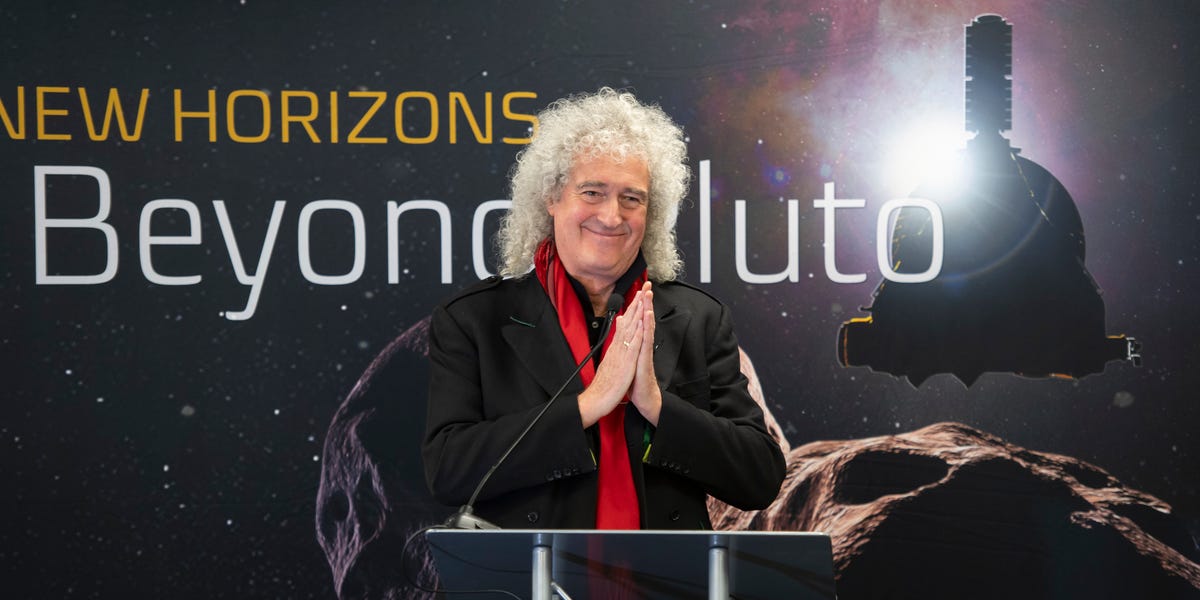
Brian May studying asteroids sounds like the setup to a very specific trivia question: “Which rock legend can play a homemade guitar, write stadium-shaking anthems, and help scientists see an asteroid in 3-D?” The answer, of course, is Sir Brian May, the lead guitarist of Queen and a PhD astrophysicist whose scientific work is far more than a celebrity side quest.
For many people, May is forever linked to the soaring guitar solo in “Bohemian Rhapsody,” the stomp-stomp-clap of “We Will Rock You,” and the roaring tone of the Red Special, the guitar he built with his father. But behind the stage lights is a lifelong scientist fascinated by space, dust, depth perception, and the rocky leftovers of our solar system. His asteroid work connects music, astronomy, public education, planetary defense, and the kind of old-school 3-D imaging that makes space rocks look suddenly, wonderfully real.
In other words, Brian May did not simply glance at an asteroid and say, “Nice boulder.” He helped scientists interpret asteroid images, co-created stereoscopic views of NASA’s asteroid Bennu, collaborated on a 3-D asteroid atlas, and helped bring asteroid awareness to a global audience through Asteroid Day. That is a pretty good encore.
The Rock Star Who Returned to Astrophysics
Brian May’s space story began long before asteroid Bennu became famous. Before Queen became one of the biggest bands on Earth, May studied physics and mathematics at Imperial College London. His doctoral research focused on zodiacal dust, the tiny particles spread through the inner solar system that scatter sunlight and create a faint glow visible from dark skies.
Then Queen happened. That is the polite way of saying a world-conquering rock band interrupted his PhD. May left academia in the 1970s as Queen’s success exploded, but he never truly left astronomy. Decades later, he returned to his thesis, updated his research, and completed his doctorate in astrophysics. His thesis, “A Survey of Radial Velocities in the Zodiacal Dust Cloud,” examined the movement of dust particles in the solar system using spectroscopy and observations connected with the Canary Islands observatories.
That background matters because asteroids are not isolated flying potatoes. They are part of the same cosmic family tree as zodiacal dust, meteorites, comets, and early planetary building blocks. When May studies asteroids, he brings a scientist’s curiosity about the small stuff that tells big stories. In astronomy, dust is not dirt. Dust is evidence.
Why Asteroids Matter
Asteroids are rocky remnants from the early solar system. Many formed more than 4.5 billion years ago, which means they preserve chemical clues from a time before Earth had oceans, continents, weather apps, or people arguing about guitar solos online.
Scientists study asteroids for several major reasons. First, they help explain how planets formed. Second, they may contain materials related to the origins of water and organic chemistry on Earth. Third, some asteroids cross Earth’s neighborhood, making asteroid detection and planetary defense a serious scientific priority. Finally, asteroids are simply fascinating worlds: irregular, ancient, sometimes rubble-like, and often stranger than a science fiction prop department would dare design.
NASA’s OSIRIS-REx mission brought this fascination into sharp focus. The spacecraft visited near-Earth asteroid Bennu, mapped it in detail, collected material from its surface, and delivered a sample capsule to Earth in 2023. Bennu is dark, carbon-rich, boulder-covered, and scientifically precious. It is also a reminder that small objects can carry enormous meaning.
Brian May and NASA’s OSIRIS-REx Mission
One of May’s most important asteroid-related contributions came through his collaboration with NASA’s OSIRIS-REx mission. Alongside stereoscopic imaging specialist Claudia Manzoni, May worked with mission data to create 3-D views of asteroid Bennu. These images were not just pretty pictures for space fans, although they absolutely were that too. They helped reveal the texture, shape, slopes, and hazards of Bennu’s surface.
Stereoscopic imaging works by using two slightly different views of the same object, similar to how human eyes perceive depth. When the left and right images are viewed properly, the brain combines them into a three-dimensional impression. For a mission team trying to understand a rocky asteroid surface, that depth perception can be extremely useful.
Bennu was not the smooth, sandy target some scientists expected. It was covered with boulders, ridges, rough patches, and tricky terrain. Choosing a safe sampling site required careful analysis. May and Manzoni’s 3-D image products helped bring that uneven surface to life, allowing scientists and the public to see Bennu not as a flat photograph, but as a world with volume and structure.
Seeing Bennu in 3-D
NASA highlighted May and Manzoni’s stereo processing in images of Bennu, including views of a large boulder on the asteroid’s southern hemisphere. The technique made surface features easier to understand: slopes rose, shadows gained context, and rocky obstacles became more than dots and blobs on a screen.
Later, after the OSIRIS-REx sample returned to Earth, May also contributed to stereoscopic views of the Bennu material itself. That meant the same visual skill used to interpret the asteroid from space could also help viewers appreciate the grains and fragments sitting in NASA’s curation facilities. From asteroid surface to sample tray, May’s specialty remained the same: make depth visible.
Bennu 3-D: Anatomy of an Asteroid
Brian May’s asteroid work also reached readers through the book Bennu 3-D: Anatomy of an Asteroid, a collaboration connected with University of Arizona Press and OSIRIS-REx principal investigator Dante Lauretta. The book presents Bennu through stereoscopic imagery, giving readers a rare chance to explore an asteroid in three dimensions.
The project is a natural fit for May. He has long been passionate about stereoscopy, including Victorian-era 3-D photography. That may sound quaint until you realize it is basically the ancestor of modern immersive visualization. May’s interest in depth perception bridges antique image viewers and spacecraft cameras. Somewhere, a 19th-century stereoscope is proudly wearing a tiny NASA badge.
In the Bennu project, stereo images do more than decorate the science. They help communicate why Bennu is such a difficult, valuable, and surprising object. Readers can better understand the asteroid’s rugged surface, the challenge of sampling it, and the drama of guiding a spacecraft to touch a world hundreds of millions of miles away.
Asteroid Day and Planetary Defense
Brian May studying asteroids is not limited to research images and books. He is also one of the co-founders of Asteroid Day, a global awareness campaign observed on June 30, the anniversary of the 1908 Tunguska event in Siberia. The mission is to educate the public about asteroids, their scientific importance, and the need to detect potentially hazardous near-Earth objects.
Asteroid Day combines science communication with planetary defense. The point is not to scare people into staring nervously at the sky every morning. The point is to explain that asteroid risks can be studied, tracked, and reduced. Unlike many natural hazards, a dangerous asteroid can potentially be detected years in advance, giving humanity time to plan a response.
NASA’s DART mission proved that asteroid deflection is not just a movie plot with dramatic music. In 2022, DART intentionally impacted Dimorphos, a moonlet of the asteroid Didymos, and changed its orbit. Future tools such as NASA’s NEO Surveyor space telescope are designed to improve the discovery of potentially hazardous asteroids and comets, especially dark objects that are difficult to detect with visible-light telescopes.
May’s public role helps make these efforts more accessible. A scientist can explain orbital mechanics; a rock star scientist can get people who clicked for Queen trivia to stay for planetary defense. That is not a small thing. Public attention is one of the rarest elements in the universe.
From Zodiacal Dust to Asteroids: The Scientific Connection
May’s early research on zodiacal dust connects beautifully with asteroid science. Zodiacal dust includes particles from comets, asteroid collisions, and even material from beyond the solar system. These tiny grains reflect sunlight and form a diffuse cloud around the Sun.
In later work with Professor Michael Rowan-Robinson, May helped model the composition of zodiacal dust in the inner solar system. Their work suggested that a large portion of the dust between the Sun and Mars comes from comets, with a significant contribution from asteroids and a smaller contribution from interstellar dust.
This matters because dust is the fine print of planetary history. Asteroids break apart. Comets shed material. Collisions grind rocks into particles. The solar system is not a museum where everything sits quietly behind glass. It is more like a cosmic workshop with dust in the corners, chips on the floor, and ancient materials still being rearranged.
By studying dust and asteroids, scientists learn how material moves, changes, and survives over billions of years. May’s work sits inside that larger scientific story: the effort to understand how small bodies shaped the planets and may have delivered ingredients essential for life.
What Bennu Taught Scientists
Bennu is especially important because it is a carbon-rich asteroid. NASA’s early analysis of the returned Bennu sample found evidence of carbon and water-bearing minerals. These findings support the idea that asteroids may have carried some of the ingredients needed for life to early Earth.
That does not mean Bennu had little asteroid microbes waving tiny flags. It means the chemistry preserved in Bennu’s rocks and dust can help scientists investigate the raw materials from which planets, oceans, and organic chemistry developed. The sample is a time capsule from the early solar system, and unlike meteorites that fall through Earth’s atmosphere, OSIRIS-REx delivered material in a controlled way with known context.
Context is everything. A random rock in a parking lot may be interesting, but a sample collected from a known asteroid surface by a spacecraft is a scientific treasure. Researchers know where it came from, how it was collected, and how it relates to spacecraft observations. That combination makes Bennu one of the most valuable asteroid studies ever conducted.
Why Brian May’s Asteroid Work Captures Public Imagination
The phrase “Brian May studying asteroids” attracts attention because it breaks the usual categories. People expect musicians to tour, record, and occasionally release memoirs with excellent hair on the cover. They do not expect them to help process NASA asteroid images. But May’s story is powerful because it shows that curiosity does not have to stay in one lane.
His career also makes science feel less distant. Astrophysics can sound intimidating, especially when it involves spectroscopy, radial velocities, infrared emission models, and stereoscopic data products. May gives the subject a human bridge. He reminds readers that science is not only equations on a board; it is also patience, visual imagination, problem-solving, and the joy of seeing something clearly for the first time.
There is also something fitting about a guitarist working with 3-D asteroid imagery. Music depends on depth: layers of sound, timing, resonance, vibration, space. Stereoscopy depends on visual depth: two perspectives becoming one richer perception. In both cases, the magic happens when separate signals combine into a fuller experience.
Lessons from Brian May’s Asteroid Journey
Curiosity Can Pause Without Dying
May left his PhD work for decades, but he did not abandon the curiosity behind it. His return to astrophysics is a reminder that learning does not expire. A delayed dream is not automatically a failed dream. Sometimes it is just waiting backstage for its cue.
Science Needs Great Communicators
Asteroid research involves complex measurements and long mission timelines. Public support depends on clear explanations. May’s visibility helps draw people into subjects they might otherwise ignore. Once they arrive for the celebrity hook, they may discover sample return missions, planetary defense, and the science of early solar system chemistry.
Images Are Scientific Tools
Beautiful space images are not just wallpaper. They can reveal shape, motion, texture, and context. May’s stereoscopic work shows how visual processing can support scientific interpretation. In asteroid missions, seeing better can mean understanding better.
Asteroids Are Not Just Threats
Popular culture often treats asteroids as incoming disasters. Real asteroid science is richer. Asteroids are hazards, yes, but they are also archives. They preserve ancient materials, record the formation of the solar system, and help answer questions about where Earth’s water and organic compounds may have come from.
Experiences Related to Brian May Studying Asteroids
One of the most memorable experiences related to Brian May studying asteroids is the simple act of viewing a stereoscopic asteroid image for the first time. At first, the image may look like a duplicated photograph: two versions of a gray, rocky surface sitting side by side. Then, with a stereoscope or the right viewing technique, the picture suddenly deepens. A boulder rises. A slope drops away. A rough patch becomes a landscape. The asteroid stops looking like a flat science diagram and starts looking like a place.
That moment captures the heart of May’s contribution. He helps transform distant data into something the human brain can feel. You do not need to be an orbital dynamicist to understand that Bennu is rugged when its terrain appears to pop forward in 3-D. You do not need to calculate surface hazards to appreciate why OSIRIS-REx needed careful planning before touching down. The image teaches before the technical explanation even begins.
Another experience is watching how people react when they learn that Brian May is a real astrophysicist. The first response is usually surprise. The second is delight. The third is often a quick search to confirm it, because the human mind needs a moment to process the fact that the guitarist from Queen also worked on asteroid imaging. This reaction is useful. It opens a door. Once people are curious, they become more willing to learn about Bennu, asteroid samples, planetary defense, and the long history of small-body science.
There is also an inspiring personal lesson in May’s return to academic work. Many people carry unfinished projects: a degree paused by life, a skill set aside, a book half-written, a telescope gathering dust in a closet. May’s story does not suggest that everyone must become a rock legend and then complete a PhD. That would be an unreasonable weekend plan. But it does suggest that intellectual passions can survive long interruptions. Curiosity can wait, and when it returns, it may return stronger.
For space enthusiasts, Brian May’s asteroid work also adds emotional texture to missions like OSIRIS-REx. Space missions often appear machine-like: launch dates, trajectory corrections, instruments, sample mass, laboratory analysis. May’s involvement reminds us that exploration is also artistic. The way we see a world affects the way we value it. A 3-D image can make a small asteroid feel immediate, solid, and worthy of attention.
Teachers and science communicators can learn from this approach. Instead of starting with a wall of technical vocabulary, they can begin with wonder: a 3-D image, a surprising biography, a story about a spacecraft touching an asteroid for only a few seconds. Once the audience is engaged, the science has room to breathe. Brian May studying asteroids is not just a quirky headline; it is a case study in how curiosity, storytelling, and visualization can turn complex science into something people want to explore.
And finally, there is the experience of looking up at the night sky with a slightly changed perspective. Asteroids are not visible to most casual observers, and zodiacal light requires dark skies and patience. But knowing that ancient dust drifts through the solar system, that spacecraft can visit carbon-rich worlds, and that a guitarist-scientist helped us see one of those worlds in depth makes the sky feel more connected. The universe becomes less like a distant backdrop and more like an active neighborhood. Some neighbors are rocky, some are dusty, and one of the tour guides happens to know the solo from “We Are the Champions.”
Conclusion
Brian May studying asteroids is more than an amusing fact for music fans. It is a story about lifelong curiosity, scientific communication, and the surprising ways art and astronomy can support each other. May’s work with stereoscopic images of Bennu helped make a distant asteroid easier to understand. His collaboration on Bennu 3-D brought asteroid science to readers in a visually rich format. His role in Asteroid Day helped raise public awareness about planetary defense and the importance of tracking near-Earth objects.
From zodiacal dust to asteroid samples, May’s scientific interests point toward one big idea: small things in space can tell enormous stories. Asteroids are not merely rocks drifting through darkness. They are records of the solar system’s beginning, clues to Earth’s history, and reminders that protecting our planet begins with understanding our cosmic surroundings.
So yes, Brian May can melt faces with a guitar solo. But he can also help reveal the shape of an ancient asteroid. In the grand concert of science and culture, that is a pretty spectacular double track.