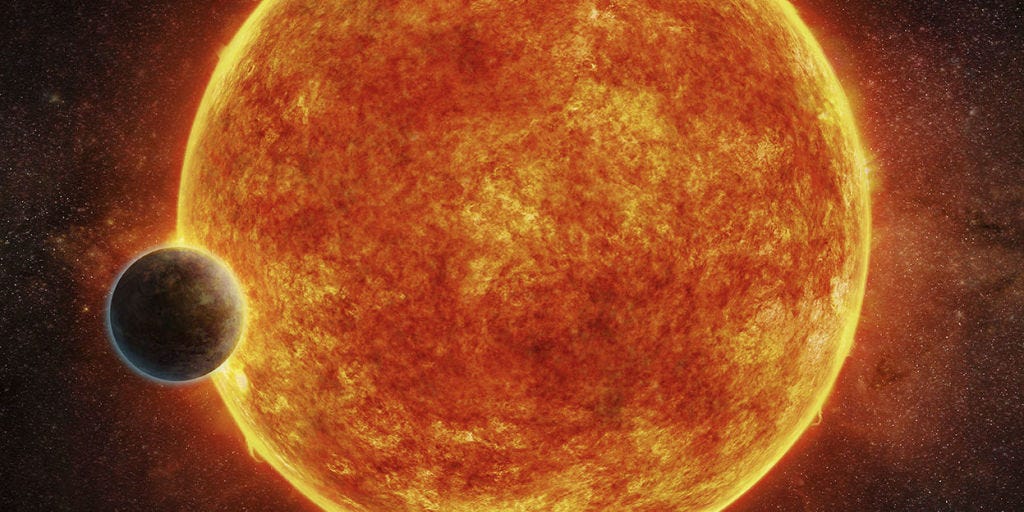
If you have been waiting for astronomy to hand you an honest-to-goodness “maybe this one” planet, the wait has gotten a lot more interesting. The current star of the alien-life conversation is LHS 1140 b, a nearby world that sits in the habitable zone of a small red dwarf star. In plain English, that means it orbits in the not-too-hot, not-too-cold region where liquid water could exist under the right conditions. And in the science of life beyond Earth, liquid water is still the celebrity ingredient. No water, no beach. No beach, probably no alien seagulls.
Now, before anyone starts designing interstellar sunscreen, let’s calm the cosmic hype machine. Scientists have not found aliens on LHS 1140 b. They have not found a city, a signal, or a little green life-form filing taxes. What they have found is arguably better for serious science: a world close enough, interesting enough, and measurable enough to test with today’s best telescopes and tomorrow’s even better ones.
That is why this planet matters. It is not just another exoplanet headline tossed into the giant galactic salad bowl. It is a practical target. A workable target. A planet that gives astronomers a real chance to study an atmosphere, estimate surface conditions, and ask the question that keeps humanity staring up at the sky like a neighborhood dog watching fireworks: Are we alone?
Why LHS 1140 b Has Scientists Paying Attention
LHS 1140 b is often described as a super-Earth, meaning it is larger and more massive than Earth but much smaller than Neptune. That label sounds dramatic, but it mainly tells us this is a big rocky-or-water-rich planet, not a giant gas balloon with delusions of grandeur. The planet lies roughly 48 to 49 light-years away, which in human travel terms is absurdly far, but in exoplanet research terms is practically next door. It is the cosmic version of saying, “Good news, the restaurant is just around the corner,” and then finding out the corner belongs to another solar system.
What makes LHS 1140 b unusually compelling is the combination of distance, orbit, and host star. Its star is a relatively cool and dim red dwarf. Because red dwarfs are smaller than the Sun, planets in their habitable zones orbit much closer in. That sounds risky, and sometimes it is, but it also makes those planets easier to detect. They transit more frequently, block more of their star’s light, and give astronomers more chances to analyze them. In other words, if you want to spy on a planet’s atmosphere from trillions of miles away, you appreciate a planet that keeps showing up on schedule.
Even better, LHS 1140 itself appears quieter than many red dwarfs. That matters because red dwarfs can be absolute chaos goblins. Their flares and radiation can erode or destroy planetary atmospheres, which is bad news for habitability and also bad news for scientists hoping to study something other than a stripped, battered rock. A calmer star does not guarantee a friendly planet, but it does make the odds less ridiculous.
Here’s the Twist: It May Not Be a Simple Earth Clone
This is where the story gets deliciously complicated. LHS 1140 b was once viewed as a dense rocky super-Earth. More recent analyses, especially work tied to the James Webb Space Telescope, suggest it may be less like a giant Earth and more like a water-rich or ice-rich world. Some researchers have proposed that it could be a kind of snowball planet with a liquid ocean in the region directly facing its star. Think less “blue marble” and more “eyeball planet with a watery pupil.” Science fiction would absolutely keep that detail.
Oddly enough, that possibility does not weaken the case for interest. It strengthens it. A world with significant water and a detectable atmosphere could be exactly the sort of place where habitability studies become more than guesswork. LHS 1140 b might not be Earth 2.0. It may be something stranger, colder, and more ocean-heavy. But strange is not bad. In exoplanet science, strange is often where the good stuff lives.
What Makes a Planet a Good Candidate for Alien Life?
People hear the phrase “habitable zone” and immediately imagine forests, oceans, and extraterrestrials naming their children after constellations. Astronomers are much more careful. A planet in the habitable zone is not automatically habitable. It simply receives an amount of starlight that might allow liquid water on the surface, assuming the atmosphere, chemistry, pressure, and planetary history cooperate. That is a lot of assuming.
To be a serious candidate in the search for life, a planet ideally checks several boxes. It should be reasonably small and dense, because smaller worlds are more likely to be rocky than gas-dominated. It should orbit in or near a habitable zone. It should have a star that is not constantly trying to incinerate its atmosphere. And, from an observational point of view, it should be positioned in a way that lets us study it repeatedly.
LHS 1140 b checks more of those boxes than many flashy exoplanets do. That is why it has become such a compelling target. It is not necessarily the easiest planet to understand, but it may be one of the most rewarding.
Why Red Dwarf Systems Are Both Great and Annoying
Most stars in the Milky Way are red dwarfs, which makes them very attractive in the hunt for habitable planets. If life is common, a lot of it may be orbiting small red stars. These systems are abundant, and because their habitable zones sit close to the star, their planets are easier for our telescopes to detect.
But red dwarfs come with baggage. Young ones can flare violently. Their planets often become tidally locked, with one side always facing the star and the other trapped in permanent night. Their ultraviolet and X-ray output can wreak havoc on atmospheres. So every time astronomers find a potentially habitable red dwarf planet, the real question becomes: Did the planet keep its atmosphere, and if so, what kind?
That is why a relatively quiet red dwarf host can make scientists sit up a little straighter. It does not prove habitability, but it removes one giant cosmic headache from the to-do list.
How Scientists Actually Search for Life on a World Like This
The modern search for alien life is not about landing a rover on a nearby planet and scooping pond water into a test tube. Not yet, anyway. For now, astronomers mostly work with light. When a planet passes in front of its star, a tiny amount of starlight filters through the planet’s atmosphere before reaching our telescopes. Different molecules absorb different wavelengths of light, leaving behind telltale patterns in the spectrum.
This technique, called transit spectroscopy, is how researchers hunt for atmospheric gases such as carbon dioxide, methane, water vapor, and possibly more exotic compounds. These gases do not automatically mean life. Methane can come from geology. Oxygen can be misleading. Water just tells you water is present, not that something is swimming in it and making weekend plans.
That is why context matters so much. Scientists do not want one “magic molecule” and a confetti cannon. They want a convincing combination of signals that make non-biological explanations less likely. On Earth, life alters the atmosphere in obvious ways. On exoplanets, the challenge is proving that weird chemistry is truly biological and not just a planet doing chemistry planet-style.
The K2-18 b Lesson: Excitement Needs a Seatbelt
A perfect example is K2-18 b, another famous exoplanet that has generated enormous buzz because of tentative atmospheric clues and possible biosignature chemistry. But the debate around K2-18 b also shows how careful researchers must be. A signal can be promising without being conclusive. A planet can be in the habitable zone without being truly habitable. And a headline can sprint much faster than the underlying data.
LHS 1140 b benefits from that lesson. Scientists are interested in it not because they want to oversell it, but because it is a planet where careful, repeated measurements might actually reduce the uncertainty. That may not be as glamorous as “aliens found,” but it is much more useful.
How LHS 1140 b Compares With Other Famous Alien-Life Targets
The search for life has no shortage of celebrity planets. TRAPPIST-1 remains the blockbuster system, with seven Earth-sized worlds and several in or near the habitable zone. It is still one of the most important laboratories for testing planetary atmospheres around a red dwarf. But recent studies have shown that red dwarf activity can muddy the picture and make atmospheric interpretation tricky.
TOI-715 b is another strong addition to the conversation. It is a habitable-zone super-Earth around a red dwarf and a promising future target, especially because it transits frequently. It gives astronomers another valuable candidate in the growing pipeline of worlds that can be examined by Webb and successor missions.
Proxima b will always be irresistible because it orbits the star closest to the Sun. But being close to a flare-prone star creates obvious habitability concerns. Meanwhile, newer candidates such as GJ 251 c are expanding the list of nearby super-Earths that may become prime atmospheric targets as next-generation observatories come online.
So why is LHS 1140 b standing out right now? Because it sits at a sweet spot. It is close. It transits. Its star appears relatively calm. Its size and density make it scientifically juicy. And recent observations have pushed it from “interesting catalog entry” to “serious habitable-world case study.”
What Future Telescopes Could Reveal
James Webb is powerful, but it is not magic. Studying a small world like LHS 1140 b is still difficult. Detecting an atmosphere is hard. Detecting water is harder. Detecting a biosignature is the astrophysical equivalent of hearing one whispered sentence in a stadium full of leaf blowers.
Researchers have already pointed out that gathering enough transit observations to search deeply for biosignatures on LHS 1140 b could take years, maybe close to a decade in some scenarios. Clouds and hazes could make things even tougher. Still, Webb can begin the process. It can narrow the possibilities. It can tell us whether we are looking at a bare rock, a water world, or something in between.
After Webb, the real cavalry arrives. NASA’s planned Habitable Worlds Observatory is being designed specifically to directly image potentially habitable planets and search their atmospheres for chemical fingerprints of life. Ground-based extremely large telescopes will also sharpen the picture. LHS 1140 b may become one of the planets that bridges the current era of exoplanet discovery and the next era of exoplanet diagnosis.
Why This Matters Even If We Never Find an Alien on It
There is a strange misconception that a planet is only interesting if it definitely hosts life. That is not how science works. A world like LHS 1140 b matters because it teaches us how planets form, how atmospheres survive, how oceans might persist under alien skies, and how rare Earth-like conditions really are.
If LHS 1140 b turns out to be a frozen water world with no meaningful atmosphere, that is still a major result. If it turns out to have a nitrogen-rich atmosphere and hints of water vapor, that is huge. If it becomes the first habitable-zone rocky or water-rich planet where scientists can confidently characterize the atmosphere, that alone would be a milestone. Sometimes the road to finding life begins with learning, very precisely, why a planet is almost suitable.
And honestly, that is part of the fun. Exoplanet science is not a straight line toward little waving aliens. It is a detective story with bad lighting, incomplete clues, and suspects made of ice, gas, rock, and stellar radiation.
What It Feels Like to Follow the Search for Alien Life
There is also a human side to this story, and it deserves space because the search for alien life is not just a technical exercise. It is an emotional one. Following the rise of a planet like LHS 1140 b feels a little like watching explorers map a coastline through fog. Every new data point sharpens the outline, but the full shape stays just out of reach. One month the planet is rocky. The next month it may be water-rich. Then the discussion shifts to clouds, atmospheric retrievals, or whether the star is quiet enough to behave itself for five whole minutes. It is science, yes, but it is also suspense with equations.
For readers, there is a special kind of thrill in realizing that “nearby” no longer means only Mars, Europa, or Titan. It can also mean a world dozens of light-years away that we can still study in measurable detail. You begin to appreciate how weird and powerful modern astronomy has become. We cannot visit LHS 1140 b, but we can infer whether it may have air, estimate whether it might host water, and debate whether its climate resembles an ice shell, a giant ocean, or something stranger than either. That is a wild sentence to be able to write with a straight face.
There is also humility baked into the experience. Every promising exoplanet teaches the same lesson: the universe does not care about our neat categories. We want “Earth-like” to mean one simple thing, but planets refuse to cooperate. Some are too puffy. Some are too dense. Some orbit stars that behave like cosmic flamethrowers. Some seem perfect until a better model arrives and politely ruins everyone’s mood. LHS 1140 b is exciting precisely because it sits in that uncertain zone where discovery and correction happen side by side.
For scientists, the experience is even more intense. Years of telescope time, calibration, modeling, and argument can hang on faint changes in light measured in tiny fractions. There is romance in that, but not the movie version. It is the romance of patience, of teams checking one another’s math, of staying cautious when the public wants a headline that screams, “We found E.T. and he’s damp.” The researchers studying worlds like LHS 1140 b are doing the slower and more important work of building confidence. They are teaching us how not to fool ourselves.
And for the rest of us, that caution makes the story better, not worse. A serious search for alien life should feel a little hard-earned. It should involve uncertainty, revisions, and the occasional scientific plot twist. That is how you know the field is maturing. We are moving from the era of simply counting exoplanets to the era of comparing climates, atmospheres, and habitability. We are no longer just asking, “Is there a planet there?” We are asking, “What kind of world is it, what happened to it, and could biology survive there?”
That is why planets like LHS 1140 b capture the imagination. They make the universe feel both bigger and more intimate at the same time. Bigger, because there are thousands upon thousands of planets and likely billions more. More intimate, because one of them might actually yield to our questions. Not today. Probably not next Tuesday. But soon enough that we can feel the pressure of it. Soon enough that the answer no longer feels purely philosophical. Soon enough that the search for life stops being abstract and starts looking like a list of real targets, real telescopes, and real nights of observation.
And that may be the most exciting experience of all: not the certainty that we have found alien life, but the growing realization that we finally know where and how to look.
Conclusion
LHS 1140 b is not a confirmed second Earth, and it is definitely not confirmed alien real estate. But it may be one of the best nearby worlds yet for testing whether a small planet in a habitable zone can keep an atmosphere, hold water, and reveal meaningful chemistry to our telescopes. In a field full of promising maybes, that makes it special.
So yes, a nearby rocky planet really is becoming one of the newest hopes for finding alien life. Not because astronomers have found little footprints in cosmic sand, but because they have finally found a target that lets the science get serious. And in the search for life beyond Earth, serious is where the magic begins.