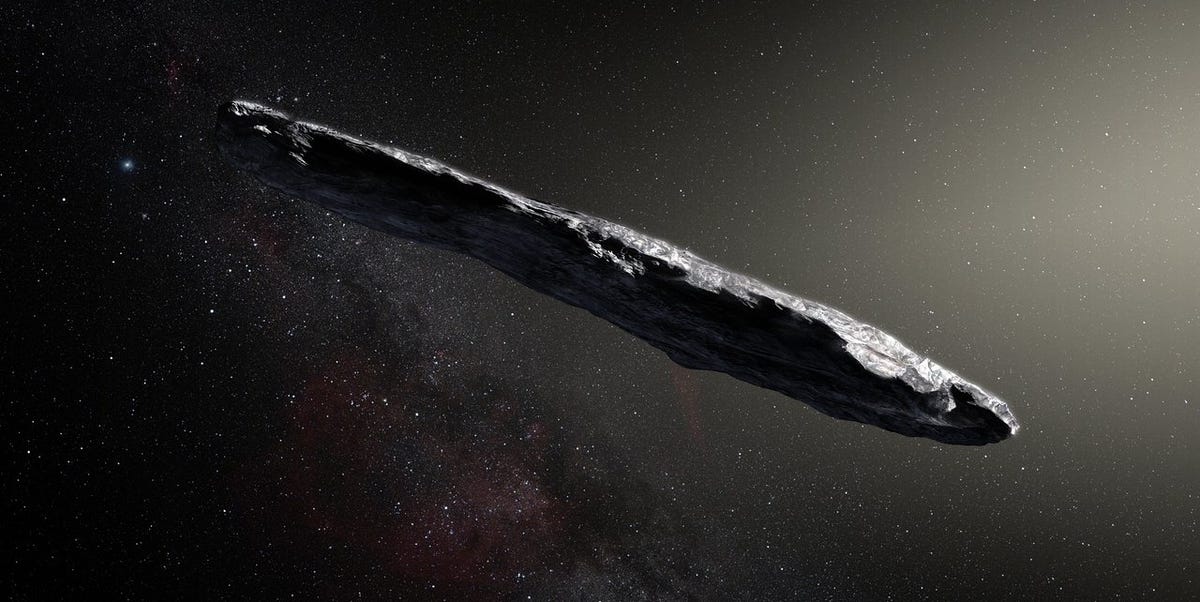
Space is full of rocks. Most of them mind their own business, keep to their lanes, and orbit the same star for billions of years like respectable celestial citizens. Then along came ʻOumuamua, a strange visitor from outside our solar system that basically kicked open the cosmic front door, waved once, confused everyone, and left before science could finish asking follow-up questions.
When astronomers first spotted it in 2017, the object looked unlike anything they had cataloged before. It was moving on a path that strongly suggested it came from interstellar space. It appeared stretched out in a bizarre way, spun chaotically, showed no obvious dusty tail, and then accelerated slightly as it moved away from the Sun. In other words, it behaved like the universe had mixed up the labels on the box.
That is exactly why ʻOumuamua became such a scientific obsession. It was the first confirmed interstellar object ever seen crossing our solar system, and it arrived carrying clues about how alien star systems build planets, eject debris, and send scraps of themselves drifting through the Milky Way. Even now, years after it vanished into the dark, astronomers are still arguing over what it was, what it was made of, and what its brief visit tells us about worlds we may never directly see.
The Moment Astronomy Realized This Rock Wasn’t From Around Here
ʻOumuamua was discovered on October 19, 2017, by the Pan-STARRS1 telescope in Hawaii, a survey instrument built to find near-Earth objects. That mission usually involves spotting asteroids and comets that belong to our own solar system. This time, however, the telescope found something with a very different résumé. Its orbit was hyperbolic, which is astronomy’s polite way of saying, “This thing is not staying.”
Scientists quickly realized the object had already swung around the Sun and was heading back out into interstellar space. It had passed closest to the Sun in early September, and by the time it was noticed, the scientific clock was already ticking. Telescopes around the world scrambled to collect as much data as possible before the object became too faint to study. Imagine trying to identify a speeding car by looking at it through a straw while it exits the highway forever. That was the vibe.
The object received the name ʻOumuamua, a Hawaiian term often translated as “a messenger from afar arriving first.” It was a perfect name, dramatic without trying too hard. It also became the first known object to receive the “I” designation for interstellar, officially marking it as 1I/ʻOumuamua. Astronomers had predicted that objects from other star systems should occasionally pass through ours, but predictions are one thing. Actually catching one in the act is another.
Why ʻOumuamua Looked So Weird
Its Shape Was Wildly Unfamiliar
One of the earliest surprises came from its brightness. As ʻOumuamua rotated, its brightness changed dramatically, by about a factor of ten. That kind of light curve suggested an extreme shape. Early interpretations described it as long and cigar-like, perhaps up to 10 times longer than it was wide. Later work suggested it might have been more pancake-like than cigar-like, which somehow made it both less and more strange at the same time.
Either way, the key point did not change: astronomers had not seen a solar-system object with quite this profile before. The geometry seemed extreme, and that alone made ʻOumuamua stand out. It was not just another lumpy rock with a funny orbit. It looked like a cosmic object built to make researchers say, “Well, that’s new.”
It Didn’t Spin Nicely
Most small bodies rotate in a fairly orderly way. ʻOumuamua did not get that memo. Observations suggested it was tumbling rather than spinning cleanly around a single axis. That non-principal-axis rotation hinted that it might have experienced a violent past, perhaps a collision in its home system before being flung into the depths of interstellar space.
Tumbling matters because it tells astronomers the object’s history may have been chaotic long before it visited us. A stable, boring rotation would have been easy. ʻOumuamua instead behaved like a suitcase thrown down a staircase in zero gravity.
Its Surface Looked Processed by Deep Time
Researchers also found that ʻOumuamua had a reddish color, somewhat similar to objects in the outer regions of our solar system. That matters because reddish surfaces can point to long-term exposure to cosmic radiation. In plain English, it looked like something that had spent a very long time drifting through space getting weathered by the galaxy itself.
That red tint added to the mystery. It suggested the object was old, battered, and shaped by a history far beyond the Sun’s influence. This was not just a local rock taking a scenic detour. It was a genuine outsider with miles on it.
Asteroid or Comet? Welcome to the Identity Crisis
The headline description of ʻOumuamua has changed over time, and that is part of what makes the story so interesting. At first, astronomers treated it as asteroid-like because it showed no visible coma, no obvious dusty tail, and no classic signs of comet activity. A lot of early coverage called it the first interstellar asteroid, and that label stuck in public memory.
Then things got messy in the best possible scientific way. Follow-up analysis found that ʻOumuamua experienced a slight extra push as it moved away from the Sun. Gravity alone did not fully explain its motion. That kind of nongravitational acceleration is often associated with comets, which vent gas as sunlight warms their icy material.
The catch was that astronomers did not see the usual comet fireworks. No dramatic tail. No obvious cloud of dust. Just a subtle acceleration and a growing pile of questions. Later studies explored natural explanations, including outgassing that was difficult to detect, hydrogen release from irradiated ice, and other exotic but still non-alien possibilities. Some theories have argued for unusual icy compositions; others have suggested it may have been a fragment from a larger body in another planetary system.
The most important takeaway is not that astronomers “got it wrong.” It is that science responded exactly as it should. Researchers updated the picture as better interpretations emerged. Today, many scientists describe ʻOumuamua less as a simple asteroid and more as an interstellar object with comet-like behavior. That nuance is not a weakness. It is the whole point of real investigation.
Why This One Object Mattered So Much
It Offered a Sample From Another Star System
Planetary systems are messy places when they form. Young giant planets can sling smaller bodies outward, ejecting asteroids, comets, and icy fragments into interstellar space. Astronomers had long suspected the galaxy should be filled with this kind of debris. ʻOumuamua was the first confirmed evidence that they were right.
That makes the object scientifically priceless. It was not just a curiosity. It was a sample, however fleeting, from another stellar neighborhood. Every detail about its shape, motion, color, and possible composition fed back into bigger questions about how planets form, how systems evolve, and how much material gets tossed into the void.
It Reminded Scientists How Biased Detection Can Be
ʻOumuamua also exposed the limits of our sky surveys. It was discovered only after it had already passed closest to the Sun, and astronomers had a narrow window to study it before it faded from view. That means we probably miss many similar objects simply because they are faint, fast, and rude enough not to announce themselves in advance.
In the years since, better surveys and sharper attention have improved the odds. The later discoveries of 2I/Borisov in 2019 and 3I/ATLAS in 2025 showed that interstellar visitors are not a one-time miracle. They may be relatively common, but spotting them requires timing, luck, and increasingly powerful survey systems.
It Made Astronomy Feel Excitingly Unfinished
There is something irresistible about an object that refuses to fit neatly into a category. ʻOumuamua became famous partly because it arrived carrying ambiguity. It was weird enough to inspire serious debate, but not so weird that natural explanations disappeared. That tension kept the story alive.
And yes, the alien-spacecraft idea made headlines. But the more meaningful part of that episode was not the speculation itself. It was the response from the broader scientific community, which kept testing natural explanations and demanding evidence rather than drama. In a media environment that loves declaring mysteries solved or unsolved in giant all-caps letters, ʻOumuamua offered a more honest lesson: sometimes the universe gives us data first and clarity later.
What ʻOumuamua Changed About Astronomy
After ʻOumuamua, interstellar objects stopped being theoretical guests and became an observational category. In 2019, astronomers identified 2I/Borisov, a clearly comet-like visitor from another star system. That gave researchers a useful contrast. Borisov looked much more like the kind of icy interstellar object many astronomers had expected to find first. By comparison, ʻOumuamua remained the oddball relative who shows up at the reunion wearing sunglasses indoors and answering no questions.
Then, in 2025, 3I/ATLAS became the third confirmed interstellar object known to pass through our solar system. By that point, astronomers were far better prepared. Instead of reacting with total astonishment, they reacted with fast coordination and a more mature scientific playbook. That shift may be one of ʻOumuamua’s biggest legacies. It trained the scientific community for the next encounter.
It also helped launch a richer conversation about what future observatories might find. If our instruments improve, and they are, astronomers could detect more interstellar visitors earlier in their approach. That would give researchers more time to gather spectra, measure composition, track motion, and maybe one day even plan a mission to intercept one. ʻOumuamua was a puzzle. The next one might be a library card.
The Experience of Watching a Cosmic Stranger Pass Through
Part of what made ʻOumuamua unforgettable was not just the object itself, but the experience it created for everyone watching the story unfold. For astronomers, it was a professional adrenaline rush. A telescope survey built to find hazards and minor bodies suddenly handed them the first confirmed interstellar visitor in history. That kind of moment does not feel routine. It feels like the sky has broken character.
The experience was also defined by urgency. Researchers did not have months to plan elegant observations. They had days and weeks. The object was already leaving. Each night of data mattered. Every telescope hour became more valuable. Scientists had to make decisions in real time about what to measure first: brightness, color, trajectory, possible activity, or rotational state. The object forced the community into a sprint, and that sprint shaped the entire narrative.
For science fans, the experience was different but just as electric. Here was a real-world cosmic visitor arriving from another star, not in a movie, not in a science fiction paperback, but in actual telescope data. It had a beautiful name, a weird shape, and a habit of becoming more mysterious every time someone thought they had it figured out. It was the perfect storm of astronomy and imagination. The public did what the public always does when faced with something that is both real and strange: it leaned in.
There was also a strange emotional quality to the story. ʻOumuamua was fleeting. We met it on the way out. There would be no second pass, no leisurely return for better photographs, no chance to wait for next season’s instruments. That created a kind of scientific heartbreak. Astronomers had enough data to know it was extraordinary, but not enough to pin down every answer. The object left while the argument was still in progress.
That experience mirrors something larger about modern astronomy. We are living in an era when survey telescopes can catch brief, rare events that older generations would have missed entirely. But discovery at that speed comes with pressure. The universe is generous with surprises and stingy with timing. ʻOumuamua became a symbol of that trade-off: a once-in-history detection wrapped in a maddeningly short observing window.
There is also the human experience of humility. The story reminded both experts and nonexperts that the solar system is not sealed off from the rest of the galaxy. Material from other stars can cross our path. Some of it probably does so more often than we once assumed. That is a thrilling idea, but also a grounding one. Earth is not standing at the center of a tidy stage. We are inside a larger traffic pattern.
In the end, ʻOumuamua gave people something rare: a scientific mystery that felt large, immediate, and honest. It was not neat. It was not fully resolved. It did not arrive carrying a simple moral. Instead, it offered a front-row seat to science in motion, where evidence accumulates unevenly, interpretations compete, and the answer becomes sharper only after the object itself has disappeared. That experience may be the most lasting part of the whole event. The rock left. The wonder stayed.
Conclusion
ʻOumuamua earned its reputation because it did not behave like a familiar asteroid, a textbook comet, or a cleanly explained cosmic visitor. It arrived fast, looked bizarre, spun chaotically, and left scientists with a stack of clues instead of a final answer. That is exactly why it mattered.
The first confirmed interstellar object showed astronomers that material from other planetary systems can be studied, even if only briefly, from inside our own. It also revealed how much we still have to learn about the debris fields of distant stars and the strange shapes that may drift between them. If astronomy sometimes feels like careful bookkeeping, ʻOumuamua was the reminder that the universe still enjoys improvisation.
And maybe that is the best way to think about it: not as a solved mystery or an unsolved one, but as the first page of a much bigger chapter. We did not just discover a weird object in 2017. We discovered that the galaxy occasionally sends visitors, and some of them are gloriously, stubbornly weird.