Words With Friends looks innocent at first. You place CAT, your friend places DOG, and everyone feels very pleased with their third-grade vocabulary. Then, suddenly, someone drops a 78-point word across two bonus squares, and you realize this is not a cozy spelling game. This is a tiny, colorful war zone with vowels.
The good news is that winning more often does not require memorizing a dictionary in a candlelit basement. It requires better board awareness, smarter tile management, a few flexible words, and the courage to resist playing QUIZ for 22 points when it gives your opponent a triple-word runway.
Note: No strategy can guarantee a win in every single game because tile draws, board position, and opponent skill matter. But these Words With Friends strategies can consistently improve your score, reduce avoidable mistakes, and make you much harder to beat.
Understand the Game Before You Try to Dominate It
Words With Friends is a turn-based crossword-style word game. You build words horizontally or vertically, connect each play to the existing board, and score as many points as possible. Premium squares matter enormously: double-letter, triple-letter, double-word, and triple-word spaces can turn a modest word into a scoreboard jump scare. The official rules also allow one move to create multiple new words, with each new word scored separately.
One important detail separates Words With Friends from traditional Scrabble: using all seven tiles earns a 35-point bonus, not a 50-point bonus. Blank tiles can represent any letter, but they have no point value. The game ends when a player empties their rack after the tile bag is exhausted, or after three scoreless turns.
With that foundation in place, let’s move from “I made a word” to “Why did you just score 64 points with OX?”
12 Strategies to Win More Words With Friends Games
1. Study the Board Before You Study Your Rack
Most players stare at their letters first. Stronger players scan the board first. Before making any move, look for available triple-word, double-word, and triple-letter squares. Then ask a simple question: Can I reach one without handing my opponent something even better?
A 14-point word that blocks a triple-word lane may be smarter than a 26-point word that leaves the next player a giant scoring opportunity. In Words With Friends, the board is not decoration. It is the boss battle.
2. Treat Premium Squares Like Real Estate
Premium squares are where ordinary turns become memorable ones. A triple-letter square is especially valuable when you can place a high-value tile such as J, X, Z, Q, or K on it. A triple-word square can be even stronger when your word also includes valuable letters already sitting on the board.
Do not forget that word multipliers apply to the entire newly formed word, including letters that were already on the board. Two double-word spaces multiply a word twice, and two triple-word spaces can produce a massive multiplier. That is why a carefully placed medium-length word can crush a flashy long word played in the wrong place.
3. Look for Parallel Plays
Parallel plays are one of the fastest ways to improve your average score. Instead of attaching a word to a single letter, place a word alongside another word so that multiple short words are created at the same time.
For example, imagine you can place a four-letter word beside existing tiles and create three additional two-letter words. Even if each tiny word is worth only a few points, the total can pile up quickly. Parallel plays also let you use one valuable tile in several scoring directions. That is excellent efficiency, like using one coupon at three stores without getting arrested.
4. Stop Chasing Long Words for the Wrong Reasons
Long words look impressive. They make you feel like you should be wearing a monocle while playing. But length alone does not win games. A seven-letter word placed on plain squares may score less than a three-letter word that hits a triple-letter square and a double-word square.
Prioritize total point value, board control, and what your move leaves behind. A shorter play can be the correct play when it scores well, keeps your rack healthy, and limits your opponent’s next move.
5. Build One Move That Scores Several Words
Whenever you place tiles, check the words created in both directions. A move that adds AT to an existing word might also create AN, TO, and IN across nearby tiles. That one placement can score several words instead of one.
This is particularly powerful near premium squares. If a newly placed tile lands on a double-letter or triple-letter square, that bonus can affect every new word formed through that tile. The official rules confirm that each newly created word is scored separately, including applicable bonuses.
6. Use High-Value Letters at the Right Time
Do not panic-play a Q, Z, J, or X just because it is sitting in your rack giving you emotional damage. High-value tiles are valuable because they can create explosive turns, not because they need to escape immediately.
Hold them until you can place them on a premium square, combine them with a word multiplier, or use them in a parallel play. A Z on a triple-letter square is much more exciting than a Z dropped into a six-point word in the corner like it is being punished for something.
7. Learn Useful Short Words
Short words are the duct tape of word games. They connect awkward openings, unload difficult letters, create parallel plays, and allow you to reach premium squares with surgical precision.
Build a small personal list of flexible two- and three-letter words. Examples worth checking in the in-game dictionary include AX, EX, JO, OX, XI, ZA, and QI. Do not assume a word accepted in another game will automatically work here; Words With Friends uses its own approved word list. Its official rules state that the English game has more than 173,000 acceptable words and draws from the Oxford English Dictionary.
8. Master Hooks: Add One Letter, Make a New Word
A hook is a letter you can add to the beginning or end of an existing word to make another valid word. For instance, ATE can become LATE, GATE, DATE, or RATED when the board allows it. Knowing these extensions helps you spot scoring chances that other players overlook.
Start with common word families. Learn what can take an S, what can take ED, what can take ER, and what can grow with prefixes such as RE-, UN-, or IN-. Word-game resources often organize vocabulary around hooks and bingo stems because these patterns make it easier to find playable options from a limited rack.
9. Keep a Balanced Rack
Your rack should not resemble a junk drawer. Try to maintain a mix of vowels and consonants, and avoid holding too many duplicates unless they create a clear scoring opportunity.
After every move, look at what remains. Leaving a flexible mix such as A, E, I, N, R, S, and T is usually healthier than keeping four vowels, two P’s, and a Q with no U in sight. Competitive word-game strategy is not only about the points you score now; it is also about the quality of the letters you keep for later.
10. Swap Tiles When Your Rack Is Truly Awful
Swapping tiles feels like admitting defeat, but it can be the best move on the board. If your rack is stuffed with duplicates, awkward vowels, or letters that cannot form useful combinations, a swap may prevent several weak turns in a row.
Do not swap merely because you have one ugly letter. Swap when your entire rack has poor scoring potential and no realistic way to create a useful word. A bad rack can become a bad mood, and a bad mood has never scored a triple word.
11. Play Defense Without Becoming Boring
Defense matters most when you are ahead. Before you play a word, examine the letters you expose. Are you opening a triple-word square? Are you leaving an easy spot for an S, a blank tile, or a high-value letter? Are you creating a lane where your opponent can build a long word?
Good defense does not mean making tiny, timid words all game. It means scoring while controlling access. The best move often earns solid points and leaves the opponent with nothing juicy to attack.
12. Change Your Strategy Near the Endgame
When the tile bag is nearly empty, the game changes. You should pay more attention to your opponent’s likely tiles, the letters remaining in your rack, and whether you can go out before they do.
Unload expensive letters if possible. Avoid being stuck with a Q, J, or Z at the end, because leftover tile values can swing the final score. When one player empties their rack after the bag is empty, the opponent loses points equal to the remaining tile values, and those points are awarded to the player who went out.
A Simple Example of Smarter Play
Suppose you have the rack A, E, I, N, R, S, T. A casual player may immediately see a basic word such as TRAIN and play it wherever it fits. A stronger player pauses.
First, check whether a word can cross a double-word or triple-word square. Next, see whether adding letters beside an existing word creates extra two-letter words. Then consider what letters you will keep. If you can play STAINER, RETAINS, NASTIER, or another seven-letter arrangement in a useful position, you may earn the 35-point all-tile bonus while also clearing your rack.
But even if no seven-letter word fits, you may still make the better move by playing five letters that hit a premium square and leave an S plus a vowel. The winning move is not always the prettiest word. It is the move that gives you the best total position.
Use Tools for Learning, Not for Turning the Game Into Homework
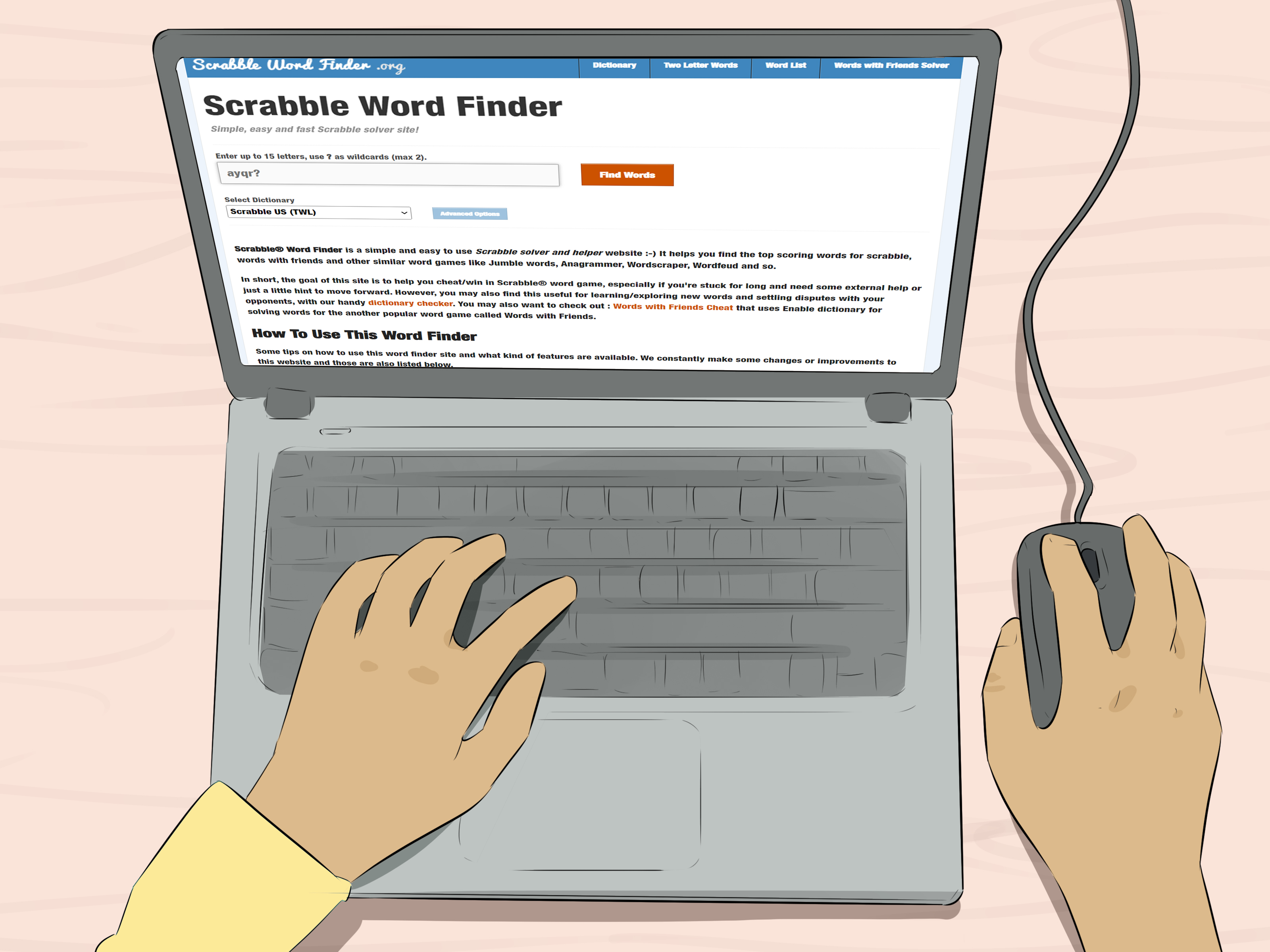
Word finders, dictionaries, and anagram tools can help you improve when used as study aids. Look up words after a game. Review unfamiliar words your opponent played. Test anagrams from difficult letter combinations. Build a list of words that repeatedly save you when your rack gets weird.
Merriam-Webster’s word tools, for example, organize playable-word searches by letters, patterns, hooks, and possible bingo stems. That is useful for practice because it teaches patterns instead of making you memorize random dictionary debris.
During a friendly match, decide what feels fair for you and your opponent. Some players love using help tools. Others prefer pure brainpower and the occasional dramatic stare at the letter Q. Either way, the most satisfying improvement comes when you start seeing better moves on your own.
Player Experience: What Changes When You Start Playing Strategically
The biggest change is not that every game suddenly becomes a landslide. It is that you stop feeling helpless. Early on, many players think their score depends mostly on getting lucky letters. Then they begin noticing that two players can receive similar racks and produce wildly different outcomes. One player sees RATE. Another sees a way to score RATE, form two side words, protect a triple-word square, and leave an S for later. Same letters. Different brain weather.
There is also a strange moment when short words stop looking silly. At first, playing OX or JO can feel like cheating with a refrigerator magnet. Then you watch a short word land on a premium square, create a parallel word, and score more than your carefully assembled seven-letter masterpiece. That is when you understand that Words With Friends rewards efficiency, not literary elegance. Shakespeare would probably be annoyed, but Shakespeare never had to deal with a rack containing Q, V, V, I, I, E, and E.
Experienced players also become calmer around ugly racks. Instead of treating five vowels as a personal insult from the universe, they ask practical questions. Can I make a small vowel-heavy word? Can I attach one letter to a word already on the board? Can I trade a weak turn now for a much better rack later? This shift matters because frustration causes rushed moves, and rushed moves tend to leave premium squares wide open like a welcome mat for disaster.
Another useful experience is learning to read your opponent’s habits. Some players cannot resist triple-word squares, even when the move is mediocre. Others love adding S to everything in sight. Some opponents play long words but forget defense. Once you recognize patterns, you can shape the board around them. Give an aggressive scorer fewer easy lanes. Force a player who relies on long words into cramped spaces. Let a short-word specialist prove that AA-style chaos is apparently a lifestyle choice.
Finally, winning more often makes the game more fun because your choices start feeling intentional. You are no longer tossing letters onto the board and hoping for applause. You are creating options, setting traps, clearing your rack, and occasionally pretending you absolutely planned that 72-point move all along. The score matters, of course. But the best feeling is looking at the board after a strong turn and realizing you did not just find a word. You found the move.
Conclusion: Play the Board, Not Just Your Letters
To win more Words With Friends games, focus on more than vocabulary. Learn how premium squares work, build parallel plays, use short words intelligently, keep your rack balanced, protect the board, and think ahead during the endgame. The player who makes the best-looking word does not always win. The player who sees the best scoring opportunity usually does.
Start with one habit: before every move, spend ten extra seconds scanning the board for premium squares, exposed lanes, and possible side words. That small pause can turn a decent player into the friend everyone suddenly claims is “taking this way too seriously.”