Breaking the sound barrier sounds like something reserved for test pilots with square jaws, mirrored visors, and a very serious relationship with checklists. The phrase practically comes with its own movie trailer voice: In a world where drag rises, shock waves form, and lunch is optional… But here is the surprise: under the right conditions, regular humans can cross Mach 1 too. Not by jogging harder, not by tuning a hatchback until the muffler becomes a public nuisance, and definitely not by trying anything reckless in your backyard. Still, in a precise and fascinating sense, everyday civilians really can experience supersonic travel.
To understand how, you first have to retire one myth. The sound barrier is not a literal wall hanging in the sky like some invisible toll booth. It is a nickname for the intense aerodynamic problems that show up as an aircraft approaches the speed of sound. Air starts behaving differently, drag rises sharply, shock waves form, and the physics gets moody. For early pilots, that shift felt dramatic enough to earn a name worthy of legend. The good news is that engineers, test pilots, and a lot of very smart people with slide rules and wind tunnels spent decades figuring it out. That is why “breaking the sound barrier” went from nearly impossible to historically important to, in a few rare cases, commercially accessible.
What the Sound Barrier Actually Is
The speed of sound is commonly called Mach 1, but it is not a fixed number everywhere. It changes with the temperature of the air. Near sea level on a standard day, it is roughly 761 to 768 miles per hour. Higher in the atmosphere, where the air is colder, the speed of sound can be lower. That means an aircraft can hit Mach 1 at different true airspeeds depending on altitude and conditions. So when people say, “That jet broke the sound barrier,” what they really mean is that it exceeded the local speed at which pressure disturbances move through the surrounding air.
As an aircraft accelerates toward that point, the air flowing around it becomes compressible in ways that matter a lot. Pressure waves bunch up. Drag increases. Control surfaces may behave differently. Parts of the airflow can go supersonic even before the whole aircraft does. That messy transition zone is called transonic flight. Once the vehicle is fully faster than the local speed of sound, it is in supersonic flight. The sound barrier, then, is less of a brick wall and more of an aerodynamic tantrum.
The famous sonic boom is part of the same story. It is not the aircraft “making a boom once” as it passes Mach 1 like a champagne cork popping in the sky. A sonic boom is the sound people on the ground hear when the pressure waves created by a supersonic object merge into shock waves and sweep past them. If that aircraft stays supersonic for a while, the boom can be heard along its flight path. In other words, the boom is a traveling signature, not a one-time sky sneeze.
How Humans First Did It
On October 14, 1947, Chuck Yeager flew the Bell X-1 faster than sound and made history. That flight did more than set a record. It proved the “barrier” could be crossed in controlled flight with the right design, the right courage, and the right understanding of aerodynamics. The X-1 looked a little like a bullet with wings, which was not an accident. Engineers knew shape mattered. If air was going to become difficult near Mach 1, the airplane had to be ready for an argument.
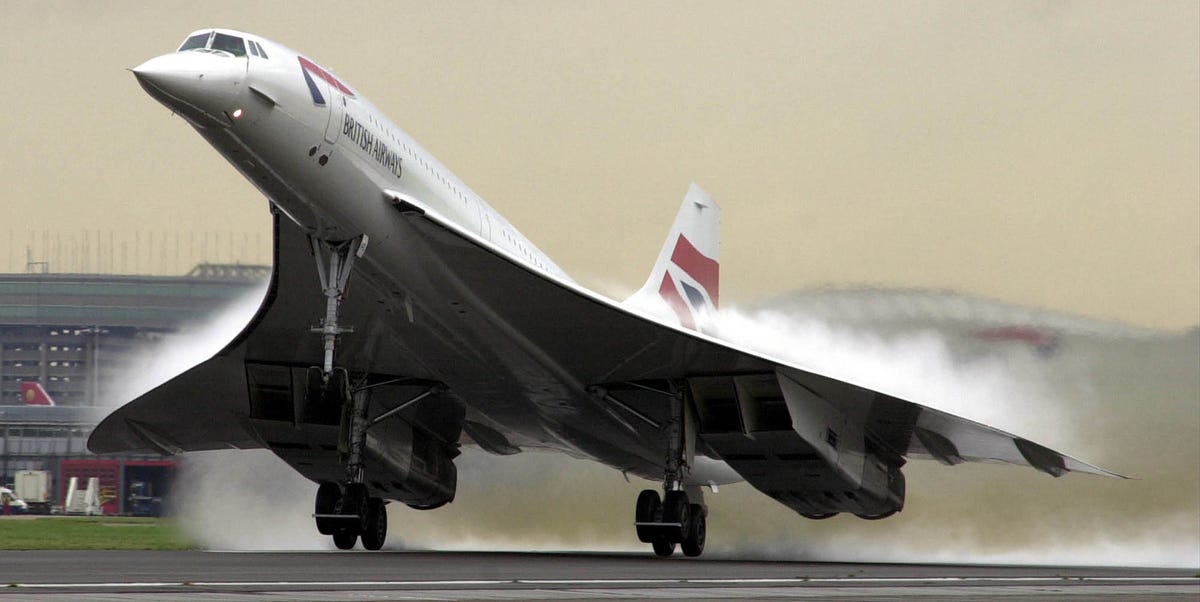
From there, supersonic aviation grew in military and experimental settings. Fighter aircraft routinely exceeded Mach 1. Rockets and space capsules blew past it by enormous margins. Eventually, civilian passengers got a taste too. The Concorde made supersonic travel glamorous, slender, and outrageously expensive. It carried passengers across the Atlantic at around twice the speed of sound and shrank London-to-New York trips into a time-saving flex. Concorde was real, operational, and beloved, but it was also noisy, costly to run, and limited by regulation and economics. It retired in 2003, leaving supersonic passenger service as a beautiful memory and a frequent answer to aviation trivia night.
So, Can Ordinary People Really Break the Sound Barrier?
Yes, but with an asterisk big enough to tow a jet.
If by “ordinary people” you mean civilians who are not military pilots, test pilots, or astronauts, the honest answer is still yes. A civilian can cross Mach 1 as a passenger in rare, professionally operated supersonic flight experiences. These are not common, cheap, or casual. They are highly specialized aviation programs using real military-type aircraft with trained crews, strict procedures, and heavy emphasis on safety and weather. But in principle, a civilian sitting in the second seat of the right aircraft can indeed go supersonic.
That said, this is not something you improvise. It is not a life hack. It is not “one weird trick” for aviation enthusiasts. It is a tightly controlled experience that depends on the aircraft, the airspace, the operator, the conditions, and the regulatory environment. In the United States, civil aircraft are generally prohibited from operating above Mach 1 over land unless specifically authorized. That rule exists largely because sonic booms are disruptive and can affect communities and natural soundscapes. So even when supersonic flight is possible, it is not legally or practically available everywhere.
There is also a second path to the answer: future commercial travel. You cannot currently buy a standard airline ticket and stroll onto a supersonic airliner the way you might board a routine flight to Chicago. But multiple organizations are working to bring faster-than-sound passenger travel back. Boom Supersonic has been developing Overture, and NASA’s X-59 program is focused on making supersonic overland flight quieter by replacing the classic boom with more of a gentle “thump.” That matters because noise, more than pure speed, has long been one of the biggest barriers to a wider supersonic future.
Why Supersonic Flight Is Still Rare
1. Noise Is a Real Problem
Sonic booms are not just dramatic. They are disruptive. Communities under flight paths notice them. Protected natural areas notice them. Regulators definitely notice them. The National Park Service has long documented how aircraft noise can affect natural quiet, wildlife interactions, and visitor experience. Supersonic travel is thrilling for the person inside the aircraft, but not always for the person on the ground trying to enjoy a canyon, a backyard, or a nap.
2. Speed Creates Heat and Stress
At supersonic speeds, aircraft do not simply fly faster; they deal with more intense aerodynamic loads, different pressure behavior, and higher thermal demands. Materials, engine design, inlets, control systems, and airframe shape all matter. A plane built for a calm subsonic cruise and one built for Mach 1-plus are not merely cousins. They are different species at the family reunion.
3. Economics Has a Vote
Concorde proved something important: people love speed, but operating a supersonic passenger aircraft at scale is expensive. Fuel burn, maintenance, route restrictions, limited seats, and noise constraints all gang up on the business model. Aviation history is full of machines that were brilliant in the air and brutal on the balance sheet.
4. Regulation Is Not Optional
Even if the technology exists, regulators must be convinced that the environmental and community impacts are acceptable. That is why NASA’s quiet supersonic research matters so much. The future of civilian supersonic travel may depend not only on how fast an aircraft can go, but also on how politely it can do so.
What Breaking the Sound Barrier Feels Like
Here is the funny part: people often imagine a giant cinematic jolt at the exact instant of Mach 1, as if the plane punches through a glowing force field and the pilot shouts something iconic into the radio. Real life is usually less theatrical and more technical. In a properly designed aircraft, the transition can feel surprisingly subtle to the people on board. The dramatic part is often the acceleration, the vibration changes, the instrumentation, and the knowledge that the numbers have crossed into a regime humans spent generations trying to reach.
Also, passengers do not usually “hear” their own sonic boom inside the aircraft the way people on the ground might imagine. The aircraft is traveling with the shock pattern, not sitting behind it like an audience member at a fireworks show. That makes the experience psychologically strange. You may be going faster than sound, yet the cabin itself is not full of cartoon thunderclaps. Supersonic flight is less “boom in your ears” and more “history in your bloodstream.”
The Return of Supersonic Ambition
Supersonic flight never disappeared from military and research settings, but the civilian story is changing again. NASA’s X-59 is one of the most interesting aircraft in the world not because it will carry passengers, but because it will not. It is a research aircraft designed to test whether the classic sonic boom can be softened enough to change the future of overland supersonic travel. That is a crucial distinction. The X-59 is not a prototype airline seat map with wings. It is a flying argument aimed at regulators, acousticians, engineers, and communities: maybe faster flight does not have to sound like the sky dropping a toolbox.
Meanwhile, private companies are betting that travelers still value time enough to support a new generation of supersonic transportation. The dream is easy to understand. Fewer hours in transit means tighter business trips, easier same-day international hops, and less of that surreal airport experience where time dissolves and everyone starts eating pretzels at emotionally confusing hours. The challenge is building an aircraft that is fast, sustainable enough to be taken seriously, quiet enough to be accepted, and practical enough to make money. In aviation, those are four very demanding roommates.
The Honest Bottom Line
So yes, you too can break the sound barrier. Just not in the casual, “let me borrow the keys” sense. Today, the most realistic civilian path is through specialized, professionally operated supersonic flight experiences, and even those are rare. Standard airline passengers cannot yet book routine supersonic travel, though the industry is trying to bring it back. In the meantime, the sound barrier remains one of the best examples of how a phrase can sound poetic, dramatic, and vaguely impossible while actually describing a very real, very measurable threshold in physics.
And maybe that is why it still captures the imagination. Breaking the sound barrier is not just about going fast. It is about humans reaching a limit, learning that the limit was really a problem to solve, and then solving it with science, nerve, and a lot of engineering. That is a pretty good story, even before the jet fuel shows up.
Experience Notes: What a Supersonic Moment Is Really Like
The following is a realistic, experience-based composite of what people often describe around high-speed flight, not a do-it-yourself guide and not a cartoon fantasy. It helps explain why the topic still feels magical.
Imagine the day starting not with a roar, but with paperwork, briefings, weather charts, and a pilot who looks suspiciously calm. That calm is contagious. Supersonic flight, at least in legitimate settings, is built on procedure. You learn where to sit, how to breathe during high-G moments, what the instruments will show, and why everyone involved keeps treating the experience with respect instead of swagger. That is your first clue that Mach 1 is not a stunt. It is a condition.
Then comes the runway. The acceleration is immediate, but not cartoonishly violent. What feels unusual is how quickly the landscape starts looking less like scenery and more like a diagram. Roads become lines. Buildings become punctuation. The aircraft climbs, turns, and heads for the part of the sky where speed matters differently. If you are expecting a theatrical “barrier” with a giant bump, you may be surprised. The body tends to notice the lead-up more than the crossing itself. Engine note changes. The airframe feels intent. The pilot watches numbers with the focus of a surgeon reading tiny handwriting.
Somewhere in that sequence, Mach number becomes the star of the show. The decimal climbs. The cabin may not feel dramatically different, but your mind absolutely does. You are watching a measurement humans once feared. Mach 0.92. Mach 0.97. Mach 0.99. And then there it is: a value beginning with 1.0-something. The moment lands less like a punch and more like a realization. You are doing a thing that schoolbooks, museum exhibits, and aviation documentaries trained your brain to file under legendary.
What many people remember most is the weird mismatch between expectation and sensation. You might expect explosion, chaos, or some huge cinematic jolt. Instead, in a properly designed aircraft, the transition can feel smooth. The drama is intellectual and emotional. You know the aircraft is outrunning the pressure signals that define ordinary sound propagation in the surrounding air, yet inside the cockpit or cabin the experience can feel almost disciplined. Supersonic flight has a professional, engineered quality to it. It is less rock concert, more controlled thunder.
Afterward, the memory tends to sharpen around details: the pressure of the harness, the view out over a curved-looking horizon, the pilot’s voice sounding routine while your brain is busy writing its memoirs, the odd fact that the sonic boom belongs mainly to observers below, not to you. That is one of the great twists. The people on the ground may hear the dramatic part. You, the person going faster than sound, mostly feel the privilege of being briefly invited into a rarer category of motion.
And that may be the deepest appeal of the whole idea. Breaking the sound barrier is not only about speed. It is about perspective. For a moment, human travel stops feeling ordinary. Distance feels negotiable. Time feels bendable. History feels close enough to touch. Even if the future of everyday supersonic travel arrives slowly, the experience already teaches something important: the impossible often survives only until engineers, pilots, and stubborn dreamers decide it has overstayed its welcome.
Conclusion
The phrase “break the sound barrier” still sounds like it belongs in a museum, but it is also part of an active conversation about the future of flight. The science is real, the history is thrilling, and the civilian possibilities, while limited, are no longer purely imaginary. Today, supersonic travel remains rare because noise, cost, regulation, and engineering complexity are stubborn realities. Even so, the dream is alive. From Yeager and Concorde to the X-59 and next-generation commercial designs, the story keeps moving forward. Faster-than-sound travel is no longer a fantasy. It is a challenge humanity has already met once and may be preparing to meet again, more quietly and more intelligently this time.