Note: This article is based on real public information about Dutch visual artist Berndnaut Smilde and his famous Nimbus series, in which he creates short-lived indoor clouds using smoke, water vapor, humidity, light, and carefully controlled architectural spaces.
When Weather Sneaks Indoors, Art Gets Wonderfully Weird
Most of us expect to see clouds doing their regular cloud business in the sky: drifting, gathering, threatening picnics, or forming suspiciously accurate shapes of dogs, dragons, and occasionally unpaid bills. Dutch artist Berndnaut Smilde, however, looked at that arrangement and apparently thought, “Nice, but what if the cloud were inside a castle?”
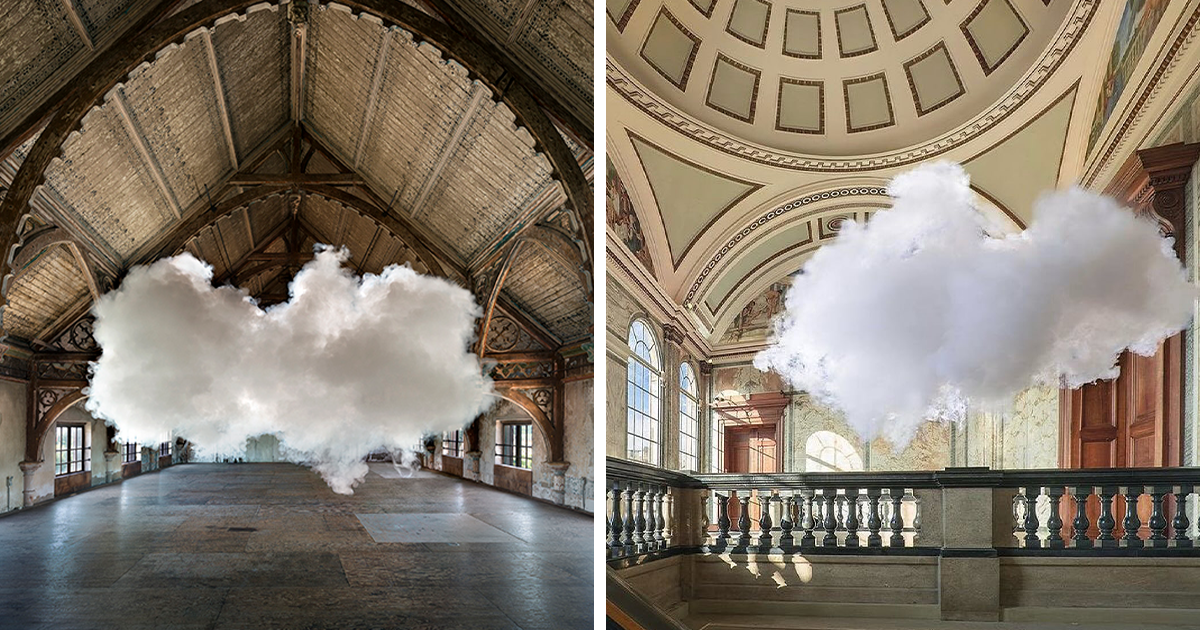
That question became one of the most poetic and visually striking contemporary art projects of the last decade: the Nimbus series. In these unforgettable images, soft white clouds appear inside castles, churches, museums, factories, chapels, and historic halls. They hover beneath vaulted ceilings, float beside stone columns, pause under stained glass windows, and vanish almost as quickly as they arrive.
The result feels like a magic trick, a science experiment, and a Renaissance painting all got trapped in an elevator together. Smilde’s clouds are real, not digital doodles pasted into empty rooms. They are temporary sculptures made from smoke and water vapor, shaped by humidity, temperature, and light. Their life span is usually measured in seconds. The photograph is the final artwork, the evidence that this tiny miracle happened before the air returned to being boring again.
In a world where we photograph every sandwich, sidewalk mural, and suspiciously photogenic latte, Smilde’s work reminds us that some images matter because the moment cannot be repeated exactly. A cloud inside a church is not just an optical surprise. It is a meditation on beauty, impermanence, architecture, atmosphere, and the very human desire to hold onto things that refuse to stay.
Who Is Berndnaut Smilde?
Berndnaut Smilde is a Dutch visual artist born in Groningen, the Netherlands, in 1978. He lives and works in Amsterdam and is known internationally for projects that explore space, atmosphere, light, construction, and disappearance. His practice includes installations, sculptures, photography, and works that often react directly to their surroundings.
His best-known body of work, Nimbus, began around 2010 and has since become a landmark example of ephemeral installation art. The word “nimbus” refers to a type of cloud, but it also suggests a halo, aura, or spiritual glow. That double meaning is perfect for Smilde’s work. His clouds feel meteorological, theatrical, and oddly sacred all at once.
Smilde has created these indoor clouds in a wide range of locations, including Gothic churches, museums, castles, historic chambers, industrial buildings, and coal mines. The contrast is part of the thrill. A cloud belongs outside, above us, uncontained. When it appears inside a room, especially a room built to last for centuries, the brain needs a second to reboot.
How Do You Make a Cloud Inside a Building?
The short answer: very carefully. The longer answer: with smoke, water vapor, controlled humidity, still air, the right temperature, good lighting, patience, and the kind of focus most of us reserve for assembling furniture without yelling.
To create a Nimbus cloud, Smilde prepares the space until the conditions are just right. The room must usually be cool, damp, and still. Air circulation is the enemy because even a small draft can tear the cloud apart before it has its big dramatic entrance. Water vapor is introduced into the room, and a smoke machine helps particles gather into a visible, cloud-like form.
The cloud may exist for only a few seconds. Sometimes it lasts long enough for a camera to capture it; sometimes it collapses into shapeless fog like a soufflé with stage fright. The final photograph depends on timing, light, architecture, and the physical behavior of the cloud itself. That means each image is both planned and unpredictable.
There is a funny humility in that process. The artist can prepare the room, study the space, adjust the moisture, place the equipment, arrange the camera, and wait for the perfect second. But the cloud still has its own personality. It may bloom beautifully, sag awkwardly, spread too fast, or form a shape that ruins the mood. Nature, even when invited indoors, refuses to become a well-behaved intern.
Why Castles, Churches, And Museums Make These Clouds So Powerful
A cloud in a plain white box would still be interesting. A cloud in a castle, church, or museum becomes unforgettable because the architecture gives it emotional weight. These spaces are designed to last. Stone walls, vaulted ceilings, carved columns, stained glass, and grand staircases all carry history. They feel stable, permanent, and serious. Then a cloud floats in like it missed the memo.
That contrast is the heartbeat of Smilde’s Nimbus series. The cloud is fragile; the building is solid. The cloud is brief; the architecture is enduring. The cloud has no fixed shape; the room has geometry, symmetry, and structure. Together, they create a visual conversation between the permanent and the passing.
Inside Churches: The Cloud As A Spiritual Visitor
When Smilde places a cloud inside a church, the image naturally feels symbolic. Churches already use height, light, and space to suggest the divine. Add a floating cloud beneath stained glass and the result feels like a visitation, or at least like heaven accidentally left a window open.
In images connected to places such as Sankt Peter Köln, the cloud appears beneath tall Gothic arches and colorful windows. The effect is quiet but intense. The cloud seems both physical and ghostly. It is present, yet obviously leaving. That makes the viewer feel the passing of time in a way that a regular architectural photograph may not.
Inside Museums: The Cloud As A Temporary Exhibit
Museums preserve objects. They protect paintings, sculptures, fossils, manuscripts, and artifacts from damage, decay, and human beings who think “Do Not Touch” means “maybe touch gently.” Smilde’s clouds disrupt that logic. They cannot be preserved in their original form. They can only be witnessed, photographed, and remembered.
When a Nimbus cloud appears in a museum hall or grand staircase, it becomes a mischievous guest inside a building devoted to permanence. It asks a beautiful question: Can something be a serious artwork if it disappears almost immediately? Smilde’s answer seems to be yes, especially when the disappearance is part of the meaning.
Inside Castles: The Cloud As A Dream In Stone
Castles are built for defense, power, and survival. They are thick-walled arguments against time. A cloud inside a castle softens that strength. It turns a room of stone into a stage for vulnerability. The image can feel like a dream, a memory, or a weather report from a fairy tale.
That is why these photographs work so well online. They are instantly understandable but not instantly explainable. You know what you are seeing, yet the image still feels impossible. It is one of those rare art experiences where the first reaction may be “Wait, what?” followed quickly by “I would like to stare at this for an unreasonable amount of time.”
The 16-Picture Appeal: What Makes Each Cloud Image Worth Looking At
The title promises 16 pictures, but the deeper appeal of Smilde’s series is not simply quantity. It is variation. Each Nimbus image has a different atmosphere because each space changes the meaning of the cloud. A white puff in a tiled room does not feel the same as a cloud hovering in a Gothic nave or a museum staircase.
Imagine a 16-image journey through the series. One picture might show a cloud glowing under stained glass. Another might place it between heavy columns. A third might set it inside a polished museum hall where the floor reflects its soft edges. Another might show it in an industrial space, where steel beams and concrete make the cloud look strangely tender. Each photograph becomes a small weather event with its own personality.
What keeps the series from becoming repetitive is the relationship between the cloud and the room. The cloud is never just decoration. It reacts visually to the architecture. It fills emptiness, interrupts symmetry, softens hard surfaces, and makes viewers newly aware of scale. A large room suddenly feels intimate because the cloud seems touchable. A familiar interior suddenly feels strange because the sky has wandered in without permission.
Why The Nimbus Series Feels Both Scientific And Poetic
One reason Smilde’s indoor clouds fascinate people is that they sit at the intersection of art and science. The project depends on real physics: condensation, moisture, temperature, airflow, and particles suspended in air. Without technical control, there is no cloud. Without visual sensitivity, there is no art.
That balance gives the work its tension. You can admire the method and still feel the mystery. Knowing that the cloud is made from smoke and water vapor does not ruin the magic. In fact, it may increase it. The materials are ordinary, but the result feels extraordinary. It is a reminder that wonder does not always require rare ingredients. Sometimes it requires the right room, the right light, and someone patient enough to negotiate with fog.
The Nimbus series also speaks to photography itself. Photography has always been connected to time: freezing a second, preserving an expression, saving a scene before it changes. Smilde pushes that idea to the extreme. His subject may disappear in ten seconds. The photograph is not just a record; it is the only durable form the artwork can take.
The Symbolism Of Clouds: More Than Pretty Vapor
Clouds are universal. They appear in myths, religious paintings, weather forecasts, childhood daydreams, landscape art, and corporate software branding. They can symbolize hope, mystery, danger, change, divinity, confusion, or the possibility that your outdoor wedding needs a tent.
Smilde uses that symbolic flexibility beautifully. He does not force one meaning onto the viewer. A Nimbus cloud can look peaceful, ominous, holy, comic, lonely, or surreal depending on the room and the person looking at it. That openness is one reason the series feels so accessible. You do not need an art history degree to respond to it. You just need eyes and a willingness to accept that a cloud has taken a wrong turn indoors.
At the same time, the work has strong connections to classical painting. Dutch landscape painters were famously attentive to skies, light, and atmosphere. Smilde’s clouds feel like fragments of those painted skies pulled out of the canvas and released into real space. In a museum or chapel, the cloud can look like a piece of an old master painting that has escaped its frame and is now floating around looking for snacks.
Why Fleeting Art Matters In A Permanent-Content World
Modern culture is obsessed with saving everything. We back up photos, archive messages, screenshot conversations, record concerts instead of watching them, and keep 47 versions of the same document because one of them might be “final_final_REALfinal.” In that context, Smilde’s fleeting clouds feel quietly rebellious.
The cloud cannot be owned in the normal sense. It cannot be packed, shipped, hung on a wall, or stored in a climate-controlled crate. The photograph can be collected, but the original event remains unrepeatable. That makes the work feel alive. It exists, it changes, it disappears.
This is not a weakness. It is the point. The temporary nature of the cloud makes viewers pay attention. When something lasts only a few seconds, you cannot casually glance at it while checking your phone. You have to be present. The cloud’s disappearance becomes part of its beauty.
Specific Visual Details That Make The Series So Memorable
Several visual ingredients make the Nimbus photographs instantly recognizable. First is the central contrast: a soft organic cloud against a hard architectural background. Second is scale. The cloud is large enough to feel physically present but small enough to seem delicate. Third is emptiness. Many images contain no people, which makes the rooms feel dreamlike and theatrical.
Light is another crucial element. In church interiors, daylight through stained glass can give the cloud a sacred glow. In museums, large windows and reflective floors can make the vapor appear sculptural. In industrial spaces, harsher surroundings make the cloud look almost vulnerable. Every setting gives the same material a different emotional tone.
There is also the comedy of impossibility. A cloud indoors is absurd in the best way. It is like finding a snowman in a board meeting or a whale in a bathtub. The difference is that Smilde handles the absurdity with elegance. He does not turn it into a joke; he lets the viewer discover the strangeness slowly.
Experiences Related To The Topic: What It Feels Like To Encounter Indoor Cloud Art
Seeing a Nimbus-style image for the first time can feel like your brain has opened the wrong folder. A castle hall should contain armor, portraits, tapestries, maybe a suspicious draft. A church should contain pews, candles, silence, and someone whispering too loudly. A museum should contain carefully labeled objects and visitors pretending to understand abstract sculpture. It should not contain a cloud floating at chest height like it is waiting for directions.
That surprise is part of the emotional experience. The image asks you to slow down because it does not fit ordinary categories. Is it sculpture? Photography? Performance? Installation? Weather with excellent taste in architecture? The answer is yes, or close enough. Smilde’s work creates the feeling of witnessing a private moment between nature and a building.
Anyone who has walked through an old cathedral or museum knows how those spaces can change your mood. Your footsteps become softer. Your voice drops. You start noticing light, dust, stone, height, and silence. Now imagine that in the center of that room, a cloud forms. Not a projection. Not a painted ceiling. A real, temporary body of vapor. The experience would likely be both peaceful and strange, the kind of thing that makes people stop mid-sentence.
The beauty of the project is that it turns architecture into atmosphere. Usually, we experience old buildings as containers of history. Smilde makes them feel like active participants. The arches frame the cloud. The windows light it. The walls hold the stillness it needs to exist. The room is not background; it is part of the artwork’s weather system.
There is also a personal lesson in the disappearing cloud. Many of the best experiences in life are like that: brief, unrepeatable, and impossible to fully capture. A perfect conversation, a sunset seen from a train, a child laughing at exactly the wrong serious moment, the smell of rain after a hot day, or the silence inside a museum before the crowd arrives. We try to save these moments with photos, but the real thing always slips away. Smilde’s clouds make that slipping visible.
For artists, designers, photographers, and everyday creative people, the Nimbus series is a useful reminder that limitations can sharpen imagination. The cloud lasts only seconds, so every decision matters. The room must be chosen carefully. The light must be right. The camera must be ready. The team must understand that the artwork is not waiting around for anyone to adjust their settings. This urgency gives the final images their quiet electricity.
For viewers, the experience is simpler and perhaps more powerful. These clouds invite us to look at familiar spaces differently. A museum is not only a place for objects. A church is not only a place for ritual. A castle is not only a symbol of defense or power. Under the right conditions, each can become a sky. That idea is charming, profound, and just weird enough to make the internet collectively lean forward.
Why This Cloud Art Keeps Going Viral
Smilde’s Nimbus photographs are perfect for digital culture because they offer immediate visual impact. You do not need a long explanation to understand why the image is special. A cloud is inside a room. That is the hook. But the longer you look, the more the work opens up.
It also helps that the images combine opposites people love: real and unreal, natural and artificial, old and new, serious and playful, scientific and spiritual. They look like fantasy scenes, yet they are grounded in real materials. They feel peaceful, but their short life span adds tension. They are visually simple, but conceptually rich.
That combination makes the series ideal for art lovers, photographers, architecture fans, science-minded readers, and anyone who enjoys seeing reality behave slightly incorrectly. It is rare for conceptual art to be so instantly shareable without becoming shallow. Nimbus manages it because the idea is clear, the execution is elegant, and the emotional response is immediate.
Conclusion: A Cloud You Can Almost Keep
Berndnaut Smilde’s indoor cloud photographs are memorable because they transform a simple natural form into a complex artistic event. By creating clouds inside castles, churches, museums, and other carefully chosen spaces, he turns architecture into a stage for impermanence. The cloud appears, floats, changes, and disappears. The camera preserves what the air refuses to hold.
The Nimbus series is not just about technical skill, though the technical skill is impressive. It is about the emotional charge of a moment that cannot last. It reminds us that beauty does not become less meaningful because it is temporary. Sometimes the opposite is true. A cloud inside a church may vanish in seconds, but the image stays with us because it feels like a tiny impossibility made visible.
In the end, Smilde does what great artists often do: he makes the familiar strange again. We have all seen clouds. We have all seen rooms. But put one inside the other, and suddenly both become new. That is the quiet genius of this work. It gives weather a roof, gives architecture a breath, and gives viewers a reason to believe that even the air can have a dramatic career change.