Investing often looks deceptively simple from a distance. Buy something, wait paticessful investing requires balancing growth, safety, liquidity, taxes, costs, emotions, and the inconvenient fact that nobody knows exactly what markets will do next.
The purpose of a balanced investment strategy is not to eliminate every risk. That would be impossible unless your preferred asset is money hidden under a mattressand even then, inflation and an enthusiastic vacuum cleaner remain serious threats. The real goal is to take the right amount of risk for your financial objectives while building a portfolio you can maintain through both exciting rallies and uncomfortable downturns.
What Does Balance Mean in Investing?
Investment balance does not mean dividing every dollar equally among stocks, bonds, cash, real estate, and whatever cryptocurrency your cousin mentioned at Thanksgiving. It means assigning each part of your money a specific job.
Growth-oriented assets, such as stocks, may help wealth increase over long periods, but their prices can fluctuate sharply. Bonds can provide income and stability, although they also carry interest-rate, inflation, and credit risks. Cash offers accessibility and usually less price volatility, but holding too much cash for too long may reduce purchasing power as prices rise.
The Three Core Jobs in a Portfolio
A balanced portfolio generally needs to address three competing priorities:
- Growth: Increasing wealth enough to fund long-term goals and stay ahead of inflation.
- Stability: Limiting the damage caused by major market declines and reducing portfolio volatility.
- Liquidity: Keeping enough money accessible for emergencies and near-term expenses.
Emphasizing one priority usually means accepting a trade-off somewhere else. More growth potential commonly brings more short-term uncertainty. More stability may mean lower expected long-term returns. More liquidity can provide peace of mind but may leave less money compounding in growth assets.
Start With Goals, Not Investments
A common investing mistake is choosing a product before defining its purpose. Someone hears that a particular stock, fund, or asset class is “hot” and buys it without asking what financial job it is supposed to perform. That is the investing equivalent of buying a chainsaw before deciding whether you need to cut down a tree or slice a birthday cake.
Every major goal should have an amount, a target date, and a priority level. Retirement in 30 years, a home down payment in three years, and next summer’s vacation are not merely different goals. They require different levels of risk and liquidity.
| Financial Goal | Likely Time Horizon | Primary Consideration |
|---|---|---|
| Emergency reserve | Immediate | Safety and accessibility |
| Home down payment | One to five years | Capital preservation |
| College expenses | Varies | Growth initially, then increasing stability |
| Retirement | Often decades | Long-term growth and inflation protection |
Money needed soon generally should not depend heavily on the short-term performance of volatile assets. A stock market decline can be temporary, but that is not especially comforting when a tuition bill is due on Tuesday.
Balance Risk Tolerance With Risk Capacity
Risk tolerance describes how emotionally comfortable you are with investment fluctuations. Risk capacity describes how much loss your financial situation can actually absorb. They sound similar, but confusing them can produce an unsuitable portfolio.
An investor may feel fearless during a strong market and claim to have a high risk tolerance. Then the portfolio falls 25%, the financial news becomes apocalyptic, and “fearless” begins refreshing account balances every four minutes. Emotional tolerance is often easier to overestimate when prices are rising.
Risk capacity is more practical. A younger investor with stable income, low debt, substantial emergency savings, and decades before retirement may have greater capacity to accept market volatility. Someone who will need portfolio withdrawals next year may have far less capacity, regardless of personality.
Questions That Reveal Your Real Risk Profile
- When will you need the money?
- How much of a temporary decline could you withstand without selling?
- Do you have reliable income outside the portfolio?
- Would a major loss delay an essential goal?
- How did you behave during previous market downturns?
The last question is especially useful. A questionnaire may say you are adventurous. Your transaction history may quietly disagree.
Use Asset Allocation as the Main Balancing Mechanism
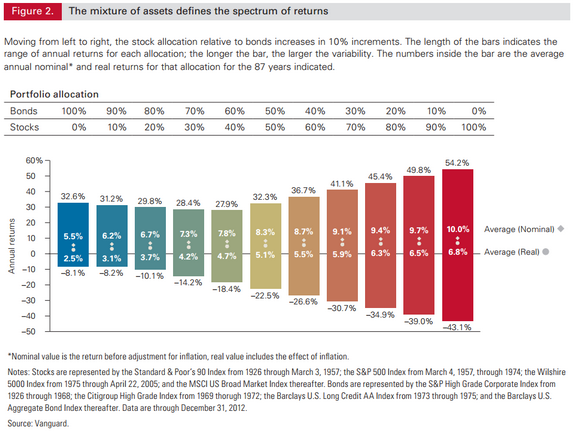
Asset allocation is the division of a portfolio among major investment categories such as stocks, bonds, and cash. It is one of the most important decisions in portfolio construction because it influences expected return, volatility, and the size of potential losses.
A growth-focused allocation might hold a larger percentage of stocks. A conservative allocation may emphasize bonds and cash. A moderate portfolio usually sits somewhere between the two, seeking enough growth to pursue long-term goals while maintaining assets that may help soften market declines.
There is no universally perfect allocation. The appropriate mix depends on the investor’s goals, timeline, income, savings rate, withdrawal needs, and tolerance for uncertainty. Even two people of the same age may need very different portfolios.
An Illustrative Allocation
Consider a fictional investor named Maya. She is 35, has stable employment, maintains an emergency fund, and is investing primarily for retirement three decades away. After reviewing her goals and ability to handle volatility, she chooses an illustrative allocation of 70% diversified stock funds, 25% bond funds, and 5% cash or short-term holdings.
This is not a universal recommendation. It simply demonstrates how each component can serve a different function. Stocks support long-term growth, bonds provide income and a potential stabilizing influence, and cash offers flexibility. Another investor might reasonably choose a substantially different mix.
Diversify Without Collecting Investments Like Souvenirs
Diversification means spreading money across investments that respond differently to economic and market conditions. It can reduce the impact of one company, industry, country, or asset class performing poorly. It cannot guarantee profits or prevent every loss, but it can help prevent a single disappointing investment from becoming a financial catastrophe.
True diversification operates at multiple levels. A stock portfolio may include companies of different sizes, industries, and geographic regions. A bond allocation may vary by issuer, maturity, and credit quality. Broad mutual funds and exchange-traded funds can make this easier by holding many securities in a single investment.
Owning many funds does not automatically create diversification. Five funds that all hold the same giant technology companies may be five account statements wearing one trench coat. Investors should examine underlying holdings rather than assuming that a longer fund list means broader exposure.
Watch for Concentration Risk
Concentration risk arises when too much of a portfolio depends on one investment or one closely related group. It is common among employees who receive company stock, longtime shareholders with large gains, or investors who chase a sector after it has already performed well.
A concentrated position can produce spectacular gains, but it can also expose the investor’s savings, income, and career to the same source of risk. Reducing concentration may involve tax consequences, so large changes should be planned carefully rather than made in a caffeine-powered burst of enthusiasm.
Keep an Emergency Fund Outside the Market
A balanced investment plan begins before the first security is purchased. An emergency fund creates a cash reserve for expenses such as medical bills, home repairs, vehicle problems, or an interruption in income.
Without accessible savings, an investor may be forced to sell investments during a market decline. That can turn a temporary paper loss into a permanent financial setback. Emergency savings act as a buffer between everyday life and the long-term portfolio.
The appropriate reserve depends on job stability, household expenses, insurance coverage, and access to other resources. The central principle is straightforward: money needed for an unexpected bill should not be riding the stock market’s emotional roller coaster.
Rebalance Before the Portfolio Chooses for You
Even a thoughtfully designed portfolio will drift over time because different investments earn different returns. Suppose Maya’s stock allocation performs strongly and grows from 70% to 80% of her portfolio. She now has more stock exposureand potentially more riskthan she originally intended.
Rebalancing restores the target allocation by selling some overweighted assets, buying underweighted assets, directing new contributions toward lagging categories, or combining these methods. It is a disciplined way to control risk rather than allowing recent market winners to redesign the portfolio.
Investors may review allocations on a calendar schedule, such as once or twice per year, or whenever an asset class moves beyond a predetermined range. Constant tinkering is usually unnecessary. Rebalancing is maintenance, not an excuse to transform a retirement account into a day-trading laboratory.
Consider Taxes Before Selling
Rebalancing within a tax-advantaged retirement account may not create the same immediate capital-gains consequences as selling appreciated assets in a taxable account. In taxable portfolios, investors can sometimes rebalance using dividends, interest, new deposits, or charitable gifts before selling holdings with large gains.
Tax treatment depends on account type and individual circumstances. For complicated portfolios, professional tax guidance may be more valuable than discovering an unpleasant surprise while preparing a return at 11:47 p.m.
Balance Investment Costs Against Expected Value
Fees reduce the amount of money left in a portfolio to earn future returns. Expense ratios, advisory fees, trading costs, account charges, sales loads, and other expenses may appear small when expressed as percentages. Over long periods, however, even modest annual differences can compound into substantial amounts.
The cheapest investment is not automatically the best, but every cost should have a clear purpose. Investors should understand what they pay, what service they receive, and whether a lower-cost option can accomplish the same objective.
Costs also include taxes and unnecessary trading. A strategy that generates frequent taxable gains must produce enough additional return to overcome those obligations. Activity can feel productive, but portfolios do not award loyalty points for the number of buttons pressed.
Balance Patience With Necessary Action
Long-term investing requires patience, but “stay the course” does not mean ignoring major changes in your life. A portfolio should be reviewed when your goals, timeline, income, family responsibilities, or withdrawal needs change.
What usually deserves less attention is the daily stream of predictions, alerts, and dramatic market commentary. Financial media must publish something every day. Your portfolio does not require a new strategy every morning.
Trying to move completely in and out of markets requires two successful decisions: when to leave and when to return. Missing either can damage long-term results. Because market recoveries may begin before the economic news feels reassuring, investors who wait for perfect certainty may remain uninvested for too long.
Automate the Boring Parts
Automatic contributions can support consistency by investing at regular intervals. Target-date funds and balanced funds may provide diversified portfolios with built-in rebalancing. These approaches are not suitable for everyone, but they can reduce the number of emotional decisions an investor must make.
Good investing is often surprisingly boring. That is a feature, not a design flaw.
A Practical Portfolio Review
A useful portfolio review does not begin with, “Which stock will rise next?” It begins with questions about whether the current plan still fits the investor’s life.
- Review each goal. Confirm the amount needed and the target date.
- Check emergency savings. Make sure an unexpected expense would not force an investment sale.
- Measure the current allocation. Compare actual percentages with intended targets.
- Look inside funds. Identify duplicated holdings and hidden concentration.
- Review costs. Examine expense ratios, advisory fees, and account charges.
- Consider taxes. Plan sales and withdrawals with after-tax results in mind.
- Rebalance when necessary. Use contributions or tax-efficient adjustments where practical.
- Update the written plan. Record why the allocation exists and what conditions justify changing it.
A written investment policy can be especially helpful during volatile markets. It allows the calm version of you to leave instructions for the nervous version of you.
Common Ways Investors Lose Their Balance
Chasing Recent Winners
Strong recent performance attracts attention, but yesterday’s winner may already be expensive or unusually concentrated. Buying only what has recently risen can quietly transform a diversified portfolio into a bet on one trend continuing indefinitely.
Taking Too Little Risk
A portfolio can also be overly cautious. Long-term goals may require growth that cash and very conservative holdings are unlikely to provide after inflation and taxes. Safety should be measured against the goal, not merely against daily price movement.
Taking Too Much Risk
An aggressive portfolio is useless if its volatility causes the investor to sell during every decline. The best allocation is not the one with the highest theoretical return. It is the one that offers a realistic path to the goal and can be maintained through difficult periods.
Confusing Complexity With Sophistication
A portfolio containing dozens of overlapping funds, speculative assets, tactical strategies, and mysterious acronyms is not necessarily advanced. It may simply be difficult to understand. Simplicity makes it easier to monitor allocation, costs, taxes, and performance.
Experiences From the Investing Tightrope
One of the most useful experiences in investing is discovering that emotional comfort changes with market conditions. During a long rally, nearly everyone feels patient, rational, and capable of tolerating risk. A diversified plan may even appear unnecessarily cautious. The strongest-performing asset begins to look obvious, while bonds and cash resemble relatives who arrived at the party early and refuse to dance.
Then markets decline. Suddenly, diversification stops looking old-fashioned. The defensive assets that seemed boring may provide enough stability to keep an investor from abandoning the entire plan. This experience teaches a lesson that cannot be fully absorbed from a risk questionnaire: volatility feels different when real money and real goals are involved.
Another common experience involves waiting for the ideal moment to invest. An investor holds cash because prices seem too high. A correction finally arrives, but the news is frightening, so the investor waits for conditions to improve. Markets begin recovering, yet prices now seem to have risen too quickly. The perfect entry point keeps moving like the last parking space at a crowded shopping center.
Regular contributions can reduce this decision-making burden. Investing gradually does not guarantee better returns, and a lump sum may outperform when markets rise immediately. However, a scheduled process can make it psychologically easier to begin and continue. The valuable experience is not predicting each market turn; it is developing a habit that does not require a fresh burst of courage every month.
Rebalancing provides another memorable lesson. Selling part of a successful investment and adding money to an underperforming category can feel deeply unnatural. Human beings enjoy rewarding winners, not trimming them. Yet rebalancing forces the investor to follow the original risk plan rather than treating recent performance as a permanent law of nature.
Investors also learn that financial life rarely follows a neat spreadsheet. A job change, new child, illness, home purchase, inheritance, or unexpected caregiving responsibility can alter risk capacity. A portfolio that was appropriate five years ago may no longer fit. Updating it is not an admission that the original plan failed. It is evidence that the plan is connected to real life.
Perhaps the most important experience is realizing that progress is not measured only by beating an index. A portfolio succeeds when it helps fund the intended goal without exposing the investor to unnecessary risk. Someone who reaches retirement with adequate savings, manageable volatility, and the confidence to follow a withdrawal plan has achieved something more meaningful than winning a one-year performance contest.
Over time, investing becomes less about finding brilliant predictions and more about maintaining useful balances: optimism with caution, growth with protection, action with patience, and ambition with realism. The investor stops asking, “What will the market do next?” and begins asking, “Is my plan prepared for several possible outcomes?” That shift is one of the clearest signs of financial maturity.
Conclusion: A Balanced Plan Is Built to Survive Real Life
Investing is a balancing act because every decision involves trade-offs. Growth must be weighed against volatility. Stability must be weighed against inflation. Liquidity must be weighed against long-term compounding. Costs, taxes, behavior, and changing life circumstances must also fit onto the same financial tightrope.
A durable investment strategy begins with specific goals, an honest assessment of risk, and an appropriate asset allocation. Diversification reduces dependence on any single outcome. Emergency savings protect long-term holdings from short-term needs. Rebalancing keeps risk from drifting, while cost and tax awareness preserve more of the return the portfolio earns.
No portfolio remains perfectly balanced every day, and no strategy removes uncertainty. The objective is to build a system that remains useful when markets are calm, headlines are loud, and life decides to improvise. In investing, balance is not a destination. It is a discipline practiced repeatedly over time.