Supersonic aircraft have always come with an awkward traveling companion: the sonic boom.
It follows the airplane like an invisible carpet of thunder, rattling windows, startling dogs,
and reminding everyone below that physics has no indoor voice.
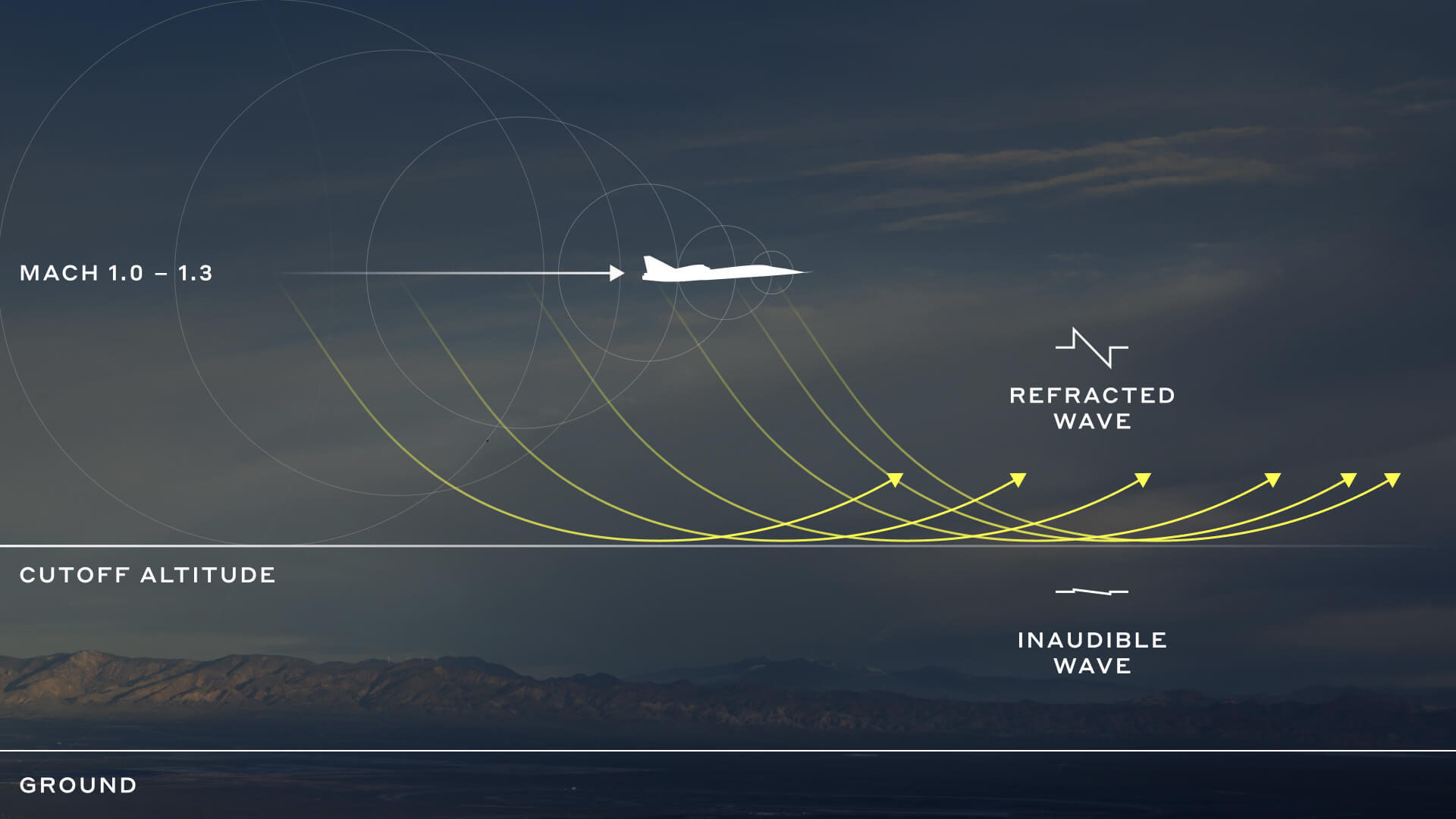
Mach cutoff offers a fascinating alternative. Instead of eliminating the shock waves produced
by a supersonic aircraft, it uses the changing atmosphere to redirect them. Under carefully
selected combinations of speed, altitude, temperature, and wind, the waves can bend away from
the ground and turn back toward the upper atmosphere. The aircraft remains supersonic, but
people below may hear no conventional boom.
It sounds like acoustic sorcery. It is actually atmospheric refraction, demanding weather
forecasting, flight planning, and engineering precision that would make an ordinary airline
timetable look delightfully uncomplicated.
What Is Mach Cutoff?
Mach cutoff is an atmospheric propagation condition in which shock waves
created by an aircraft at a relatively low supersonic speed do not travel all the way to the
ground. As those waves move downward through layers of air with different temperatures and
wind speeds, their paths curve. When the conditions are right, the wavefront reaches a
turning region and bends upward, leaving an acoustic shadow near the surface.
The term “cutoff” refers to the boundary beyond which the main sonic-boom wave can no longer
continue toward the ground through ordinary geometric propagation. The shock has not been
deleted, canceled, or persuaded to take the day off. It has simply been routed elsewhere.
That distinction matters. A Mach-cutoff aircraft still generates pressure disturbances and
shock waves. The strategy is therefore different from designing an aircraft whose shape
spreads those shocks into a softer sound. NASA’s X-59, for example, is designed to transform
the familiar explosive boom into a quieter thump. Mach cutoff instead attempts to keep the
primary shock signature from reaching listeners at all.
Why Supersonic Aircraft Make Sonic Booms
Mach Number Is a Ratio, Not a Fixed Speed
Mach number compares an aircraft’s speed with the local speed of sound. Mach 1 means the
aircraft and sound are moving at the same speed in the surrounding air. Mach 1.2 means the
aircraft is traveling 20 percent faster than sound under those local conditions.
The speed represented by Mach 1 is not constant. Near sea level on a standard day, it is
roughly 760 miles per hour. At cruising altitudes, where the air is much colder, the speed of
sound is lower. That is why pilots and engineers use Mach number rather than treating the
sound barrier as one universal number on a speedometer.
The Aircraft Carries a Moving System of Shock Waves
A common myth says a sonic boom happens only at the instant an aircraft “breaks” the sound
barrier. In reality, an aircraft continuously generates shock waves while it remains
supersonic. Every featureincluding the nose, wings, canopy, engine inlets, and taildisturbs
and compresses the surrounding air.
Farther from the aircraft, many of those individual disturbances tend to merge into strong
pressure changes associated with the front and rear of the vehicle. A ground observer often
perceives them as a double boom. On a pressure graph, the classic signature resembles the
letter N, which explains the technical term N-wave.
During steady supersonic cruise, that pressure pattern sweeps across the surface beneath the
aircraft. Researchers call the affected strip a sonic-boom carpet. It is less a single
thunderclap dropped at one location and more a long acoustic welcome mat that nobody asked
the aircraft to deliver.
How the Atmosphere Bends a Sonic Boom
Sound Speed Changes With Temperature
Sound generally travels faster through warmer air and more slowly through colder air. In
much of the lower atmosphere, temperature decreases as altitude increases. A shock wave
traveling downward from a high-flying aircraft may therefore move from colder air, where
sound travels relatively slowly, into warmer air, where it travels faster.
When different parts of a wavefront move at different speeds, the wave changes direction.
This process is called refraction. Light does something similar when it
passes between air and water, making a straight straw appear bent in a glass. The sonic boom
remains invisible, unfortunately, so nobody gets an impressive floating-straw demonstration.
The Wave Can Reach a Turning Point
As a downward-moving shock encounters progressively higher effective sound speeds, its path
becomes flatter. Near the cutoff condition, the wave may approach horizontal propagation.
Rather than continuing to the surface, it curves upward, producing a region below the
turning path where the direct boom is absent or dramatically reduced.
Early NASA research described a sonic cutoff altitude at which the relevant local sound
speed approaches the aircraft’s speed. Modern calculations are more detailed because the
atmosphere is not a stack of perfectly calm, uniform layers. Wind, humidity, turbulence,
aircraft motion, and the complete vertical temperature profile all influence propagation.
Wind Changes the Effective Speed of Sound
Wind can help or spoil the effect. A wind component moving in the direction of wave
propagation effectively carries the disturbance along, while an opposing component slows
its progress relative to the ground. Wind direction and speed also change with altitude,
sometimes sharply.
Consequently, two flights at the same indicated Mach number and altitude may produce
different ground results on different days. A reliable Mach-cutoff plan must use detailed
atmospheric observations and forecasts extending from the surface to the aircraft’s flight
level.
The Narrow Operating Window
Mach cutoff works most naturally at relatively low supersonic speeds. If an aircraft travels
much faster, its shock waves can penetrate through the atmosphere and reach the ground even
when refraction bends their paths. Flying too slowly, meanwhile, sacrifices much of the time
advantage that made supersonic travel interesting in the first place.
Engineers must therefore locate a moving sweet spot involving:
- Aircraft Mach number and true airspeed
- Altitude and ground elevation
- Temperature at multiple atmospheric levels
- Wind speed and direction throughout the propagation path
- Aircraft heading, acceleration, climb rate, and bank angle
- The desired safety margin between the predicted wave and the surface
This is not a “set Mach 1.1 and forget it” feature. The permissible speed may change along a
route as weather systems, terrain, and upper-level winds change. A practical aircraft would
need updated meteorological data and onboard software capable of adjusting its operating
point while preserving adequate margins.
Why Maneuvers Can Break the Acoustic Trick
Mach-cutoff calculations are easiest for straight, level, steady flight. Turns, climbs,
descents, and acceleration alter the geometry of the shock-wave system. Multiple wave paths
may converge, creating a concentrated region called a caustic.
A caustic is the acoustic equivalent of focusing sunlight with a magnifying glass. Energy
from neighboring wave paths gathers in a smaller area, potentially creating a louder,
U-shaped pressure signature known as a focused boom. Historical flight research found that
maneuver-generated focused booms could substantially exceed the levels produced during
steady flight, although the strongest area was usually localized.
The edge of a Mach-cutoff region deserves similar respect. Close to the predicted turning
boundary, minor changes in aircraft speed or atmospheric structure can shift where the wave
focuses. A route cannot simply place the mathematical cutoff line over a suburb and hope
every weather balloon filled out its paperwork correctly.
Does Mach Cutoff Make a Flight Completely Silent?
Not necessarily. Mach cutoff is better understood as preventing the principal sonic-boom
wave from reaching the ground at normal strength. Weak signals may still enter the shadow
zone through atmospheric turbulence, scattering, secondary propagation paths, or small
departures from the predicted flight condition.
The result may be inaudible outdoors, detectable only by sensitive microphones, or heard as
a faint rumble under certain circumstances. Buildings can also respond to low-frequency
pressure changes differently from people standing outside. A signal that barely attracts
attention in an open field might be more noticeable when it causes a loose window, vent, or
cabinet door to vibrate.
“Boomless” is therefore an operational description rather than a claim that the aircraft has
stopped producing shock waves. The airplane is still arguing with the atmosphere. The goal
is to keep that argument from reaching the neighbors.
XB-1 and the Return of Mach-Cutoff Interest
Mach cutoff has been studied for decades, but it gained fresh public attention during the
XB-1 flight-test program in California. Boom Supersonic’s independently developed
demonstrator first exceeded Mach 1 in January 2025 over the Mojave Desert.
The company later reported using detailed atmospheric forecasts and calculated operating
conditions to demonstrate supersonic flight without an audible boom reaching the ground. It
calls the proposed operating concept Boomless Cruise. The company’s plan is
not to use Mach cutoff for the airliner’s maximum oceanic cruise speed, but to permit a
slower supersonic mode over land when weather and regulations allow.
The test did not make atmospheric refraction a newly discovered phenomenon. NASA and other
organizations investigated cutoff behavior extensively in the 1960s and 1970s. What has
changed is the supporting technology: better numerical models, satellite observations,
atmospheric forecasting, navigation systems, onboard computing, and high-resolution flight
data.
In other words, the physics is vintage. The computers preventing it from becoming a
scheduling nightmare are considerably newer.
Mach Cutoff Versus Low-Boom Aircraft Design
Mach cutoff and low-boom shaping address the same public problem through different methods.
Mach-Cutoff Operation
Mach cutoff manages the path taken by an ordinary supersonic shock system. Its biggest
advantage is that it may allow existing or conventionally shaped aircraft to fly somewhat
faster than sound without producing a conventional boom at the surface. Its main weakness is
dependence on weather and a comparatively narrow operating envelope.
Low-Boom Shaping
Low-boom design changes the aircraft itself. Its nose, fuselage, wings, engine placement,
and volume distribution are arranged so that shock waves remain separated and reach the
ground as several smaller pressure changes rather than merging into a sharp N-wave.
NASA’s X-59 is the leading experimental example. In June 2026, the aircraft completed its
first supersonic flight and subsequently reached its planned mission condition of Mach 1.4
at approximately 55,000 feet. Its purpose is to demonstrate a quieter sonic thump and gather
community-response data for regulators.
A future commercial aircraft could potentially combine both strategies. Its shape might
reduce boom intensity when cutoff is unavailable, while atmospheric routing could keep the
remaining signature away from the ground during favorable conditions.
The Regulatory Question
Sonic-boom concerns shaped U.S. aviation policy for more than half a century. Regulations
adopted in 1973 generally prohibited civil aircraft from operating above Mach 1 over the
United States unless specially authorized.
The policy landscape is now changing. A June 2025 executive order directed the FAA to move
away from a blanket speed-based prohibition and toward noise-based standards. In June 2026,
the FAA released a proposed rule that would permit authorized civil supersonic operations
when predicted surface overpressure remains within a specified interim limit. The proposal
is part of a continuing rulemaking process rather than a final nationwide invitation to push
every throttle through Mach 1.
Mach cutoff fits naturally into a performance-based system because it focuses on what
reaches the ground rather than merely how fast the aircraft flies. Certification will still
require dependable prediction methods, atmospheric measurements, flight monitoring, and
procedures for handling unexpected weather changes.
Practical Challenges That Remain
Forecast Errors
A small error in an upper-air temperature or wind forecast can shift the cutoff boundary.
Commercial operations would need conservative buffers and reliable options for slowing
below Mach 1 whenever confidence falls.
Route and Terrain Restrictions
Atmospheric profiles vary along a route, while mountains and elevated terrain reduce the
vertical distance available before a wave reaches the surface. A condition that works above
a low desert may not provide the same margin above a mountain range.
Traffic Management
Air-traffic controllers would need to accommodate aircraft whose permitted Mach number may
vary with location and weather. Supersonic corridors, transitions, separation standards,
and contingency procedures would all need careful integration.
Public Trust
Communities will judge the technology by actual experience, not elegant ray-tracing
diagrams. Even rare unexpected booms could affect acceptance. Operators would need
transparent monitoring, complaint procedures, and evidence that their predictions work
outside carefully prepared demonstrations.
A Composite Mach-Cutoff Test-Day Experience
The following scenario is a realistic composite based on common aerospace flight-test
practices rather than a claim of personal participation in a specific test.
A Mach-cutoff test begins long before anyone starts an engine. The morning briefing feels
less like an air show and more like a meeting between aerodynamicists and very suspicious
meteorologists. Engineers compare balloon soundings, forecast models, surface stations, and
winds measured at different altitudes. The aircraft’s planned speed is adjusted by tiny
increments because a difference that looks trivial on a cockpit display can move the
predicted turning altitude by thousands of feet.
On the ground, microphone arrays are positioned along and across the expected flight path.
Some instruments sit beneath the aircraft’s ground track. Others are placed near the edge of
the predicted acoustic shadow, where the most interesting behavior may occur. Teams verify
timing systems, weather sensors, data recorders, and radio links. Then they wait, because
flight testing contains a surprising amount of standing beside expensive equipment and
asking whether the wind has changed again.
When the aircraft takes off, observers do not immediately hear anything unusual. The jet
climbs into thinner, colder air and proceeds toward the test area. Controllers clear the
route, the pilot stabilizes the airplane, and the engineering team confirms that altitude,
heading, and atmospheric conditions remain inside the planned window.
The supersonic run itself may last only a few minutes. To a spectator beneath the predicted
shadow zone, the experience can feel anticlimactic. The aircraft may be too high to see
clearly. There is no theatrical explosion and no dramatic moment when the sky announces
“Mach 1 achieved.” One hears ordinary distant engine noise, the wind, perhaps a vehicle on a
nearby roadand then nothing resembling the expected boom.
The instruments tell the more complicated story. Sensors near the center of the shadow may
record only weak pressure fluctuations. Stations closer to the cutoff boundary may detect a
rounded pulse or low rumble. Farther away, microphones may capture secondary signals that
traveled along different atmospheric paths. A result described casually as “no audible
boom” can therefore produce gigabytes of extremely audible excitement among acoustics
specialists.
After landing, the aircraft is inspected and data from the airplane, radar, weather systems,
and ground microphones are synchronized. Engineers compare the measured pressure traces with
the predicted ray paths. Did the shock turn at the calculated altitude? Did turbulence scatter
energy into the shadow zone? Was the cutoff boundary where the model placed it? Did a small
speed variation create an unexpected feature?
One quiet pass proves only that the method worked for one aircraft, route, atmosphere, and
moment. The real achievement comes from repeating the result under varied conditions and
showing that the system can recognize when cutoff is unavailable. In aviation, knowing when
not to use a clever capability is often as important as demonstrating it.
Conclusion: A Sonic Boom Can Be Redirected, Not Wished Away
Mach cutoff demonstrates that the atmosphere is not merely empty space through which sound
travels. It is a dynamic optical lens for pressure waves, continually reshaped by
temperature, wind, altitude, and weather.
By matching aircraft speed and altitude to that changing environment, engineers can make a
downward-moving sonic boom flatten, turn, and remain above the ground. The concept could
support faster overland travel without exposing communities to the classic thunder-like
signature associated with earlier supersonic aircraft.
The method is promising but demanding. Forecasts must be accurate, aircraft motion must be
controlled, cutoff margins must remain conservative, and regulators must be satisfied that
quiet operation can be repeated safely. Mach cutoff does not repeal physics. It simply reads
the fine print and chooses a more neighbor-friendly flight path through it.