The classic Butterfly Chair performs a rare design trick: it looks almost too simple to have a history. Four high points, a slender metal frame, and a loose sling appear to be the entire recipe. Surely someone sketched it on a napkin between lunch and coffee.
In reality, this casual-looking seat carries an unusually rich story involving Argentine modernism, European campaign furniture, Frank Lloyd Wright’s Fallingwater, the Museum of Modern Art, American mass production, and one very frustrating battle against knockoffs. It is a museum object that also spent decades lounging in beach houses, dorm rooms, patios, artists’ studios, and living rooms where standing up gracefully was considered optional.
The Butterfly Chair is therefore more than an icon of midcentury modern furniture. It is an object lesson in how a brilliant design can escape its creators, cross borders, become cheaper, become more famous, and remain recognizable long after its original context has faded.
What Is a Butterfly Chair?
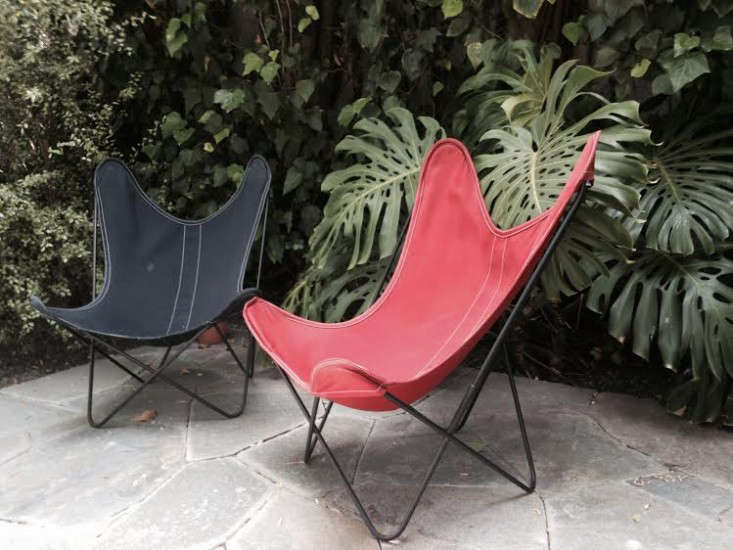
A Butterfly Chair is a low sling chair consisting of a shaped metal frame and a flexible seat cover suspended from four corners. The cover may be made from leather, canvas, felt, hide, or another durable textile. Seen from the front, its two upper corners spread outward like wings, which explains the familiar nickname.
The original is properly known as the BKF Chair, a name formed from the surnames of its three designers: Antonio Bonet, Juan Kurchan, and Jorge Ferrari Hardoy. It is also called the Hardoy Chair, although that name can unintentionally hide the collaborative nature of the design. MoMA dates the chair to 1938 and describes its historic example as painted wrought iron with a leather sling.
Its basic construction is easy to understand. The frame defines the chair’s outline, while the suspended cover supports the sitter. There is no conventional upholstered back, separate cushion, wooden seat platform, or collection of decorative joints. Gravity does most of the upholstery work. It is minimalism with excellent delegation skills.
Born in Buenos Aires, Not in a California Dorm Room
The Three Designers Behind the BKF Chair
Antonio Bonet, Juan Kurchan, and Jorge Ferrari Hardoy developed the BKF Chair in Buenos Aires in 1938. The three architects had connections to Le Corbusier’s Paris studio and later became associated with Grupo Austral, an important voice in Argentine modern architecture. Their chair translated modernist ideas about efficiency, structure, and new ways of living into a compact domestic object.
This origin matters because the Butterfly Chair is sometimes treated as a generic piece of American midcentury furniture. Its global popularity may have been accelerated by the United States, but its design identity is distinctly Latin American. Dwell has described the original BKF as a lightweight, elegant Argentine predecessor to the countless butterfly chairs that followed, noting that it became an international design icon during the 1940s.
A Modern Chair for Less Formal Living
The chair did not force the body into a rigid, upright pose. Instead, it encouraged the sitter to sink, lean, curl up, and occupy the seat informally. That was a meaningful social change. Traditional furniture often reinforced traditional behavior: sit straight, face forward, mind your manners, and try not to spill anything on the brocade.
The BKF Chair suggested another possibility. A modern home could be relaxed. Furniture could support conversation rather than ceremony. A chair could feel youthful, mobile, and slightly rebellious without becoming impractical sculpture. Knoll later characterized the design as an early example of seating that freed people from formal situations and promoted a more convivial way of living.
The Campaign Chair That Came Before It
Like many great designs, the Butterfly Chair did not materialize from an empty historical room. Its clearest ancestor was the Tripolina, a nineteenth-century folding campaign chair associated with travel, military use, and outdoor life. The Tripolina generally used a hinged wooden frame and a flexible hide or fabric seat.
Bonet, Kurchan, and Ferrari Hardoy did not merely make the Tripolina prettier. They transformed its visual and structural character. The bulky folding framework became an airy, continuous-looking metal support. The revised frame was less rustic and more architectural, connecting the chair to the tubular-steel experiments of European modernism. The result retained the relaxed sling-seat principle while appearing radically lighter.
This distinction helps explain why the BKF feels both familiar and new. Its basic seating idea belongs to a long tradition of portable furniture, but its silhouette belongs to the machine age. It is part camp chair, part line drawing, and part small building for one reclining human.
How the Butterfly Chair Works
The Frame Is Both Structure and Image
The metal frame is not hidden beneath upholstery. It is the chair’s skeleton, outline, and signature. Its diagonal lines rise from the floor and cross through space, creating a sense of movement even when the chair is empty.
This exposed construction is one reason the design remains visually light. A solid lounge chair occupies a block of space. A Butterfly Chair mostly draws around that space. You can see the floor, wall, rug, and surrounding room through it, making the chair useful in interiors where a conventional armchair would feel heavy.
The Sling Replaces Conventional Upholstery
The seat cover stretches between four elevated points and forms a pocket under the sitter’s weight. Rather than forcing the body to match a fixed cushion, the cover shifts slightly with the person using it. Thick leather gradually softens and develops character, while canvas tends to look lighter and more casual.
The concept is economical because one flexible surface can perform the jobs of seat, back, and arms. MoMA’s historic example measures roughly 34 inches high and 33 inches wide, giving it a generous lounge-chair presence despite its spare construction.
Comfort Depends on the User and the Version
The Butterfly Chair has a reputation for comfort, but it is not universally comfortable. Some people love the enveloping sling and reclined posture. Others feel folded into a leather taco and immediately begin planning an exit strategy.
Much depends on frame geometry, sling depth, cover quality, body height, and intended use. A properly proportioned chair with a supportive cover can be excellent for reading, listening to music, or relaxed conversation. A poorly made reproduction may sag too deeply, pinch the legs, wobble, or place the sitter so close to the floor that getting up becomes a team-building activity.
How the BKF Chair Reached the United States
The chair attracted the attention of Edgar Kaufmann Jr., an influential advocate for modern design who worked with the Museum of Modern Art. Examples were brought to the United States after the chair was exhibited in Buenos Aires. One went to MoMA, while another went to Fallingwater, the Pennsylvania house designed by Frank Lloyd Wright for the Kaufmann family.
That placement was almost impossibly perfect. Fallingwater was already an argument for modern living: open, dramatic, connected to nature, and uninterested in behaving like an ordinary traditional house. The low BKF Chair looked at home against stone, steel, concrete, terraces, and forest views. Its open frame did not compete with the architecture.
Artek-Pascoe manufactured the chair in New York from 1941 to 1948. Hans Knoll licensed the design in 1947 and introduced it into the Knoll collection, helping turn the chair into a familiar presence in postwar American design culture.
Success, Copies, and the Problem of Being Too Simple
The Butterfly Chair became popular partly because its visual idea was immediately understandable. Unfortunately for its designers and licensed manufacturers, it was also easy to imitate. Once consumers recognized the four-cornered sling and crossing metal frame, manufacturers could offer increasingly inexpensive variations.
Knoll attempted to defend its production rights but could not prevent unauthorized copies from flooding the market. The company discontinued the chair around 1950–1951, depending on how catalog and production dates are counted. The design museum accounts generally agree that the failed effort to secure protection allowed versions to proliferate internationally.
By the 1950s, the Butterfly Chair had moved beyond the controlled world of licensed modern furniture. Some estimates place production in the millions during that decade. It appeared in American homes as both serious modern design and affordable casual seatinga rare double life for a museum-worthy object.
This mass copying weakened the connection between the object and its creators. Many owners knew the shape without knowing the names Bonet, Kurchan, or Ferrari Hardoy. Yet imitation also helped make the chair immortal. A protected luxury product might have remained admired by specialists; the copied Butterfly Chair became part of everyday visual culture.
Why the Classic Butterfly Chair Still Looks Modern
Many designs announce the decade that produced them. The Butterfly Chair is harder to pin down. Its leather sling can look rustic beside reclaimed wood, sharply modern beside concrete, warm in a minimalist white room, or relaxed on a covered porch. Remove the surrounding décor and the chair becomes almost timeless.
Its durability comes from several qualities:
- A memorable silhouette: The winglike outline is recognizable from across a room.
- Material honesty: The frame supports; the sling holds. Neither pretends to be anything else.
- Visual openness: The chair occupies physical space without creating a large visual wall.
- Adaptability: Leather, canvas, hide, and contemporary textiles give the same structure very different personalities.
- Informal posture: It suits the way people actually relax rather than the way formal portraits suggest they should.
The chair also photographs beautifully. Its diagonals create energy, its cover adds texture, and its low profile makes nearby furniture look intentional. Interior designers can place one in an otherwise quiet corner and instantly create a focal point without adding bright color or excessive decoration.
How to Style a Butterfly Chair
Give It Breathing Room
A Butterfly Chair is compact in construction but broad in gesture. Its upper corners spread outward, so it benefits from open space on either side. Squeezing it between a sofa and a bookcase makes the chair look accidental and can make sitting down awkward.
Place it in a reading corner, beside a fireplace, near a low coffee table, or at the edge of a conversation area. Angling it slightly toward the center of the room often looks more natural than lining it up rigidly with a wall.
Balance the Low Seat
Because the chair sits low, pair it with furniture of compatible scale. A small side table usually works better than a tall pedestal table. A floor lamp can provide reading light without forcing the chair to compete with a bulky table lamp.
In a living room, the Butterfly Chair works especially well with a low sofa, a flat-woven rug, and a modest coffee table. In a bedroom, it can fill an empty corner without becoming a second upholstered mountain.
Use Texture Instead of Excess Decoration
A leather Butterfly Chair already contains strong texture and movement. It generally does not need five pillows, a decorative throw, and an emotional-support tassel. One sheepskin or small lumbar cushion may add warmth, but the chair’s shape should remain visible.
Natural leather pairs well with oak, walnut, brick, plaster, and stone. Black leather or dark canvas can sharpen a contemporary interior. Pale canvas makes the chair feel coastal or informal, although light covers require more attention to dirt and staining.
Mix It With Other Periods
The chair does not need to live in a perfectly preserved midcentury modern room. In fact, placing it alongside antiques, handmade ceramics, contemporary artwork, or traditional rugs often produces a richer interior. Its frame is simple enough to connect different periods without looking confused.
How to Recognize a Better Butterfly Chair
Because the form has been reproduced so widely, the phrase “Butterfly Chair” covers everything from collectible vintage examples to inexpensive collapsible seats. A buyer should examine construction rather than trusting the silhouette alone.
Start with the frame. It should sit evenly on the floor, feel stable under shifting weight, and show clean connections. A frame that twists, rocks, or spreads excessively may become uncomfortable or unsafe. Check whether it is a rigid welded structure or a folding version, since the two can feel very different.
Next, inspect the cover. Good leather should be substantial enough to support weight without feeling brittle. Seams, corner pockets, and attachment points carry considerable stress, so weak stitching is a warning sign. Canvas should be dense, durable, and properly tensioned rather than thin and hammock-like.
Finally, sit in the chair. Design history is fascinating, but it will not improve circulation in your legs. Make sure the seat depth supports your body, the front edge does not cut into your thighs, and you can stand without reenacting the launch of a weather satellite.
Living With a Butterfly Chair: Experiences and Practical Lessons
The First Sit Is Usually a Surprise
The first experience of a Butterfly Chair rarely matches the first visual impression. From across the room, the chair appears almost weightless. When you sit down, however, the sling closes around the body and creates a much more enclosed feeling. It is less like perching on a normal chair and more like settling into a pocket.
That sensation can be immediately relaxing. The chair naturally encourages you to lean back, stop typing, and remain in one place for a while. It is excellent for activities that do not require military posture: reading a novel, listening to an album, drinking coffee, or pretending to read while actually watching the sunlight move across the wall.
The surprise comes later, when it is time to stand. Because the seat is low and angled, rising requires a deliberate forward shift. This is not necessarily a defect; it is part of the chair’s lounge-oriented character. Still, people with limited mobility, knee problems, or a strong preference for dignified exits may want a higher and firmer seat.
It Changes the Way a Room Feels
Moving a Butterfly Chair into a room often makes the space feel less formal, even when nothing else changes. A traditional armchair says, “Please sit.” A Butterfly Chair says, “Drop in, stay awhile, and do not worry too much about matching the coasters.”
This relaxed effect is useful in rooms that feel overly arranged. A single leather version can soften a strict grid of sofa, coffee table, and media cabinet. Its diagonal frame interrupts all the horizontal and vertical lines, while the sling introduces a natural curve.
The chair is also relatively easy to reposition compared with a fully upholstered lounge chair. It can migrate from the fireplace in winter to a window in spring. It can move into a guest room when extra seating is needed or return to the living room when the guest room becomes, once again, a storage facility with a bed in it.
Leather Improves Slowly and Visibly
A quality leather cover creates one of the most satisfying ownership experiences. New leather may initially feel firm and look almost too perfect. With use, it begins to relax. Subtle creases appear where the body applies pressure, the surface gains tonal variation, and the cover starts to feel specific to the household.
This aging process suits the design because the Butterfly Chair was never meant to look precious. Scratches and variations can add character, particularly in natural brown leather. Basic care matters, but aggressive polishing can remove the relaxed quality that makes the material appealing.
Canvas offers a different experience. It feels cooler, lighter, and more casual, but it may stretch or collect dust more noticeably. A removable cover is convenient because cleaning a sling is much easier when the sling is not currently attached to a metal sculpture.
Guests Will Have Opinions
A Butterfly Chair tends to divide visitors. One guest will claim it immediately and remain there for the entire evening. Another will examine it suspiciously, lower themselves into it, and ask whether assistance will be provided when dinner is ready.
This difference is useful information. The chair works best as an accent seat rather than the only chair in a room. Pairing it with a more upright armchair gives guests a genuine choice. It also allows the Butterfly Chair to perform the role it handles best: special-purpose relaxation rather than universal ergonomic diplomacy.
Placement Matters More Than Expected
The open frame makes the chair visually light, but its widest points can catch bags, curtains, and the occasional passing hip. Leaving clearance around the upper corners prevents daily collisions. A rug can visually anchor the chair and protect floors, although the frame should remain stable and level.
After living with one for a while, the strongest lesson is that the Butterfly Chair should not be treated as empty-corner filler. It has too much personality for that. Give it a view, a lamp, a side table, or a reason to be used. When thoughtfully placed, it becomes less like an accessory and more like a small destination within the home.
Conclusion: A Design That Refused to Stay Put
The classic Butterfly Chair demonstrates how little material a great idea may require. Bonet, Kurchan, and Ferrari Hardoy took the sling-seat tradition of campaign furniture, redrew it in steel, and created a chair that expressed a new kind of modern living. It was open rather than bulky, informal rather than ceremonial, and visually bold without relying on decoration.
Its journey was not tidy. The chair crossed from Buenos Aires to MoMA and Fallingwater, entered American production, inspired countless copies, and became so familiar that many people forgot it had identifiable designers at all. That loss of authorship is part of the object lesson. Good design can become culturally powerful at the same moment it becomes difficult to control.
More than eight decades after its creation, the Butterfly Chair continues to work because it balances opposites. It is historic but youthful, sculptural but practical, minimal but expressive, and elegant while remaining just a little awkward when you try to stand up. Few chairs have done so much with four corners, one sling, and absolutely no interest in sitting politely.
Note: Historical details were synthesized from museum collections, manufacturer archives, architectural publications, and established design resources. The experiential section is a composite practical evaluation rather than the story of one documented owner.